

Dock-anmeldelse: Fordele, ulemper, funktioner og priser
Dock udmærker sig ved at tilbyde en brugervenlig grænseflade, der forenkler strategier for kundeengagement, hvilket gør løsningen populær blandt teams, der søger effektivitet.

We review tools independently, and commissions help fund our testing. See our transparency policy, our methodology, or suggest a tool.
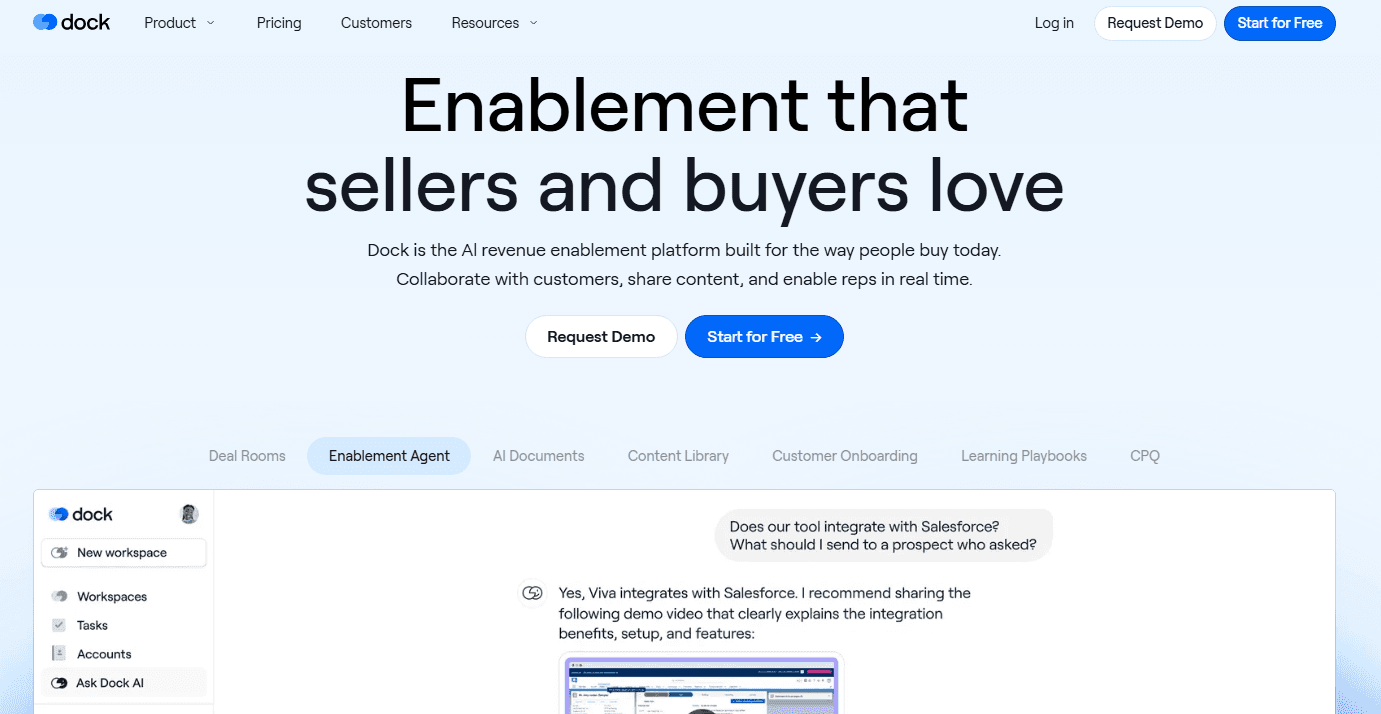
Dock is a customer engagement software for customer success and onboarding teams that need a structured, client-facing workspace for onboarding, renewals, and account management. I'd consider it if your team is cobbling together client deliverables from scattered docs and slide decks. Unlike Notion, Dock gives you purpose-built client portals with mutual action plans and engagement tracking—not a blank canvas you have to build from scratch.
Dock Evaluation Summary
4.9/5
- From $350/month (billed annually)
- Free plan + free demo available
Why Trust Our Software Recommendations
6,700+
Reviews
20
Industry experts
16+
Evaluation factors
14
Years
Our team has been testing and reviewing software since 2012. As CX leaders ourselves, we know how difficult—and important—it is to choose the right software.
For this guide, we evaluated tools using hands-on testing and independent research, scoring tools using our selection criteria.
Our reviews reflect our human editorial judgment, not a sales pitch.
 Gui DrusinaCreative Director
 Tim FisherVP of AI
Dock Overview
In my opinion, Dock is a solid choice for customer engagement and retention needs. It offers a good balance of core and standout features, making it a versatile tool for many teams. The interface is intuitive, though onboarding could be smoother. Customer support is generally responsive, but there’s room for improvement.
Dock software offers good value, especially for teams looking to consolidate collaboration tools. While it may not have all the bells and whistles of premium competitors, its practicality and functionality, and its integration with apps make it a reliable option for small to medium-sized businesses. If your team values ease of use and solid features without the steep learning curve, Dock is worth considering.
Pros
- You can easily customize Dock to fit your team's specific needs.
- The user interface is straightforward, making it simple for your team to use.
- Dock offers strong analytics that help you understand your customer data better through AI and machine learning insights.
Cons
- You might find the initial setup takes more time than expected.
- Some users report occasional slow performance with large datasets.
- There are limited templates available for quick setup.
Is Dock Right For Your Needs?
Who Would be a Good Fit for Dock?
Dock is ideal for small to medium-sized businesses that need a simple yet effective tool for customer engagement. If your team values ease of use and strong customer support, Dock provides a user-friendly interface and robust assistance. It's especially useful for teams that require seamless integration with existing CRM systems, allowing you to streamline your workflows without hassle. Dock's focus on customer engagement makes it a great choice for businesses wanting to improve their customer satisfaction and loyalty.
- Small BusinessesDock's user-friendly setup and cost-effective pricing are perfect for small businesses looking to enhance customer engagement without a steep learning curve.
- Customer Support TeamsIf your team handles customer queries, Dock's integrations and support tools help you manage interactions efficiently and keep customers satisfied.
- Sales DepartmentsSales teams benefit from Dock's CRM integration, which allows tracking customer interactions and improving follow-ups to influence purchase decisions and boost sales.
- Healthcare ProvidersHealthcare organizations can use Dock, which is HIPAA-compliant, to manage patient follow-ups and improve communication, ensuring better patient retention and satisfaction.
- Retail IndustryRetail businesses can leverage Dock's customer insight features to tailor their sales strategies, enhancing customer loyalty and repeat business.
- Educational InstitutionsSchools and universities can use Dock for managing student interactions and improving engagement, leading to better retention rates.
Who Would be a Bad Fit for Dock?
Dock might not be the best choice for small teams or startups with limited budgets. Its pricing structure can be higher compared to other tools, which may not be justified if you don't need all the advanced features. If you're a team that relies on extensive third-party integrations, Dock's limited integration capabilities might not meet your needs. Also, businesses that require robust analytics might find Dock lacking in comprehensive data insights. If your work heavily depends on these aspects, you might want to consider Dock alternatives.
- Small StartupsDock's pricing can be prohibitive for small startups that don't need its extensive feature set.
- FreelancersFreelancers might find Dock's capabilities excessive and costly for managing a single-person operation.
- Non-Tech IndustriesIndustries not focused on tech may not benefit from Dock's specialized features tailored for tech-savvy users.
- Data-Driven TeamsIf your team needs in-depth analytics, Dock's reporting features might not suffice.
- Budget-Conscious TeamsDock's costs can be a barrier for teams with strict budget constraints.
- Integration-Heavy WorkflowsIf your workflow depends on multiple integrations, Dock's limited integration options might not support your process.
How We Test & Score Tools
We’ve spent years building, refining, and improving our software testing and scoring system. The rubric is designed to capture the nuances of software selection and what makes a tool effective, focusing on critical aspects of the decision-making process.
Below, you can see exactly how our testing and scoring works across seven criteria. It allows us to provide an unbiased evaluation of the software based on core functionality, standout features, ease of use, onboarding, customer support, integrations, customer reviews, and value for money.
Core Functionality (25% of final scoring)
The starting point of our evaluation is always the core functionality of the tool. Does it have the basic features and functions that a user would expect to see? Are any of those core features locked to higher-tiered pricing plans? At its core, we expect a tool to stand up against the baseline capabilities of its competitors.
Standout Features (25% of final scoring)
Next, we evaluate uncommon standout features that go above and beyond the core functionality typically found in tools of its kind. A high score reflects specialized or unique features that make the product faster, more efficient, or offer additional value to the user.
We also evaluate how easy it is to integrate with other tools typically found in the tech stack to expand the functionality and utility of the software. Tools offering plentiful native integrations, 3rd party connections, and API access to build custom integrations score best.
Ease of Use (10% of final scoring)
We consider how quick and easy it is to execute the tasks defined in the core functionality using the tool. High scoring software is well designed, intuitive to use, offers mobile apps, provides templates, and makes relatively complex tasks seem simple.
Onboarding (10% of final scoring)
We know how important rapid team adoption is for a new platform, so we evaluate how easy it is to learn and use a tool with minimal training. We evaluate how quickly a team member can get set up and start using the tool with no experience. High scoring solutions indicate little or no support is required.
Customer Support (10% of final scoring)
We review how quick and easy it is to get unstuck and find help by phone, live chat, or knowledge base. Tools and companies that provide real-time support score best, while chatbots score worst.
Customer Reviews (10% of final scoring)
Beyond our own testing and evaluation, we consider the net promoter score from current and past customers. We review their likelihood, given the option, to choose the tool again for the core functionality. A high scoring software reflects a high net promoter score from current or past customers.
Value for Money (10% of final scoring)
Lastly, in consideration of all the other criteria, we review the average price of entry level plans against the core features and consider the value of the other evaluation criteria. Software that delivers more, for less, will score higher.
Dock Specs
- API: No
- Approval Workflows: No
- Contact Management: Yes
- Conversion Tracking: No
- CRM Integration: Yes
- Custom Reports: No
- Dashboard: Yes
- Data Export: No
- Data Import: No
- Data Visualization: Yes
- Document Management: No
- Email Integration: No
- Employee Training: No
- External Integrations: Yes
- Forecasting: No
- Google Apps Integration: Yes
- Guided Selling: No
- Lead Management: No
- Lead Scoring: No
- Marketing Automation: No
- Multi-User: Yes
- Notifications: Yes
- Performance Reviews: No
- Pipeline Management: Yes
- Project Management: Yes
- Sales Automation: Yes
- Sales Motivator: No
- Sales Proposals: Yes
- Workflow Management: No