

Confluent-Bewertung: Vor- und Nachteile, Funktionen und Preise
Confluent überzeugt beim Echtzeit-Datenstreaming und bietet Ihrem Team unübertroffene Flexibilität bei der effizienten Verwaltung von Kundendaten.

Wir bewerten Tools unabhängig; Provisionen helfen, unsere Tests zu finanzieren. Siehe unsere Transparenzrichtlinie und unsere Methodik.
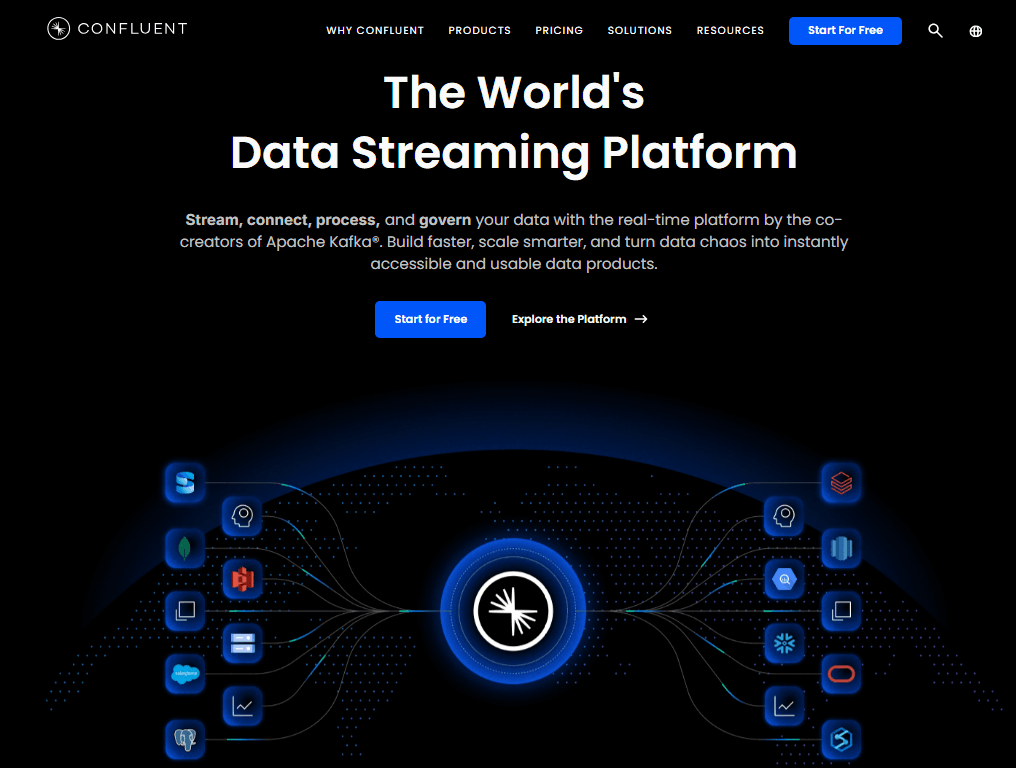
Confluent is a data streaming platform that enables businesses to stream, connect, process, and govern data in real-time, built on Apache Kafka. It best serves industries that require robust data handling capabilities, such as finance, retail, and technology, where real-time analytics and data integration are crucial. Confluent delivers a unified platform for managing continuous data streams, enhancing operational efficiency.
Confluent addresses common pain points like data silos and integration challenges for IT and data teams, enabling seamless data flow across systems. In this article, I'll cover Confluent's features, pros and cons, use cases, and pricing to help you decide if it aligns with your data management needs and organizational goals.
Confluent Evaluation Summary
0/5
- Starts at $1.75/hour
- Free forever plan available
Warum Sie unseren Software-Empfehlungen vertrauen können
6,700+
Reviews
20
Industry experts
16+
Evaluation factors
14
Years
Unser Team testet und bewertet Software seit 2012. Als CX-Führungskräfte selbst wissen wir, wie schwierig – und wichtig – es ist, die richtige Software auszuwählen.
Für diesen Leitfaden haben wir Tools mithilfe von praktischen Tests und unabhängiger Recherche bewertet und dabei unsere Bewertungskriterien angewendet.
Unsere Bewertungen spiegeln unser menschliches redaktionelles Urteilsvermögen wider, keine Verkaufsstrategie.
 Gui DrusinaCreative Director
 Tim FisherVP of AI
Confluent Overview
In my opinion, Confluent serves as a solid customer data streaming platform with notable strengths and some room for improvement. Its standout features, like real-time data streaming, set it apart in the market. However, the onboarding process could be more intuitive compared to competitors. While the platform offers good value for money, its customer support might not be as responsive as some users would prefer. If your team values real-time data capabilities and robust integrations, Confluent could be a great match. However, if ease of onboarding and immediate support are priorities, you might want to explore other options.
Pros
- You can handle real-time data streams with ease.
- It supports a wide range of connectors for different data sources.
- Your team can rely on its strong security features.
Cons
- You might find the learning curve steep.
- It can be resource-intensive for your systems.
- Your team might need time to fully leverage its capabilities.
Is Confluent Right For Your Needs?
Who Would be a Good Fit for Confluent?
Confluent is ideal for businesses that need to handle large volumes of real-time data. It's particularly suited for industries like financial services and telecommunications, where instant data processing is crucial. If your team relies on event-driven microservices or needs robust data streaming capabilities, Confluent's advanced features and deployment options can support your goals effectively.
- Financial ServicesConfluent excels in real-time data streaming, making it perfect for financial services needing immediate transaction processing.
- Retail AnalyticsRetailers benefit from Confluent's data integration features, which enhance inventory management and customer insights.
- TelecommunicationsConfluent supports the massive data flows in telecoms, optimizing network performance and customer service.
- Event-Driven MicroservicesConfluent’s platform enables seamless integration and communication between microservices, improving application responsiveness.
- AI ApplicationsFor AI-driven businesses, Confluent facilitates data processing that powers AI insights and decision-making.
- Fraud DetectionConfluent offers real-time data processing capabilities essential for detecting and preventing fraudulent activities.
Who Would be a Bad Fit for Confluent?
If your team doesn't handle real-time data streams, Confluent might not be the best choice. It's designed for managing and integrating data streams, which can be overkill for businesses focused solely on batch data processing or less complex data needs. For example, small businesses or departments that don't require complex data integration might find Confluent's capabilities excessive and its setup unnecessarily complicated.
- Small RetailersConfluent's robust data streaming capabilities are too advanced and costly for small retailers who don't need real-time data analytics.
- Non-Tech StartupsNon-tech startups without a dedicated IT team might struggle with Confluent's complexity, making simpler tools a better fit.
- Local Government OfficesThese offices often have simple data needs and might find Confluent's advanced features unnecessary.
- Traditional ManufacturingManufacturing sectors focused on physical production rather than data-centric processes won't benefit from Confluent's streaming services.
- Basic Customer Support TeamsTeams handling straightforward customer inquiries don't need Confluent's data integration and streaming abilities.
- Educational InstitutionsUnless involved in tech research, educational institutions may not leverage Confluent's full capabilities, making it an inefficient choice.
Wie wir Tools testen & bewerten
Wir haben jahrelang unser System zur Softwarebewertung entwickelt, verfeinert und verbessert. Unser Bewertungsraster ist darauf ausgelegt, die Nuancen der Softwareauswahl und Merkmale eines effektiven Tools abzubilden, wobei der Fokus auf den entscheidenden Aspekten des Entscheidungsprozesses liegt. Nachfolgend sehen Sie, wie unser Test- und Bewertungssystem anhand von sieben Kriterien funktioniert. Es ermöglicht uns, eine unabhängige Bewertung der Software basierend auf Kernfunktionen, besonderen Merkmalen, Benutzerfreundlichkeit, Onboarding, Kundensupport, Integrationen, Kundenbewertungen und Preis-Leistungs-Verhältnis zu geben.
Kernfunktionen (25% der Gesamtnote)
Der Ausgangspunkt unserer Bewertung ist immer die grundlegende Funktionalität eines Tools. Verfügt es über die Basisfunktionen, die ein Benutzer erwarten würde? Sind einige dieser Kernfunktionen nur in teureren Preisplänen verfügbar? Im Kern erwarten wir, dass ein Tool mit den Grundfunktionen seiner Konkurrenten mithalten kann.
Besondere Merkmale (25% der Gesamtnote)
Anschließend bewerten wir außergewöhnliche Funktionen, die über die üblichen Kernfunktionen hinausgehen. Eine hohe Punktzahl spiegelt spezialisierte oder einzigartige Features wider, die das Produkt schneller, effizienter oder für den Endnutzer besonders wertvoll machen. Wir prüfen außerdem, wie einfach es ist, das Tool mit anderen typischerweise verwendeten Programmen zu integrieren, um die Funktionalität und den Nutzen zu erweitern. Tools mit vielen nativen Integrationen, Verbindungen zu Drittanbietern und API-Zugang für eigene Integrationen erhalten die besten Bewertungen.
Benutzerfreundlichkeit (10% der Gesamtnote)
Wir berücksichtigen, wie schnell und einfach sich Aufgaben ausführen lassen, die zur Kernfunktionalität gehören. Software mit hoher Punktzahl ist gut gestaltet, intuitiv zu bedienen, bietet mobile Apps, stellt Vorlagen bereit und erleichtert auch relativ komplexe Aufgaben erheblich.
Onboarding (10% der Gesamtnote)
Wir wissen, wie wichtig eine schnelle Team-Akzeptanz einer neuen Plattform ist. Deshalb bewerten wir, wie leicht sich ein Tool mit minimalem Training erlernen und benutzen lässt. Wir prüfen, wie schnell ein Teammitglied ohne Vorkenntnisse eingerichtet ist und das Tool nutzen kann. Lösungen mit hoher Bewertung erfordern wenig oder keine Unterstützung.
Kundensupport (10% der Gesamtnote)
Wir beurteilen, wie schnell und einfach man telefonisch, per Live-Chat oder Wissensdatenbank Unterstützung erhält. Tools und Anbieter mit echtem Echtzeit-Support bekommen die besten Bewertungen, während Chatbots am schlechtesten abschneiden.
Kundenbewertungen (10% der Gesamtnote)
Neben unseren eigenen Tests berücksichtigen wir den Net Promoter Score von aktuellen und ehemaligen Nutzern. Wir prüfen, ob sie sich wieder für das Tool entscheiden würden. Software mit hoher Bewertung weist auch einen hohen Net Promoter Score auf.
Preis-Leistungs-Verhältnis (10% der Gesamtnote)
Schließlich bewerten wir unter Berücksichtigung aller anderen Kriterien den durchschnittlichen Preis der Einstiegspläne in Bezug auf die Kernfunktionen und vergleichen den Nutzen der anderen Bewertungskriterien. Software, die mehr für weniger bietet, erhält eine höhere Bewertung.
Core Features
Real-Time Data Processing: Confluent lets you process data as it's generated, so your team can react instantly. This capability is crucial for businesses needing immediate insights from customer interactions.
Event Streaming: This feature allows you to stream events from various sources, maintaining a continuous flow of data. Your team can build real-time applications that respond to customer actions as they happen.
Scalable Architecture: Confluent's platform is built to grow with your business, handling increasing amounts of data effortlessly. You won't need to worry about performance drops as your customer base expands.
Data Integration: With Confluent, you can connect disparate data sources into a unified view. This helps your team make informed decisions by having all necessary data at their fingertips.
Security and Compliance: The platform includes built-in security features to protect sensitive customer data. Your team can ensure compliance with industry standards, giving peace of mind regarding data privacy.
Data Transformation: Confluent provides tools to transform raw data into actionable insights. This means your team can tailor data outputs to fit specific business needs quickly.

Ease of Use
Confluent's user interface can be complex, making it difficult for new users to navigate. Despite this, its robust features and extensive integration capabilities make it a powerful tool for managing customer data. The platform's detailed customer support can help you overcome usability challenges. If your team is tech-savvy, Confluent's feature set will likely be beneficial, but expect a learning curve compared to other platforms.

Integrations
Confluent integrates with popular platforms and services including Salesforce, AWS Lambda, Microsoft Azure Blob Storage, MongoDB Atlas, Google BigQuery, Snowflake, Oracle Database, Elasticsearch, IBM MQ, and Datadog.
Confluent also offers an API and connects with third-party integration tools. For more detailed information, users can explore the Confluent Hub.

Confluent Specs
- 2-Factor Authentication: No
- A/B Testing: No
- Analytics: Yes
- API: Yes
- Calendar Management: No
- Contact Management: No
- Dashboard: Yes
- Data Export: Yes
- Data Import: Yes
- Data Mining: No
- Data Visualization: Yes
- External Integrations: Yes
- Forecasting: No
- Keyword Tracking: No
- Multi-User: Yes
- Notifications: Yes
- Scheduling: No
- SEO: No


