

Os chatbots de IA para a banca são ferramentas conversacionais que tratam do atendimento ao cliente através de chat, voz e outros canais digitais. Podem responder a perguntas, orientar percursos de conta, encaminhar pedidos complexos e apoiar transferências para agentes humanos. A plataforma certa deve ser adequada aos seus sistemas centrais, canais de atendimento, modelo de governação e objetivos de experiência do cliente.
Este guia compara ferramentas concebidas para a banca com base nas suas funcionalidades de automatização, opções de integração, análise, controlos de conformidade e suporte para interações recebidas e efetuadas. Utilize-o para reduzir a sua seleção e planear uma avaliação prática.
Why Trust Our Software Recommendations
6,700+
Reviews
20
Industry experts
16+
Evaluation factors
14
Years
Our team has been testing and reviewing software since 2012. As CX leaders ourselves, we know how difficult—and important—it is to choose the right software.
For this guide, we evaluated tools using hands-on testing and independent research, scoring tools using our selection criteria.
Our reviews reflect our human editorial judgment, not a sales pitch.
 Gui DrusinaCreative Director
 Tim FisherVP of AI
Tabela de comparação: chatbots de IA para a banca
Compare preços e especificações, lado a lado, dos chatbots de IA para a banca que incluí na minha seleção.
| Tool | Best For | Trial Info | Price | ||
|---|---|---|---|---|---|
| 1 | Best for Microsoft-native agent governance | Not available | From $30/user/month (billed annually) | Website | |
| 2 | Best for banking-wide agent deployment | Free plan available | From $500/100k credits | Website | |
| 3 | Best for voice biometrics support | Free demo + 14-day free trial available | From $99/month (billed annually) | Website | |
| 4 | Best for named core system connectors | Free demo available | Pricing upon request | Website | |
| 5 | Best for NLU at high intent volume | Free demo available | Pricing upon request | Website | |
| 6 | Best for prebuilt user journeys and analytics | Free plan available | Pricing upon request | Website | |
| 7 | Best for compliance and omnichannel reach | Free demo available | Pricing upon request | Website | |
| 8 | Best for credit unions deploying AI chat and voice | Free demo available | Pricing upon request | Website | |
| 9 | Best for fully managed AI deployment | Free demo available | Pricing upon request | Website | |
| 10 | Best for proactive outreach | Free demo available | Pricing upon request | Website |


Avaliações de chatbots de IA para a banca
Apresento abaixo os meus resumos dos melhores chatbots de IA para a banca que incluí na minha seleção. As minhas avaliações analisam as funcionalidades, integrações e controlos de conformidade de cada plataforma para ajudar a encontrar a opção mais adequada às suas necessidades.
 Best for Microsoft-native agent governance
- Not available
- From $30/user/month (billed annually)
Visit WebsiteCustomer Rating:4.4/5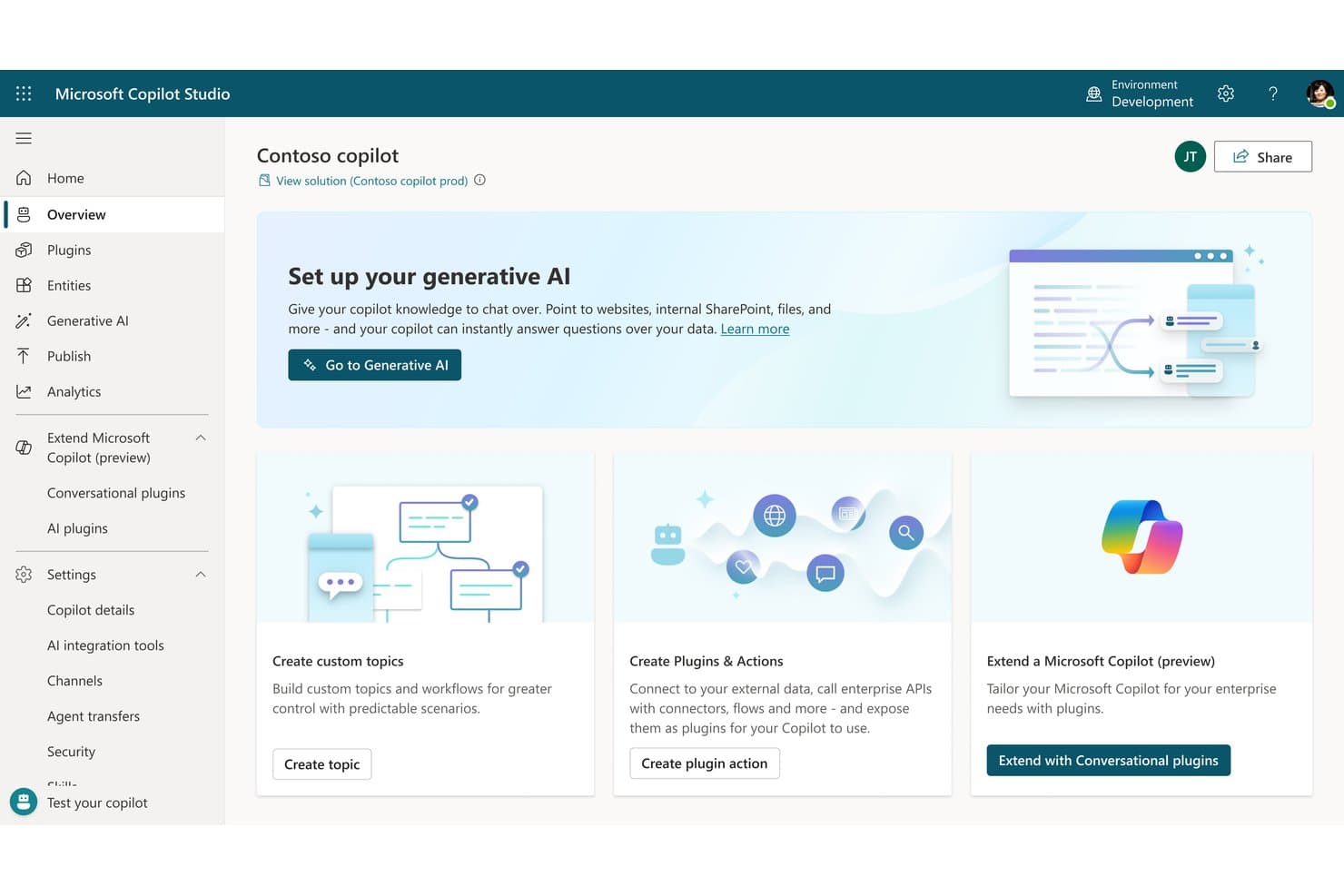
Microsoft Copilot Studio lets users build AI chatbots with custom topics and plugins. Microsoft Copilot Studio is a no-code/low-code agent-building platform that lets you create, deploy, and govern AI chat and voice agents across web, mobile, and social channels.
Who Is Microsoft Copilot Studio Best For?
Microsoft Copilot Studio is a strong fit for banks already running on the Microsoft stack—particularly those using Dynamics 365, Teams, or Azure—who need enterprise-grade governance alongside agent deployment.
Why I Picked Microsoft Copilot Studio
I've included Microsoft Copilot Studio in my top picks because no other platform on this list matches its depth of governance controls for banks already operating in the Microsoft ecosystem. I particularly like how Agent 365 centralizes agent identities through Entra ID, enforcing role-based access controls and DLP policies across every deployed agent from a single admin layer. On top of that, ALM pipelines with approval gates and deploy-from-Git mean your compliance team can sign off at every stage before a new agent version touches production.
Microsoft Copilot Studio Key Features
- Generative orchestration: Automatically selects the best combination of topics, knowledge sources, and tools on each conversation turn to handle complex banking queries.
- Multilingual agent support: Build agents with a primary language and add secondary languages to serve customers across regions within a single agent.
- Proactive outbound messaging: Trigger outbound notifications to customers based on events—such as card renewal confirmations—without requiring the customer to initiate contact.
- Real-time voice agents: Deploy low-latency speech-to-speech agents with billing, payment, and account management templates that customers can interrupt mid-conversation.
Microsoft Copilot Studio Integrations
Microsoft Copilot Studio offers 1,500+ prebuilt connectors across the Microsoft ecosystem, including Microsoft 365, Azure, SharePoint, Dataverse, and Dynamics 365. REST APIs, SDKs, and webhooks for custom connections are also available.
Pros and Cons
Pros:
- Banking journeys support disputes and KYC
- Outbound messages reach customers proactively
- Approval gates support regulated agent releases
Cons:
- Chat channels lack attachment support
- Some voice languages remain regionally limited
Learn more about Microsoft Copilot Studio: Best for banking-wide agent deployment
- Free plan available
- From $500/100k credits
Visit WebsiteCustomer Rating:4.3/5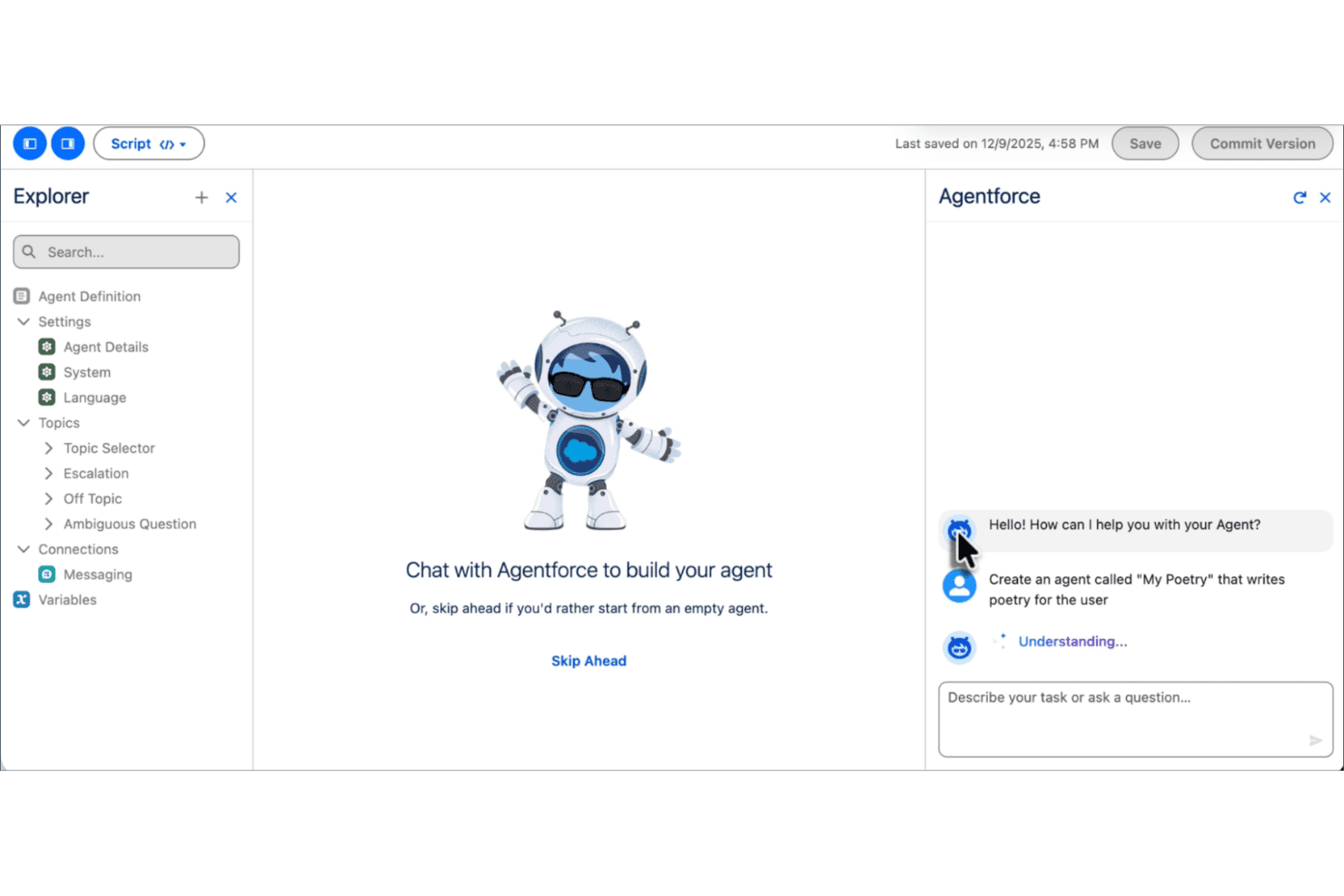
Agentforce lets users build AI agents via natural language chat. Agentforce is Salesforce's AI agent platform for banking that deploys autonomous, role-based agents across customer service, lending, and collections workflows.
Who Is Agentforce Best For?
Agentforce is a strong fit for banks and credit unions already on Salesforce Financial Services Cloud and want to roll out agents across multiple departments.
Why I Picked Agentforce
I picked Agentforce as one of the best because it's built for banks that want generative AI agents running across every department, not just one support queue. The prebuilt Financial Services Cloud templates, covering customer service, loan guidance, and collections, let you stand up role-specific agents without custom builds. BCU deployed its agent and hit 82% autonomous resolution within 90 days, which shows what banking-wide deployment actually looks like in practice.
Agentforce Key Features
- Atlas Reasoning Engine: Breaks customer requests into tasks, plans next steps, and executes actions within guardrails—without fixed conversation trees.
- Agentforce Observability: Splits conversation turns by intent and sentiment, generates quality scores, and surfaces real-time alerts across chat and voice.
- Einstein Trust Layer: Enforces zero data retention with third-party large language models (LLMs), data privacy, toxicity detection, and prompt-injection protection with full audit trails.
- Multi-Agent Orchestration: Coordinates multiple specialized agents working in parallel or sequence, including a Long-Horizon Runtime that maintains context across goals spanning days or weeks.
Agentforce Integrations
Agentforce offers native integrations across the Salesforce ecosystem, including Financial Services Cloud, Service Cloud, Data 360, and Slack. It also provides an API and MCP servers for custom connections.
Pros and Cons
Pros:
- Audit controls support regulated banking workflows
- Voice and chat share customer context
- Banking templates cover cards, transfers, and loans
Cons:
- Authentication methods lack public implementation details
- Complex setup requires Salesforce administration
Learn more about Agentforce: Best for voice biometrics support
- Free demo + 14-day free trial available
- From $99/month (billed annually)
Visit WebsiteCustomer Rating:4.3/5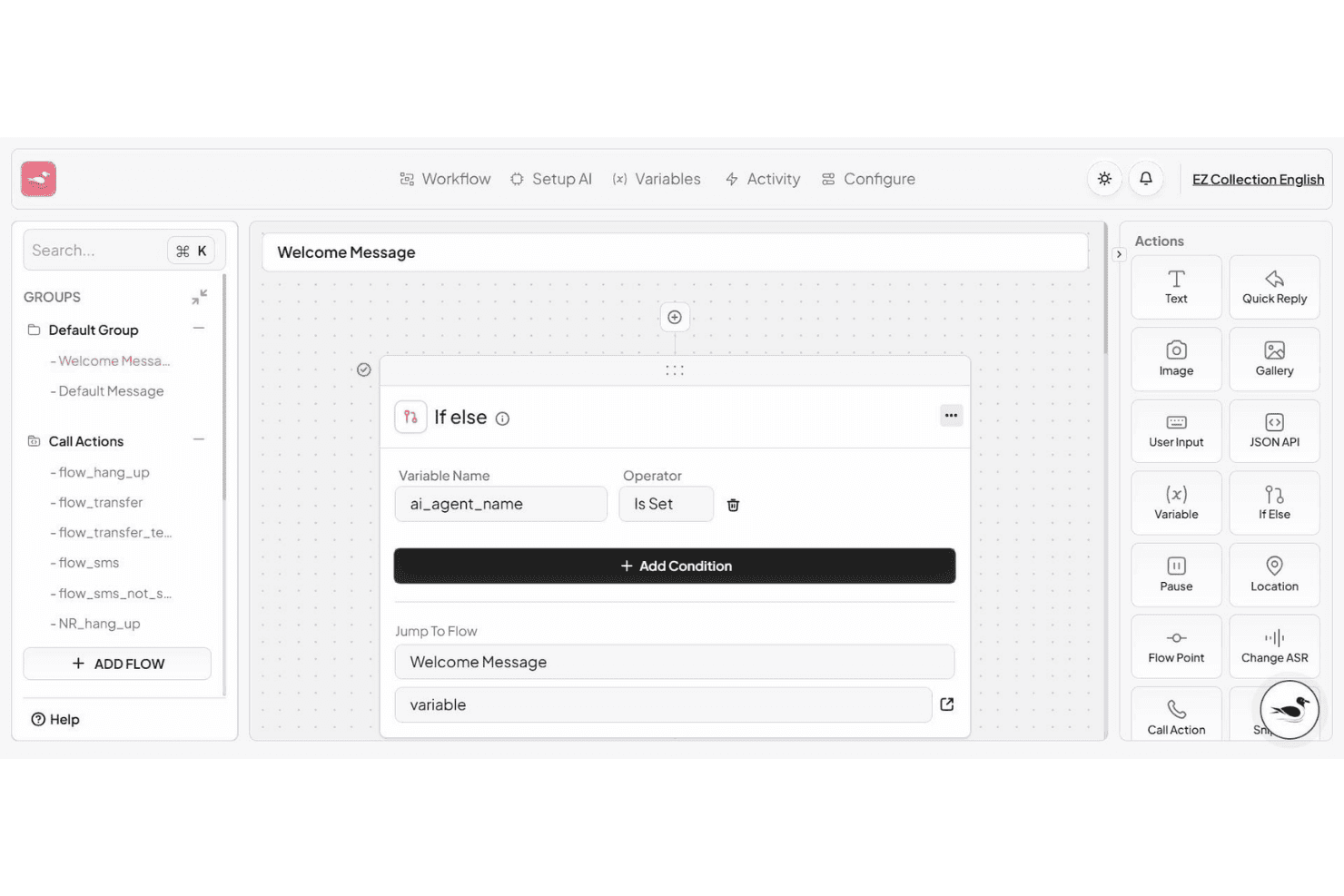
Floatbot lets users build conditional logic flows with if-else nodes. Floatbot is a conversational AI platform that combines chat, voice, and SMS automation through its pre-trained banking agent, LEXI, with built-in voice biometrics, omnichannel deployment, and back-office workflow automation.
Who Is Floatbot Best For?
Floatbot is a strong fit for retail banks and credit unions that need a purpose-built conversational AI agent with voice biometrics across channels.
Why I Picked Floatbot
I've included Floatbot in my top picks because its ARMOR voice biometrics system is genuinely unlike what most banking chatbot platforms offer. Instead of routing customers through OTP flows, ARMOR builds a voiceprint in seconds and authenticates passively, mid-conversation, regardless of language or channel. Paired with LEXI, a pre-trained banking AI agent that handles everything from balance queries to dispute workflows, it's a strong fit for banks that need secure, phone-channel automation without sacrificing the conversational experience.
Floatbot Key Features
- LEXI pre-trained banking agent: Handles account balance queries, KYC collection, lending workflows, and dispute triage without requiring custom training from scratch.
- AI Workflow back-office automation: Routes and processes dispute evidence, sorts documents, matches statements to internal records, and extracts data to handle back-office banking tasks.
- Omnichannel deployment across 15+ touchpoints: Runs across web chat, mobile, WhatsApp, SMS, IVR, and email with shared conversation context across channels.
- Sentiment and intent analytics: Tracks customer sentiment and intent in real time across voice and chat interactions, with 50+ KPI dashboards covering usage, goals, and AI performance.
Floatbot Integrations
Floatbot offers integrations with Genesys Cloud, Five9, Atlassian, RingCentral, Zendesk, and Nextiva. It also offers an API for custom connections.
Pros and Cons
Pros:
- Reviewers praise no-code implementation and support
- Banking workflows cover disputes and lending
- Voice biometrics supports passwordless banking authentication
Cons:
- Independent banking reviews remain limited
- Core banking compatibility remains unclear
Learn more about Floatbot:
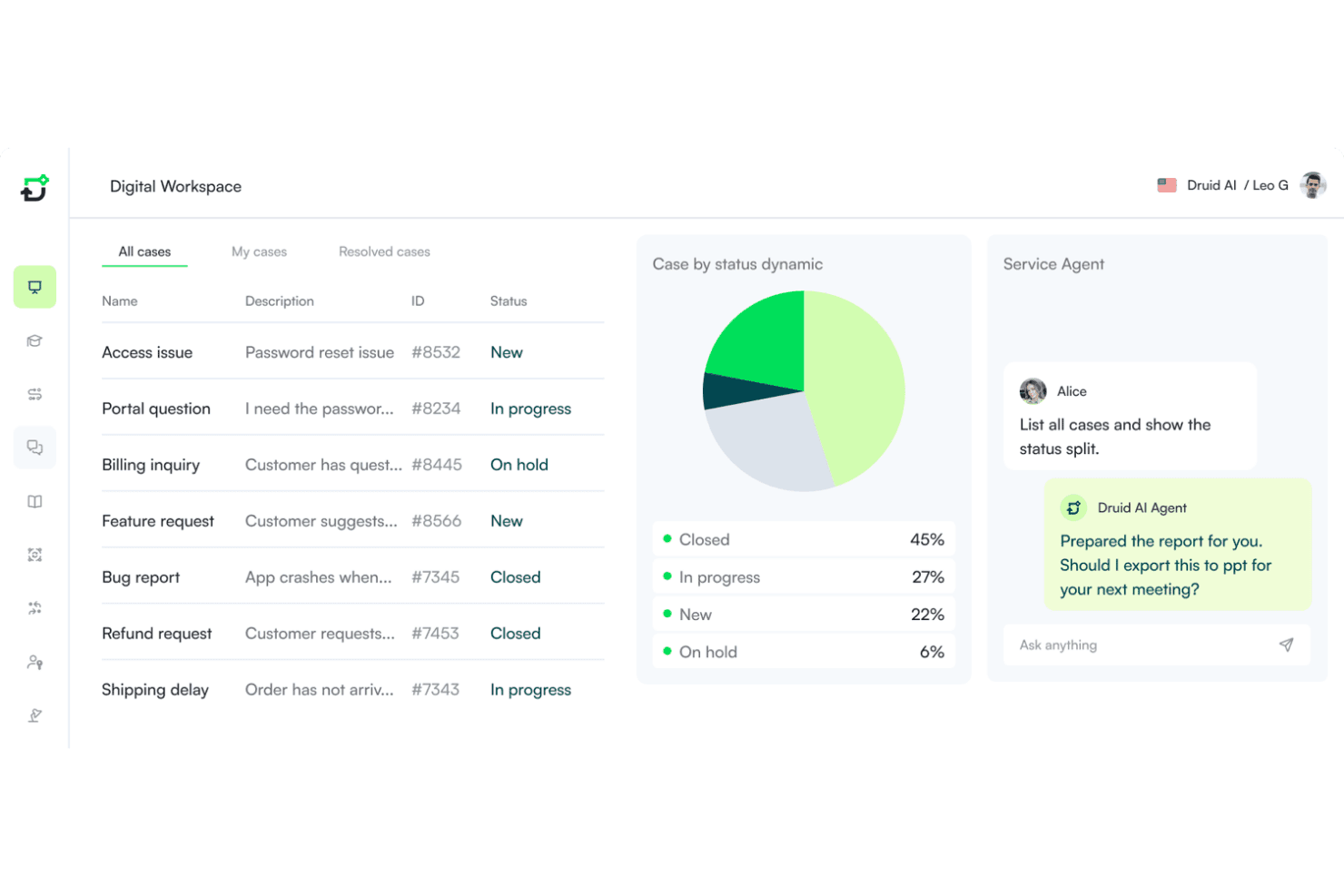
DRUID lets users manage support cases with an AI agent assistant. Druid is a conversational AI chatbot that combines virtual agents, voice AI, and core banking connectors to handle account inquiries, loan workflows, card services, and outbound customer engagement across digital and phone channels.
Who Is DRUID Best For?
Druid is a strong fit for mid-to-large banks and financial institutions that need to connect conversational AI to named core banking platforms.
Why I Picked Druid
I picked Druid as one of the best because its named core banking connectors are what genuinely set it apart. Rather than generic API frameworks, DRUID ships pre-built connectors for Finastra, Jack Henry, FIS, Fiserv, and Mambu, so agents can execute real transactions like loan prequalification, card blocking, and balance inquiries inside a single conversation. I also like that it bridges legacy systems through RPA tools like UiPath and Blue Prism for core platforms that lack APIs entirely.
Druid Key Features
- Proactive outbound campaigns: Triggers voice or SMS outreach to recover abandoned loan applications, activate pre-approved customers, and send payment reminders.
- Sentiment and intent analytics: Real-time transcription tracks sentiment, intent, containment, escalation ratio, and 50+ other conversation metrics across every interaction.
- Multilingual voice agents: Handle inbound and outbound calls across 110+ languages and dialects, connecting to existing phone systems via SIP or API.
- Pre-built banking skill templates: Offers 500+ pre-configured skills that cover banking use cases like onboarding, payments, and loan workflows.
Druid Integrations
Druid offers integrations with Microsoft Dynamics, Temenos, Slack, SAP, Oracle, Flywire, Nextgen, ServiceNow, and Blue Yonder. It also offers API, webhooks, and an MCP server for custom integrations.
Pros and Cons
Pros:
- Supports proactive loan application outreach
- Provides auditable conversation decision trails
- Handles multilingual voice banking journeys
Cons:
- Some channels vary by deployment model
- Complex workflows need specialist support
Learn more about DRUID:
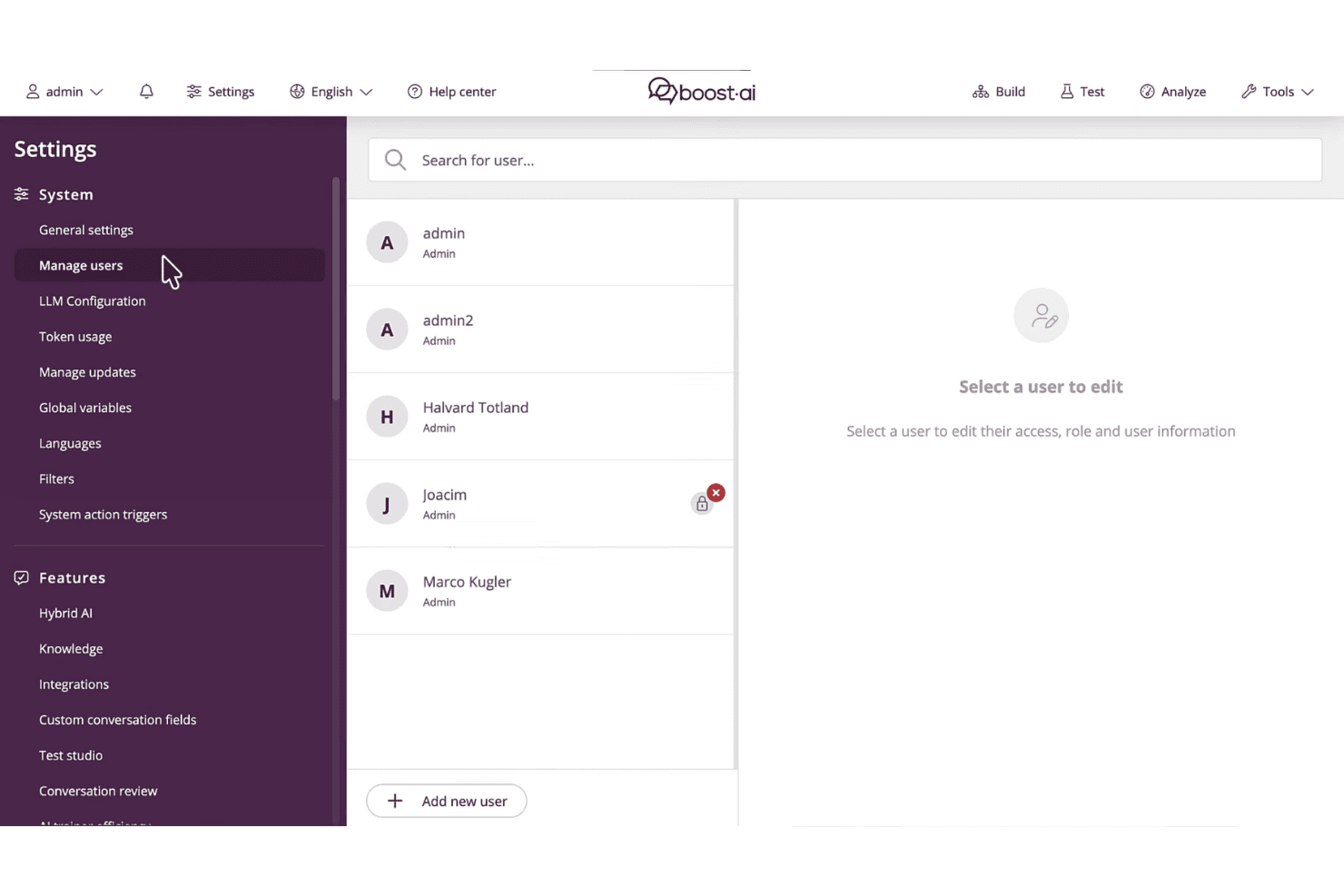
Boost.ai lets admins manage and add users with roles and access controls. Boost.ai is a conversational AI platform built for regulated industries, combining a hybrid natural language understanding (NLU) and LLM engine with native voice, chat, and omnichannel deployment to handle banking inquiries, authenticated transactions, and live agent handoffs.
Who Is Boost.ai Best For?
Boost.ai is a strong fit for mid-to-large financial institutions that need to handle a high volume of distinct customer intents.
Why I Picked Boost.ai
I've included Boost.ai in my top picks because its hybrid engines are purpose-built to handle the kind of intent volume that breaks most banking chatbots. MSUFCU's virtual agent "Fran" covers roughly 4,000 distinct intents at a 98% resolution rate, which shows what the platform can actually sustain at scale. Boost.ai's Automatic Semantic Understanding handles spelling variation, synonyms, and sentiment, while Action Hooks keep sensitive transactions like card lock/unlock and account transfers on scripted, auditable flows.
Boost.ai Key Features
- Regulatory compliance certifications: Boost.ai holds ISO 27001, SOC 2 Type 2, ISAE 3402, and FSQS certifications, with published materials for DORA and the EU AI Act.
- Native Test Studio: Testing tool that runs persona-based simulations to check guardrails, identify knowledge gaps, and catch potential jailbreaks before deployment.
- Native voice banking: Voice is built into the platform, with adaptive speech-to-speech for low-risk calls and a structured pipeline for authenticated transactions.
- Agent-assist with live transcription: Human agents get real-time transcription, intent and sentiment detection, next-best-action guidance, and LLM-generated after-call summaries during live interactions.
Boost.ai Integrations
Documented integrations include Microsoft Teams, Slack, Salesforce, Zendesk, Okta, Microsoft Azure, and Facebook Messenger. It also provides OIDC, SAML, and a generic API connector for custom banking integrations.
Pros and Cons
Pros:
- Provides strong compliance testing controls
- Supports scripted authenticated transactions
- Handles thousands of banking intents
Cons:
- Advanced reporting customization remains limited
- Requires dedicated AI training staff
Learn more about Boost.ai: Best for prebuilt user journeys and analytics
- Free plan available
- Pricing upon request
Visit WebsiteCustomer Rating:4.6/5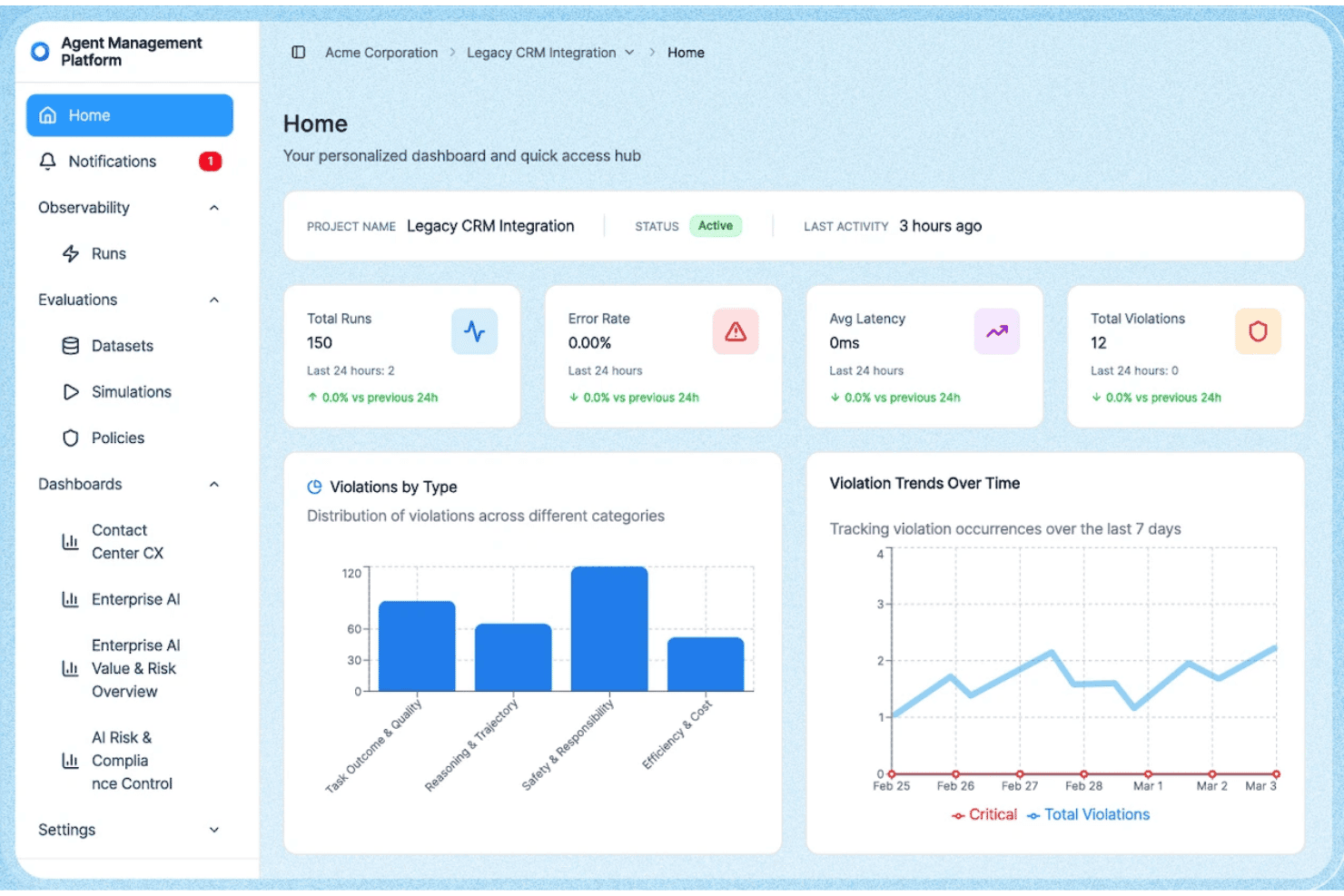
Kore.ai tracks AI agent violations and performance metrics on one dashboard. Kore.ai is an AI chatbot platform for banking services that offers omnichannel deployment across 40+ voice and digital channels, and sentiment and QA analytics.
Who Is Kore.ai Best For?
Kore.ai is a strong fit for mid-to-large banks and credit unions that need ready-to-deploy conversational agents across both voice and digital channels.
Why I Picked Kore.ai
I picked Kore.ai as one of the best because its prebuilt banking agents come loaded with hundreds of intents already mapped to real banking workflows, like balance inquiries, dispute filing, and card controls, so you're not configuring from scratch. What I find especially useful is the sentiment and QA analytics layer, which scores 100% of voice and chat interactions automatically. That kind of full-coverage analysis, not a sampled subset, gives CX teams a concrete view of where journeys break down.
Kore.ai Key Features
- Prebuilt core banking connectors: Includes named integrations with Jack Henry, Fiserv, FIS, Q2, Alkami, and other core banking, card, and digital banking platforms out of the box.
- Omnichannel deployment across 40+ channels: Runs across web, mobile, WhatsApp, voice IVR, Microsoft Teams, and more without requiring separate configurations per channel.
- Dual-brain architecture: A deterministic flow engine and an LLM reasoning engine run in parallel, keeping policy enforcement in the scripted layer so the LLM can't override banking rules.
- Outbound campaigns module: Lets you run personalized, data-driven outreach over both voice and digital channels from the same platform managing your inbound banking agents.
Kore.ai Integrations
Kore.ai integrates with Amazon SES, HubSpot, Zendesk, Pipedrive, Salesforce, Five9, Kore SmartAssist, and Genesys Cloud. An API for custom integrations is also available.
Pros and Cons
Pros:
- Voice and digital channels share agents
- Full-session QA scoring supports CX oversight
- Prebuilt banking journeys cover hundreds of intents
Cons:
- Documentation can lag newer platform features
- Advanced configurations require specialist expertise
Learn more about Kore.ai: Best for compliance and omnichannel reach
- Free demo available
- Pricing upon request
Visit WebsiteCustomer Rating:3.9/5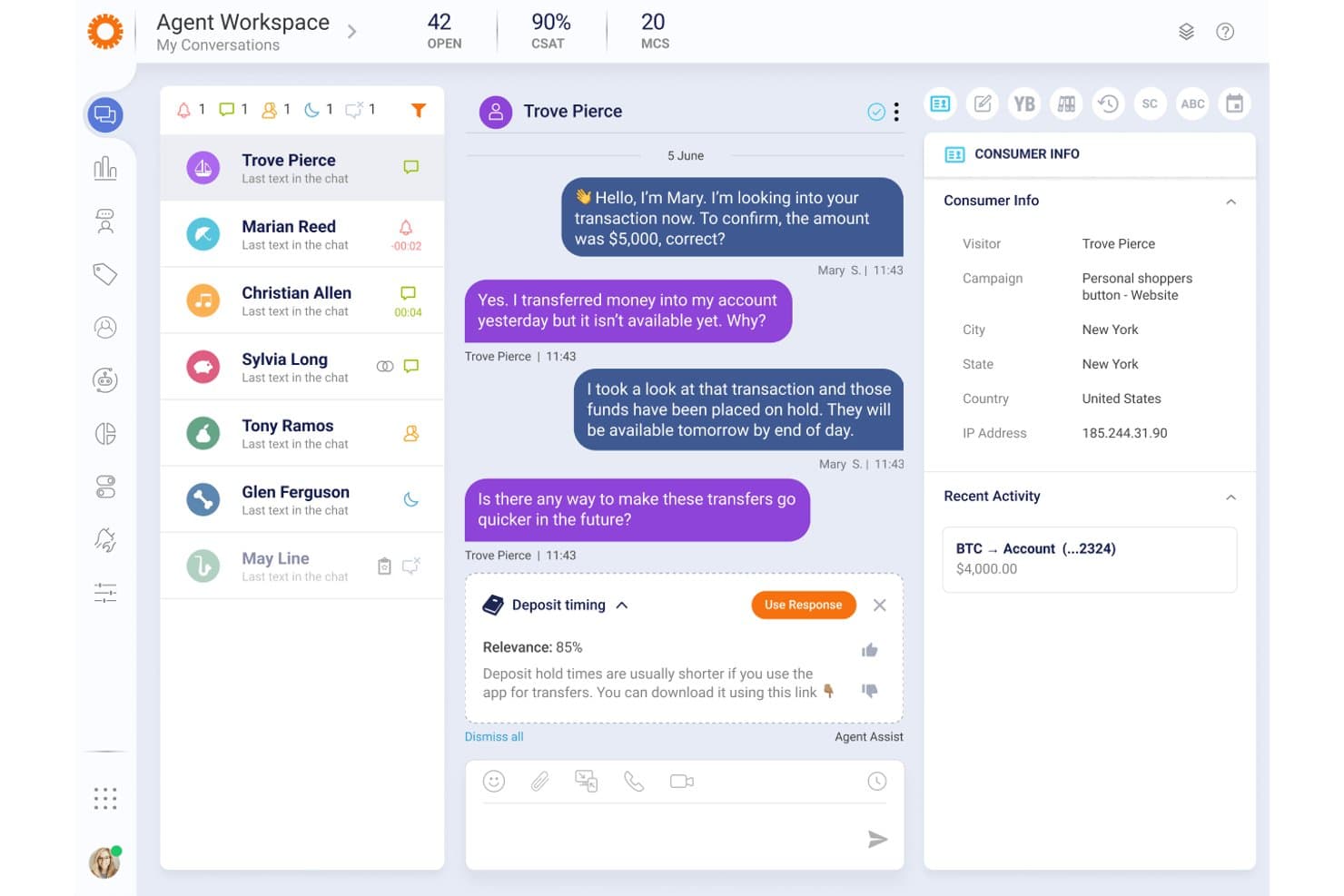
LivePerson surfaces AI-suggested responses to help agents reply faster. LivePerson, acquired by Soundhound AI, is an AI chatbot for financial services that combines no-code bot building, omnichannel messaging, intent-based routing, and compliance-grade authentication.
Who Is LivePerson Best For?
LivePerson is a strong fit for retail banks, credit unions, and card issuers that need to manage high conversation volumes across multiple digital channels while meeting strict regulatory requirements.
Why I Picked LivePerson
LivePerson earns its spot on my shortlist because no other platform I've tested matches its combination of compliance depth and omnichannel reach for regulated financial institutions. Its Trust Center holds 31 documents covering PCI DSS 4.0, HITRUST, SOC 2 Type II, and an AI Governance pack with bias analysis, which gives compliance teams real audit material. I also like that its Meaningful Conversation Score tracks customer sentiment in real time across every message, so agents get alerts on difficult conversations before they escalate.
LivePerson Key Features
- Intent Manager: Build and tune custom intent models using LivePerson's own NLU engine, with support for up to 1,000 training phrases per intent.
- Connect to Messaging: Moves customers off the phone queue into a messaging channel mid-call, reducing live agent call volume.
- Proactive Messaging: Sends outbound alerts and reminders to customers via WhatsApp, SMS, or in-app messaging.
- KnowledgeAI: Converts webpages, PDFs, and FAQs into AI-ready knowledge sources, with hallucination detection that checks responses against your own data.
LivePerson Integrations
LivePerson connects with Salesforce, Microsoft Dynamics, ServiceNow, Zendesk, Oracle, and Adobe Experience Cloud. It also provides APIs for custom integrations.
Pros and Cons
Pros:
- Banking deployments show high conversation volumes
- Omnichannel support spans 15 channels
- Compliance certifications and AI governance documents
Cons:
- Core transaction workflows remain thinly documented
- Setup requires vendor configuration for security features
Learn more about LivePerson: Best for credit unions deploying AI chat and voice
- Free demo available
- Pricing upon request
Visit WebsiteCustomer Rating:4.3/5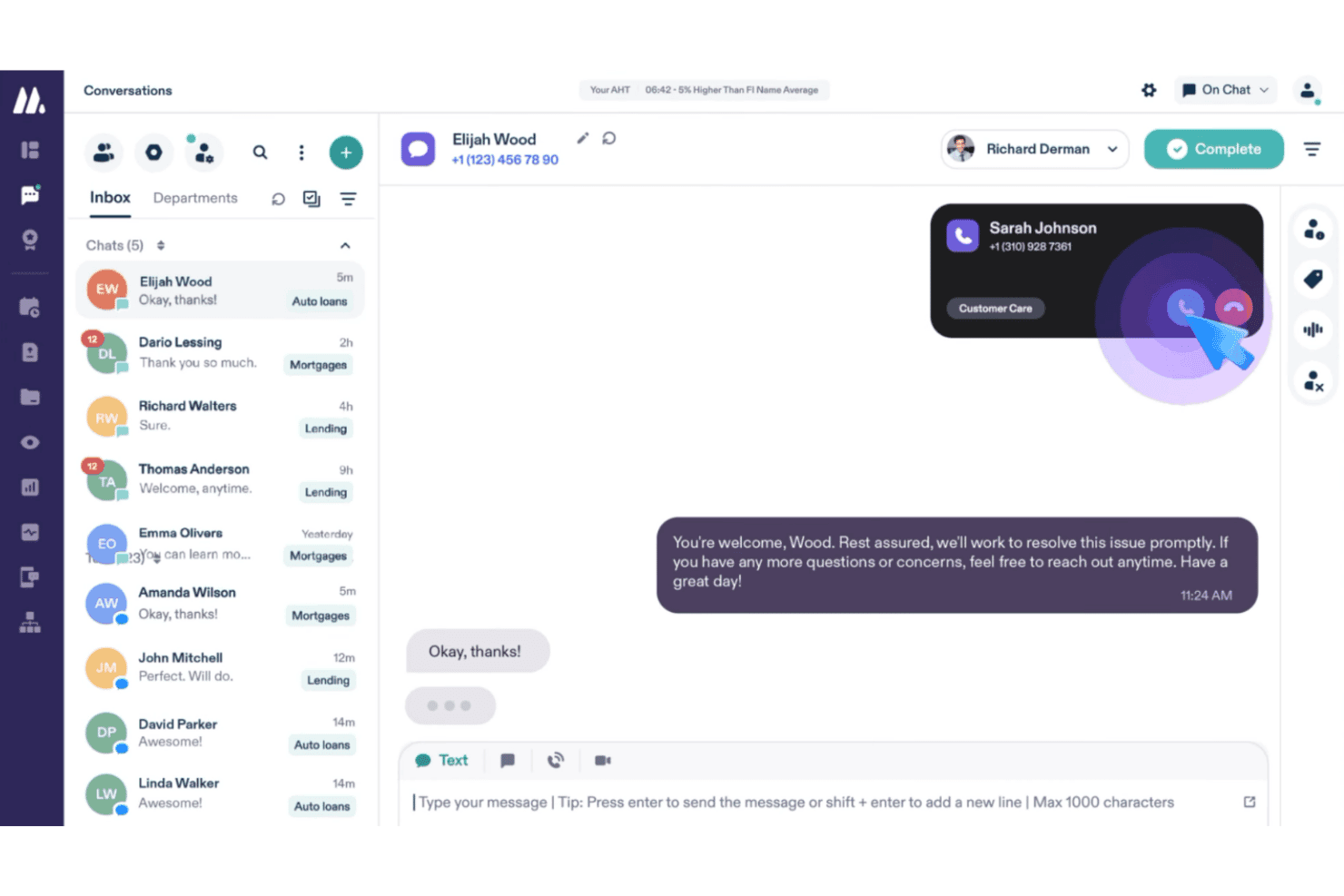
Eltropy centralizes multi-channel customer conversations in one inbox. Eltropy is an agentic AI platform that combines chat agents, voice agents, a staff-facing virtual assistant, and conversation analytics across text, voice, video, and in-branch channels.
Who Is Eltropy Best For?
Eltropy is a good fit for credit unions and community banks that want to deploy AI chat and voice agents across member-facing channels.
Why I Picked Eltropy
I've included Eltropy in my top picks because it's built exclusively for credit unions and community banks, which means its AI voice and chat agents come pre-trained on the workflows these institutions actually run, from skip-a-pay requests to loan pre-qualification handoffs. I also rate its Safe AI Framework highly: every agent action is logged with a full audit trail showing what data was used and why, which matters when examiners come knocking.
Eltropy Key Features
- Conversation Intelligence dashboard: Transcribes, summarizes, and scores every chat and voice session, surfacing containment gaps, missed intents, and transfer trends in real time.
- Prebuilt workflow library: Ready-to-deploy templates cover over 60% of typical credit union and community bank use cases, from checking balance inquiries to loan pre-qualification handoffs.
- Omnichannel context continuity: Members can move between text, chat, voice, video, and in-branch channels without repeating themselves, as conversation context carries across each transition.
- Staff-facing digital assistant: Uses retrieval-augmented generation (RAG) over internal policy documents, with AI Compose and AI Translate tools built in for live agents.
Eltropy Integrations
Eltropy integrates with Akuvo, Alkami, Temenos, Prodigy, Finastra, Salesforce, Q2, and DocuSign. Open APIs for custom connections are also available.
Pros and Cons
Pros:
- Conversation analytics expose containment gaps
- Cross-channel context preserves member conversations
- Layered authentication supports secure self-service
Cons:
- Transaction history depth varies by workflow age
- English and Spanish limit language coverage
Learn more about Eltropy:
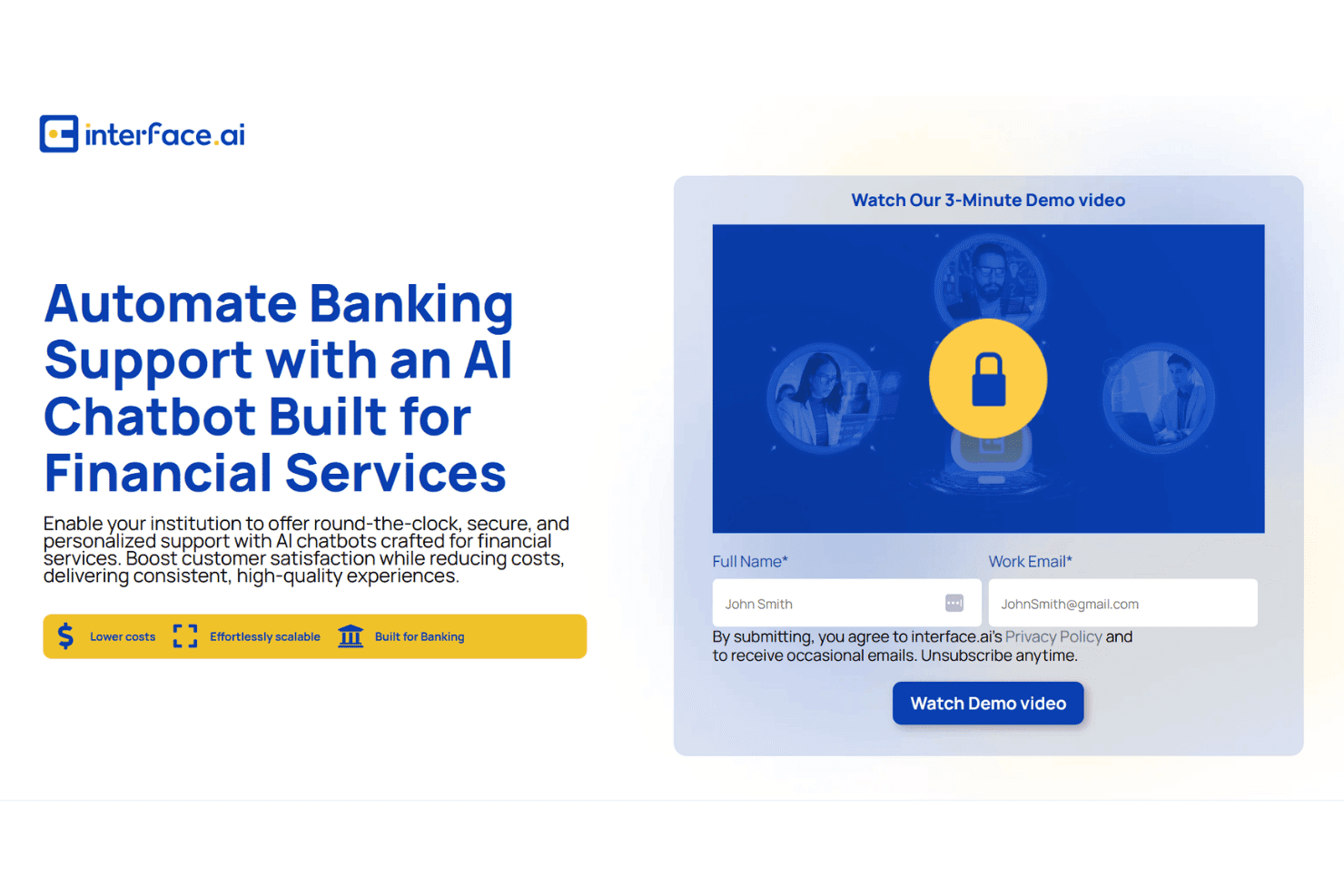
interface.ai automates banking support with an AI chatbot for financial services. interface.ai is an agentic AI platform covering voice banking, chat, fraud prevention, collections, and contact center automation across channels.
Who Is interface.ai Best For?
interface.ai is a good fit for credit unions and community banks that want a fully managed AI deployment across voice, chat, and SMS.
Why I Picked interface.ai
interface.ai earns its spot on my shortlist because it's one of the few banking AI platforms where implementation, ongoing training, and integration maintenance are all handled for you. I'm particularly drawn to its Nexus contact center model, which keeps the AI active on a call and routes only the specific question requiring human input to a skills-based queue, eliminating transfers entirely. Its risk-tiered authentication is also genuinely impressive: high-risk requests like fund transfers trigger Caller ID forensics plus on-device biometrics, all within the conversation flow itself.
interface.ai Key Features
- Sentiment and frustration detection: The chat and voice AI monitors conversations in real time to identify when a member is upset or struggling, feeding that signal into an Experience Score.
- Co-browsing for applications: Guides customers through loan or account applications using a shared-screen experience directly within the chat flow.
- Multilingual support: Handles conversations in 100+ languages, 24/7, with dedicated Spanish-language support added for digital banking channels.
- Knowledge graph with cited answers: Responses draw from a structured knowledge graph and include citations, with daily or on-demand re-ingestion of website content and documents.
interface.ai Integrations
interface.ai integrates with Acquire, Quovo, Bakerhill, Salesforce, Experian, Plaid, and Twilio. A managed services team handles integration support and maintenance.
Pros and Cons
Pros:
- Context-rich handoffs preserve conversation continuity
- Banking-specific workflows support complex inquiries
- Risk-tiered authentication protects sensitive requests
Cons:
- Several capabilities remain in phased rollout
- Independent customer feedback remains scarce
Learn more about interface:
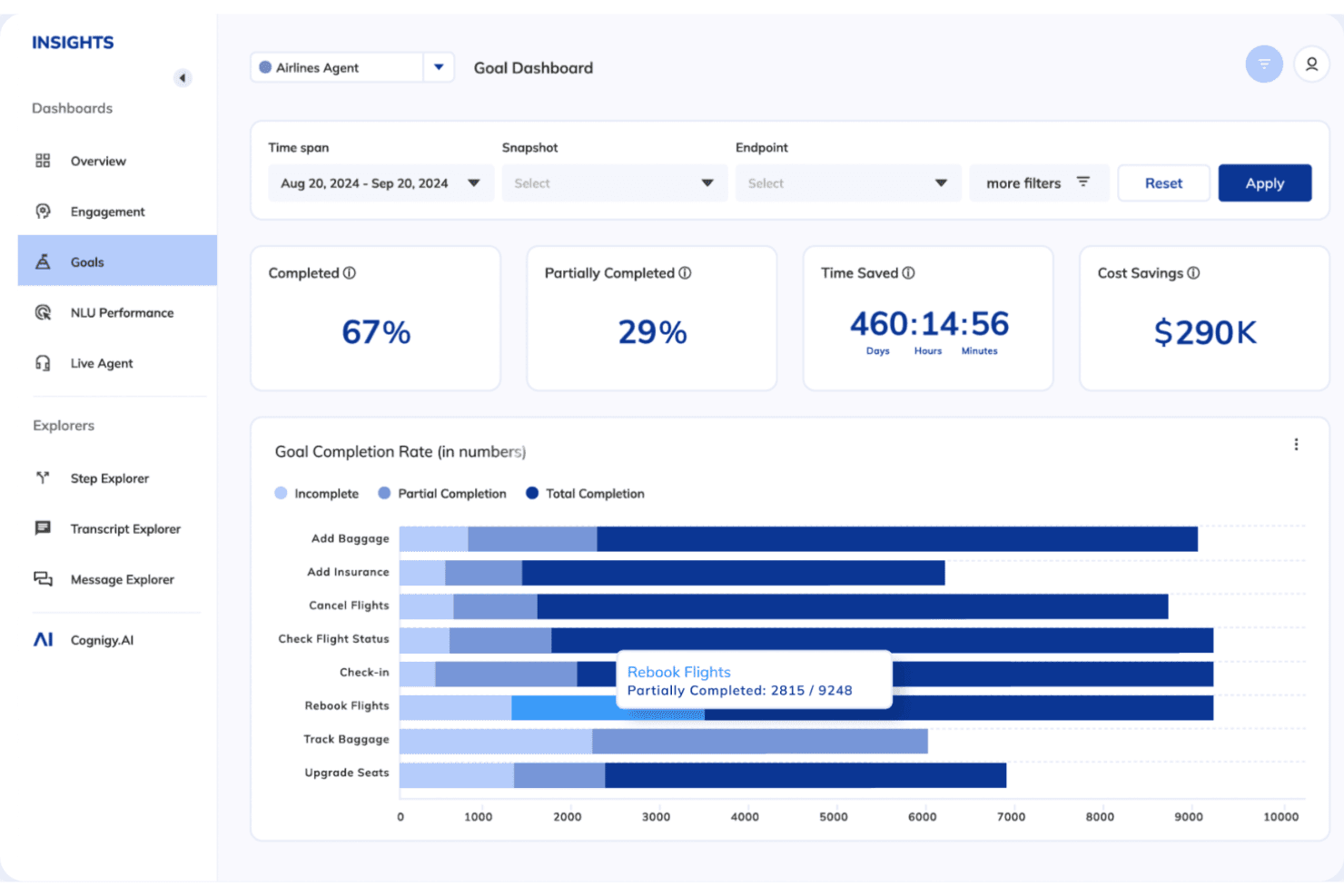
Cognigy tracks AI agent goal completion rates and cost savings. NiCE Cognigy offers a low-code flow builder, voice banking, and omnichannel deployment to handle customer interactions across digital and phone channels.
Who Is NiCE Cognigy Best For?
NiCE Cognigy is a strong fit for enterprise banks and financial institutions that need outbound AI-driven customer engagement.
Why I Picked NiCE Cognigy
I picked NiCE Cognigy as one of the best because its proactive outreach capability sets it apart from platforms that only respond to customers. Its AI Agents for Proactive Engagement monitor real-time signals like CRM updates and billing events, then initiate contact via SMS, voice, or in-app before a customer ever reaches out. I also love the Composite AI approach: deterministic flows handle regulated steps like loan applications and KYC, while LLM-based agents manage open-ended conversations.
NiCE Cognigy Key Features
- Composite AI flow builder: Build banking workflows where deterministic, rule-based flows handle regulated steps like KYC and loan applications, while LLM agents manage open-ended customer questions.
- xApps secure interaction layer: Launch in-conversation mini web apps that support biometric login, e-signature, and secure payment capture without exposing sensitive data.
- Omnichannel deployment: Deploy a single flow across 30+ channels including webchat, WhatsApp, SMS, and voice, with context preserved across channel switches.
- Conversation Analyzer: Use an LLM-powered tool to score sentiment, containment rates, and whether AI agents followed instructions across banking interactions.
NiCE Cognigy Integrations
NiCE Cognigy integrates with Genesys Cloud, Salesforce, Sitecore, Five9, Amazon Connect, Google Cloud, and RingCentral. REST APIs, custom extensions, and MCP support custom connections to core banking systems.
Pros and Cons
Pros:
- Voice banking supports multilingual self-service
- Composite AI separates regulated and open-ended workflows
- Proactive outreach reaches customers before contact
Cons:
- Advanced workflows can demand implementation expertise
- Core banking connections require custom development
Learn more about NiCE Cognigy:
Outros chatbots de IA para a banca
Eis algumas opções adicionais que não entraram na minha lista principal, mas que vale a pena conhecer:
- 11ZowieBest for auditable, rules-driven actions
- 12Gradient LabsBest for outcome-based automation
- 13HaptikBest for WhatsApp-first fintech chat
- 14FinBest for regulated escalation and analytics
- 15GliaBest for AI with zero-hallucination guarantee
- 16PolyAIBest for voice-led call containment
- 17BackbaseBest for transactional chat with a full audit trail
- 18AvaamoBest for PCI-compliant voice payments
How I Evaluate AI Chatbots for Banking
To make this list, a tool's AI needs to handle banking work, like interpreting account questions or executing transfers. From there, I evaluate three things. Core functionality carries most weight, like supporting secure authentication and live-agent handoffs. Then I look at standout features, like voice banking, and beyond features, like data residency.
Core Functionality (Table Stakes For This List)
When I'm selecting tools for my list, I score each one on a scale from 0 (does not offer the functionality) to 5 (excels in this area) for each core functionality listed below. I then convert the total into a percentage to help assess each tool's overall fit, with extra weight on any functionalities I’ve deemed essential.
- Natural Language Understanding (Essential): I assess how well it handles varied account questions, follow-up context, and multi-step requests such as disputing a transaction.
- Core Banking Integration (Essential): I look for live account access and actions such as transfers, payments, card controls, and loan-status updates.
- Secure Authentication: I check for identity verification, step-up authentication, and safeguards before revealing balances or approving transactions.
- Compliance Controls: Audit trails, encryption, configurable disclosures, and permission controls matter when reviewing regulated customer conversations.
- Omnichannel Deployment: I assess consistent experiences across web, mobile apps, messaging, and voice, including conversation history between channels.
- Human Handoff: I look for context-preserving escalation, intent-based routing, and transfer to the right banking team when automation reaches its limits.
Once I have a list of tools that meet the criteria, I consider what sets each platform apart.
Differentiating Factors (What Sets Vendors Apart)
Here's how I compare and contrast different vendors:
Standout Features
I look for proactive insights that surface spending alerts or savings nudges before a customer reaches out—tools like interface and Kore.ai approach this differently, so I compare trigger logic and personalization depth. Sentiment and intent analytics matter just as much; I check whether a platform detects frustration in real time and adjusts routing or tone mid-conversation. I also evaluate voice banking support, since handling transfers or balance checks through natural speech adds a channel many teams underserve. Finally, I consider how each tool learns from past conversations to sharpen intent models without heavy manual retraining.
Beyond Features
Data residency and encryption policies matter because many banks must host customer data in specific regions or on private cloud infrastructure. I check whether vendors clearly disclose data retention, model training practices, and third-party sharing. Pre-built connectors to core banking platforms like Temenos or FIS also reduce integration risk, especially when your stack mixes legacy systems with modern APIs. Finally, I evaluate vendor governance models—role-based access controls and managed tuning support help your team adapt conversation flows as regulations and products change without relying on a single bot admin.
Como escolher um chatbot de IA para a banca
Escolha um chatbot de IA para a banca fazendo corresponder as suas prioridades de atendimento a evidências sobre segurança, governação, integração e encaminhamento.
| Se a sua prioridade for | Procure |
|---|---|
| Se a sua prioridade forProteger operações de conta | ProcureDocumentação sobre fluxos de trabalho de verificação de identidade e autenticação reforçada |
| Se a sua prioridade forCumprir requisitos de auditoria | ProcureRegistos de conversas exportáveis, registos de acesso e controlos de retenção |
| Se a sua prioridade forSuportar vários canais | ProcureUm modelo documentado de histórico de conversas entre chat, dispositivos móveis, mensagens e voz |
| Se a sua prioridade forLigar sistemas bancários | ProcureDocumentação de conectores identificados, referências da API e acesso a uma área de testes |
| Se a sua prioridade forTratar pedidos complexos | ProcureRegras de transferência que preservem o contexto e documentação de encaminhamento |
Como avaliar a sua seleção
- Peça evidências sobre o tratamento de dados: Solicite, no prazo de cinco dias úteis, um diagrama atualizado do fluxo de dados, um calendário de retenção, uma declaração sobre encriptação e informações sobre a utilização dos dados para treinar modelos.
- Realize uma tarefa de teste definida: Teste uma pergunta sobre o saldo, uma transação contestada e um pedido de transferência durante um período experimental de 14 dias, registando os pedidos de autenticação e os pontos de encaminhamento.
- Teste o encaminhamento com um pedido de suporte: Registe um pedido de suporte prioritário sobre uma transferência falhada e exija uma resposta por escrito, um responsável e um prazo para a resolução.
- Obtenha as obrigações por escrito: Antes da aprovação da contratação, solicite cláusulas contratuais que abranjam o acesso aos registos de auditoria, a eliminação de dados, a divulgação de subcontratantes e a notificação de incidentes.
- Escolha o seu compromisso: Decida entre um serviço gerido pelo fornecedor, com uma configuração mais limitada, e uma plataforma configurável que exija uma governação interna mais abrangente.
O que são os chatbots de IA para a banca?
Os chatbots de IA para a banca são ferramentas conversacionais que respondem às perguntas dos clientes e apoiam tarefas bancárias através de chat, voz e canais digitais. Podem explicar transações, orientar os clientes nos processos relacionados com as contas, autenticar clientes, encaminhar pedidos complexos e transmitir o contexto da conversa aos agentes humanos. Os bancos configuram-nos de acordo com os sistemas centrais, os requisitos de segurança, os controlos de conformidade e os fluxos de trabalho do serviço de apoio ao cliente.
Funcionalidades
Eis as principais funcionalidades que procuro em qualquer chatbot de IA para a banca de qualidade:
- Compreensão da linguagem natural: Interpreta perguntas sobre contas, mensagens de acompanhamento e termos bancários, permitindo que os clientes recebam respostas relevantes sem terem de repetir o contexto.
- Integração com o sistema bancário central: Liga-se aos sistemas bancários para apresentar saldos, explicar transações, iniciar pagamentos, gerir cartões e fornecer atualizações sobre empréstimos.
- Autenticação segura: Verifica a identidade do cliente antes de revelar informações da conta ou aprovar ações sensíveis, através de métodos como códigos de utilização única ou verificações reforçadas.
- Suporte omnicanal: Presta assistência consistente através de sítios Web, aplicações móveis, plataformas de mensagens e canais de voz, preservando o contexto da conversa.
- Transferência para um agente humano: Transfere conversas complexas ou sensíveis para o agente adequado, anexando o histórico, a intenção e os dados recolhidos do cliente.
- Controlos de conformidade: Fornece permissões de acesso, encriptação, divulgações configuráveis, definições de retenção e registos de auditoria para interações regulamentadas com clientes.
- Interação proativa: Envia alertas aprovados, lembretes de pagamentos, atualizações sobre despesas ou sugestões de poupança com base na atividade do cliente e em regras bancárias definidas.
- Análise de conversas: Apresenta relatórios sobre intenções, taxas de resolução, motivos de encaminhamento, sentimento dos clientes e perguntas sem resposta, de modo a orientar melhorias no serviço.
- Banca por voz: Permite que os clientes façam perguntas e concluam tarefas bancárias suportadas através de comandos de voz, com autenticação e confirmação antes de executar ações na conta.
Benefícios
Na minha experiência, os chatbots de IA no setor bancário oferecem vários benefícios, incluindo:
- Respostas mais rápidas aos clientes: A compreensão da linguagem natural trata de perguntas sobre contas, explicações de transações e pedidos de acompanhamento sem exigir que os clientes repitam o contexto.
- Autosserviço mais seguro: A autenticação segura e a verificação reforçada protegem saldos, transferências, pagamentos e outras ações sensíveis nas contas.
- Suporte omnicanal consistente: Os clientes recebem assistência integrada através de sítios Web, aplicações móveis, plataformas de mensagens e canais de voz.
- Melhor resolução de casos complexos: As transferências que preservam o contexto transmitem o histórico da conversa, a intenção e os dados recolhidos ao agente humano adequado.
- Orientação mais proativa: Alertas sobre despesas, lembretes de pagamentos, sugestões de poupança e outras notificações aprovadas chegam aos clientes antes de estes terem de perguntar.
- Supervisão da conformidade reforçada: A encriptação, as permissões baseadas em funções, as divulgações configuráveis, as definições de retenção e os registos de auditoria apoiam as interações regulamentadas.
- Informações úteis sobre o serviço: A análise de conversas revela as intenções dos clientes, o sentimento, os motivos de encaminhamento, as taxas de resolução e as perguntas sem resposta.
Custos e preços
Os custos variam consoante as funcionalidades, a dimensão da equipa, os complementos, as integrações e os requisitos de conformidade. Eis os intervalos de preços que pode esperar normalmente dos chatbots para a banca:
Tabela de comparação de planos para chatbots de IA para a banca
| Tipo de plano | Preço médio | Funcionalidades comuns |
|---|---|---|
| Tipo de planoPlano gratuito | Preço médio$0 | Funcionalidades comunsCriador de chatbots básico, conversas limitadas, respostas a FAQ e apoio da comunidade. |
| Tipo de planoPlano pessoal | Preço médio$25–$100/utilizador/mês | Funcionalidades comunsLimites de conversação mais elevados, chat personalizado com a marca, análise básica e apoio por e-mail. |
| Tipo de planoPlano empresarial | Preço médio$500–$2,000/mês | Funcionalidades comunsIntegrações com sistemas bancários, autenticação segura, análise de conversas e transferência para um agente humano. |
| Tipo de planoPlano empresarial avançado | Preço médio$2,000–$20,000+/mês | Funcionalidades comunsIntegrações personalizadas, implementação omnicanal, controlos de conformidade avançados e apoio dedicado. |
Perguntas frequentes
Algumas respostas a perguntas comuns sobre chatbots de inteligência artificial:
Um chatbot de IA pode concluir transações bancárias?
Sim, um chatbot de IA pode concluir transações bancárias suportadas após a autenticação e confirmação. As ações comuns incluem transferências, pagamentos de faturas, controlos do cartão e verificações do estado dos pagamentos. A sua equipa deve definir quais as ações que o chatbot pode realizar. Exija uma verificação reforçada antes de alterações sensíveis ou da movimentação de fundos. Apresente os detalhes da transação antes da aprovação. Mantenha um registo do pedido, do resultado da autenticação, da confirmação e do resultado final. Comece com ações de baixo risco e, em seguida, alargue o acesso depois de analisar os erros e o feedback dos clientes.
Como é que os bancos evitam as alucinações dos chatbots de IA?
Os bancos reduzem as alucinações limitando as respostas a conteúdos aprovados e a dados bancários ligados. Configure o chatbot para recusar pedidos não suportados em vez de adivinhar. Utilize a recuperação de informação a partir de fontes de conhecimento controladas para perguntas sobre produtos e políticas. Adicione regras de validação antes de apresentar saldos ou iniciar transações. Analise as perguntas sem resposta e as respostas incorretas através da análise das conversas. A sua equipa também deve testar alterações às políticas, formulações invulgares e pedidos com várias etapas antes de disponibilizar novos fluxos de conversação.
Quando deve um chatbot bancário encaminhar um cliente para um agente?
Um chatbot bancário deve encaminhar os clientes quando o risco, a complexidade ou a frustração do cliente ultrapassarem os seus limites. Os exemplos de encaminhamento incluem suspeitas de fraude, preocupações relativas a clientes vulneráveis, transações contestadas, reclamações e autenticação falhada. A transferência deve incluir o histórico da conversa, os dados verificados, a intenção e as ações já concluídas. Encaminhe o cliente para a equipa bancária certa, em vez de o enviar para uma fila geral. Apresente uma mensagem clara de transferência para que os clientes saibam o que acontece a seguir e evitem repetir a sua situação.
Como deve um banco testar um chatbot de IA antes do lançamento?
Um banco deve testar um chatbot de IA com cenários de atendimento realistas antes do lançamento. Inclua perguntas sobre saldos, contestações de transações, pedidos de transferência, bloqueios de cartões, falhas de autenticação e transferências para agentes. Teste formulações normais, erros tipográficos, perguntas de seguimento e tentativas de contornar as verificações de segurança. Confirme que o chatbot oculta informações sensíveis até a verificação ser bem-sucedida. Avalie a precisão das respostas, a conclusão das tarefas, a qualidade do encaminhamento e as taxas de ações incorretas. Repita os testes após alterações às políticas, integrações, modelos ou fluxos de autenticação.