

Com tantas soluções de software de atendimento ao cliente diferentes disponíveis, é difícil perceber qual é a mais adequada para a sua pequena empresa. Sabe que quer um software que o ajude a responder eficazmente às necessidades dos seus clientes, de modo a aumentar a satisfação e a fidelização, mas precisa de descobrir qual é o melhor.
Neste artigo, vou ajudá-lo a tornar a sua escolha mais fácil, partilhando as minhas perspetivas sobre os melhores softwares de atendimento ao cliente para pequenas empresas, para o ajudar a acompanhar, gerir, estabelecer prioridades e resolver pedidos dos clientes, proporcionando uma experiência excecional ao cliente em todos os pontos de contacto.
Why Trust Our Software Recommendations
6,700+
Reviews
20
Industry experts
16+
Evaluation factors
14
Years
Our team has been testing and reviewing software since 2012. As CX leaders ourselves, we know how difficult—and important—it is to choose the right software.
For this guide, we evaluated tools using hands-on testing and independent research, scoring tools using our selection criteria.
Our reviews reflect our human editorial judgment, not a sales pitch.
 Gui DrusinaCreative Director
 Tim FisherVP of AI
Tabela comparativa: software de atendimento ao cliente para pequenas empresas
Esta tabela comparativa resume os detalhes básicos de cada uma das minhas principais escolhas de software de atendimento ao cliente, especificamente para pequenas empresas.
| Tool | Best For | Trial Info | Price | ||
|---|---|---|---|---|---|
| 1 | Best for implementing call center operations | Free trial available | From $19/user/month (billed annually) | Website | |
| 2 | Best for building custom AI chatbots | 7-day free trial + free plan + free demo available | From $32/month (billed annually) | Website | |
| 3 | Best for AI-driven ticket deflection and handoff | Free plan + free demo available | From $150/month (billed annually) | Website | |
| 4 | Best for AI driven customer interactions | Free plan available | From $25/user/month | Website | |
| 5 | Best for monitoring ticketing systems with AI | 15-day free trial | Pricing upon request | Website | |
| 6 | Best for omnichannel inbox support | Free plan available; 14-day free trial | From $16/user/month | Website | |
| 7 | Best for AI-powered call management | Free plan + 14-day trial + free demo available | From $25/user/month (billed annually) | Website | |
| 8 | Best for call insights and analytics | Free plan available | From $29/month (billed annually) | Website | |
| 9 | Best for inbox collaboration with lean support teams | 30-day free trial + free demo available | From $14/user/month (billed annually) | Website | |
| 10 | Best for managing interactions with digital workflows | Free trial + free demo available | From $5,000/year (billed annually) | Website |


Análise do melhor software de atendimento ao cliente para pequenas empresas
Eis breves descrições dos 10 melhores softwares de atendimento ao cliente para pequenas empresas que entraram na minha seleção. Destaquei as funcionalidades mais relevantes de cada sistema e incluí uma captura de ecrã para lhe mostrar a respetiva interface de utilizador.
Caso queira considerar opções adicionais, incluí também abaixo mais 12 opções suplementares para acompanhar os seus problemas de atendimento ao cliente.
 Best for implementing call center operations
- Free trial available
- From $19/user/month (billed annually)
Visit WebsiteCustomer Rating:4.4/5
Freshdesk offers a unified inbox with AI-powered conversation summaries, contact details, and order history to help small business support teams manage customer requests efficiently. Freshdesk is an omnichannel customer service platform that unifies email, live chat, social media, voice, and messaging into a single inbox, with built-in ticketing, a self-service knowledge base, workflow automation, and AI-assisted support tools.
Who Is Freshdesk Best For?
Freshdesk suits small and mid-sized businesses running lean support teams who need a structured, multi-channel help desk without the complexity of enterprise-grade platforms.
Why I Picked Freshdesk
I picked Freshdesk as one of the best because its voice channel integrates directly into the same unified inbox as email, chat, and social, so call center agents aren't toggling between tools mid-shift. I particularly like skill-based routing, which automatically directs incoming calls to the agent best equipped to handle them based on predefined competencies. Freddy AI Copilot's real-time sentiment analysis gives agents a live read on how a call is trending, so they can course-correct before the conversation deteriorates.
Freshdesk Key Features
- Unified inbox: Manage email, chat, social, and SMS conversations in a single, organized workspace.
- Customer portal: Provide customers with branded self-service options, knowledge base access, and community forums.
- Collision detection: Prevent duplicate responses by alerting agents when another team member is viewing or replying to a ticket.
- Customizable workflows: Build rule-based automations for ticket assignment, escalation, and follow-up based on your team's needs.
Freshdesk Integrations
Freshdesk offers native integrations with Shopify, Slack, HubSpot, Salesforce, Mailchimp, Google Workspace, Microsoft 365, WooCommerce, and WhatsApp, plus connects with Zapier and provides an API for custom integrations.
Pros and Cons
Pros:
- Freddy AI summarizes tickets automatically
- AI reply suggestions cut agent response time
- Voice channel built in for call centers
Cons:
- Onboarding complexity grows with additional channels
- Reporting customization limited on lower-tier plans
Learn more about Freshdesk: Best for building custom AI chatbots
- 7-day free trial + free plan + free demo available
- From $32/month (billed annually)
Visit WebsiteCustomer Rating:4.4/5
Chatbase offers AI-powered agents that handle customer support interactions and automate actions like booking meetings and updating subscriptions for small businesses. Chatbase is a no-code platform for building and deploying AI-powered customer support agents that are trained on your own business data, with smart escalation to human agents, omnichannel deployment, and built-in analytics.
Who Is Chatbase Best For?
Chatbase is a strong fit for small business owners and solo operators who want to automate customer support without hiring developers or managing complex software.
Why I Picked Chatbase
I picked Chatbase as one of the best because training an AI agent on your own business data is where it really stands out. You connect it to your existing sources, such as PDFs, help docs, or live CRM and order management data, and the agent answers questions using that specific knowledge. I also like the AI-powered guardrails, which prevent the agent from going off-script or generating inaccurate responses based on information outside your data sources.
Chatbase Key Features
- Human escalation: Route conversations from the AI agent to a live human agent when a customer's question falls outside what the bot can handle.
- Omnichannel deployment: Embed your AI agent on your website or connect it to WhatsApp, Messenger, Slack, and email from one place.
- Conversation analytics: Track message volume, resolution rates, and unanswered questions to identify gaps in your agent's knowledge.
- No-code agent builder: Build, configure, and update your AI agent through a visual dashboard without writing any code.
Chatbase Integrations
Chatbase offers integrations across 15+ platforms, including WordPress, Shopify, WhatsApp, Slack, Zendesk, as well as Salesforce, Stripe, Calendly, Cal.com, Notion, and Messenger. It's also available on Zapier and Make, and provides an API for custom integrations.
Pros and Cons
Pros:
- Supports 80+ languages without separate setup
- AI Actions let the bot perform tasks
- Deploys a working chatbot within minutes
Cons:
- Bot occasionally invents URLs or answers
- No visual flow builder for multi-step logic
Learn more about Chatbase: Best for AI-driven ticket deflection and handoff
- Free plan + free demo available
- From $150/month (billed annually)
Visit WebsiteCustomer Rating:4.5/5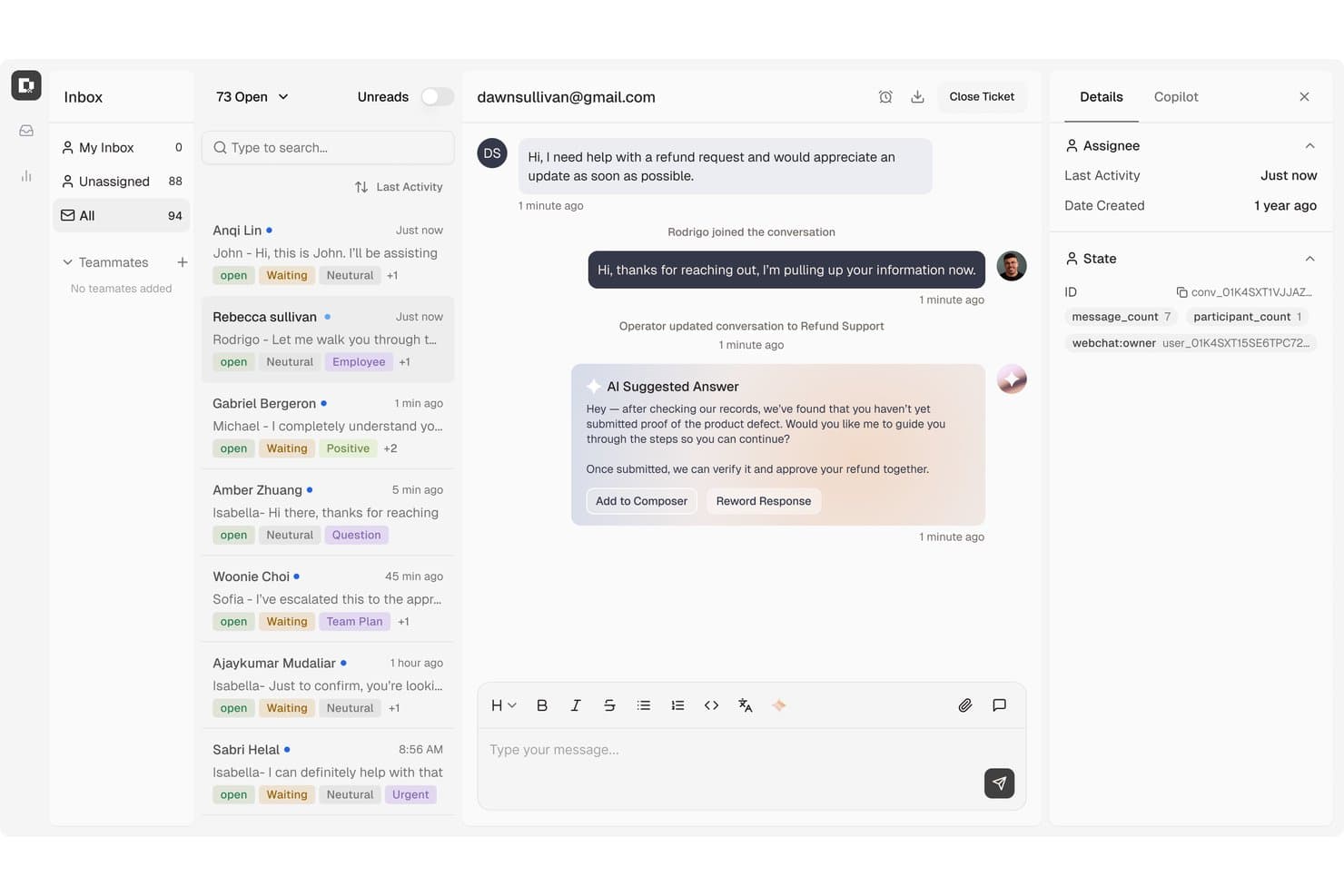
Botpress centralizes customer support tickets with AI-suggested replies. Botpress is an AI-powered helpdesk that unifies customer conversations from webchat, email, WhatsApp, and social channels into a single inbox, with built-in ticket management, knowledge base, and automated escalation tools.
Who Is Botpress Best For?
Botpress is a strong fit for small support teams that want AI to handle the bulk of incoming tickets before a human ever needs to get involved.
Why I Picked Botpress
I picked Botpress as one of the best because its AI deflection and handoff capabilities go well beyond basic chatbot routing. The ticket deflection engine searches your connected knowledge base, detects the customer's language, and responds with a cited source, so agents only step in when the AI's confidence drops below a threshold you set. When escalation does happen, the handoff includes the full conversation history, an AI-generated summary, and a suggested next step, which means your agent doesn't start from zero.
Botpress Key Features
- Unified multi-channel inbox: Consolidates conversations from webchat, email, WhatsApp, Slack, Telegram, Instagram, and Messenger into a single shared inbox.
- CSAT dashboard: Tracks post-resolution survey scores with localized survey questions that display in the customer's language.
- Macro responses: Lets agents save replies with automatic follow-up actions to handle common requests without typing from scratch.
- Team routing rules: Directs incoming tickets to specialized groups like billing or technical support based on configurable assignment criteria.
Botpress Integrations
Botpress offers native integrations with HubSpot, Salesforce, Shopify, Stripe, Gmail, Google Drive, Slack, Zendesk, and Intercom, plus API access for custom integrations and Zapier.
Pros and Cons
Pros:
- Macros trigger follow-up actions
- Handoffs carry summaries and next steps
- Reviewers praise source-grounded chatbot answers
Cons:
- Advanced bot setups need careful testing
- Usage costs can be hard to predict
Learn more about Botpress: Best for AI driven customer interactions
- Free plan available
- From $25/user/month
Visit WebsiteCustomer Rating:4.5/5
Help Scout offers a live chat interface where agents can view customer profiles, browsing history, and product inquiries alongside real-time messaging. Help Scout is a customer support platform that brings email, live chat, social messaging, and a self-service knowledge base together in a shared inbox built for small teams.
Who Is Help Scout Best For?
Help Scout is a strong fit for small to mid-sized teams that handle most customer communication over email and want a straightforward, low-overhead support setup.
Why I Picked Help Scout
Help Scout earns its spot as one of the best on my shortlist because of how naturally its AI features fit into a small team's daily workflow. I love that AI Assist helps agents draft responses directly in the inbox without switching tools, while AI Summarize condenses long conversation threads into a quick brief. The AI Answers chatbot takes it further, automatically resolving routine questions before they ever reach the queue.
Help Scout Key Features
- Shared inbox and collision detection: Multiple agents can manage emails collaboratively with real-time updates and internal notes.
- Docs knowledge base: Create a branded self-service help center with search, categories, and article analytics.
- Customizable workflows: Build rule-based automations for ticket assignment, tagging, auto-replies, and SLAs.
- Mobile agent app: Respond to customer conversations and manage support tickets directly from iOS or Android.
Help Scout Integrations
Help Scout offers native integrations with HubSpot, Salesforce, Shopify, Mailchimp, Slack, Jira, Aircall, Asana, WooCommerce, and Facebook Messenger. It also connects with Zapier and provides an API for custom integrations.
Pros and Cons
Pros:
- Knowledge base deflects repetitive support tickets
- Shared inbox supports collaborative small team resolution
- AI tools built directly into the inbox
Cons:
- No native voice or phone channel support
- Reporting lacks advanced customization options
Learn more about Help Scout: Best for monitoring ticketing systems with AI
- 15-day free trial
- Pricing upon request
Visit WebsiteCustomer Rating:4.4/5
Zoho Desk offers a comprehensive analytics dashboard displaying ticket volume, traffic sources, reply times, and customer happiness ratings for support teams. Zoho Desk is a context-aware help desk platform that unifies customer support tickets from email, social media, live chat, phone, and messaging apps into a single workspace with built-in AI, automation, and self-service tools.
Who Is Zoho Desk Best For?
Zoho Desk is a strong fit for small businesses already using Zoho CRM or other Zoho apps who want a deeply integrated, AI-assisted support platform.
Why I Picked Zoho Desk
I picked Zoho Desk as one of the best because Zia, its built-in AI, actively monitors your ticket queue and flags anomalies before they snowball into backlogs. Zia reads incoming tickets, detects customer sentiment, and auto-tags issues so my team can prioritize the right conversations first. I also like that AI Agents handle routine requests end-to-end, escalating to a human only when the situation genuinely calls for it.
Zoho Desk Key Features
- Customer context panel: See a full customer profile, including CRM history, past tickets, and order details alongside every conversation.
- Multichannel inbox: Manage email, social, live chat, messaging apps, and voice interactions from one place.
- Self-service help center: Build and customize a branded knowledge base, FAQ, and community forum for customers.
- Mobile agent app: Let agents view, respond to, and manage tickets on iOS or Android devices wherever they are.
Zoho Desk Integrations
Zoho Desk offers native integrations with Zoho CRM, Shopify, Slack, Jira, Microsoft Teams, Trello, Mailchimp, Salesforce, HubSpot, and Google Workspace. An API is available for custom integrations.
Pros and Cons
Pros:
- No-code chatbot resolves routine tickets autonomously
- Collision detection prevents duplicate agent responses
- Zia AI flags incoming ticket sentiment automatically
Cons:
- Setup complexity grows with multiple channels
- Advanced AI features locked to paid plans
Learn more about Zoho Desk: Best for omnichannel inbox support
- Free plan available; 14-day free trial
- From $16/user/month
Visit WebsiteCustomer Rating:4.6/5
SparrowDesk’s omnichannel inbox centralizes conversations, priorities, and assignments in one workspace. SparrowDesk offers a user-friendly platform tailored for small businesses seeking to enhance their customer service capabilities. By integrating AI-driven solutions, it helps your team efficiently handle customer inquiries while maintaining a consistent brand voice. The ability to manage omnichannel interactions from a single inbox addresses the challenge of fragmented communication, ensuring that your customers receive timely and coherent support.
Why I Picked SparrowDesk
I picked SparrowDesk for its unique integration of AI capabilities that cater specifically to small businesses' needs. The AI colleague, Zoona, stands out by providing personalized resolutions, ensuring that your brand's voice is consistently maintained. Furthermore, its Service Level Agreements (SLAs) feature helps your team manage and meet customer expectations effectively. These functionalities, combined with the AI Copilot that assists agents with instant summaries and context-aware replies, make it an excellent choice for businesses looking to elevate their customer support operations.
SparrowDesk Key Features
In addition to its standout AI capabilities, I also found the following features valuable for small businesses:
- Interactive Analytics: Provides real-time data and insights to help your team make informed decisions and improve service quality.
- Custom Views: Allows you to tailor the interface according to your team's preferences, enhancing workflow and productivity.
- Multilingual Support: Ensures you can communicate with customers in their preferred language, broadening your reach and improving user experience.
- Omnichannel Support: Centralizes all customer interactions in a single inbox, making it easier to manage conversations across different platforms.
SparrowDesk Integrations
Native integrations include Okta, Plumsail Forms, and Plumsail Documents. Additional integrations may be available through third-party platforms like Zapier. Native integrations are not currently listed comprehensively by SparrowDesk.
Pros and Cons
Pros:
- Customizable analytics with real-time data
- Unified omnichannel shared inbox
- AI Copilot assists complex tickets
Cons:
- SLA tools require configuration effort
- API documentation lacks public detail
Learn more about SparrowDesk: Best for AI-powered call management
- Free plan + 14-day trial + free demo available
- From $25/user/month (billed annually)
Visit WebsiteCustomer Rating:4.2/5
CloudTalk tracks call volume and talk time to support AI-driven phone support. For small business owners seeking a reliable customer service solution, CloudTalk offers a practical option. This cloud-based call center software helps teams manage customer calls more efficiently, making it suitable for businesses in retail, tech support, and other service-driven industries. With AI-driven phone support and real-time monitoring, CloudTalk helps teams handle calls consistently while keeping staffing and operating costs under control.
Why I Picked CloudTalk
I picked CloudTalk because its AI-powered features are particularly beneficial for small businesses aiming to enhance customer service. The AI Dialer automates dialing processes, reducing waiting times and increasing agent productivity. Additionally, AI Conversation Intelligence provides automatic call summaries and sentiment analysis, offering actionable insights to improve customer interactions. These features directly address the need for efficient resource management and quality service delivery, making CloudTalk a smart choice for small businesses.
CloudTalk Key Features
In addition to its AI capabilities, CloudTalk offers:
- Call Management: Custom call routing, IVR, call queuing, and recording streamline communication processes.
- Real-Time Monitoring: Provides live call listening and performance analytics to help you manage and improve your service.
- Communication Tools: SMS and WhatsApp messaging expand your team's communication options.
- Number Management: Offers local numbers in over 160 countries, allowing for an international reach.
CloudTalk Integrations
Integrations include HubSpot, Salesforce, Zoho, Pipedrive, Zendesk, Intercom, Freshdesk, Help Scout, Microsoft Dynamics, and Shopify.
Pros and Cons
Pros:
- Call analytics help track performance and trends
- Provides real-time monitoring and analytics for call management
- AI-powered features enhance call efficiency and insights
Cons:
- Limited customization options in dashboards
- Occasional call connection issues reported by users


Weav offers a detailed agent reporting dashboard showing individual customer interactions for support teams. Weav is an AI-powered customer service platform that combines AI agents, a unified inbox, and automated query resolution trained on your own product documentation and support history.
Who Is Weav Best For?
Weav is a good fit for small business teams that want to automate first-line customer support without hiring additional support staff.
Why I Picked Weav
I picked Weav as one of the best because its reporting module gives small support teams clear visibility into what's actually happening across customer interactions. Rather than drowning you in raw data, Weav's reporting is built around outcomes: you can see where support flows break down, which query types your AI agents are resolving, and where human escalation is happening most. I also like that the training system ties directly into this feedback loop, so when patterns emerge in the data, you can upload new materials and the agent sharpens its responses automatically.
Weav Key Features
- Unified inbox: Consolidates customer conversations from chat and email into a single queue for your support team to manage.
- AI-drafted replies: Weav's AI agent generates suggested responses to incoming queries, which teammates can review, edit, and send.
- Smart routing rules: Automatically directs incoming messages to the right team member or department based on rules you configure.
- Human handoff: Lets the AI agent escalate a conversation to a live agent mid-session without losing the conversation history.
Weav Integrations
Weav offers a smaller set of native integrations, including Shopify, Google Drive, and Stripe. It also supports custom actions, and its REST API and real-time webhooks are available on Pro plans and above for building custom integrations.
Pros and Cons
Pros:
- Deploys trained AI agents in minutes
- Tone and response controls per agent
- AI learns from your resolved tickets
Cons:
- No built-in voice or phone channel
- Requires existing docs for best results
Learn more about Weav: Best for inbox collaboration with lean support teams
- 30-day free trial + free demo available
- From $14/user/month (billed annually)
Visit WebsiteCustomer Rating:4.8/5
Missive’s shared inbox view shows how teams can collaborate on email threads, assign tasks, and manage client conversations in one workspace. Missive is a shared inbox and team messaging platform that consolidates email, SMS, WhatsApp, live chat, and social messaging channels into a single collaborative workspace.
Who Is Missive Best For?
Missive is a strong fit for lean support teams that handle customer conversations across email, WhatsApp, and social channels and need tight internal collaboration without the overhead of a full helpdesk.
Why I Picked Missive
Missive earns its spot on my shortlist because of how genuinely it's built around team collaboration inside a shared inbox. I love that internal threads let my team discuss a customer email privately before anyone hits send, and collision detection means two agents never accidentally fire off duplicate replies to the same person. The native WhatsApp Business integration (no third-party account required) is a real differentiator for lean teams handling messaging-heavy customer bases across multiple channels from one workspace.
Missive Key Features
- Round-robin assignment: Automatically distributes incoming conversations across available agents using round-robin, least-busy, or random routing methods.
- Canned responses: Save and insert templated replies with variable substitution to keep responses fast and consistent across your team.
- Missive MCP Server: Connect external AI clients (like Claude or ChatGPT) to mcp.missiveapp.com to query your customer inbox, check calendars, and draft replies—keeping human approval required before sending.
- Guest access: Invite external collaborators into specific conversations without assigning them a paid seat.
- Live chat widget: Manage website visitor conversations directly inside the shared inbox alongside email and social channels.
Missive Integrations
Missive offers 25+ native integrations, including HubSpot, Shopify, WhatsApp Business, Aircall, Dialpad, Twilio, Google Drive, and Dropbox. It also supports custom integrations through its REST API, webhooks, Zapier, and its new MCP Server on Productive and Business plans (requires admin activation).
Pros and Cons
Pros:
- Collision detection prevents duplicate responses
- Native WhatsApp Business integration included for teams
- Internal collaboration threads for private team discussions
Cons:
- No built-in CSAT or satisfaction surveys
- No native customer-facing knowledge base
Learn more about Missive: 10Best for managing interactions with digital workflows
Moxo
- Free trial + free demo available
- From $5,000/year (billed annually)
Visit WebsiteCustomer Rating:4.4/5
Moxo provides a business interaction management system focused on virtual workspaces. Moxo is an AI workflow platform that combines client portals, service request tracking, live chat, document management, and workflow automation into a single operational hub.
Who Is Moxo Best For?
Moxo is a strong fit for professional services teams in industries like legal, finance, and real estate that need to coordinate client-facing workflows with document collection, approvals, and eSignatures in one branded portal.
Why I Picked Moxo
I've included Moxo in my top picks because it structures client interactions around digital workflows in a way that keeps every document request, approval, and status update tied to a single branded portal. I particularly like the Service Requests module, which lets clients submit and track issues while agents manage assignment and resolution without juggling separate inboxes. The AI chat assistant also handles routine status questions automatically, so your team focuses on the interactions that actually need a human.
Moxo Key Features
- Live Support module: Clients connect with agents or bots in real time through a dedicated support channel built into their portal.
- Client Resources library: Admins upload and organize files into folders that clients can browse, preview, and download directly from their portal.
- eSignature collection: Signature requests are built into workflow steps, so clients can sign documents without leaving the portal.
- Magic link access: Clients enter their portal through a single link—no account creation or password required.
Moxo Integrations
Moxo offers integrations with HubSpot, Salesforce, QuickBooks, Stripe, Google Drive, Slack, and Zendesk. It also supports webhooks, REST APIs, and Zapier for custom connectivity.
Pros and Cons
Pros:
- Magic links reduce client login friction
- Workflow automation handles approvals and follow-ups
- Branded portals keep client requests organized
Cons:
- Service requests lack documented SLA controls
- No shared inbox across support channels
Learn more about Moxo:
Outras ferramentas de gestão do atendimento ao cliente
Eis mais algumas opções interessantes que não entraram na minha seleção dos melhores softwares de atendimento ao cliente, mas que ainda merecem uma análise mais detalhada:
- 11LiveAgentBest for cross-channel ticket history in one view
- 12TidioBest for multichannel AI chat support
- 13ZendeskBest for scaling support without adding headcount
- 14CrispBest for flat-rate workspace pricing with AI included
- 15TalkdeskBest for conversation quality and resolution speed
- 16GorgiasBest for ecommerce support driven by macros
- 17FrontBest for cross-team customer request routing
- 18monday serviceBest for automatic ticket classification
- 19HubSpot Free Service ToolsBest for VoIP functionality from the platform
- 20QuidgetBest for automating repetitive frontline support
- 2114.aiBest for intent-aware AI responses
How I Evaluate Customer Service Software for Small Business
I look at two things: the baseline features a small team juggling email, chat, and social needs just to keep up, and the differentiators that separate one tool from another.
Core Functionality (Table Stakes For This List)
When I'm selecting tools for my list, I rank each one on a scale from 0 (does not offer the functionality) to 5 (excels in this area) for each core functionality listed below. Then, I calculate the tool's total score into a percentage. Each tool needs to achieve a minimum total score of 65% to be considered for inclusion.
- Omnichannel Inbox: I check whether email, live chat, social media, and phone conversations land in a single workspace rather than forcing agents to tab-switch between platforms.
- Ticket Management: Routing, tagging, priority levels, and SLA tracking all matter here. I look at how a tool handles assignment when, say, three agents share a queue of 200 tickets.
- Knowledge Base & Self-Service: A good help center deflects repeat questions like "where's my order?" before they become tickets. I evaluate the article editor, search, and public-facing design.
- Automation & Workflows: Small teams rely on canned responses, auto-assignment rules, and triggers to keep up with volume. I look at how many conditions and actions you can chain together.
- Reporting & CSAT: Beyond basic volume counts, I evaluate whether the tool tracks first-response time, resolution time, agent workload, and lets you send satisfaction surveys after a ticket closes.
- SMB-Friendly Pricing & Setup: Transparent per-agent pricing, a low-cost entry tier, and self-serve onboarding are what I look for. Tools like Freshdesk and Zoho Desk offer free starter plans, while others like Help Scout keep paid tiers accessible.
Once I have a list of tools that meet this criteria, I consider what sets each platform apart.
Differentiating Factors (What Sets Vendors Apart)
Here's how I compare and contrast different vendors:
Standout Features
AI-powered features like reply suggestions and ticket summarization can make a three-person team feel like six. I also evaluate whether a tool offers a no-code chatbot that handles FAQs around the clock, which matters when you can't staff overnight coverage. A customer context panel that surfaces order history and past tickets alongside the active conversation speeds up resolution. For owners who answer tickets between meetings, a solid mobile app makes a real difference.
Beyond Features
Total cost matters beyond the sticker price. I look at whether adding channels or agents later forces a jump to a much higher tier. Integrations also weigh heavily; a support tool that connects natively to Shopify, HubSpot, or Stripe saves small teams from manual data entry between systems. I also consider how fast a team can go live. If setup requires a consultant or weeks of configuration, that's a poor fit for a five-person company that needs to start answering tickets this week.
Como escolher software de atendimento ao cliente para pequenas empresas
É fácil perder-se em listas extensas de funcionalidades e estruturas de preços complexas. Para o ajudar a manter-se concentrado enquanto percorre o seu processo único de seleção de software, eis uma lista de verificação dos fatores a ter em conta:
| Fator | O que considerar |
|---|---|
| FatorEscalabilidade | O que considerarO software acompanhará o crescimento da sua empresa? Considere se consegue lidar com mais utilizadores ou com um aumento dos dados à medida que a sua equipa cresce. |
| FatorIntegrações | O que considerarConsegue ligar-se às suas ferramentas existentes? Verifique a compatibilidade com o seu CRM, e-mail e outros sistemas essenciais para garantir fluxos de trabalho integrados. |
| FatorPersonalização | O que considerarPode adaptá-lo aos seus processos? Procure opções para ajustar fluxos de trabalho, painéis e permissões de utilizador de acordo com as necessidades da sua equipa. |
| FatorFacilidade de utilização | O que considerarÉ fácil de utilizar pela sua equipa? Teste a interface quanto à simplicidade e intuitividade para minimizar o tempo de formação e aumentar a adoção. |
| FatorImplementação e integração inicial | O que considerarQuanto tempo será necessário para começar? Avalie o processo de integração inicial, incluindo recursos disponíveis, como tutoriais e suporte, para garantir uma transição simples. |
| FatorCusto | O que considerarEnquadra-se no seu orçamento? Compare os planos de preços e procure taxas ocultas ou contratos de longa duração que possam afetar a sua flexibilidade financeira. |
| FatorMedidas de segurança | O que considerarOs seus dados e as informações dos clientes estão protegidos? Verifique as medidas de segurança implementadas, como a encriptação e a conformidade com as normas de proteção de dados. |
| FatorDisponibilidade do suporte | O que considerarExiste ajuda disponível quando precisa? Considere as opções de suporte oferecidas, como disponibilidade 24 horas por dia, 7 dias por semana, chat e suporte telefónico, para garantir assistência atempada quando surgem problemas. |
O que é o software de atendimento ao cliente para pequenas empresas?
Os softwares de atendimento ao cliente para pequenas empresas são ferramentas SaaS baseadas na nuvem que ajudam as equipas de atendimento ao cliente a gerir pedidos de suporte e outras comunicações com os clientes. Estas ferramentas foram especificamente concebidas para ajudar as pequenas e médias empresas a simplificar os fluxos de trabalho, automatizar processos repetitivos, encaminhar chamadas para os agentes adequados, melhorar a comunicação à medida que os pedidos dos clientes são escalados e reduzir os tempos de resposta.
A utilização de software de atendimento ao cliente pode ajudar as pequenas empresas a reduzir os custos operacionais, eliminando a necessidade de equipas extensas de atendimento ao cliente, ao mesmo tempo que melhora a eficiência, a rapidez e a consistência das respostas. Também recolhe dados úteis sobre as necessidades dos clientes para ajudar a prestar um melhor atendimento ao cliente em geral.
Funcionalidades
Ao selecionar software de atendimento ao cliente para pequenas empresas, esteja atento às seguintes funcionalidades essenciais:
- Gestão de pedidos: Organiza os pedidos dos clientes em solicitações geríveis, ajudando as equipas a acompanhar e resolver os problemas de forma mais eficiente.
- Suporte multicanal: Permite comunicar com os clientes através de vários canais, como e-mail, chat e redes sociais, garantindo a acessibilidade.
- Relatórios e análises: Fornece informações sobre as interações com os clientes e o desempenho da equipa, ajudando na tomada de decisões e no planeamento de estratégias.
- Fluxos de trabalho personalizáveis: Permite às empresas adaptar os processos às suas necessidades específicas, melhorando a eficiência operacional.
- Capacidades de integração: Liga-se a outras ferramentas e sistemas, melhorando a funcionalidade e simplificando as operações empresariais.
- Acesso através de aplicação móvel: Oferece acesso em qualquer lugar às informações dos clientes e às tarefas de suporte, aumentando a flexibilidade do trabalho remoto.
- Informações baseadas em IA: Utiliza inteligência artificial para analisar dados e fornecer informações práticas, melhorando a qualidade do serviço.
- Medidas de segurança: Garante a proteção dos dados através de encriptação e conformidade com normas, salvaguardando as informações dos clientes.
- Interface fácil de utilizar: Simplifica a navegação e a utilização, reduzindo o tempo de formação e aumentando a adoção pela equipa.
- Suporte ao cliente 24 horas por dia, 7 dias por semana: Fornece assistência contínua, garantindo ajuda atempada e mantendo a continuidade do serviço.
Benefícios
A implementação de software de atendimento ao cliente para pequenas empresas proporciona vários benefícios para a sua equipa e para a sua empresa. Eis alguns dos benefícios que pode esperar:
- Maior eficiência: A gestão de pedidos e os fluxos de trabalho personalizáveis ajudam a simplificar os processos, permitindo que a sua equipa trate de mais pedidos em menos tempo.
- Maior satisfação dos clientes: O suporte multicanal garante que os clientes podem contactá-lo através do método que preferem, melhorando a sua experiência.
- Melhor tomada de decisões: Os relatórios e as análises fornecem informações sobre as interações com os clientes, permitindo desenvolver estratégias fundamentadas.
- Maior flexibilidade: O acesso através de uma aplicação móvel permite à sua equipa gerir as tarefas de atendimento ao cliente a partir de qualquer lugar, facilitando o trabalho remoto.
- Segurança dos dados: Medidas de segurança robustas protegem os dados dos clientes, reforçando a confiança e garantindo a conformidade com os regulamentos.
- Poupança de custos: A automatização e as informações baseadas em IA reduzem as tarefas manuais, diminuindo os custos operacionais e mantendo a qualidade do serviço.
Tendências no software de apoio ao cliente para pequenas empresas
O software de apoio ao cliente está a tornar-se cada vez mais orientado por IA, automatizado e omnicanal, ajudando as pequenas empresas a prestar um apoio mais rápido sem aumentarem significativamente as suas equipas.
- Apoio ao cliente baseado em IA: Os agentes de IA e os copilotos respondem cada vez mais a perguntas rotineiras, resumem conversas, sugerem respostas e ajudam os agentes humanos.
- Mais autonomia para os clientes: As bases de conhecimento, a pesquisa com IA e o apoio automatizado ajudam os clientes a resolver problemas comuns sem contactarem um agente.
- Apoio omnicanal unificado: As plataformas estão a reunir o e-mail, o chat em direto, as mensagens, as redes sociais, a voz e outros canais numa única conversa com o cliente.
- Apoio mais personalizado: O histórico do cliente e os dados do CRM são cada vez mais utilizados para manter o contexto e personalizar as interações entre canais.
- IA com transferência para agentes humanos: A automatização está a crescer, mas continua a ser importante permitir uma transferência fácil para agentes humanos — 87% dos clientes inquiridos afirmaram que o acesso a um agente humano é essencial quando as empresas utilizam GenAI no apoio ao cliente.
Para as pequenas empresas, as plataformas de apoio ao cliente mais completas combinam cada vez mais automatização económica, IA, autonomia para os clientes e apoio omnicanal num único sistema.
Custos e preços
A seleção de software de apoio ao cliente para pequenas empresas requer uma compreensão dos vários modelos de preços e planos disponíveis. Os custos variam consoante as funcionalidades, o tamanho da equipa, os complementos e outros fatores.
A tabela abaixo resume os planos comuns, os respetivos preços médios e as funcionalidades normalmente incluídas nas soluções de software de apoio ao cliente para pequenas empresas:
Tabela de comparação de planos de software de apoio ao cliente para pequenas empresas
| Tipo de plano | Preço médio | Funcionalidades comuns |
|---|---|---|
| Tipo de planoPlano gratuito | Preço médio$0 | Funcionalidades comunsGestão básica de pedidos, apoio por e-mail e relatórios limitados. |
| Tipo de planoPlano pessoal | Preço médio5-$25/utilizador/mês | Funcionalidades comunsApoio multicanal, integrações básicas e análises simples. |
| Tipo de planoPlano empresarial | Preço médio30-$60/utilizador/mês | Funcionalidades comunsRelatórios avançados, fluxos de trabalho personalizáveis e acesso a aplicações móveis |
| Tipo de planoPlano empresarial avançado | Preço médio$70-$120/utilizador/mês | Funcionalidades comunsInformações baseadas em IA, apoio prioritário, medidas de segurança avançadas e opções completas de personalização. |
Perguntas frequentes sobre software de atendimento ao cliente para pequenas empresas
Ainda tem dúvidas sobre o software de atendimento ao cliente e sobre como pode ajudar a sua pequena empresa? Estas respostas às perguntas frequentes indicar-lhe-ão o caminho certo:
Qual é o melhor software de assistência técnica para pequenas empresas?
O software de atendimento ao cliente é seguro?
Sim, a maioria dos fornecedores de software conceituados oferece medidas seguras de proteção de dados. Procure funcionalidades como encriptação, atualizações de segurança regulares e conformidade com os regulamentos de proteção de dados. É importante avaliar as políticas de segurança do fornecedor e ler avaliações para garantir que os dados dos seus clientes estão seguros.
Quais são as 3 principais ferramentas de CRM?
Para as empresas que dão prioridade ao atendimento ao cliente, Zoho, HubSpot e Salesforce são três dos principais ecossistemas de CRM; o Zoho Desk, em particular, liga diretamente o apoio ao cliente ao Zoho CRM.
Qual é o CRM mais fácil de utilizar por principiantes?
O Zoho é um ecossistema de CRM fácil de utilizar por principiantes e destinado a pequenas empresas, especialmente para equipas que pretendem ligar a gestão do relacionamento com os clientes a um serviço de assistência acessível através do Zoho Desk.
Existe um CRM gratuito para pequenas empresas?
Sim. O HubSpot CRM disponibiliza um plano gratuito para pequenas empresas, com ferramentas para gerir contactos, interações com clientes, negócios e atividades básicas de vendas. Pode ser um bom ponto de partida para pequenas equipas que pretendam funcionalidades de CRM sem custos iniciais de software.