

As melhores ferramentas de análise de sentimentos por IA ajudam as equipas de experiência do cliente, marketing e produto a compreender como os clientes se sentem—e não apenas o que dizem. Estas ferramentas transformam avaliações, pedidos de suporte e conversas em informações estruturadas que revelam alterações de humor, identificam pontos de fricção e orientam decisões mais inteligentes ao longo da jornada do cliente.
Utilizei a minha experiência de liderança na interseção entre a tecnologia e a inovação em IA para testar e analisar dezenas de plataformas de análise de sentimentos por IA. Cada ferramenta foi avaliada relativamente à facilidade de utilização, precisão, integrações, profundidade dos relatórios e valor empresarial no mundo real. Este guia apresenta os melhores desempenhos, o que os distingue e como escolher a opção certa para as suas fontes de dados, dimensão da equipa e objetivos.
Why Trust Our Software Recommendations
6,700+
Reviews
20
Industry experts
16+
Evaluation factors
14
Years
Our team has been testing and reviewing software since 2012. As CX leaders ourselves, we know how difficult—and important—it is to choose the right software.
For this guide, we evaluated tools using hands-on testing and independent research, scoring tools using our selection criteria.
Our reviews reflect our human editorial judgment, not a sales pitch.
 Gui DrusinaCreative Director
 Tim FisherVP of AI
Tabela comparativa de ferramentas de análise de sentimentos por IA
Esta tabela comparativa resume os detalhes de preços das minhas principais escolhas de ferramentas de análise de sentimentos por IA:
| Tool | Best For | Trial Info | Price | ||
|---|---|---|---|---|---|
| 1 | Best for using CX insights in AI agents | Free demo available | Pricing upon request | Website | |
| 2 | Best for customer support workflows | Free demo available | From $45/month (billed annually) | Website | |
| 3 | Best for real-time feedback | Free plan available | From $19.99/month (billed annually) | Website | |
| 4 | Best for document classification | Free demo available | Pricing upon request | Website | |
| 5 | Best for conversational AI | Free demo available | Pricing upon request | Website | |
| 6 | Best for multilingual analysis | Free trial available | Pricing upon request | Website | |
| 7 | Best for call centers | Free demo available | Pricing upon request | Website | |
| 8 | Best for compliance needs | Free trial available | Pricing upon request | Website | |
| 9 | Best for ESG insights | Free trial available | Pricing upon request | Website | |
| 10 | Best for review analysis | Free demo available | From $8/month | Website |


Análises das melhores ferramentas de análise de sentimentos por IA
Apresento abaixo os meus resumos detalhados das melhores ferramentas de análise de sentimentos por IA que chegaram à minha lista restrita. As minhas análises oferecem uma visão detalhada das principais funcionalidades, vantagens & desvantagens, integrações e casos de utilização ideais de cada ferramenta, para o ajudar a encontrar a melhor opção para si.
 Best for using CX insights in AI agents
- Free demo available
- Pricing upon request
Visit WebsiteCustomer Rating:4.4/5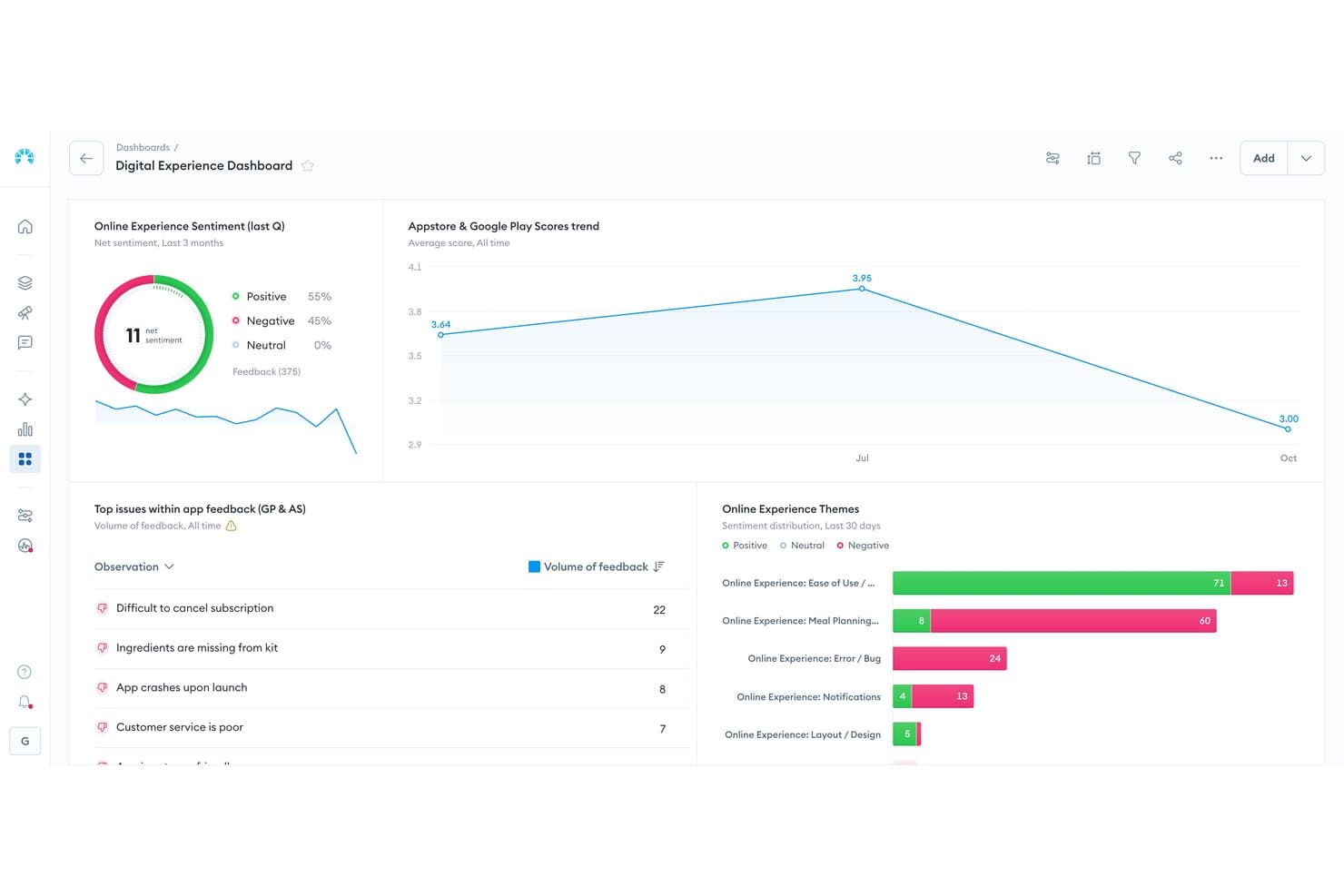
Chattermill tracks sentiment trends and app feedback themes in one dashboard. Chattermill is an AI-native voice of customer platform that unifies feedback from surveys, reviews, support tickets, call transcripts, and social media to deliver aspect-based sentiment analysis, theme detection, and CX impact reporting.
Who Is Chattermill Best For?
Chattermill fits enterprise CX and VoC teams that need to unify feedback from dozens of sources and connect customer sentiment directly to NPS, CSAT, and retention outcomes.
Why I Picked Chattermill
I've included Chattermill in my top picks because of how it feeds live customer sentiment directly into AI agents via its MCP server. While most sentiment tools stop at the dashboard, Chattermill connects its aspect-based sentiment analysis and ranked Precision Insights to agents like Claude, ChatGPT, and Notion AI, so those agents can act on real customer signals. I also like that Impact Analysis ties specific themes to NPS and CSAT shifts, giving you quantified evidence rather than vague sentiment scores.
Chattermill Key Features
- Multi-source feedback ingestion: Connects 65+ native integrations spanning surveys, support tickets, call transcripts, reviews, and social media into a single unified data model.
- Anomaly detection and alerting: Monitors feedback channels for significant deviations from baseline sentiment or volume, then routes alerts to Slack or email.
- Scheduled insight delivery: Automates report and insight sharing on a daily, weekly, or monthly cadence, with filtering by theme, metric, or data source.
- Role-based dashboard sharing: Controls access to reports and dashboards through user roles and data permissions, with read-only external sharing for stakeholders without a Chattermill account.
Chattermill Integrations
Chattermill has 65+ native integrations, including Zendesk, Intercom, Qualtrics, Medallia, Salesforce, SurveyMonkey, Trustpilot, Aircall, Talkdesk, and Slack. It also supports API connections for custom sources, plus CSV uploads and S3-based ingestion.
Pros and Cons
Pros:
- AI agent answers cite feedback and quotes
- Impact analysis ties themes to NPS shifts
- Aspect sentiment links themes to customer tone
Cons:
- Dashboard filters and reports frustrate some reviewers
- Sentiment tagging can misread some feedback
Learn more about Chattermill: Best for customer support workflows
- Free demo available
- From $45/month (billed annually)
Visit WebsiteCustomer Rating:4.5/5
TeamSupport interface displaying customer support features and platform navigation. When it comes to understanding the emotional pulse of your customer interactions, TeamSupport offers AI-driven sentiment analysis that could be the solution your team needs. Tailored for businesses that prioritize customer service excellence, it provides insights into customer emotions, helping support teams respond more effectively. This tool is perfect for industries where understanding customer sentiment is crucial, such as retail or tech support, as it addresses the challenge of gauging customer satisfaction in real-time.
Why I Picked TeamSupport
I picked TeamSupport for its ability to seamlessly integrate sentiment analysis into customer support workflows. With features like real-time sentiment monitoring, your team can quickly assess the emotional tone of interactions and make informed decisions on the spot. The tool also offers automated chat summarization, providing quick updates that help resolve ongoing issues faster. These capabilities are essential for teams looking to enhance customer satisfaction and response times.
TeamSupport Key Features
In addition to its standout real-time sentiment monitoring, TeamSupport provides other valuable features to enhance your team's efficiency:
- Automated Chat Summarization: This feature generates concise summaries of customer interactions, helping agents quickly understand ongoing issues.
- Improvement Recommendations: Analyzes ticket actions to offer suggestions on enhancing future customer support, improving both team performance and customer satisfaction.
- Suggested Solutions: Provides relevant solutions based on past interactions, allowing agents to address common issues more effectively.
- Intuitive Dashboard: Consolidates customer insights and workflows into a single, easy-to-navigate platform, streamlining the support process.
TeamSupport Integrations
Integrations include Salesforce, Microsoft Dynamics, Zendesk, Slack, Jira, HubSpot, Freshdesk, Zoho CRM, Google Analytics, and Mailchimp.
Pros and Cons
Pros:
- Customizable customer self service hub
- Real time sentiment insights
- AI powered ticket automation
Cons:
- Limited mobile app functionality
- Knowledge base lacks configurability
Learn more about TeamSupport: Best for real-time feedback
- Free plan available
- From $19.99/month (billed annually)
Visit WebsiteCustomer Rating:4.6/5
Qualaroo gathers real-time customer feedback to improve user experience. Qualaroo is a real-time feedback tool primarily used by businesses to gather customer insights and improve user experience. It helps teams analyze customer sentiment and make informed decisions based on real-time data.
Why I picked Qualaroo: It stands out by integrating AI sentiment analysis with IBM Watson, allowing your team to automatically gauge emotional responses in user feedback. Features like question branching and advanced targeting ensure you get precise insights. Real-time feedback capabilities make it ideal for businesses wanting immediate customer insights. In my experience, these features directly support the tool's focus on enhancing real-time feedback.
Standout features & integrations:
Features include AI-driven sentiment analysis, question branching for targeted surveys, and advanced user targeting to reach specific audiences. The tool also offers mobile in-app nudges to capture feedback directly within apps. A/B testing is available to compare different survey approaches.
Integrations include HubSpot, Salesforce, Marketo, Slack, Zapier, Google Analytics, WordPress, Shopify, Segment, and Mailchimp.
Pros and Cons
Pros:
- In-app survey capabilities
- Advanced targeting options
- Real-time feedback collection
Cons:
- Requires learning curve for advanced features
- Limited offline capabilities
Learn more about Qualaroo: Best for document classification
- Free demo available
- Pricing upon request
Visit WebsiteCustomer Rating:4.2/5
OpenText automates document classification for efficient enterprise data management. OpenText offers a sentiment analysis tool that specializes in intelligent document classification, catering mainly to large enterprises needing to manage vast amounts of unstructured data. Its primary function is to automate the classification and organization of documents, making it easier for your team to access and process information efficiently.
Why I picked OpenText: It focuses on document classification, using AI and text analysis to categorize documents efficiently. With strong analysis capabilities, it ensures each piece of text is properly classified for compliance and organization.
Standout features & integrations:
Features include metadata extraction that helps your team capture and organize important document details. Content-based classification ensures documents are categorized based on their content, improving retrieval accuracy. The tool also offers automated document tagging, which simplifies the organization of large volumes of information.
Integrations include Microsoft Office, SAP, Salesforce, Oracle, IBM, Google Workspace, Box, Dropbox, Amazon Web Services, and Microsoft SharePoint.
Pros and Cons
Pros:
- Improves document retrieval accuracy
- Handles large data volumes
- Supports regulatory compliance
Cons:
- High learning curve for new users
- Requires ongoing management
Learn more about OpenText: 5Best for conversational AI
Yogi
- Free demo available
- Pricing upon request
Visit WebsiteCustomer Rating:4.6/5
Yogi enhances customer interactions with AI-driven natural language processing. Yogi is a conversational AI tool designed to assist businesses in enhancing customer interactions through natural language processing. Its primary users are customer service teams and businesses looking to improve their customer engagement strategies.
Why I picked Yogi: It offers unique conversational AI capabilities, allowing your team to automate and personalize customer interactions. The tool's natural language processing helps understand and respond to customer queries effectively. Real-time analytics provide insights into customer interactions, supporting strategic improvements. In my experience, these features make it ideal for businesses focusing on conversational engagement.
Standout features & integrations:
Features include real-time analytics that offer insights into customer interactions, helping your team make informed decisions. The tool's natural language processing capabilities enhance the quality of automated responses. Additionally, its customization options allow you to tailor interactions to fit specific business needs.
Integrations include Slack, Microsoft Teams, Salesforce, Zendesk, HubSpot, Google Workspace, Zoom, Intercom, Asana, and Trello.
Pros and Cons
Pros:
- Supports strategic engagement improvements
- Customization options available
- Effective natural language processing
Cons:
- Limited to conversational AI use
- Requires ongoing management
Learn more about Yogi:

Pangeanic’s NLP ECO platform supports AI sentiment analysis with in-domain MT, anonymization, and summarization for accurate and secure insights. Pangeanic provides a customizable AI sentiment analysis tool aimed at businesses needing to extract opinions from diverse text sources like social media and reviews. Its main users are companies focused on understanding customer sentiment across multiple languages.
Why I picked Pangeanic: It offers a hybrid approach, combining lexicon-based methods with machine learning to analyze sentiment effectively. The tool's API allows for immediate analysis, which is helpful for real-time needs. Batch processing capabilities make it suitable for handling large datasets efficiently. In my experience, these features align with its strength in multilingual analysis.
Standout features & integrations:
Features include emotion detection to understand specific feelings expressed in text. Batch processing helps your team handle large volumes of data quickly. The API integration allows for seamless real-time analysis, aiding in timely decision-making.
Integrations include connections with popular platforms such as Twitter, Facebook, LinkedIn, Instagram, YouTube, Reddit, and Tumblr.
Pros and Cons
Pros:
- Efficient batch processing
- Adaptable to different languages
- High accuracy in sentiment detection
Cons:
- Context sensitivity challenges
- Complexity in sentiment analysis
Learn more about Pangeanic:

Diabolocom analyzes call center interactions to enhance customer service quality. Diabolocom is a sentiment analysis tool tailored for call centers, helping businesses analyze customer interactions to improve service quality. Its primary users are call center managers and teams who need to assess customer sentiment in real time.
Why I picked Diabolocom: It focuses on call centers, offering features like real-time sentiment analysis during calls to enhance customer interactions. Automated call categorization helps your team manage and prioritize calls efficiently. The tool also provides detailed call analytics, which supports performance evaluation and training. In my experience, these features are essential for optimizing call center operations.
Standout features & integrations:
Features include real-time call monitoring to ensure quality and compliance. Automated call categorization streamlines the management of high volumes of calls. The tool offers comprehensive call analytics, providing insights into team performance and customer satisfaction.
Integrations include Salesforce, Microsoft Dynamics, Zendesk, ServiceNow, Oracle, SAP, SugarCRM, Freshdesk, Zoho CRM, and HubSpot.
Pros and Cons
Pros:
- Enhances customer interaction
- Supports performance evaluation
- Automated call categorization
Cons:
- Limited to call center use
- Complexity in setup with steep learning curve
Learn more about Diabolocom:

AGAT Software offers AI-driven compliance and security for unified communications. AGAT Software provides an AI sentiment analysis tool designed for enhancing compliance, security, and productivity in unified communications. Its main users are organizations utilizing platforms like Teams, Skype, Webex, Zoom, Slack, and SharePoint, focusing on real-time data loss prevention and compliance analysis.
Why I picked AGAT Software: It excels in meeting compliance needs with features like real-time data loss prevention (DLP) and ethical wall management. Advanced search capabilities allow your team to retrieve archived data. The tool supports real-time content inspection, ensuring communications meet compliance standards. In my experience, these features are crucial for organizations prioritizing security and compliance.
Standout features & integrations:
Features include flexible communication policies that help your team manage data flow effectively. Real-time content inspection ensures that all communications adhere to compliance guidelines. Advanced search capabilities make it easy to find archived communications quickly.
Integrations include Microsoft Teams, Cisco Webex, Zoom, Slack, and SharePoint.
Pros and Cons
Pros:
- Supports multiple communication platforms
- Advanced search functionality
- Real-time data protection
Cons:
- Not ideal for small teams
- Complexity in initial setup with high learning curve for new users
Learn more about AGAT Software:

Permutable AI offers AI-driven sentiment analysis for ESG data insights. Permutable AI provides an AI-driven sentiment analysis tool tailored for organizations focusing on environmental, social, and governance (ESG) insights. Its main users are companies and analysts looking to understand and manage ESG-related data effectively.
Why I picked Permutable AI: It offers specialized ESG insights, helping your team track and analyze sustainability data. The tool's machine learning capabilities allow for detailed sentiment analysis across various sources. Real-time monitoring of ESG data supports timely decision-making. In my experience, these features make it ideal for organizations prioritizing ESG factors.
Standout features & integrations:
Features include real-time monitoring of ESG metrics to keep your team informed about sustainability trends. Machine learning models provide detailed sentiment analysis for more accurate insights. The tool also offers customizable dashboards, allowing you to tailor data views to your specific needs.
Integrations include the popular charting library TradingView, allowing for full system integration and enterprise data pipelines.
Pros and Cons
Pros:
- Suitable for sustainability-focused teams
- Detailed sentiment analysis
- Strong focus on ESG insights
Cons:
- Complexity in setting up dashboards
- Requires customization for best results
Learn more about Permutable AI:

RightResponse AI analyzes customer sentiment to improve satisfaction and decisions. RightResponse AI is a sentiment analysis tool designed for businesses focused on understanding and reacting to customer feedback. Its main users include customer support teams and business analysts who leverage it to enhance customer satisfaction and strategic decision-making.
Why I picked RightResponse AI: It excels in review analysis, offering features like the Intelligent Review Responder that personalizes responses using AI. The Review Analytics feature helps your team understand customer preferences by analyzing feedback from over 100 platforms. The Google Maps Rank Tracker is useful for monitoring business rankings, making it a valuable tool for location-based insights. In my experience, these features align well with its focus on review analysis.
Standout features & integrations:
Features include competitor review analytics, which provide insights into competitors' customer feedback. The review requestor automates personalized review requests to enhance engagement. Additionally, machine learning aspect-based sentiment analysis categorizes and analyzes reviews effectively.
Integrations include Google My Business, Yelp, TripAdvisor, Facebook, Trustpilot, Amazon, Booking.com, Expedia, OpenTable, and Zomato.
Pros and Cons
Pros:
- Effective trend identification
- Personalized review responses
- Detailed competitor insights
Cons:
- Some features need manual input
- Not suitable for small businesses
- Complexity in feature navigation
- Requires initial setup time
- Limited language support
Learn more about RightResponse AI:
Outras ferramentas de análise de sentimentos por IA
Eis algumas opções adicionais de ferramentas de análise de sentimentos por IA que não chegaram à minha lista restrita, mas que ainda vale a pena conhecer:
- 11ClientZenBest for customer feedback
- 12Comments AnalyticsBest for comment analysis
- 13HiverBest for AI-driven customer insights
- 14Brand24Best for social media monitoring
- 15UserlyticsBest for remote usability testing
- 16Lumen by TalkwalkerBest for brand monitoring
- 17SprigBest for user experience feedback
- 18ConvinBest for sales team insights
- 19SentiSumBest for support ticket analysis
- 20MeetingPulseBest for live audience feedback
How I Evaluate AI Sentiment Analysis Tools
Every tool here has to go beyond keyword-matching and basic polarity—I look for AI that actually surfaces why customers feel the way they do, not just whether feedback skews positive or negative. I split my evaluation into core functionality every tool must meet to make the list and differentiating factors that separate one option from another.
Core Functionality (Table Stakes For This List)
When I'm selecting tools for my list, I rank each one on a scale from 0 (does not offer the functionality) to 5 (excels in this area) for each core functionality listed below. Then, I calculate the tool's total score into a percentage. Each tool needs to achieve a minimum total score of 65% to be considered for inclusion.
- AI-Powered Sentiment Classification: I evaluate whether the tool goes beyond simple polarity tagging—it should detect emotion, intensity, or context like sarcasm in open-ended survey responses.
- Multi-Channel Feedback Ingestion: Tools should pull from the channels CX teams actually use, like support tickets, live chat transcripts, app reviews, and social mentions.
- Topic & Theme Detection: I look for automatic topic clustering tied to sentiment, so you can see that "billing" drove negative scores last month without building manual tags.
- Real-Time Analysis & Alerts: The tool should flag emerging sentiment shifts as they happen, such as alerting a support lead when negative chat sentiment spikes during a product launch.
- CX Reporting & Dashboards: I check for dashboards that connect sentiment data to CX metrics like CSAT or NPS trends, with drill-down views useful for both analysts and executives.
- CX Stack Integrations: The platform should connect natively with the tools CX teams already rely on, such as Zendesk, Salesforce, Intercom, or survey platforms like Qualtrics.
Once I have a list of tools that meet the criteria, I consider what sets each platform apart.
Differentiating Factors (What Sets Vendors Apart)
Here's how I compare and contrast different vendors:
Standout Features
Generative AI summarization is a big differentiator—I look for tools that can turn thousands of open-ended responses into an actionable narrative a CX leader can share in a stakeholder meeting. Predictive churn signals also stand out, especially for customer success teams who want to flag at-risk accounts before renewal conversations. For global CX operations, multilingual sentiment accuracy matters because poor translation layers produce misleading scores. I also evaluate custom model training for teams with specialized terminology.
Beyond Features
Model transparency matters—I check whether a tool lets you see why a specific ticket or review was scored the way it was, so your team can trust and act on the data. Data security is another factor I weigh, particularly whether the vendor is clear about not using your customer feedback to train shared AI models. I also evaluate time-to-value: tools with prebuilt CX taxonomies and guided onboarding get teams to usable insights in days, while others can take months of configuration before they're reliable.
Como escolher uma ferramenta de análise de sentimentos por IA
É fácil perder-se em listas extensas de funcionalidades e estruturas de preços complexas. Para o ajudar a manter o foco enquanto analisa o seu processo específico de seleção de software, eis uma lista de verificação dos fatores a ter em conta:
| Fator | O que considerar |
| Escalabilidade | Certifique-se de que a ferramenta consegue acompanhar o crescimento da sua equipa e lidar com volumes de dados crescentes. Procure opções que disponibilizem planos de preços escaláveis e suporte para grandes conjuntos de dados. |
| Integrações | Verifique se a ferramenta se integra com as plataformas que já utiliza, como ferramentas de CRM ou redes sociais. Uma integração sem interrupções garante um fluxo de dados harmonioso e informações mais úteis. |
| Personalização | Verifique se a ferramenta permite adaptar painéis de controlo e relatórios às suas necessidades e preferências específicas. |
| Facilidade de utilização | Procure uma interface intuitiva que exija o mínimo de formação para a sua equipa. Um design fácil de utilizar pode aumentar a adoção e a eficiência. |
| Orçamento | Avalie se os preços estão alinhados com o seu orçamento. Considere as funcionalidades incluídas e se o custo justifica o valor que acrescentam às suas operações. |
| Medidas de segurança | Certifique-se de que a ferramenta cumpre os regulamentos de proteção de dados e disponibiliza funcionalidades de segurança robustas para proteger informações sensíveis. |
| Suporte | Analise o nível de suporte ao cliente disponível, incluindo os tempos de resposta e o acesso a recursos como tutoriais e perguntas frequentes. |
| Análise em tempo real | Determine se a ferramenta disponibiliza informações em tempo real, essenciais para tomar decisões atempadas e responder ao feedback dos clientes. |
Tendências nas ferramentas de análise de sentimentos por IA
Durante a minha investigação, recolhi inúmeras atualizações de produtos, comunicados de imprensa e registos de lançamentos de diferentes fornecedores de ferramentas de análise de sentimentos por IA. Eis algumas das tendências emergentes que estou a acompanhar:
- Deteção de emoções: As ferramentas estão agora a ir além do simples sentimento positivo ou negativo para detetar emoções específicas, como alegria, raiva e tristeza. Isto acrescenta profundidade à análise, ajudando as empresas a compreender os sentimentos dos clientes com maior precisão. Fornecedores como a Pangeanic incorporaram a deteção de emoções nas suas ofertas.
- Suporte multilingue: À medida que os mercados globais se expandem, as ferramentas de análise de sentimentos suportam cada vez mais vários idiomas. Esta tendência ajuda as empresas a compreender o sentimento dos clientes em diferentes regiões, sem barreiras linguísticas. Muitas ferramentas oferecem agora esta funcionalidade como padrão.
- Análise contextual: Compreender o contexto de um sentimento está a tornar-se fundamental. As ferramentas estão a concentrar-se na análise do contexto em que as palavras são utilizadas, de modo a fornecer pontuações de sentimentos mais precisas. Isto é particularmente útil em setores onde as nuances linguísticas são importantes.
- Análise visual de sentimentos: A análise de imagens e vídeos para identificar sentimentos está a ganhar força. Esta tendência permite às empresas obter informações a partir de conteúdos visuais partilhados nas plataformas de redes sociais. Alguns fornecedores estão a começar a disponibilizar esta funcionalidade para responder à procura de análise de dados visuais.
- Informações em tempo real: As empresas querem agir com base nos dados de sentimentos à medida que estes são gerados. As ferramentas que oferecem análise de sentimentos em tempo real estão a tornar-se mais populares, permitindo às empresas responder rapidamente ao feedback dos clientes e às tendências. Esta tendência é crucial para as marcas que pretendem manter-se na vanguarda em mercados dinâmicos.
O que é uma ferramenta de análise de sentimentos com IA?
Uma ferramenta de análise de sentimentos com IA utiliza o processamento de linguagem natural e a análise de texto para detetar emoções e intenções no feedback dos clientes. Ajuda as equipas a interpretar opiniões em avaliações, conversas e redes sociais, de modo a identificar tendências, melhorar a satisfação e tomar decisões de CX mais rápidas e baseadas em dados.
Funcionalidades das ferramentas de análise de sentimentos com IA
Ao selecionar uma ferramenta de análise de sentimentos com IA, tenha em atenção as seguintes funcionalidades principais:
- Deteção de emoções: Identifica emoções específicas, como alegria ou raiva, fornecendo informações mais aprofundadas sobre os sentimentos dos clientes.
- Suporte multilingue: Analisa sentimentos em vários idiomas, sendo útil para empresas com uma audiência global.
- Informações em tempo real: Disponibiliza uma análise imediata de sentimentos, permitindo responder rapidamente ao feedback dos clientes.
- Análise contextual: Compreende o contexto em que as palavras são utilizadas, conduzindo a pontuações de sentimentos mais precisas.
- Análise visual de sentimentos: Analisa imagens e vídeos para identificar sentimentos, expandindo as informações para além dos dados textuais.
- Painéis de controlo personalizáveis: Permite aos utilizadores adaptar as visualizações de dados às necessidades específicas da empresa.
- Análise avançada de tendências: Deteta tópicos e tendências emergentes, ajudando as empresas a manterem-se na vanguarda dos seus mercados.
- Acesso à API para integração: Permite uma integração contínua com os sistemas existentes, simplificando o fluxo de dados.
- Geração automatizada de relatórios: Fornece relatórios atempados, poupando tempo e esforço aos utilizadores na análise de dados.
- Pontuação de sentimentos: Categoriza o texto como positivo, negativo ou neutro, facilitando uma avaliação rápida.
Benefícios das ferramentas de análise de sentimentos com IA
A implementação de uma ferramenta de análise de sentimentos com IA proporciona vários benefícios à sua equipa e à sua empresa. Eis alguns dos benefícios que pode esperar:
- Melhor compreensão dos clientes: A deteção de emoções e a pontuação de sentimentos ajudam-no a compreender com maior precisão as emoções e opiniões dos clientes.
- Tomada de decisões mais rápida: As informações em tempo real permitem à sua equipa responder rapidamente ao feedback dos clientes e às tendências.
- Alcance global: O suporte multilingue permite analisar diferentes idiomas, ampliando a compreensão global da sua empresa.
- Reputação da marca reforçada: A análise de tendências e as informações contextuais ajudam-no a gerir e proteger eficazmente a imagem da sua marca.
- Gestão eficiente de dados: A geração automatizada de relatórios poupa tempo, permitindo à sua equipa concentrar-se em ações estratégicas.
- Informações personalizadas: Os painéis de controlo personalizáveis permitem-lhe concentrar-se nas métricas mais relevantes para os objetivos da sua empresa.
- Informações visuais: A análise visual de sentimentos amplia a sua compreensão ao incluir imagens e vídeos, e não apenas texto.
Custos e preços das ferramentas de análise de sentimentos com IA
A seleção de uma ferramenta de análise de sentimentos com IA exige uma compreensão dos vários modelos de preços e planos disponíveis. Os custos variam consoante as funcionalidades, o tamanho da equipa, os complementos, entre outros fatores. A tabela abaixo resume os planos mais comuns, os seus preços médios e as funcionalidades normalmente incluídas nas soluções de ferramentas de análise de sentimentos com IA:
Tabela de comparação de planos para ferramentas de análise de sentimentos com IA
| Tipo de plano | Preço médio | Funcionalidades comuns |
| Plano gratuito | $0 | Análise básica de sentimentos, processamento limitado de dados e suporte mínimo. |
| Plano pessoal | $10-$50/ utilizador/mês | Avaliação de sentimentos, deteção de emoções, suporte multilingue e relatórios básicos. |
| Plano empresarial | $50-$100/ utilizador/mês | Informações em tempo real, análise avançada de tendências, painéis personalizáveis e acesso à API. |
| Plano para empresas | $100-$300/utilizador/mês | Integração abrangente de dados, análise visual de sentimentos, suporte dedicado e personalização completa. |
Uma análise dos tipos de planos, custos e funcionalidades das ferramentas de análise de sentimentos com IA
Perguntas frequentes sobre ferramentas de análise de sentimentos com IA
Eis algumas respostas a perguntas comuns sobre ferramentas de análise de sentimentos com IA:
Como é utilizada a IA na análise de sentimentos?
Uma ferramenta de análise de sentimentos com IA utiliza o processamento de linguagem natural e a análise de texto para detetar emoções e intenções no feedback dos clientes. Ajuda as equipas a interpretar opiniões em avaliações, conversas e redes sociais, de modo a identificar tendências, melhorar a satisfação e tomar decisões de CX mais rápidas e baseadas em dados.A IA na análise de sentimentos é utilizada para processar e analisar o feedback dos clientes proveniente de várias fontes, como redes sociais e avaliações. Ajuda as empresas a compreender as emoções e os sentimentos dos clientes, permitindo-lhes melhorar os serviços e responder às reclamações de forma mais eficaz. A IA pode identificar padrões e tendências nos dados de sentimentos, fornecendo informações valiosas.
A análise de sentimentos é supervisionada ou não supervisionada?
A análise de sentimentos pode ser supervisionada e não supervisionada. Na análise de sentimentos supervisionada, os algoritmos são treinados com dados etiquetados para reconhecer padrões de sentimentos. A análise de sentimentos não supervisionada não utiliza dados etiquetados e baseia-se em técnicas como a criação de agrupamentos para identificar sentimentos. As empresas podem escolher qualquer uma das abordagens com base nos seus dados e necessidades de análise.
Como funcionam as ferramentas de análise de sentimentos?
As ferramentas de análise de sentimentos funcionam atribuindo pontuações de sentimento às palavras com base num léxico. O software analisa os dados de texto à procura dessas palavras e calcula uma pontuação de sentimento para determinar se o texto é positivo, negativo ou neutro. Este processo ajuda as empresas a avaliar rapidamente os sentimentos dos clientes a partir de grandes conjuntos de dados.
Qual é a precisão do modelo de análise de sentimentos?
A precisão dos modelos de análise de sentimentos varia, mas muitos procuram igualar ou superar os níveis de precisão humana de 80-85%. A precisão depende de fatores como a qualidade dos dados de treino e a complexidade da linguagem utilizada. O treino e as atualizações contínuos do modelo podem melhorar a precisão ao longo do tempo.
A análise de sentimentos consegue detetar sarcasmo?
Detetar sarcasmo na análise de sentimentos é um desafio, porque o sarcasmo envolve frequentemente contexto e tom, que são difíceis de interpretar pelos algoritmos. Alguns modelos avançados tentam detetar sarcasmo através da análise de padrões e contexto, mas a precisão pode continuar a ser limitada.
Quais são as limitações das ferramentas de análise de sentimentos?
As ferramentas de análise de sentimentos podem ter dificuldades com nuances como o sarcasmo, o contexto e as diferenças culturais. Podem também exigir grandes conjuntos de dados para alcançar precisão e estar limitadas pela qualidade dos léxicos utilizados. Compreender estas limitações ajuda a definir expectativas realistas relativamente aos resultados da análise.
O que se segue?
Subscreva a nossa newsletter para receber as informações mais recentes sobre CX, guias práticos, estratégias e recursos dos principais especialistas na área de CX.