

En iyi yapay zekâ duygu analizi araçları CX, pazarlama ve ürün ekiplerinin müşterilerin yalnızca ne söylediğini değil, nasıl hissettiğini de anlamasına yardımcı olur. Bu araçlar; yorumları, destek taleplerini ve görüşmeleri, duygu değişimlerini ortaya çıkaran, sorunlu noktaları belirleyen ve müşteri yolculuğu boyunca daha akıllı kararlar alınmasını sağlayan yapılandırılmış içgörülere dönüştürür.
Teknoloji ve yapay zekâ inovasyonunun kesişiminde liderlik yaparken edindiğim deneyimi kullanarak düzinelerce yapay zekâ duygu analizi platformunu test edip inceledim. Her araç kullanım kolaylığı, doğruluk, entegrasyonlar, raporlama kapsamı ve gerçek dünyadaki işletme değeri açısından değerlendirildi. Bu rehberde en başarılı araçları, onları öne çıkaran özellikleri ve veri kaynaklarınız, ekip büyüklüğünüz ve hedefleriniz için doğru seçimi nasıl yapacağınızı açıklıyorum.
Why Trust Our Software Recommendations
6,700+
Reviews
20
Industry experts
16+
Evaluation factors
14
Years
Our team has been testing and reviewing software since 2012. As CX leaders ourselves, we know how difficult—and important—it is to choose the right software.
For this guide, we evaluated tools using hands-on testing and independent research, scoring tools using our selection criteria.
Our reviews reflect our human editorial judgment, not a sales pitch.
 Gui DrusinaCreative Director
 Tim FisherVP of AI
Yapay Zekâ Duygu Analizi Araçları Karşılaştırma Tablosu
Bu karşılaştırma tablosu, en iyi yapay zekâ duygu analizi aracı seçimlerimin fiyatlandırma ayrıntılarını özetler:
Sorted by: Default
| Tool | Starting Price | Website | |
|---|---|---|---|
Best for using CX insights in AI agents | 4.4 out of 5 | Pricing upon request Free demo available | Website |
Best with AI-powered agent coaching and simulation | 5.0 out of 5 | Pricing upon request Free demo available | Website |
Best for adaptive feedback taxonomy | 4.8 out of 5 | Pricing upon request Free demo available | Website |
Best for customer support workflows | 4.5 out of 5 | $45/month Free demo available | Book Demo |
Best for VoC programs without per-seat limits | 4.8 out of 5 | $2,000/month 30-day free trial | Book Demo |
Best for real-time feedback | 4.6 out of 5 | $19.99/month Free plan available | Website |
Best for document classification | 4.2 out of 5 | Pricing upon request Free demo available | Website |
Best for conversational AI | 4.6 out of 5 | Pricing upon request Free demo available | Website |
Best for multilingual analysis | Not rated | Pricing upon request Free trial available | Website |
Best for call centers | Not rated | Pricing upon request Free demo available | Website |


En İyi Yapay Zekâ Duygu Analizi Araçları İncelemeleri
Aşağıda kısa listeme giren en iyi yapay zekâ duygu analizi araçlarının ayrıntılı özetlerini bulabilirsiniz. İncelemelerim, sizin için en iyi aracı bulmanıza yardımcı olmak amacıyla her aracın temel özelliklerine, artılarına ve eksilerine, entegrasyonlarına ve ideal kullanım alanlarına yakından bakar.
 Best for using CX insights in AI agents
- Free demo available
- Pricing upon request
Visit WebsiteCustomer Rating:4.4/5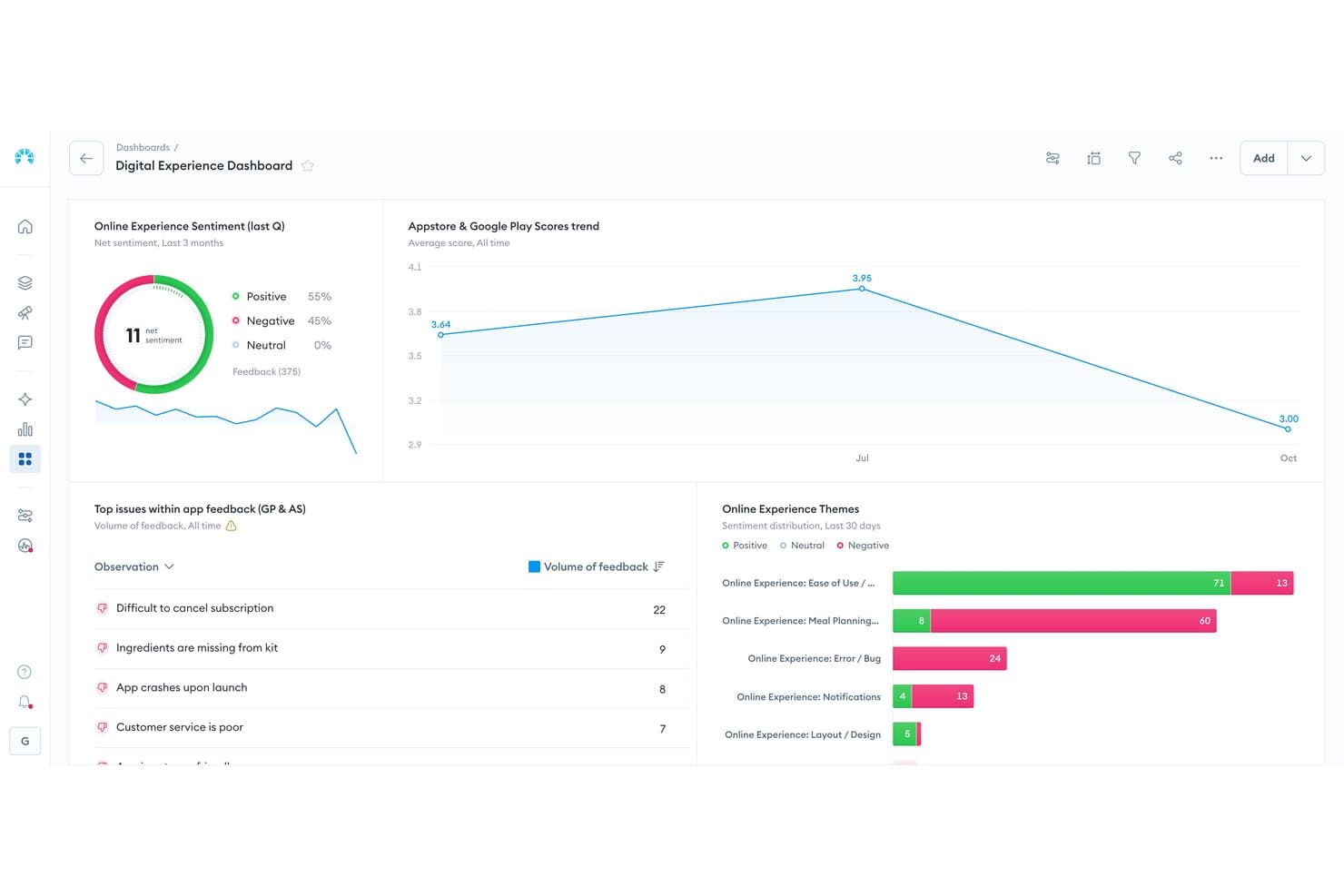
Chattermill tracks sentiment trends and app feedback themes in one dashboard. Chattermill is an AI-native voice of customer platform that unifies feedback from surveys, reviews, support tickets, call transcripts, and social media to deliver aspect-based sentiment analysis, theme detection, and CX impact reporting.
Who Is Chattermill Best For?
Chattermill fits enterprise CX and VoC teams that need to unify feedback from dozens of sources and connect customer sentiment directly to NPS, CSAT, and retention outcomes.
Why I Picked Chattermill
I've included Chattermill in my top picks because of how it feeds live customer sentiment directly into AI agents via its MCP server. While most sentiment tools stop at the dashboard, Chattermill connects its aspect-based sentiment analysis and ranked Precision Insights to agents like Claude, ChatGPT, and Notion AI, so those agents can act on real customer signals. I also like that Impact Analysis ties specific themes to NPS and CSAT shifts, giving you quantified evidence rather than vague sentiment scores.
Chattermill Key Features
- Multi-source feedback ingestion: Connects 65+ native integrations spanning surveys, support tickets, call transcripts, reviews, and social media into a single unified data model.
- Anomaly detection and alerting: Monitors feedback channels for significant deviations from baseline sentiment or volume, then routes alerts to Slack or email.
- Scheduled insight delivery: Automates report and insight sharing on a daily, weekly, or monthly cadence, with filtering by theme, metric, or data source.
- Role-based dashboard sharing: Controls access to reports and dashboards through user roles and data permissions, with read-only external sharing for stakeholders without a Chattermill account.
Chattermill Integrations
Chattermill has 65+ native integrations, including Zendesk, Intercom, Qualtrics, Medallia, Salesforce, SurveyMonkey, Trustpilot, Aircall, Talkdesk, and Slack. It also supports API connections for custom sources, plus CSV uploads and S3-based ingestion.
Pros and Cons
Pros:
- AI agent answers cite feedback and quotes
- Impact analysis ties themes to NPS shifts
- Aspect sentiment links themes to customer tone
Cons:
- Dashboard filters and reports frustrate some reviewers
- Sentiment tagging can misread some feedback
Learn more about Chattermill: Best with AI-powered agent coaching and simulation
- Free demo available
- Pricing upon request
Visit WebsiteCustomer Rating:5/5
Cresta offers an AI Analyst tool that uncovers customer sentiment insights—such as reasons for ProPlus package dissatisfaction—from conversation data in minutes. Cresta is an AI-driven customer sentiment analysis software that offers real-time conversation intelligence, advanced sentiment detection, and live agent guidance for customer support and sales teams.
Who Is Cresta Best For?
Cresta suits midsize and enterprise customer service teams in industries like telecom, retail, or finance that need scalable agent coaching and deep conversational insights.
Why I Picked Cresta
I picked Cresta as one of the best because I rely on its AI-powered agent coaching and simulation to deliver live feedback, train new hires with realistic customer scenarios, and surface nuanced sentiment trends in real time.
Cresta Key Features
- Real-time sentiment analysis: Tracks customer mood shifts during every interaction and visualizes sentiment trends.
- Automatic conversation transcription: Captures and transcribes calls and chats for later review or compliance.
- Conversation intelligence dashboard: Aggregates metrics and insights from customer interactions in an interactive interface.
- CRM integration: Connects with Salesforce and other major CRM systems to sync conversation data.
Cresta Integrations
Cresta offers native integrations with Salesforce, Twilio, and Amazon Connect, and provides an API for custom integrations.
Pros and Cons
Pros:
- Simulated training scenarios for quick onboarding
- Advanced sentiment analysis with emotion detection
- Real-time AI coaching during live conversations
Cons:
- Advanced setup is best for large teams
- Sentiment scoring requires ongoing fine tuning
Learn more about Cresta: Best for adaptive feedback taxonomy
- Free demo available
- Pricing upon request
Visit WebsiteCustomer Rating:4.8/5
Enterpret offers AI-powered churn analysis and escalation alert workflows that surface customer sentiment insights and automate responses across support channels. Enterpret is an AI-powered customer feedback intelligence platform that aggregates signals from support tickets, surveys, reviews, social, and sales calls, then automatically classifies and analyzes them using adaptive taxonomy and machine learning.
Who Is Enterpret Best For?
Enterpret is a strong fit for mid-market and enterprise B2B SaaS teams that receive high volumes of customer feedback and need VoC insights without relying on analysts.
Why I Picked Enterpret
I picked Enterpret as one of the best because its Adaptive Taxonomy doesn't stay fixed after setup. It evolves as customer language and product areas change, so sentiment categories stay accurate without manual reclassification. I also like how the Context Graph ties every signal to segments, LTV, and business outcomes like churn or expansion, making it easy to see what's actually driving sentiment shifts at any given time.
Enterpret Key Features
- Multichannel feedback ingestion: Aggregate support tickets, surveys, reviews, social conversations, and call transcripts into one unified view.
- Natural language query engine: Ask questions in plain English to surface insights across all feedback.
- Role-based dashboards: Visualize sentiment trends and topics by segment, product area, or customer lifecycle stage.
- Automated workflow integrations: Trigger Slack alerts, Jira issues, or Salesforce tasks based on real-time sentiment changes.
Enterpret Integrations
Enterpret offers native integrations with Zendesk, Intercom, Salesforce, Gong, Slack, Qualtrics, Linear, Jira, Google Play Store, and the Apple App Store. An API is available for custom integrations.
Pros and Cons
Pros:
- Context Graph links sentiment to churn signals
- Granular theme detection across unstructured feedback
- Adaptive taxonomy evolves without manual reclassification
Cons:
- Reporting flexibility limited compared to dedicated BI tools
- Initial configuration requires significant time investment
Learn more about Enterpret: Best for customer support workflows
- Free demo available
- From $45/month (billed annually)
Visit WebsiteCustomer Rating:4.5/5
TeamSupport interface displaying customer support features and platform navigation. When it comes to understanding the emotional pulse of your customer interactions, TeamSupport offers AI-driven sentiment analysis that could be the solution your team needs. Tailored for businesses that prioritize customer service excellence, it provides insights into customer emotions, helping support teams respond more effectively. This tool is perfect for industries where understanding customer sentiment is crucial, such as retail or tech support, as it addresses the challenge of gauging customer satisfaction in real-time.
Why I Picked TeamSupport
I picked TeamSupport for its ability to seamlessly integrate sentiment analysis into customer support workflows. With features like real-time sentiment monitoring, your team can quickly assess the emotional tone of interactions and make informed decisions on the spot. The tool also offers automated chat summarization, providing quick updates that help resolve ongoing issues faster. These capabilities are essential for teams looking to enhance customer satisfaction and response times.
TeamSupport Key Features
In addition to its standout real-time sentiment monitoring, TeamSupport provides other valuable features to enhance your team's efficiency:
- Automated Chat Summarization: This feature generates concise summaries of customer interactions, helping agents quickly understand ongoing issues.
- Improvement Recommendations: Analyzes ticket actions to offer suggestions on enhancing future customer support, improving both team performance and customer satisfaction.
- Suggested Solutions: Provides relevant solutions based on past interactions, allowing agents to address common issues more effectively.
- Intuitive Dashboard: Consolidates customer insights and workflows into a single, easy-to-navigate platform, streamlining the support process.
TeamSupport Integrations
Integrations include Salesforce, Microsoft Dynamics, Zendesk, Slack, Jira, HubSpot, Freshdesk, Zoho CRM, Google Analytics, and Mailchimp.
Pros and Cons
Pros:
- Customizable customer self service hub
- Real time sentiment insights
- AI powered ticket automation
Cons:
- Limited mobile app functionality
- Knowledge base lacks configurability
Learn more about TeamSupport: Best for VoC programs without per-seat limits
- 30-day free trial
- From $2,000/month (billed annually)
Visit WebsiteCustomer Rating:4.8/5
Unwrap surfaces AI-detected customer sentiment insights grouped by issue. Unwrap is an AI-powered customer sentiment analysis platform that ingests feedback from 40+ sources and uses NLP and machine learning to automatically classify sentiment, surface emerging themes, and generate natural language insights across support tickets, reviews, surveys, and call transcripts.
Who Is Unwrap Best For?
Unwrap is a strong fit for VoC program managers and CX analysts at mid-market to enterprise companies who need to unify feedback across dozens of sources without paying per seat.
Why I Picked Unwrap
Unwrap earns its spot on my shortlist because its volume-based pricing means your entire org—product, support, CX, research—can access sentiment insights without license headaches. I particularly like the Auto Tagger, which proactively surfaces emerging themes you didn't know to search for, and the SupportIQ module, which grades 100% of support cases against your own rubric rather than relying on sampling. Together, these make Unwrap a genuinely different kind of VoC platform.
Unwrap Key Features
- Natural language Assistant: Query all ingested feedback in plain English and get structured answers with supporting customer quotes and dynamic charts.
- Real-time anomaly alerts: Detects emerging spikes or issues and delivers Slack and email notifications within an average of 24 hours.
- Research Suite surveys: Deploys no-code onsite surveys with AI-generated follow-up questions that adapt dynamically based on each customer's response.
- Multi-source feedback ingestion: Pulls from 40+ native connectors—including Zendesk, Gong, Qualtrics, and Salesforce—with no volume limits and no engineering required.
Unwrap Integrations
Unwrap offers 40+ native integrations, including Zendesk, Salesforce, Gong, Qualtrics, Talkdesk, and Trustpilot. It also supports a GraphQL API and 3,000+ additional connections through Zapier.
Pros and Cons
Pros:
- Auto Tagger eliminates manual theme tagging
- Proactive trend detection uncovers hidden issues
- No seat limits for organization-wide access
Cons:
- No public list of supported languages
- Lacks granular emotion or aspect sentiment
Learn more about Unwrap: Best for real-time feedback
- Free plan available
- From $19.99/month (billed annually)
Visit WebsiteCustomer Rating:4.6/5
Qualaroo gathers real-time customer feedback to improve user experience. Qualaroo is a real-time feedback tool primarily used by businesses to gather customer insights and improve user experience. It helps teams analyze customer sentiment and make informed decisions based on real-time data.
Why I picked Qualaroo: It stands out by integrating AI sentiment analysis with IBM Watson, allowing your team to automatically gauge emotional responses in user feedback. Features like question branching and advanced targeting ensure you get precise insights. Real-time feedback capabilities make it ideal for businesses wanting immediate customer insights. In my experience, these features directly support the tool's focus on enhancing real-time feedback.
Standout features & integrations:
Features include AI-driven sentiment analysis, question branching for targeted surveys, and advanced user targeting to reach specific audiences. The tool also offers mobile in-app nudges to capture feedback directly within apps. A/B testing is available to compare different survey approaches.
Integrations include HubSpot, Salesforce, Marketo, Slack, Zapier, Google Analytics, WordPress, Shopify, Segment, and Mailchimp.
Pros and Cons
Pros:
- In-app survey capabilities
- Advanced targeting options
- Real-time feedback collection
Cons:
- Requires learning curve for advanced features
- Limited offline capabilities
Learn more about Qualaroo: Best for document classification
- Free demo available
- Pricing upon request
Visit WebsiteCustomer Rating:4.2/5
OpenText automates document classification for efficient enterprise data management. OpenText offers a sentiment analysis tool that specializes in intelligent document classification, catering mainly to large enterprises needing to manage vast amounts of unstructured data. Its primary function is to automate the classification and organization of documents, making it easier for your team to access and process information efficiently.
Why I picked OpenText: It focuses on document classification, using AI and text analysis to categorize documents efficiently. With strong analysis capabilities, it ensures each piece of text is properly classified for compliance and organization.
Standout features & integrations:
Features include metadata extraction that helps your team capture and organize important document details. Content-based classification ensures documents are categorized based on their content, improving retrieval accuracy. The tool also offers automated document tagging, which simplifies the organization of large volumes of information.
Integrations include Microsoft Office, SAP, Salesforce, Oracle, IBM, Google Workspace, Box, Dropbox, Amazon Web Services, and Microsoft SharePoint.
Pros and Cons
Pros:
- Improves document retrieval accuracy
- Handles large data volumes
- Supports regulatory compliance
Cons:
- High learning curve for new users
- Requires ongoing management
Learn more about OpenText: 8Best for conversational AI
Yogi
- Free demo available
- Pricing upon request
Visit WebsiteCustomer Rating:4.6/5
Yogi enhances customer interactions with AI-driven natural language processing. Yogi is a conversational AI tool designed to assist businesses in enhancing customer interactions through natural language processing. Its primary users are customer service teams and businesses looking to improve their customer engagement strategies.
Why I picked Yogi: It offers unique conversational AI capabilities, allowing your team to automate and personalize customer interactions. The tool's natural language processing helps understand and respond to customer queries effectively. Real-time analytics provide insights into customer interactions, supporting strategic improvements. In my experience, these features make it ideal for businesses focusing on conversational engagement.
Standout features & integrations:
Features include real-time analytics that offer insights into customer interactions, helping your team make informed decisions. The tool's natural language processing capabilities enhance the quality of automated responses. Additionally, its customization options allow you to tailor interactions to fit specific business needs.
Integrations include Slack, Microsoft Teams, Salesforce, Zendesk, HubSpot, Google Workspace, Zoom, Intercom, Asana, and Trello.
Pros and Cons
Pros:
- Supports strategic engagement improvements
- Customization options available
- Effective natural language processing
Cons:
- Limited to conversational AI use
- Requires ongoing management
Learn more about Yogi:

Pangeanic’s NLP ECO platform supports AI sentiment analysis with in-domain MT, anonymization, and summarization for accurate and secure insights. Pangeanic provides a customizable AI sentiment analysis tool aimed at businesses needing to extract opinions from diverse text sources like social media and reviews. Its main users are companies focused on understanding customer sentiment across multiple languages.
Why I picked Pangeanic: It offers a hybrid approach, combining lexicon-based methods with machine learning to analyze sentiment effectively. The tool's API allows for immediate analysis, which is helpful for real-time needs. Batch processing capabilities make it suitable for handling large datasets efficiently. In my experience, these features align with its strength in multilingual analysis.
Standout features & integrations:
Features include emotion detection to understand specific feelings expressed in text. Batch processing helps your team handle large volumes of data quickly. The API integration allows for seamless real-time analysis, aiding in timely decision-making.
Integrations include connections with popular platforms such as Twitter, Facebook, LinkedIn, Instagram, YouTube, Reddit, and Tumblr.
Pros and Cons
Pros:
- Efficient batch processing
- Adaptable to different languages
- High accuracy in sentiment detection
Cons:
- Context sensitivity challenges
- Complexity in sentiment analysis
Learn more about Pangeanic:

Diabolocom analyzes call center interactions to enhance customer service quality. Diabolocom is a sentiment analysis tool tailored for call centers, helping businesses analyze customer interactions to improve service quality. Its primary users are call center managers and teams who need to assess customer sentiment in real time.
Why I picked Diabolocom: It focuses on call centers, offering features like real-time sentiment analysis during calls to enhance customer interactions. Automated call categorization helps your team manage and prioritize calls efficiently. The tool also provides detailed call analytics, which supports performance evaluation and training. In my experience, these features are essential for optimizing call center operations.
Standout features & integrations:
Features include real-time call monitoring to ensure quality and compliance. Automated call categorization streamlines the management of high volumes of calls. The tool offers comprehensive call analytics, providing insights into team performance and customer satisfaction.
Integrations include Salesforce, Microsoft Dynamics, Zendesk, ServiceNow, Oracle, SAP, SugarCRM, Freshdesk, Zoho CRM, and HubSpot.
Pros and Cons
Pros:
- Enhances customer interaction
- Supports performance evaluation
- Automated call categorization
Cons:
- Limited to call center use
- Complexity in setup with steep learning curve
Learn more about Diabolocom:
Diğer Yapay Zekâ Duygu Analizi Araçları
Kısa listeme giremeyen ancak yine de göz atmaya değer bazı ek yapay zekâ duygu analizi aracı seçenekleri şunlardır:
- 11AGAT SoftwareBest for compliance needs
- 12Permutable AIBest for ESG insights
- 13RightResponse AIBest for review analysis
- 14ClientZenBest for customer feedback
- 15Comments AnalyticsBest for comment analysis
- 16HiverBest for AI-driven customer insights
- 17Brand24Best for social media monitoring
- 18UserlyticsBest for remote usability testing
- 19Lumen by TalkwalkerBest for brand monitoring
- 20SprigBest for user experience feedback
How I Evaluate AI Sentiment Analysis Tools
Every tool here has to go beyond keyword-matching and basic polarity—I look for AI that actually surfaces why customers feel the way they do, not just whether feedback skews positive or negative. I split my evaluation into core functionality every tool must meet to make the list and differentiating factors that separate one option from another.
Core Functionality (Table Stakes For This List)
When I'm selecting tools for my list, I rank each one on a scale from 0 (does not offer the functionality) to 5 (excels in this area) for each core functionality listed below. Then, I calculate the tool's total score into a percentage. Each tool needs to achieve a minimum total score of 65% to be considered for inclusion.
- AI-Powered Sentiment Classification: I evaluate whether the tool goes beyond simple polarity tagging—it should detect emotion, intensity, or context like sarcasm in open-ended survey responses.
- Multi-Channel Feedback Ingestion: Tools should pull from the channels CX teams actually use, like support tickets, live chat transcripts, app reviews, and social mentions.
- Topic & Theme Detection: I look for automatic topic clustering tied to sentiment, so you can see that "billing" drove negative scores last month without building manual tags.
- Real-Time Analysis & Alerts: The tool should flag emerging sentiment shifts as they happen, such as alerting a support lead when negative chat sentiment spikes during a product launch.
- CX Reporting & Dashboards: I check for dashboards that connect sentiment data to CX metrics like CSAT or NPS trends, with drill-down views useful for both analysts and executives.
- CX Stack Integrations: The platform should connect natively with the tools CX teams already rely on, such as Zendesk, Salesforce, Intercom, or survey platforms like Qualtrics.
Once I have a list of tools that meet the criteria, I consider what sets each platform apart.
Differentiating Factors (What Sets Vendors Apart)
Here's how I compare and contrast different vendors:
Standout Features
Generative AI summarization is a big differentiator—I look for tools that can turn thousands of open-ended responses into an actionable narrative a CX leader can share in a stakeholder meeting. Predictive churn signals also stand out, especially for customer success teams who want to flag at-risk accounts before renewal conversations. For global CX operations, multilingual sentiment accuracy matters because poor translation layers produce misleading scores. I also evaluate custom model training for teams with specialized terminology.
Beyond Features
Model transparency matters—I check whether a tool lets you see why a specific ticket or review was scored the way it was, so your team can trust and act on the data. Data security is another factor I weigh, particularly whether the vendor is clear about not using your customer feedback to train shared AI models. I also evaluate time-to-value: tools with prebuilt CX taxonomies and guided onboarding get teams to usable insights in days, while others can take months of configuration before they're reliable.
Yapay Zekâ Duygu Analizi Aracı Nasıl Seçilir?
Uzun özellik listeleri ve karmaşık fiyatlandırma yapıları arasında kaybolmak kolaydır. Kendinize özgü yazılım seçim sürecinizi yürütürken odağınızı korumanıza yardımcı olmak için göz önünde bulundurmanız gereken faktörlerin bir kontrol listesini aşağıda bulabilirsiniz:
| Faktör | Dikkat Edilmesi Gerekenler |
| Ölçeklenebilirlik | Aracın ekibinizle birlikte büyüyebildiğinden ve artan veri hacimlerini işleyebildiğinden emin olun. Ölçeklenebilir fiyatlandırma planları ve büyük veri kümeleri desteği sunan seçenekleri tercih edin. |
| Entegrasyonlar | Aracın CRM veya sosyal medya araçları gibi mevcut platformlarınızla entegre olup olmadığını kontrol edin. Sorunsuz entegrasyon, verilerin akıcı biçimde aktarılmasını ve daha iyi içgörüler elde edilmesini sağlar. |
| Özelleştirilebilirlik | Aracın gösterge tablolarını ve raporları özel ihtiyaçlarınıza ve tercihlerinize göre uyarlamanıza izin verip vermediğini değerlendirin. |
| Kullanım Kolaylığı | Ekibiniz için minimum eğitim gerektiren sezgisel bir arayüz arayın. Kullanıcı dostu bir tasarım, benimsenmeyi ve verimliliği artırabilir. |
| Bütçe | Fiyatlandırmanın bütçenizle uyumlu olup olmadığını değerlendirin. Sunulan özellikleri ve maliyetin operasyonlarınıza kattığı değeri karşılayıp karşılamadığını göz önünde bulundurun. |
| Güvenlik Önlemleri | Aracın veri koruma düzenlemelerine uyduğundan ve hassas bilgileri korumak için güçlü güvenlik özellikleri sunduğundan emin olun. |
| Destek | Yanıt süreleri ve eğitimler ile sıkça sorulan sorular gibi kaynaklara erişim de dahil olmak üzere sunulan müşteri desteğinin düzeyini analiz edin. |
| Gerçek Zamanlı Analiz | Aracın zamanında karar almak ve müşteri geri bildirimlerine yanıt vermek için kritik olan gerçek zamanlı içgörüler sunup sunmadığını belirleyin. |
Yapay Zekâ Duygu Analizi Araçlarındaki Trendler
Araştırmam sırasında farklı yapay zekâ duygu analizi aracı sağlayıcılarından sayısız ürün güncellemesi, basın bülteni ve sürüm günlüğü inceledim. Takip ettiğim yeni ortaya çıkan trendlerden bazıları şunlar:
- Duygu tespiti: Araçlar artık basitçe olumlu veya olumsuz duygu durumunu belirlemenin ötesine geçerek neşe, öfke ve üzüntü gibi belirli duyguları tespit ediyor. Bu, analize derinlik katarak işletmelerin müşteri duygularını daha kesin bir şekilde anlamasına yardımcı olur. Pangeanic gibi sağlayıcılar duygu tespitini tekliflerine dahil etmiştir.
- Çok dilli destek: Küresel pazarlar genişledikçe duygu analizi araçları giderek daha fazla dili destekliyor. Bu eğilim, işletmelerin dil engelleri olmadan farklı bölgelerdeki müşteri duygu durumunu anlamasına yardımcı olur. Artık birçok araç bu özelliği standart olarak sunuyor.
- Bağlamsal analiz: Bir duygu durumunun bağlamını anlamak giderek daha önemli hale geliyor. Araçlar, daha doğru duygu puanları sağlamak için kelimelerin kullanıldığı bağlamı analiz etmeye odaklanıyor. Bu özellik, dil inceliklerinin önemli olduğu sektörlerde özellikle yararlıdır.
- Görsel duygu analizi: Görüntüleri ve videoları duygu durumu açısından analiz etmek giderek daha fazla ilgi görüyor. Bu eğilim, işletmelerin sosyal medya platformlarında paylaşılan görsel içeriklerden içgörüler elde etmesini sağlar. Bazı sağlayıcılar, görsel veri analizine yönelik talebi karşılamak için bu özelliği sunmaya başlıyor.
- Gerçek zamanlı içgörüler: İşletmeler, duygu durumu verilerine oluştuğu anda göre hareket etmek istiyor. Gerçek zamanlı duygu analizi sunan araçlar giderek daha popüler hale geliyor ve şirketlerin müşteri geri bildirimlerine ve eğilimlere hızlı bir şekilde yanıt vermesine olanak tanıyor. Bu eğilim, hızlı ilerleyen pazarlarda önde kalmayı hedefleyen markalar için kritik öneme sahiptir.
Yapay Zekâ Duygu Analizi Aracı Nedir?
Yapay zekâ duygu analizi aracı, müşteri geri bildirimlerindeki duygu ve amacı tespit etmek için doğal dil işleme ve metin analizi kullanır. Ekiplerin incelemeler, sohbetler ve sosyal medya genelindeki görüşleri yorumlayarak eğilimleri ortaya çıkarmasına, memnuniyeti artırmasına ve daha hızlı, veriye dayalı müşteri deneyimi kararları almasına yardımcı olur.
Yapay Zekâ Duygu Analizi Araçlarının Özellikleri
Bir yapay zekâ duygu analizi aracı seçerken aşağıdaki temel özelliklere dikkat edin:
- Duygu tespiti: Neşe veya öfke gibi belirli duyguları tespit ederek müşteri duygularına ilişkin daha derin içgörüler sunar.
- Çok dilli destek: Duygu durumunu çeşitli dillerde analiz eder; küresel kitleye sahip işletmeler için kullanışlıdır.
- Gerçek zamanlı içgörüler: Anında duygu analizi sunarak müşteri geri bildirimlerine hızlı yanıt verilmesini sağlar.
- Bağlamsal analiz: Kelimelerin kullanıldığı bağlamı anlayarak daha doğru duygu puanları elde edilmesini sağlar.
- Görsel duygu analizi: Görüntüleri ve videoları duygu durumu açısından analiz ederek metin verilerinin ötesine geçen içgörüler sunar.
- Özelleştirilebilir panolar: Kullanıcıların veri görünümlerini belirli iş ihtiyaçlarını karşılayacak şekilde uyarlamasına olanak tanır.
- Gelişmiş eğilim analizi: Ortaya çıkan konuları ve eğilimleri tespit ederek işletmelerin pazarlarında önde kalmasına yardımcı olur.
- Entegrasyon için API erişimi: Veri akışının daha verimli hale getirilmesi için mevcut sistemlerle sorunsuz entegrasyon sağlar.
- Otomatik rapor oluşturma: Zamanında raporlar sunarak kullanıcıların veri analizindeki zamanını ve çabasını azaltır.
- Duygu puanlaması: Metni olumlu, olumsuz veya nötr duygu durumu olarak kategorilere ayırarak hızlı değerlendirmeye yardımcı olur.
Yapay Zekâ Duygu Analizi Araçlarının Faydaları
Bir yapay zekâ duygu analizi aracının uygulanması ekibiniz ve işletmeniz için çeşitli faydalar sağlar. Yararlanabileceğiniz birkaç fayda şunlardır:
- Müşterileri daha iyi anlama: Duygu tespiti ve duygu puanlaması, müşteri duygularını ve görüşlerini daha doğru kavramanıza yardımcı olur.
- Daha hızlı karar alma: Gerçek zamanlı içgörüler, ekibinizin müşteri geri bildirimlerine ve eğilimlere hızlı bir şekilde yanıt vermesini sağlar.
- Küresel erişim: Çok dilli destek, farklı diller genelinde analiz yapılmasını sağlayarak işletmenizin küresel anlayışını genişletir.
- Geliştirilmiş marka itibarı: Eğilim analizi ve bağlamsal içgörüler, marka imajınızı etkili bir şekilde yönetmenize ve korumanıza yardımcı olur.
- Verimli veri işleme: Otomatik rapor oluşturma zaman kazandırarak ekibinizin stratejik eylemlere odaklanmasını sağlar.
- İhtiyaca göre uyarlanmış içgörüler: Özelleştirilebilir panolar, işletme hedefleriniz için en önemli metriklere odaklanmanızı sağlar.
- Görsel içgörüler: Görsel duygu analizi, yalnızca metni değil, görüntüleri ve videoları da dahil ederek anlayışınızı genişletir.
Yapay Zekâ Duygu Analizi Araçlarının Maliyetleri ve Fiyatlandırması
Bir yapay zekâ duygu analizi aracı seçmek, mevcut çeşitli fiyatlandırma modellerinin ve planların anlaşılmasını gerektirir. Maliyetler özelliklere, ekip büyüklüğüne, eklentilere ve daha fazlasına göre değişir. Aşağıdaki tabloda yaygın planlar, bunların ortalama fiyatları ve yapay zekâ duygu analizi aracı çözümlerinde genellikle yer alan özellikler özetlenmiştir:
Yapay Zekâ Duygu Analizi Araçları için Plan Karşılaştırma Tablosu
| Plan Türü | Ortalama Fiyat | Yaygın Özellikler |
| Ücretsiz Plan | $0 | Temel duygu analizi, sınırlı veri işleme ve minimum destek. |
| Kişisel Plan | $10-$50/ kullanıcı/ay | Duygu puanlaması, duygu tespiti, çok dilli destek ve temel raporlama. |
| İşletme Planı | $50-$100/ kullanıcı/ay | Gerçek zamanlı içgörüler, gelişmiş trend analizi, özelleştirilebilir panolar ve API erişimi. |
| Kurumsal Plan | $100-$300/kullanıcı/ay | Kapsamlı veri entegrasyonu, görsel duygu analizi, özel destek ve tam özelleştirilebilirlik. |
Ücretsiz satın alma siparişi yazılımı için plan türleri, maliyetler ve özelliklerin dökümü
Yapay Zekâ Duygu Analizi Aracı SSS
Yapay zekâ duygu analizi araçları hakkında sık sorulan bazı soruların yanıtları aşağıda yer alıyor:
Yapay zekâ duygu analizinde nasıl kullanılır?
Bir yapay zekâ duygu analizi aracı, müşteri geri bildirimlerindeki duyguları ve niyetleri tespit etmek için doğal dil işleme ve metin analizini kullanır. Ekiplerin değerlendirmeler, sohbetler ve sosyal medya genelindeki görüşleri yorumlamasına yardımcı olarak trendleri ortaya çıkarmayı, memnuniyeti artırmayı ve veriye dayalı CX kararlarını daha hızlı almayı sağlar.Yapay zekâ, sosyal medya ve değerlendirmeler gibi çeşitli kaynaklardan gelen müşteri geri bildirimlerini işlemek ve analiz etmek için duygu analizinde kullanılır. İşletmelerin müşteri duygularını ve hislerini anlamasına yardımcı olarak hizmetlerini geliştirmelerini ve şikâyetleri daha etkili şekilde ele almalarını sağlar. Yapay zekâ, duygu verilerindeki kalıpları ve trendleri belirleyerek değerli içgörüler sunabilir.
Duygu analizi denetimli mi yoksa denetimsiz mi yapılır?
Duygu analizi hem denetimli hem de denetimsiz olabilir. Denetimli duygu analizinde algoritmalar, duygu kalıplarını tanımak için etiketlenmiş verilerle eğitilir. Denetimsiz duygu analizi etiketlenmiş verileri kullanmaz ve duyguyu belirlemek için kümeleme gibi tekniklere dayanır. İşletmeler, verilerine ve analiz ihtiyaçlarına göre bu yaklaşımlardan birini seçebilir.
Duygu analizi araçları nasıl çalışır?
Duygu analizi araçları, bir sözlüğe dayanarak kelimelere duygu puanları atar. Yazılım, metin verilerini bu kelimeler için tarar ve metnin olumlu, olumsuz veya nötr olup olmadığını belirlemek üzere bir duygu puanı hesaplar. Bu süreç, işletmelerin büyük veri kümelerindeki müşteri duygularını hızlı bir şekilde değerlendirmesine yardımcı olur.
Duygu analizi modeli ne kadar doğrudur?
Duygu analizi modellerinin doğruluğu değişiklik gösterir, ancak çoğu model %80-85 düzeyindeki insan doğruluğuna ulaşmayı veya bunu aşmayı hedefler. Doğruluk; eğitim verilerinin kalitesi ve kullanılan dilin karmaşıklığı gibi faktörlere bağlıdır. Modelin sürekli eğitilmesi ve güncellenmesi, zaman içinde doğruluğu artırabilir.
Duygu analizi alaycılığı tespit edebilir mi?
Alaycılığı duygu analizinde tespit etmek zordur çünkü alaycılık, algoritmaların yorumlamasının güç olduğu bağlamı ve tonu sıklıkla içerir. Bazı gelişmiş modeller, kalıpları ve bağlamı analiz ederek alaycılığı tespit etmeye çalışır, ancak doğruluk yine de sınırlı olabilir.
Duygu analizi araçlarının sınırlamaları nelerdir?
Duygu analizi araçları; alaycılık, bağlam ve kültürel farklılıklar gibi incelikleri anlamakta zorlanabilir. Ayrıca doğruluk için büyük veri kümelerine ihtiyaç duyabilir ve kullanılan duygu sözlüklerinin kalitesiyle sınırlı kalabilir. Bu sınırlamaları anlamak, analiz sonuçları için gerçekçi beklentiler belirlemeye yardımcı olur.