

Yapay zekâ müşteri etkileşimi yazılımları, etkileşimleri kişiselleştirmek, desteği otomatikleştirmek ve müşteri yolculuklarını kanallar arasında koordine etmek için yapay zekâ kullanır. En iyi platformlar, ekiplerin otomasyon ve insanlara devretme süreçleri üzerinde kontrol sahibi olmasını sağlarken pazarlama, hizmet ve destek verilerini birbirine bağlar. Bu rehberde önde gelen araçlar; yolculuk düzenleme, kişiselleştirme, iletişim merkezi özellikleri, entegrasyonlar, analizler ve müşteri elde tutma kullanım alanlarına göre karşılaştırılmaktadır.
Why Trust Our Software Recommendations
6,700+
Reviews
20
Industry experts
16+
Evaluation factors
14
Years
Our team has been testing and reviewing software since 2012. As CX leaders ourselves, we know how difficult—and important—it is to choose the right software.
For this guide, we evaluated tools using hands-on testing and independent research, scoring tools using our selection criteria.
Our reviews reflect our human editorial judgment, not a sales pitch.
 Gui DrusinaCreative Director
 Tim FisherVP of AI
Karşılaştırma Tablosu: Yapay Zekâ Müşteri Etkileşimi Yazılımları
Kısa listeme giren aracılı müşteri etkileşimi araçlarının fiyatlarını ve teknik özelliklerini yan yana karşılaştırın.
Score legend (out of 5)
- Excellent4.5–5
- Good4–4.4
- Average3–3.9
- Below average2–2.9
- Poor1–1.9
Sorted by: Default
| Tool | Starting Price | Website | |||||||
|---|---|---|---|---|---|---|---|---|---|
Best for support resolution at scale | 3.7 out of 5 | 1 | 4 | 4 | 5 | 3 | 5 | $19/user/month 14-day free trial + demo available | Website |
Best for developer-built AI across voice and data | 3.8 out of 5 | 4 | 4 | 4 | 3 | 4 | 4 | Pricing upon request Free plan available | Website |
Best for agentic journey orchestration | 4.7 out of 5 | 4 | 5 | 5 | 4 | 5 | 5 | Pricing upon request Free demo available | Website |
Best for contact center conversational AI at scale | 3.8 out of 5 | 4 | 4 | 2 | 5 | 4 | 4 | $110/agent/month Free demo available | Website |
Best for enterprise next-best-action decisioning | 3.8 out of 5 | 4 | 5 | 4 | 1 | 4 | 5 | Pricing upon request Free demo available | Website |
Best for self-learning cross-channel optimization | 3.7 out of 5 | 3 | 4 | 4 | 2 | 4 | 5 | Pricing upon request 14-day free trial | Website |
Best for CRM-native support and outreach | 3.7 out of 5 | 3 | 4 | 4 | 4 | 3 | 4 | $20/user/month Free plan + 14-day trial + demo available | Website |
Best for marketer-controlled AI journey triggers | 3.8 out of 5 | 4 | 4 | 4 | 1 | 5 | 5 | Pricing upon request Free demo available | Website |
Best for multichannel journeys in APAC markets | 4.0 out of 5 | 4 | 4 | 4 | 3 | 4 | 5 | ₹12,000/month 30-day free trial | Website |
Best for enterprise campaign creation | 4.2 out of 5 | 4 | 4 | 5 | 3 | 4 | 5 | $1,500/org/month Not available | Website |


Yapay Zekâ Müşteri Etkileşimi Yazılımı İncelemeleri
Aşağıda kısa listemde yer alan en iyi yapay zekâ müşteri etkileşimi yazılımlarına dair özetlerimi bulabilirsiniz. İncelemelerim, doğru seçimi yapmanıza yardımcı olmak için her platformun özelliklerini, en uygun kullanım alanlarını ve entegrasyonlarını ele alıyor.
 Best for support resolution at scale
- 14-day free trial + demo available
- From $19/user/month (billed annually)
Visit WebsiteCustomer Rating:4.4/5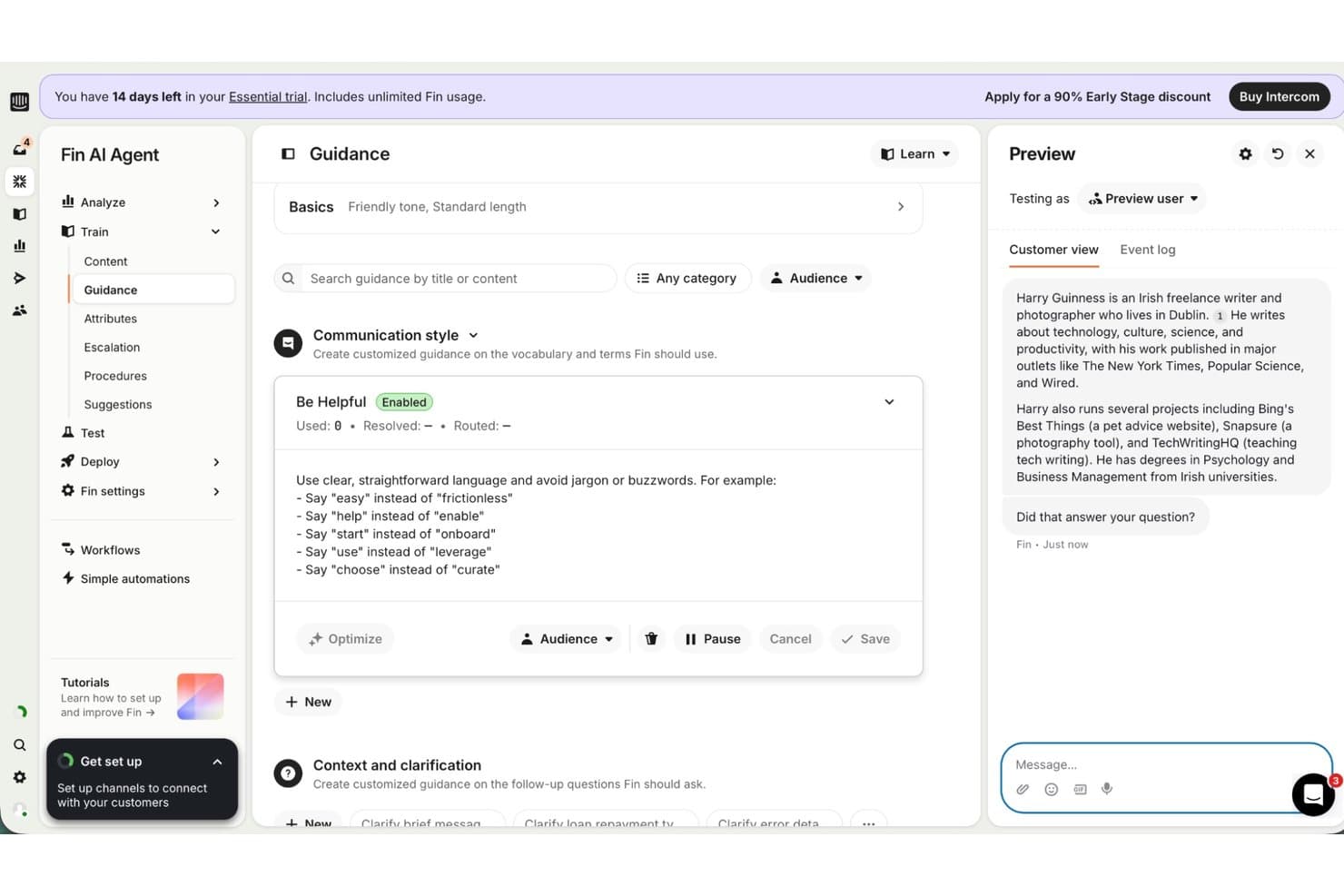
Intercom lets users customize AI tone and vocabulary guidance rules. Intercom is an AI-first customer service platform that combines a conversational AI agent (Fin), an omnichannel helpdesk, ticketing system, proactive messaging, and a shared inbox for human agents across chat, email, phone, and social channels.
Who Is Intercom Best For?
Intercom is a strong fit for customer support teams at mid-market and enterprise companies that need to handle high conversation volumes with AI before routing to human agents.
Why I Picked Intercom
I've included Intercom in my top picks because it handles support resolution at scale better than almost anything else I've tested. Fin AI Agent resolves over 76% of conversations on average across 12,000+ customers, handling multi-turn, multi-step exchanges across chat, email, voice, and WhatsApp without dropping context. I also like that Fin uses live Data Connectors to pull in order details from Shopify or Stripe mid-conversation, so it can process a refund or subscription change without escalating to a human agent.
Intercom Key Features
- Fin Copilot: An AI assistant that drafts suggested replies for human agents by pulling from past conversations, help articles, PDFs, and synced content from Notion, Guru, and Confluence.
- Series campaign builder: A no-code visual builder for multi-step message sequences across in-app, email, mobile push, and SMS channels, with A/B testing and goal tracking built in.
- CX Score: A machine learning (ML) model that rates every closed conversation on a 1–5 scale without relying on surveys, surfacing signals like customer effort, answer quality, and sentiment.
- Knowledge Hub: A centralized content layer that pulls in articles from Zendesk, Guru, Confluence, and Notion, giving Fin and human agents one shared knowledge source.
Intercom Integrations
Intercom offers 450+ integrations, including Salesforce, Shopify, Stripe, Jira, Slack, Discord, and Amazon Connect. It also supports REST APIs, webhooks, and MCP-compliant tools for custom connections.
Pros and Cons
Pros:
- Series supports behavior-based proactive engagement
- Preserves context across multiple customer channels
- Fin resolves complex, multi-turn conversations
Cons:
- Predictive churn scoring requires third-party tools
- Support-first design limits marketing optimization
 Best for developer-built AI across voice and data
- Free plan available
- Pricing upon request
Visit WebsiteCustomer Rating:4.4/5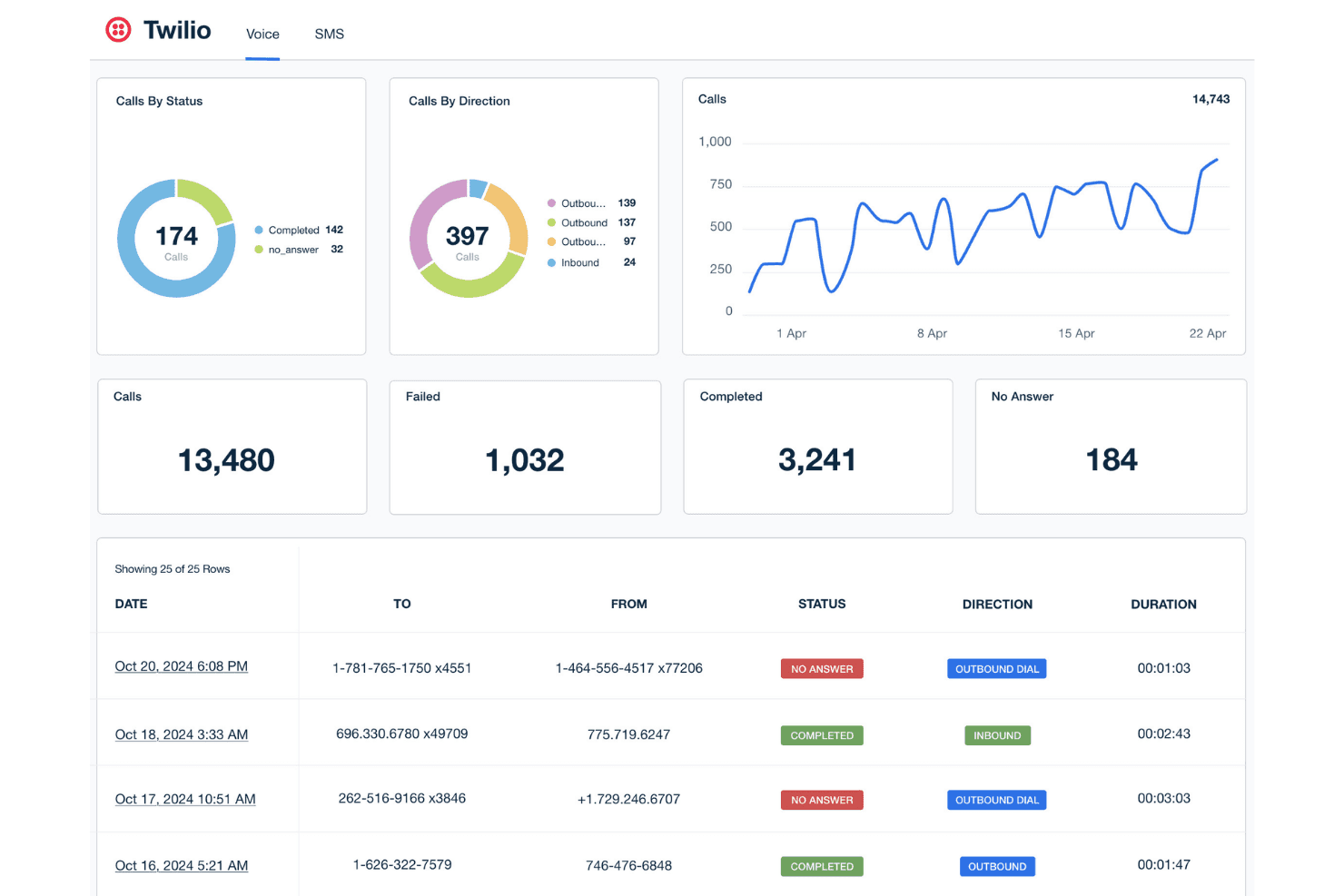
Twilio is a modular AI customer engagement platform that combines a customer data platform (Segment), conversational AI tools, a contact center (Flex), and communications channel APIs across voice, SMS, WhatsApp, and email.
Who Is Twilio Best For?
Twilio is a strong fit for engineering-led teams that want to build custom AI engagement workflows across channels rather than deploy a pre-packaged solution.
Why I Picked Twilio
I've included Twilio in my top picks because it's the only platform here that lets engineering teams build custom AI engagement workflows directly on top of their own LLMs, rather than adopting a packaged bot. ConversationRelay handles real-time voice AI with sub-0.5-second median latency, while Conversation Orchestrator threads voice, SMS, WhatsApp, and chat into a single context-aware session. Segment Predictions then feeds churn scores and purchase likelihood into those journeys automatically.
Twilio Key Features
- Segment Predictions: No-code predictive models score each customer on likelihood to purchase, churn, or hit a custom goal, with refresh windows from 15 to 120 days.
- Conversation Intelligence: Analyzes 100% of voice, SMS, and chat conversations in real time, flagging sentiment shifts, churn risk, and upsell opportunities with custom scoring rules.
- Engage Journeys: Triggers personalized messages across email, SMS, push, and ads based on real-time events, predictive traits, or audience membership.
- Generative Audiences: Builds targetable customer segments from plain-language prompts, without requiring manual filter configuration or SQL.
Twilio Integrations
Twilio integrates with Snowflake, Salesforce, Zendesk, Zapier, Yotpo, CommandBar, and Vero. It also provides APIs and webhooks for custom connections.
Pros and Cons
Pros:
- Explainable predictions expose contributing events
- Low-latency voice conversations support interruptions
- Builds AI journeys around your data
Cons:
- Beta copilots limit production confidence
- Developer build-out precedes conversational deployment
Learn more about Twilio: Best for agentic journey orchestration
- Free demo available
- Pricing upon request
Visit WebsiteCustomer Rating:4.8/5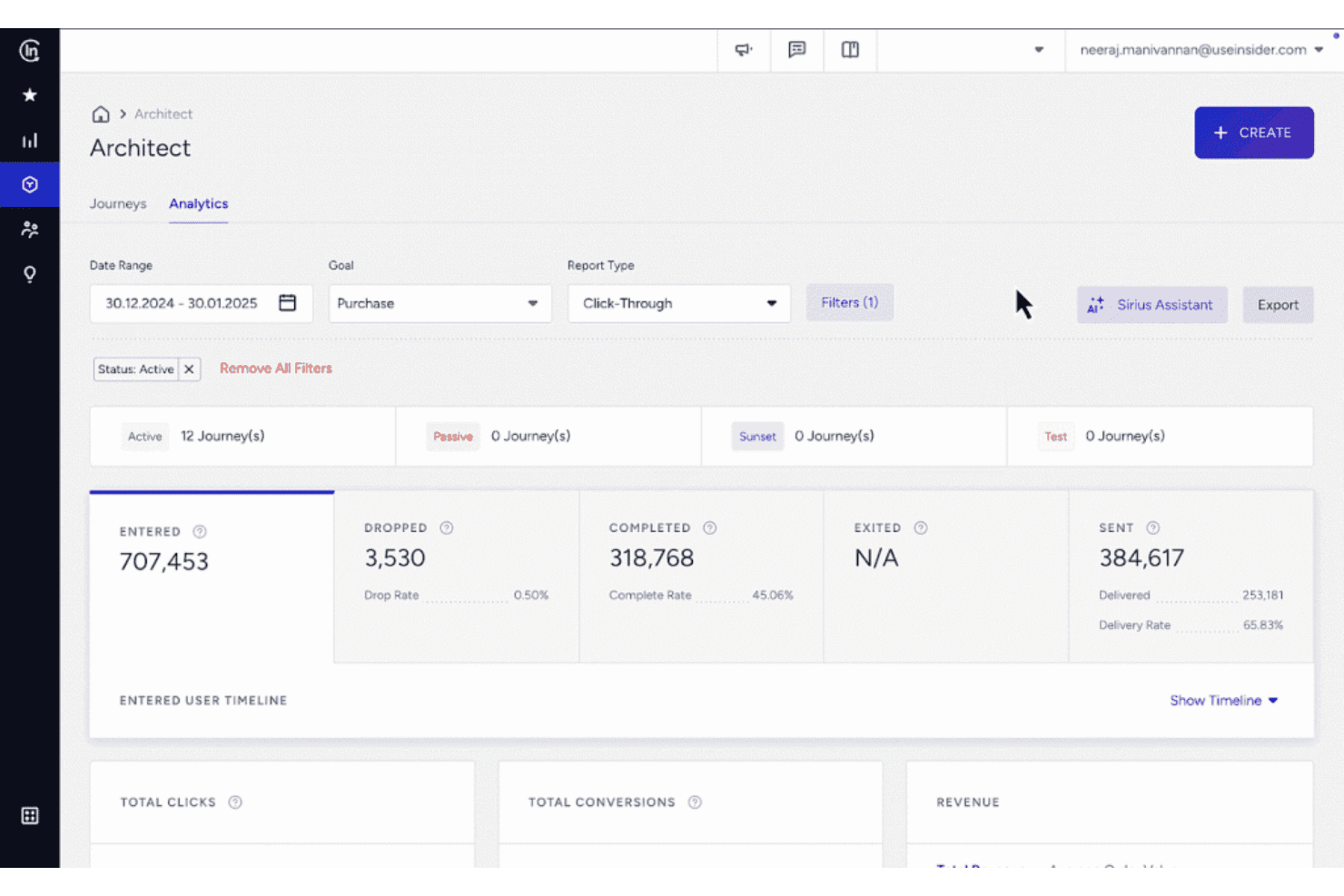
Insider One tracks journey analytics including entries, completions, and delivery rates. Insider One is an agentic AI customer engagement platform that combines a built-in CDP, multichannel journey orchestration, conversational AI, and real-time personalization.
Who Is Insider One Best For?
Insider One is a strong fit for B2C brands in retail, travel, and financial services that need a single platform to unify customer data.
Why I Picked Insider One
I picked Insider One as one of the best because its Agent One system takes journey orchestration further than any other platform I've seen, moving from human-directed execution to fully autonomous planning and optimization within guardrails you define. In practice, that means my team can set campaign goals, brand rules, and approval thresholds once, then let Agent One build, run, and self-optimize journeys across 12+ channels without touching the canvas again. The four autonomy modes, from Command to Autonomous, make that level of AI control genuinely usable rather than a feature you never trust enough to turn on.
Insider One Key Features
- Native CDP with 360° profiles: Unified customer profiles pull from behavioral, transactional, and third-party data sources, with identity resolution across brands and devices.
- Multichannel journey builder: Design and trigger journeys across channels with real-time behavioral events, conditional branches, and pre-built templates.
- Predictive segmentation: AI-generated segments use 120+ attributes plus models for purchase likelihood, churn risk, and engagement likelihood to define and target audiences automatically.
- Insights Agent: Ask plain-language questions about campaign and channel performance to get forward-looking analysis, early risk flags, and optimization suggestions.
Insider One Integrations
Insider One offers 100+ integrations, including Salesforce, Kustomer, Snowflake, Databricks, BigQuery, Pipedrive, and Shopify. It also supports unlimited APIs and webhooks for custom connections.
Pros and Cons
Pros:
- Native CDP powers predictive personalization
- Architect coordinates engagement across multiple channels
- Autonomously optimizes customer journeys
Cons:
- Reporting depth trails campaign execution needs
- Advanced setup needs dedicated marketing operations
Learn more about Insider One: Best for contact center conversational AI at scale
- Free demo available
- From $110/agent/month (proactive AI extra)
Visit WebsiteCustomer Rating:4.3/5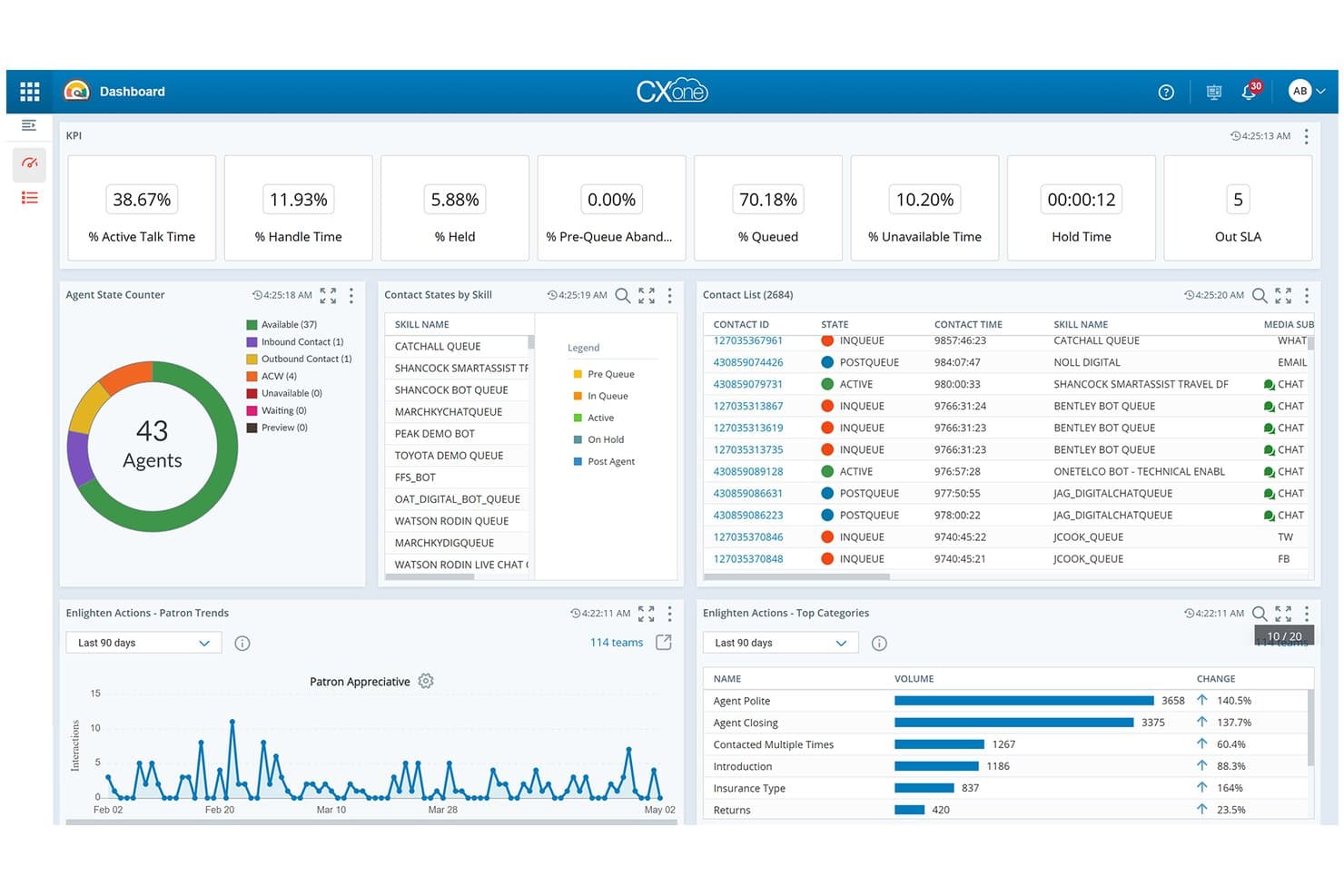
NICE CXone centralizes real-time call center KPIs and agent activity in one dashboard. NiCE CXone is an AI-first cloud contact center platform that brings together conversational AI agents, omnichannel routing, interaction analytics, workforce management, and proactive outbound engagement in one suite.
Who Is NiCE CXone Best For?
NiCE CXone is a strong fit for mid-market and enterprise customer support directors who need AI agents, workforce management, and analytics in one platform.
Why I Picked NiCE CXone
I picked NiCE CXone as one of the best because its conversational AI operates at a scale most platforms can't match, resolving over 1 billion requests annually across 1,000+ brands. I'm particularly impressed by AI Agent Studio, which lets you build LLM-agnostic agents that handle multi-turn voice and chat conversations, call external APIs, and hand off to humans without losing context. The Proactive AI Agent goes further, running outreach journeys that span days or weeks using behavioral and sentiment data to personalize every touchpoint.
NiCE CXone Key Features
- Interaction analytics: Scores 100% of interactions for sentiment, churn risk, and CSAT using speech and text analysis.
- Copilot for agents: Surfaces next-best-action suggestions and AI-generated responses to agents during live conversations.
- Omnichannel routing: Assigns interactions to the right human or AI agent based on skills, context, and customer data.
- Prebuilt CRM integrations: Connects to Salesforce, Microsoft Dynamics, ServiceNow, and Zendesk for a unified customer view.
NiCE CXone Integrations
NiCE CXone offers integrations with Salesforce, Ada, Microsoft Dynamics 365, Condado, ServiceNow, Zendesk, and Kustomer. REST APIs and an SDK are also available for custom integrations.
Pros and Cons
Pros:
- Analytics scores every interaction for sentiment
- Multi-turn agents preserve conversation context
- Proactive AI agents sustain long journeys
Cons:
- Reviewers report occasional lag and dropped calls
- Implementation and migration can be labor-intensive
Learn more about NiCE CXone: Best for enterprise next-best-action decisioning
- Free demo available
- Pricing upon request
Visit WebsiteCustomer Rating:4.4/5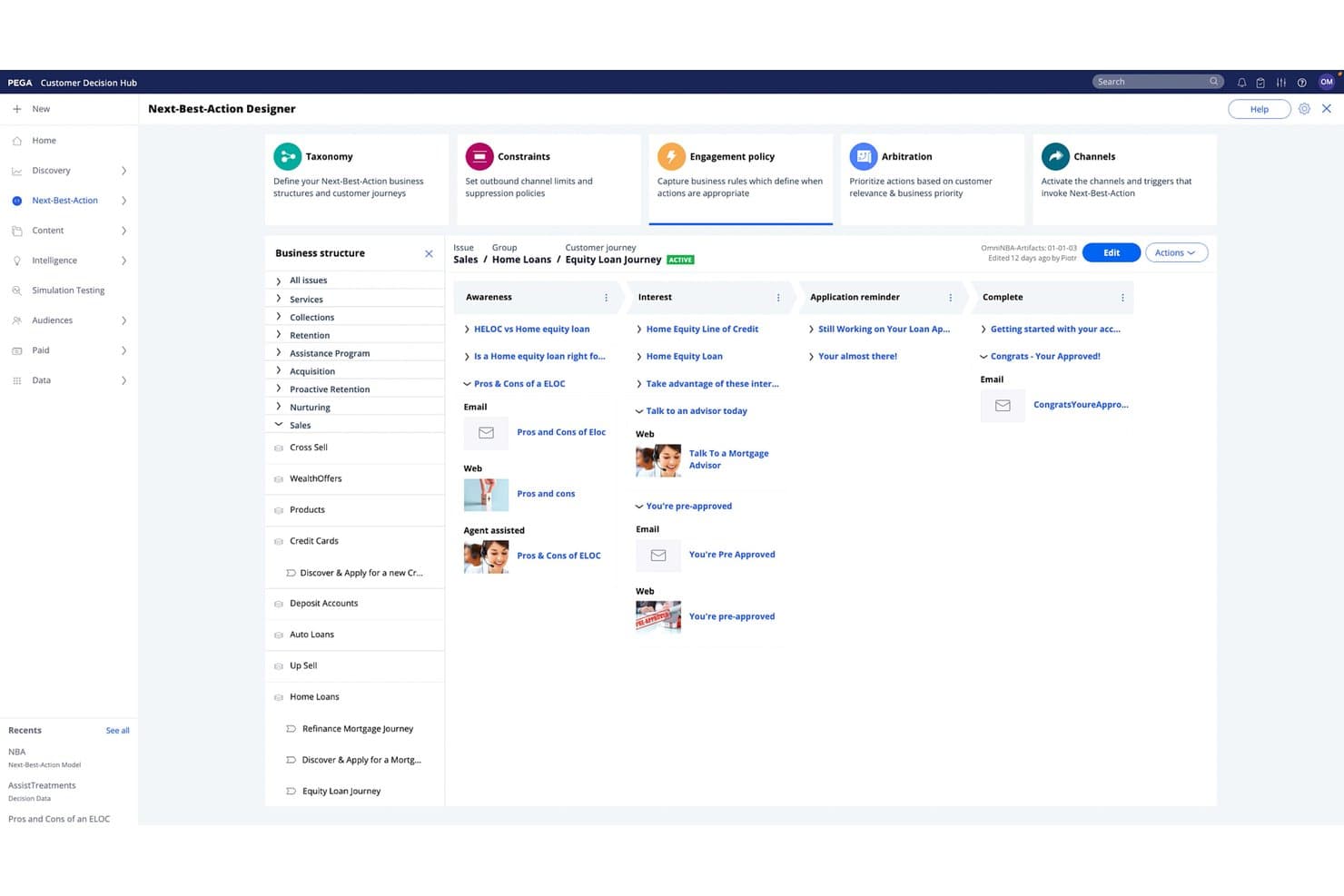
Pega Customer Decision Hub maps customer journeys across channels and actions. Pega Customer Decision Hub is an enterprise AI decisioning platform that uses predictive and adaptive models to orchestrate next-best-action recommendations across 20+ channels, including web, email, SMS, paid media, and the contact center agent desktop.
Who Is Pega Customer Decision Hub Best For?
Pega Customer Decision Hub is built for large enterprises in financial services, telecoms, and retail that need a single AI decisioning engine to coordinate personalized customer actions.
Why I Picked Pega Customer Decision Hub
I picked Pega Customer Decision Hub as one of the best because no other platform I've seen matches its depth of enterprise next-best-action decisioning across 20+ channels from a single AI engine. I love how the Next-Best-Action Designer weighs thousands of possible actions against real-time customer context, returning a ranked decision in under 200ms, whether that's a retention offer surfaced to a contact center agent or a personalized loan price generated through adaptive models. The Always-On Insights layer pulls in streaming CDP signals and continuously recalibrates those recommendations mid-journey as customer behavior shifts.
Pega Customer Decision Hub Key Features
- Generative AI content creation: Drafts and rewrites treatment variants—including subject lines, headlines, and body copy—directly within the platform.
- Customer Profile Designer: Collects and maps streaming behavioral and third-party data into unified customer profiles in real time.
- Engagement policy controls: Eligibility rules check segment membership directly, so you can define who qualifies for which actions without importing data into a separate cache.
- Customer Engagement Strategy Blueprint: Uses GenAI to help teams map and build engagement strategies, with a round-trip link to push designs back into CDH.
Pega Customer Decision Hub Integrations
Pega Customer Decision Hub integrates with Salesforce, Movable Ink, Adobe, Google, Snowflake, BigQuery, Stripo, and Meta. It also provides pre-built connectors for customer data platforms and supports existing CRM, marketing, data warehouse, and channel systems.
Pros and Cons
Pros:
- Self-learning models adjust to behavior shifts
- Explainable recommendations guide agent conversations
- One decision engine spans 20+ channels
Cons:
- Conversational AI requires a separate product
- Business-rule customization can become expensive
Learn more about Pega Customer Decision Hub: Best for self-learning cross-channel optimization
- 14-day free trial
- Pricing upon request
Visit WebsiteCustomer Rating:4.6/5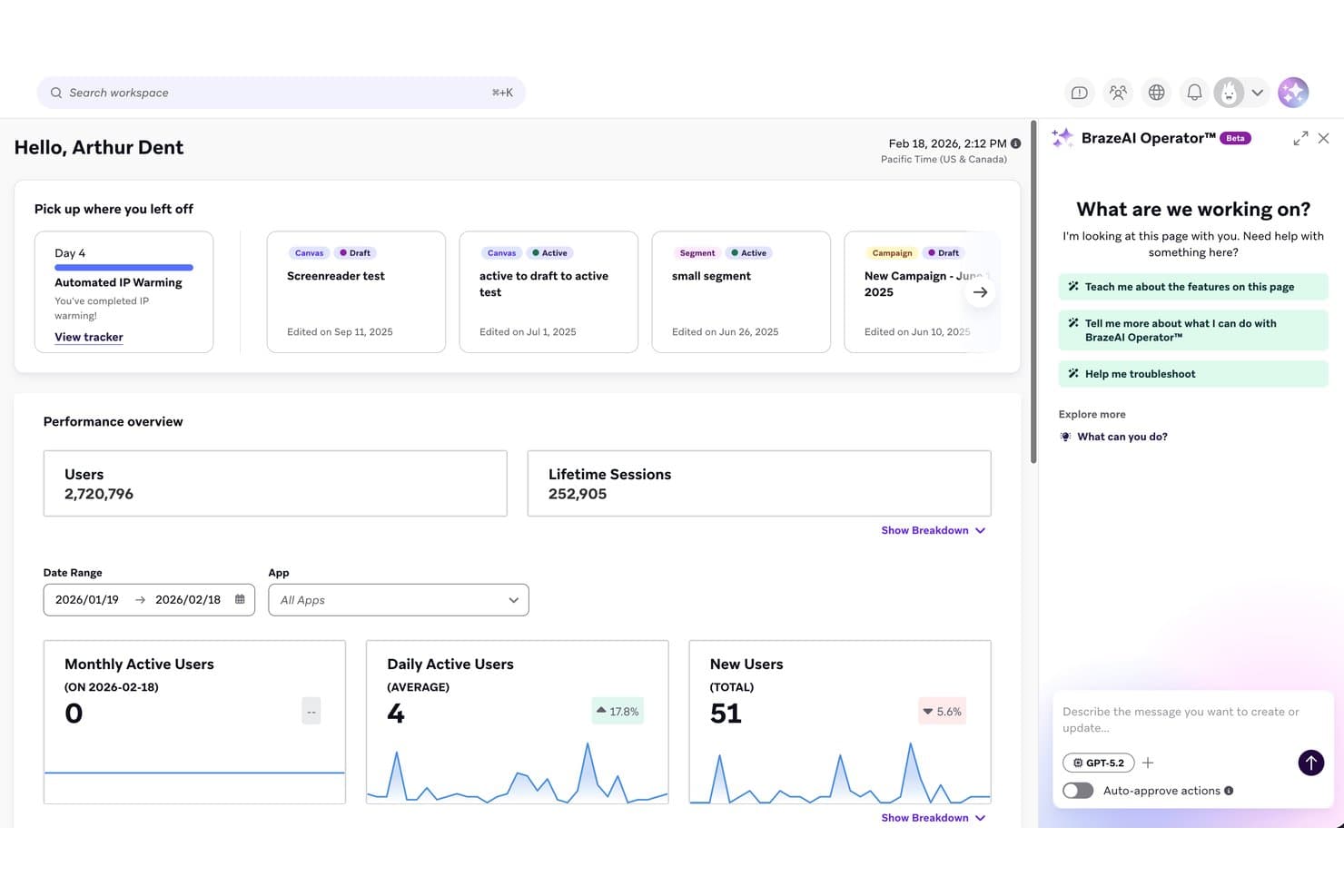
Braze's AI Operator assists users with campaign creation and troubleshooting. Braze is an AI-powered customer engagement platform built around multichannel journey orchestration, predictive analytics, and self-learning decisioning.
Who Is Braze Best For?
Braze is ideal for mid-market, enterprise marketing, and customer experience teams managing large, multichannel campaigns through email, SMS, push notifications, and WhatsApp.
Why I Picked Braze
I've included Braze in my top picks because its self-learning optimization actually compounds over time—Decisioning Studio uses reinforcement learning to personalize channel, offer, timing, and frequency for each customer individually, without requiring manual tuning. I also love how Intelligent Channel and Winning Path continuously route users based on real engagement patterns across email, SMS, WhatsApp, and push.
Braze Key Features
- AI Item Recommendations: A deep-learning model trained on up to six months of purchase or event data to surface personalized, trending, or popular items for each user.
- Cloud Data Ingestion: Syncs directly from Snowflake, Redshift, BigQuery, Databricks, and Microsoft Fabric—with zero-copy querying so your warehouse data never has to move into Braze.
- Predictive Suite: Scores each user's churn risk from 0 to 100 using gradient-boosted decision trees, with up to three active predictions running at once.
- Canvas journey triggers: Supports action-based, audience-based, location, and geofence triggers, with frequency capping and warehouse-driven events that fire journeys without manual setup.
Braze Integrations
Braze supports integrations through its Alloys partner ecosystem, including Front, Snowflake, Redshift, Databricks, Segment, and Regal. It also offers REST APIs, SDKs, and webhooks for custom connections.
Pros and Cons
Pros:
- Broad cross-channel journey orchestration
- Explainable next-best-action recommendations
- Self-learning channel and timing optimization
Cons:
- Advanced AI needs substantial behavioral data
- Conversational agents remain in beta
 Best for CRM-native support and outreach
- Free plan + 14-day trial + demo available
- From $20/user/month
Visit WebsiteCustomer Rating:4.4/5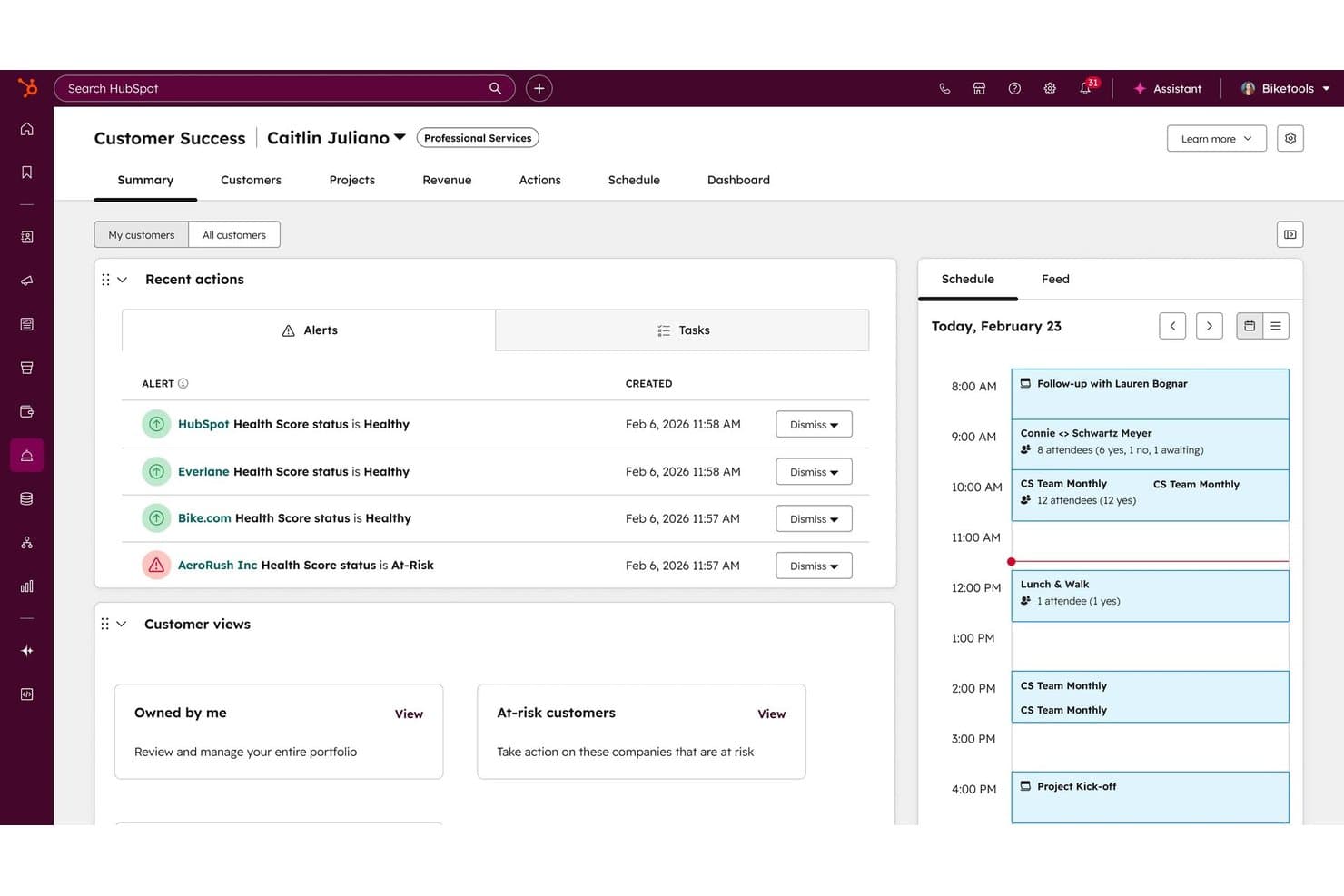
HubSpot Service Hub centralizes customer health alerts and daily schedules. HubSpot Service Hub is a CRM-native customer engagement platform that combines AI-powered support automation, multichannel conversation management, help desk ticketing, and customer success tooling across chat, email, voice, WhatsApp, and social channels.
Who Is HubSpot Service Hub Best For?
HubSpot Service Hub is a strong fit for teams that already use HubSpot's CRM and want their support, success, and AI tooling to run on the same customer record.
Why I Picked HubSpot Service Hub
HubSpot Service Hub earns its spot on my shortlist because every AI feature, from the Breeze Customer Agent to lead scoring and Conversation Intelligence, runs on the same customer record your sales and marketing teams already use. I love that the Customer Agent handles live chat, email, inbound voice, WhatsApp, and Messenger in one place, with documented resolution rates around 65–70%, and hands off to a human agent with full context when needed. That CRM-native foundation is what makes the outreach side work too: nurture emails, Lookalike Lists, and campaign automation all pull from the same live data.
HubSpot Service Hub Key Features
- Lookalike Lists: Breeze analyzes your best contacts and builds new audience segments of similar people, with editable criteria.
- Conversation Intelligence: Records, transcribes, and analyzes sales and support calls to surface coaching moments, objections, and competitor mentions.
- Agent Builder: A no-code tool for building custom AI agents using your own prompts, knowledge sources, and live CRM data, with event-based triggers and built-in testing.
- Customer success workspace: A dedicated space in Service Hub for tracking account health scores, managing renewals, and monitoring customer lifecycle milestones.
HubSpot Service Hub Integrations
HubSpot has 2,000+ Marketplace apps, including Salesforce, Google Workspace, Microsoft 365, Slack, Shopify, Jira, SurveyMonkey, and Facebook Messenger. Salesforce supports native two-way sync, while Data Hub offers 100+ real-time sync integrations and APIs that support custom connections.
Pros and Cons
Pros:
- AI campaign and list personalization from behavior
- Customer Agent handles multimodal conversations with handoff
- CRM-native context across service and marketing
Cons:
- Ticketing customization draws mixed reviews
- Many useful AI features remain beta
Learn more about HubSpot Service Hub: Best for marketer-controlled AI journey triggers
- Free demo available
- Pricing upon request
Visit WebsiteCustomer Rating:4.4/5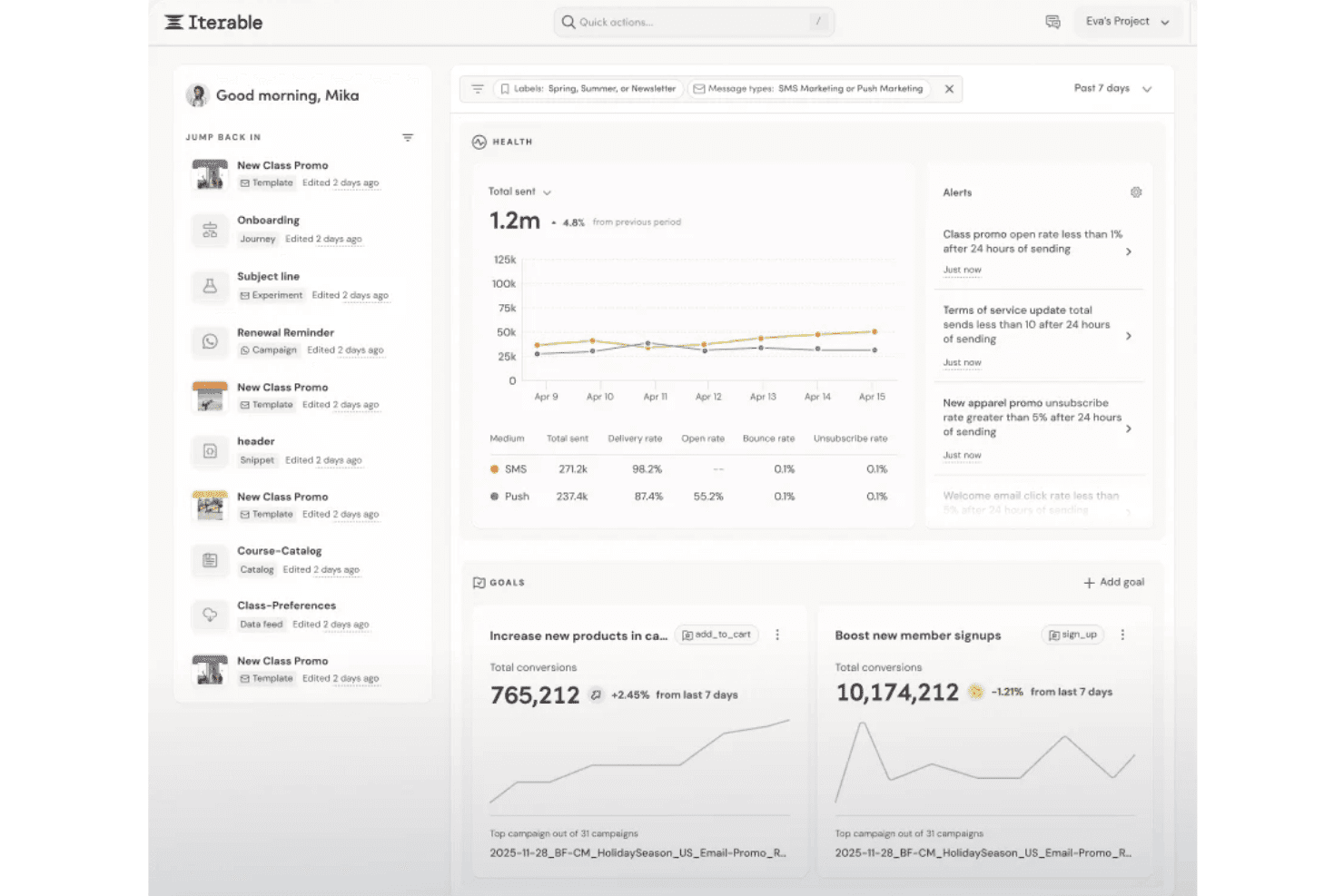
Iterable's dashboard gives marketers a unified view of campaign health and goals. Iterable is an AI-powered customer engagement platform that combines cross-channel journey orchestration, predictive audience segmentation, and AI-driven send-time and channel decisioning.
Who Is Iterable Best For?
Iterable is a strong fit for marketing and lifecycle teams that need to orchestrate cross-channel journeys with AI-driven controls.
Why I Picked Iterable
I picked Iterable as one of the best because it gives marketers direct, visible control over how AI drives journey decisions. Its Nova Decisioning layer picks the next best action for each customer based on live behavior, but always within guardrails you define. Channel Decisioning takes it further, routing each person to email, SMS, or push within a single journey step. What I appreciate most is the "Glassbox AI" approach: every decision is explainable, not a black box.
Iterable Key Features
- Predictive Audiences: AI scores each user's likelihood to convert or churn, letting you build segments directly from those scores without writing SQL.
- Brand Affinity scoring: Automatically classifies users as Loyal, Positive, Neutral, or Negative based on email, push, and in-app engagement, then exposes those labels in segments and journey splits.
- Experimentation Agent: Creates, tests, and promotes message variants automatically, reducing the manual work of running A/B tests across campaigns.
- Smart Ingest: Pulls data from 23+ warehouse sources, including Snowflake, BigQuery, and Databricks, into user profiles with syncs running as often as every 15 minutes.
Iterable Integrations
Iterable integrates with Salesforce, Google Ads, Zendesk, Meta Ads, Movable Ink, Snowflake, and Kustomer. It also provides REST APIs, webhooks, and SDKs for custom connections.
Pros and Cons
Pros:
- Predictive audiences trigger conversion and churn journeys
- Cross-channel orchestration spans eight messaging channels
- Marketer-controlled next-best-action journey decisions
Cons:
- Reporting lacks depth for attribution decisions
- Customer-facing conversational AI remains private beta
Learn more about Iterable : Best for multichannel journeys in APAC markets
- 30-day free trial
- From ₹12,000/month
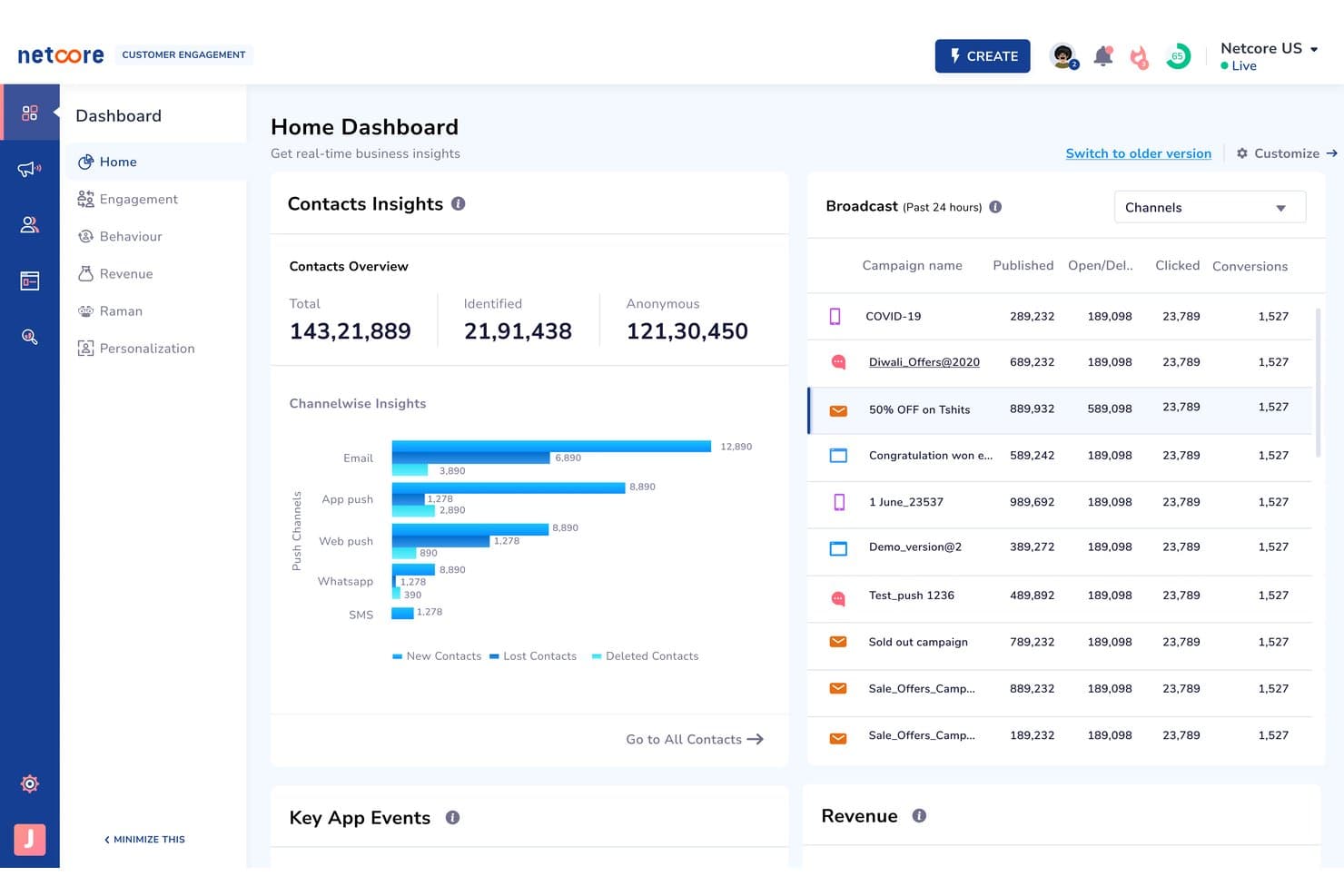
Netcore Cloud unifies contact insights and broadcast campaign metrics in one dashboard. Netcore Cloud is an AI customer engagement platform that combines a built-in CDP, nine-channel journey orchestration, predictive analytics, and a suite of named AI agents for content generation, audience building, and send-time decisioning.
Who Is Netcore Cloud Best For?
Netcore Cloud is a strong fit for marketing and CX teams in India and Asia-Pacific that run high-volume, multichannel campaigns across email, WhatsApp, SMS, and push.
Why I Picked Netcore Cloud
I picked Netcore Cloud as one of the best because no other platform on this list matches its depth across nine channels, with WhatsApp, RCS, and SMS built in from day one, which is a real advantage for APAC-market campaigns. I love how the Decisioning Agent picks the right message, channel, and send time per customer without manual A/B testing, and how the Journey Path Optimizer continuously shifts audiences toward higher-converting paths. The Identity Resolution Cloud stitching 16M+ profiles in real time, as Adidas proved, is what makes that orchestration actually land.
Netcore Cloud Key Features
- Content Agent: Writes subject lines, copy, and channel-specific variations using generative AI, and learns from past campaign performance to improve future output.
- Catalog-event triggers: Automatically fires messages when a product drops in price, comes back in stock, or hits low inventory, targeting only users who previously engaged with that item.
- Identity Resolution Cloud: Links a customer's identities across devices and channels in real time to build a single, unified profile.
- Add-on packs: Modular AI, analytics, personalization, recommendations, and security packs let you expand capabilities on either plan without upgrading your entire contract.
Netcore Cloud Integrations
Netcore Cloud offers 100+ native integrations, including Salesforce, AppsFlyer, Adjust, Branch, Databricks, Snowflake, Shopify, and Zapier. An API for custom connections is also available.
Pros and Cons
Pros:
- Named agents support auditable decisions
- Predictive models personalize customer outreach
- Nine-channel journey orchestration
Cons:
- Support-focused conversational AI remains limited
- Reporting dashboards can feel slow
Learn more about Netcore Cloud: Best for enterprise campaign creation
- Not available
- $1,500/org/month (billed annually)
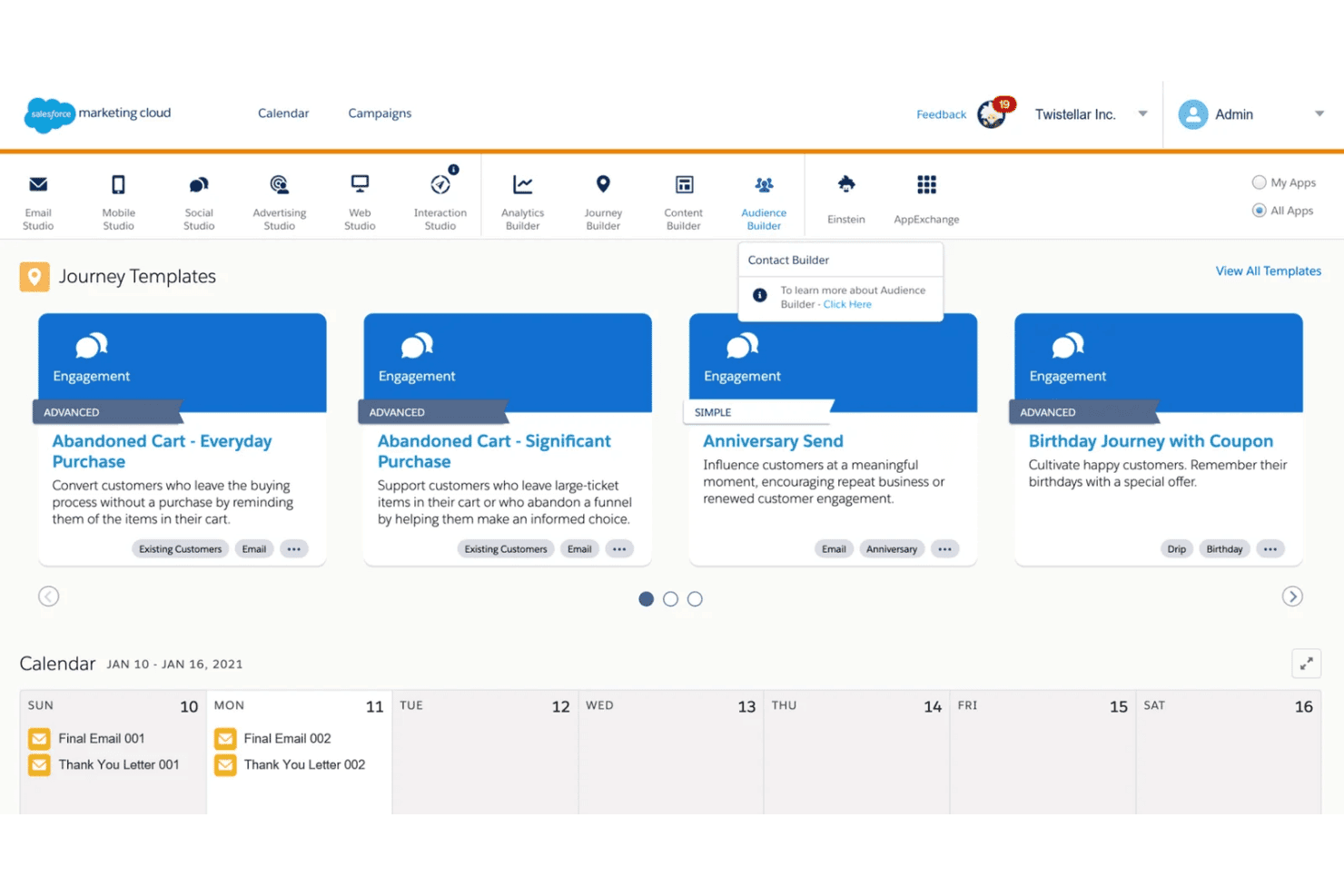
Salesforce Marketing Cloud offers journey templates for automated customer engagement. Salesforce Marketing Cloud is an AI-driven marketing platform that combines multichannel campaign orchestration, real-time customer data unification, predictive analytics, and generative AI tools for email, SMS, push, web, and paid ad engagement.
Who Is Salesforce Marketing Cloud Best For?
Salesforce Marketing Cloud is a strong fit for enterprise marketing teams running high-volume, multichannel campaigns across channels.
Why I Picked Salesforce Marketing Cloud
I picked Salesforce Marketing Cloud as one of the best because Agentforce Campaign Creation is genuinely unlike anything else I've seen at this scale: give it a natural-language prompt and it drafts the segment, email and SMS copy, and the entire journey flow. For enterprise teams running high-volume campaigns across email, SMS, push, and paid ads simultaneously, Data 360's Zero Copy architecture keeps every channel pulling from the same real-time customer profile, while Einstein Send Time Optimization scores all 168 hours of the week per contact to hit the right moment.
Salesforce Marketing Cloud Key Features
- Einstein Content Selection: Picks the best content asset for each contact based on their profile and category affinity, automatically adapting what each person sees in email and push messages.
- Two-way SMS and WhatsApp conversations: Turns outbound messages into real-time two-way exchanges, with Agentforce handling replies and escalating to a human agent when needed.
- Einstein Engagement Frequency: Identifies the optimal number of messages to send each contact, reducing the risk of over-messaging based on individual engagement patterns.
- Agentforce Paid Media Optimization: Monitors ad performance continuously, pauses underperforming ads, and surfaces spend reallocation suggestions across connected ad platforms.
Salesforce Marketing Cloud Integrations
Salesforce Marketing Cloud integrates with the Salesforce ecosystem, Snowflake, BigQuery, Databricks, Google Workspace, Meta, and LinkedIn. A REST API is also available for custom connections.
Pros and Cons
Pros:
- Predicts engagement timing and message frequency
- Generates campaign briefs, copy, and journeys
- Unifies real-time customer data across channels
Cons:
- Complex campaigns often require SQL or AMPscript
- Marketing Cloud Next has unfinished workflows
Learn more about Salesforce Marketing Cloud:
Diğer Yapay Zekâ Müşteri Etkileşimi Yazılımları
İşte en iyi listeme girmeyen ancak yine de göz atmaya değer birkaç ek seçenek:
- 11BloomreachBest for AI-driven personalization
- 12KlaviyoBest for customer engagement and retention
- 13Customer.ioBest for behavior-triggered journeys
- 14MedalliaBest for VoC-led predictive engagement
- 15MoEngageBest for campaign creation and control
- 16Genesys Cloud CXBest for native compliance governance
- 17BlueshiftBest for B2C lifecycle management with built-in CDP
- 18OptimoveBest for customer retention marketing
- 19Adobe Journey OptimizerBest for real-time multichannel journey governance
How I Evaluate AI Customer Engagement Software
To make this list, a tool’s AI needs to handle real customer engagement work, like personalizing messages or handling customer conversations. From there, I evaluate three things. Core functionality carries the most weight, like coordinating journeys and unifying customer data. Then I look at standout features, like generative AI content creation, and how well it fits your existing tech stack.
Core Functionality (Table Stakes For This List)
When I'm selecting tools for my list, I score each one on a scale from 0 (does not offer the functionality) to 5 (excels in this area) for each core functionality listed below. I then convert the total into a percentage to help assess each tool’s overall fit, with extra weight on any functionalities I’ve deemed essential.
- AI Personalization (Essential): I look for behavioral and contextual data that tailor content, offers, or messages across email, web, and in-app interactions.
- Conversational AI (Essential): I evaluate how well virtual agents handle multi-turn questions, understand intent, and hand off complex cases to people.
- Predictive Analytics: I check whether models forecast churn, purchase intent, or next-best actions and turn those predictions into useful engagement decisions.
- Multichannel Orchestration: I assess coordinated journeys across email, messaging, chat, voice, and in-app channels with consistent customer context.
- Unified Customer Data: I look for profiles that combine CRM, service, behavioral, and transactional data to inform timely engagement.
- Automated Journey Triggers: I evaluate triggers that respond to lifecycle stages, browsing behavior, purchases, support events, or changing customer intent.
Once I have a list of tools that meet the criteria, I consider what sets each platform apart.
Differentiating Factors (What Sets Vendors Apart)
Here's how I compare and contrast different vendors:
Standout Features
I look for next-best-action recommendations that go beyond generic suggestions. Platforms like Pega and Braze use real-time decisioning to tell agents or marketers which channel, message, and timing to use for a specific customer. Sentiment analysis also matters—I evaluate whether the AI can read emotional cues mid-conversation and escalate before a frustrated customer churns. A self-learning optimization engine rounds this out, automatically refining send times and content variants so your team isn't manually A/B testing every campaign.
Beyond Features
I evaluate how well each platform integrates with your existing CRM, CDP, and help desk tools. Pre-built connectors between systems like Salesforce, HubSpot, or Zendesk save weeks of setup compared to custom API work. I also check whether AI decisions are explainable and overridable—your team needs to see why a model recommended a specific action and adjust it when context demands. Scalability matters too: I look at whether pricing stays predictable as your contact volume or channel count grows.
Yapay Zekâ Müşteri Etkileşimi Yazılımı Nasıl Seçilir?
Yapay zekâ kararlarının, veri işleme süreçlerinin ve insanlara devretme adımlarının hizmet standartlarınıza uygun olduğunu kanıtlayabilen platformu seçin.
| Önceliğiniz | Şunları arayın |
|---|---|
| ÖnceliğinizTutarlı müşteri bağlamı | Şunları arayınKaynakları, sahipliği ve güncelleme zamanını gösteren belgelenmiş bir veri haritası |
| ÖnceliğinizGüvenli insanlara devretme | Şunları arayınRolleri, tetikleyicileri ve görüşme geçmişini içeren örnek bir eskalasyon iş akışı |
| ÖnceliğinizAçıklanabilir yapay zekâ kararları | Şunları arayınGirdileri, gerekçeyi ve geçersiz kılma denetimlerini gösteren karar kayıtları |
| ÖnceliğinizKanallar arası yönetişim | Şunları arayınE-posta, mesajlaşma, sohbet ve sesli iletişimi kapsayan bir izin matrisi |
Kısa Listeniz Nasıl Değerlendirilir?
- Kanıt dosyası isteyin: Beş iş günü içinde bir veri akışı diyagramı, saklama politikası ve yapay zekâ karar belgeleri talep edin.
- Tanımlı bir deneme görevi yürütün: Her sağlayıcıya aynı anonimleştirilmiş müşteri senaryosunu verin ve ortaya çıkan yolculuğu, eskalasyonu ve denetim kaydını karşılaştırın.
- Bir destek devrini test edin: Kasıtlı olarak belirsiz bir istek içeren bir bilet oluşturun, ardından yanıtı, eskalasyon yolunu ve sağlanan insan bağlamını belgeleyin.
- Taahhütleri yazılı hâle getirin: Sağlayıcılardan veri sahipliği, insan incelemesi, model değişikliği bildirimi ve dışa aktarma gereksinimlerini sözleşmeye veya sipariş formuna eklemelerini isteyin.
- Yönlendirici ödünleşimi seçin: Ekibinizin müşteri kararları üzerindeki merkezi kontrolü mü, yoksa pazarlama ve hizmet ekibinin daha fazla özerkliğini mi önemsediğine karar verin.
Yapay Zekâ Müşteri Etkileşimi Yazılımı Nedir?
Yapay zekâ müşteri etkileşimi yazılımı, etkileşimleri kişiselleştirmek, müşteri sorularını yanıtlamak ve kanallar arasındaki iletişimi koordine etmek için yapay zekâ kullanır. İlgili mesajları tetiklemek, sonraki adımları önermek ve karmaşık görüşmeleri insan ekiplerine yönlendirmek için müşteri verilerini otomasyonla birleştirir. Müşteri deneyimi, destek, müşteri başarısı ve pazarlama ekipleri; e-posta, sohbet, mesajlaşma, sesli iletişim ve uygulama içi deneyimler üzerinden müşteri yolculuklarını yönetmek için bu platformları kullanır.
Özellikler
Her iyi yapay zekâ müşteri etkileşimi yazılımında aradığım temel özellikler şunlardır:
- Yapay zekâ ile kişiselleştirme: Dijital kanallardaki mesajları, teklifleri, içerikleri ve önerileri uyarlamak için müşteri davranışlarını, tercihlerini ve bağlamını kullanır.
- Diyaloğa dayalı yapay zekâ: Müşteri sorularını anlar, görüşme bağlamını korur, yanıtlar sağlar ve karmaşık sorunları doğru ekip üyesine yönlendirir.
- Kestirimci analiz: Müşteri verilerini analiz ederek müşteri kaybını, satın alma niyetini, memnuniyeti veya destek ihtiyaçlarını öngörür ve ardından uygun etkileşim eylemlerini önerir.
- Çok kanallı orkestrasyon: Bağlantılı müşteri yolculukları içinde e-posta, mesajlaşma, sohbet, sesli iletişim, web ve uygulama içi mesajlaşmayı koordine eder.
- Birleştirilmiş müşteri profilleri: Daha bilinçli etkileşimler için CRM, hizmet, davranışsal, işlemsel ve etkileşim verilerini tek bir profilde birleştirir.
- Otomatik yolculuk tetikleyicileri: Müşteriler ürünlere göz attığında, satın alma işlemlerini tamamladığında, talep gönderdiğinde, yaşam döngüsü aşamalarına ulaştığında veya etkileşim kalıplarını değiştirdiğinde iş akışlarını başlatır ya da ayarlar.
- En uygun sonraki eylem önerileri: Her etkileşim için uygun mesajı, kanalı, zamanlamayı veya takibi önermek üzere müşteri bağlamını değerlendirir.
- İnsan ekiplerine devir: Görüşme dökümlerini, müşteri geçmişini, niyet ayrıntılarını ve önerilen sonraki adımları sağlayarak görüşmeleri ekip üyelerine aktarır.
- Etkileşim analizleri: Raporlar ve panolar aracılığıyla kampanya performansını, görüşme sonuçlarını, yolculuk ilerlemesini, elde tutma sinyallerini ve müşteri geri bildirimlerini izler.
Avantajlar
Yapay zekâ müşteri etkileşimi yazılımını kullanarak elde edebileceğiniz bazı yaygın avantajlar şunlardır:
- Daha kişiselleştirilmiş deneyimler: Yapay zekâ ile kişiselleştirme, müşteri temas noktalarındaki mesajları, teklifleri ve önerileri uyarlamak için davranışsal, işlemsel ve bağlamsal verileri kullanır.
- Daha hızlı müşteri desteği: Diyaloğa dayalı yapay zekâ rutin soruları yanıtlar, birden fazla tur boyunca bağlamı korur ve karmaşık sorunları uygun ekip üyesine yönlendirir.
- Daha erken elde tutma fırsatları: Kestirimci analiz; müşteri kaybı riskini, satın alma niyetini, memnuniyet değişikliklerini ve zamanında etkileşim eylemlerine yön veren diğer sinyalleri belirler.
- Tutarlı çok kanallı yolculuklar: Yolculuk orkestrasyonu, ortak müşteri bağlamı etrafında e-posta, mesajlaşma, sohbet, sesli iletişim, web ve uygulama içi etkileşimleri koordine eder.
- Daha bilinçli kararlar: Birleştirilmiş müşteri profilleri; daha doğru en uygun sonraki eylem önerileri sunmak için CRM, hizmet, davranışsal, işlemsel ve etkileşim verilerini birleştirir.
- Daha duyarlı iş akışı otomasyonu: Otomatik tetikleyiciler, müşteriler ürünlere göz attığında, satın alma işlemlerini tamamladığında, talep gönderdiğinde veya etkileşim kalıplarını değiştirdiğinde yolculukları ayarlar.
- Daha güçlü devirler: İnsan ekiplerine devir özellikleri, ekip üyelerine görüşme dökümleri, müşteri geçmişi, niyet ayrıntıları ve önerilen sonraki adımları sağlar.
Maliyetler ve Fiyatlandırma
Maliyetler özelliklere, ekip büyüklüğüne, eklentilere ve müşteri hacmine göre değişir. Bu platformlarda genellikle karşılaşabileceğiniz fiyat aralıkları şunlardır:
Yapay Zekâ Müşteri Etkileşimi Yazılımı İçin Plan Karşılaştırma Tablosu
| Plan Türü | Ortalama Fiyat | Yaygın Özellikler |
|---|---|---|
| Plan TürüÜcretsiz Plan | Ortalama Fiyat$0/user/month | Yaygın ÖzelliklerTemel kişi profilleri, e-posta kampanyaları, basit sohbet robotu desteği ve sınırlı analizler. |
| Plan TürüKişisel Plan | Ortalama Fiyat$20-$100/user/month | Yaygın ÖzelliklerMüşteri segmentasyonu, otomatik mesajlaşma, temel yolculuk tetikleyicileri ve standart raporlama. |
| Plan Türüİşletme Planı | Ortalama Fiyat$100-$300/user/month | Yaygın ÖzelliklerÇok kanallı orkestrasyon, kestirimci analiz, diyaloğa dayalı yapay zekâ ve CRM entegrasyonları. |
| Plan TürüKurumsal Plan | Ortalama Fiyat$500-$5,000/month | Yaygın ÖzelliklerBirleştirilmiş müşteri verileri, gelişmiş kişiselleştirme, özel otomasyon, özel destek ve yönetişim denetimleri. |
Sıkça Sorulan Sorular
Yapay zekâ müşteri etkileşimi yazılımı hakkında sık sorulan soruların bazı yanıtları:
Yapay zekâ müşteri etkileşimi yazılımı, müşteri hizmetleri temsilcilerinin yerini alır mı?
Hayır, bu platformlar insan temsilcileri destekler. Sanal temsilciler rutin soruları yanıtlayabilir ve ilk bilgileri toplayabilir. İnsan ekip üyeleri hassas, karmaşık veya alışılmadık durumlarla ilgilenebilir. Görüşme dökümünü, müşteri geçmişini, amacı ve önerilen sonraki adımları içeren aktarımları arayın. Bir platform seçmeden önce belirsiz bir isteği test edin. Sistemin belirsizliği tanıyıp görüşmeyi doğru kişiye yönlendirip yönlendirmediğini kontrol edin.
Yapay zekâ müşteri etkileşimi yazılımı mevcut sistemlere nasıl bağlanır?
Yapay zekâ müşteri etkileşimi aracı, yerel entegrasyonlar, API’ler, veri aktarımları veya ara yazılım aracılığıyla mevcut sistemlere bağlanır. Yaygın bağlantı noktaları arasında CRM’niz, CDP’niz, yardım masanız, ticaret platformunuz ve mesajlaşma araçlarınız bulunur. Tedarikçilere hangi sistemlerin çift yönlü senkronizasyonu desteklediğini sorun. Kayıtların ne sıklıkla güncellendiğini ve her alanın hangi sistem tarafından yönetildiğini doğrulayın. Ayrıca müşteri onayının, görüşme geçmişinin ve profil değişikliklerinin platformlar arasında doğru şekilde aktarılıp aktarılmadığını test edin.
Yapay zekâ etkileşimi yazılımının hangi müşteri verilerine ihtiyacı vardır?
Yapay zekâ etkileşimi yazılımı genellikle müşteri profillerine, davranışsal etkinliklere, işlem geçmişine, hizmet etkileşimlerine ve onay bilgilerine ihtiyaç duyar. İşe, işe alım veya yenileme iletişimi gibi belirli bir yolculuk için gereken verilerle başlayın. Ardından veri kalitesini, güncelleme zamanlamasını, erişim izinlerini ve saklama kurallarını doğrulayın. Mevcut her alanı platforma göndermekten kaçının. Gereksiz veriler yönetişimi karmaşıklaştırabilir ve model kararlarının incelenmesini zorlaştırabilir.
Bir yapay zekâ müşteri etkileşimi platformunu nasıl ölçmelisiniz?
Platformu, belirli iş akışlarıyla bağlantılı müşteri ve operasyon sonuçlarına göre ölçün. Çözüm oranlarını, eskalasyon oranlarını, yanıt sürelerini, yolculuğun tamamlanma oranını, elde tutma sinyallerini ve müşteri geri bildirimlerini takip edin. Yapay zekâ destekli etkileşimleri, uygulama öncesindeki temel değerle karşılaştırın. Sonuçları kanala ve müşteri segmentine göre inceleyin. Ayrıca hatalı yanıtları, başarısız aktarımları, onay hatalarını ve temsilci müdahalelerini izleyin. Bu ölçümler, platformun hizmet standartlarınızı destekleyip desteklemediğini gösterir.