
Formstack-anmeldelse: Fordele, ulemper, funktioner og priser
Formstack udmærker sig ved tilpasning og integration, hvilket gør det til et alsidigt valg for teams, der har brug for en fleksibel kundedataplatformsløsning, som effektiviserer forretningsprocesser.

We review tools independently, and commissions help fund our testing. See our transparency policy, our methodology, or suggest a tool.
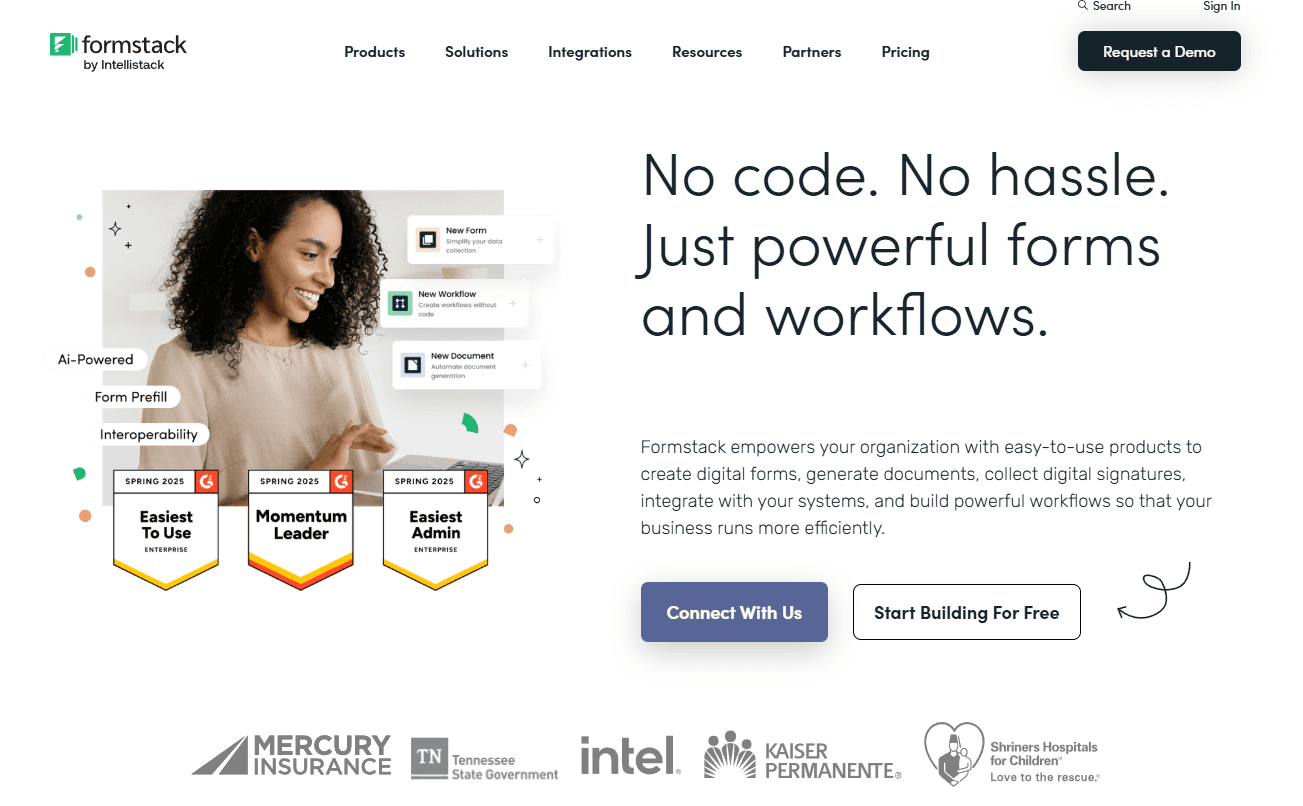
Formstack is a form builder for teams that need more than basic data collection—think conditional logic, workflow routing, document generation, and e-signatures connected in one platform. It's worth a serious look if your team handles regulated data like PHI under HIPAA, or needs forms that feed directly into approval workflows. Compared to JotForm, Formstack gives you more built-in workflow automation without needing as many third-party tools to stitch it all together.
Formstack Evaluation Summary
4.2/5
- From $83/month (billed annually)
- 14-day free trial
Formstack Overview
I believe Formstack serves well as a form building software for teams needing flexibility and customization. Its core features are reliable, though not the most intuitive, making the onboarding process slightly challenging. You might find its standout features satisfactory, but they don't quite leap ahead of competitors like Typeform, Jotform, or Wufoo. In terms of support, while it provides the basics, accessing immediate help can be cumbersome. For the price, Formstack offers decent value, especially if your team requires a platform that can adapt to various needs. It suits small to mid-sized businesses that prioritize customization and are willing to invest time into learning the platform. However, if you're seeking a tool that's ready to go with minimal setup, other options might better suit your needs.
Pros
- You can easily create custom forms to fit your specific needs using a drag-and-drop builder.
- It streamlines the form design and data collection process with reusable templates and form routing.
- The platform is user-friendly, even with advanced features like conditional logic and centralized dashboard views for admins and team members.
Cons
- Users report poor customer support during critical issues.
- The platform can be challenging to use for complex workflows.
- Some users experience difficulties with the cancellation process.
Is Formstack Right For Your Needs?
Who Would be a Good Fit for Formstack?
Formstack is ideal for teams and businesses that need a robust tool for online form builder tasks, document generation, and electronic signature collection. If you're in industries like healthcare or education, Formstack's features can streamline your business processes and enhance efficiency. The platform's no-code form builder, integration with tools like Salesforce, and HIPAA-compliant features (HIPAA plan availability for Forms/Docs) make it a strong choice for those looking to manage sensitive data securely and effectively.
- Education ManagementFormstack's digital forms and document generation are ideal for managing student data and engagement.
- Healthcare ServicesThe platform's HIPAA-compliant features and compliance options help enable secure patient form submission and management (HIPAA forms and best-practice guides are available on Formstack.com). Forms ensure secure patient data collection and management.
- Marketing TeamsWith its campaign-oriented templates and analytics like Field Bottlenecks, Formstack helps you optimize strategies and improve conversion rates.
- Small BusinessesFormstack's no-code online form builder helps you to quickly set up forms and automate workflows without technical expertise. You can also collect payments via gateways like PayPal and Stripe.
- Financial ServicesSecure payment processing and PCI compliance help with transactions and sensitive data handling.
- Human ResourcesAutomate employee onboarding and manage approvals and notifications effectively with workflow automation.
Who Would be a Bad Fit for Formstack?
If your team needs advanced analytics or deep integration with financial ERPs, Formstack might not be the best choice. While it connects to many apps (250+ integrations), niche finance tools may still require Zapier bridges. Teams that need real-time and simultaneous, Google Docs-style editing may find Formstack limiting, as it focuses primarily on form submission workflows rather than collaborative document editing. In addition, if your marketing department relies on an in-app CDP-level attribution dashboard, you may need a CRM to complement Formstack.
- Financial SectorFormstack doesn't offer financial features like budgets or expenses, making it unsuitable for finance teams needing deep FP&A capabilities.
- Large EnterprisesLarge companies that require extremely complex and bespoke integrations may find additional middleware or API development.
- Marketing DepartmentsIf your marketing team relies on in-depth, real-time analytics dashboards, Formstack's limitations in these areas might be a dealbreaker.
- IT DepartmentsFor IT teams that require extensive custom coding and technical depth, Formstack's no-code model may feel restrictive. Although API access exists for extensibility,
- Healthcare IndustryHIPAA options do exist for digital forms and documents, but require extensive configuration. Teams requiring out-of-the-box EHR may need to look elsewhere.
- Retail BusinessesRetail businesses needing robust inventory and sales tracking will find Formstack lacking in these functionalities as it primarily focuses on online forms, document generation, and e-signatures.
How We Test & Score Tools
We’ve spent years building, refining, and improving our software testing and scoring system. The rubric is designed to capture the nuances of software selection and what makes a tool effective, focusing on critical aspects of the decision-making process.
Below, you can see exactly how our testing and scoring works across seven criteria. It allows us to provide an unbiased evaluation of the software based on core functionality, standout features, ease of use, onboarding, customer support, integrations, customer reviews, and value for money.
Core Functionality (25% of final scoring)
The starting point of our evaluation is always the core functionality of the tool. Does it have the basic features and functions that a user would expect to see? Are any of those core features locked to higher-tiered pricing plans? At its core, we expect a tool to stand up against the baseline capabilities of its competitors.
Standout Features (25% of final scoring)
Next, we evaluate uncommon standout features that go above and beyond the core functionality typically found in tools of its kind. A high score reflects specialized or unique features that make the product faster, more efficient, or offer additional value to the user.
We also evaluate how easy it is to integrate with other tools typically found in the tech stack to expand the functionality and utility of the software. Tools offering plentiful native integrations, 3rd party connections, and API access to build custom integrations score best.
Ease of Use (10% of final scoring)
We consider how quick and easy it is to execute the tasks defined in the core functionality using the tool. High scoring software is well designed, intuitive to use, offers mobile apps, provides templates, and makes relatively complex tasks seem simple.
Onboarding (10% of final scoring)
We know how important rapid team adoption is for a new platform, so we evaluate how easy it is to learn and use a tool with minimal training. We evaluate how quickly a team member can get set up and start using the tool with no experience. High scoring solutions indicate little or no support is required.
Customer Support (10% of final scoring)
We review how quick and easy it is to get unstuck and find help by phone, live chat, or knowledge base. Tools and companies that provide real-time support score best, while chatbots score worst.
Customer Reviews (10% of final scoring)
Beyond our own testing and evaluation, we consider the net promoter score from current and past customers. We review their likelihood, given the option, to choose the tool again for the core functionality. A high scoring software reflects a high net promoter score from current or past customers.
Value for Money (10% of final scoring)
Lastly, in consideration of all the other criteria, we review the average price of entry level plans against the core features and consider the value of the other evaluation criteria. Software that delivers more, for less, will score higher.
Core Features
No-Code Online Forms: You can easily create online forms without any coding skills using a drag-and-drop builder, making data collection straightforward. This feature simplifies your work by allowing quick deployment of forms for any purpose, including event registration and landing pages for form submissions.
Document Automation: Generate professional documents from the data you collect, saving you time on manual document creation. This document generation ensures consistency and professionalism and pairs well with Formstack Documents for end-to-end automation.
eSignature Solutions: Collect secure e-signatures/electronic signatures with ease, streamlining your approval processes. This feature is perfect for those needing quick and secure sign-offs on important documents.
Process Automation: Create efficient workflows in minutes just by drag-and-drop using Formstack’s Workflows. You can also employ Workflows Pro if you want to add features like step logic, advanced approvals, and API connector access.
Data & Analytics: Gain insights into your data to improve conversion rates, enable Field Bottlenecks to pinpoint friction, and optimize the end-user experience.
Payment Processing: Collect payments securely and efficiently, which is crucial for any transaction-based operations through PayPal and Stripe.

Ease of Use
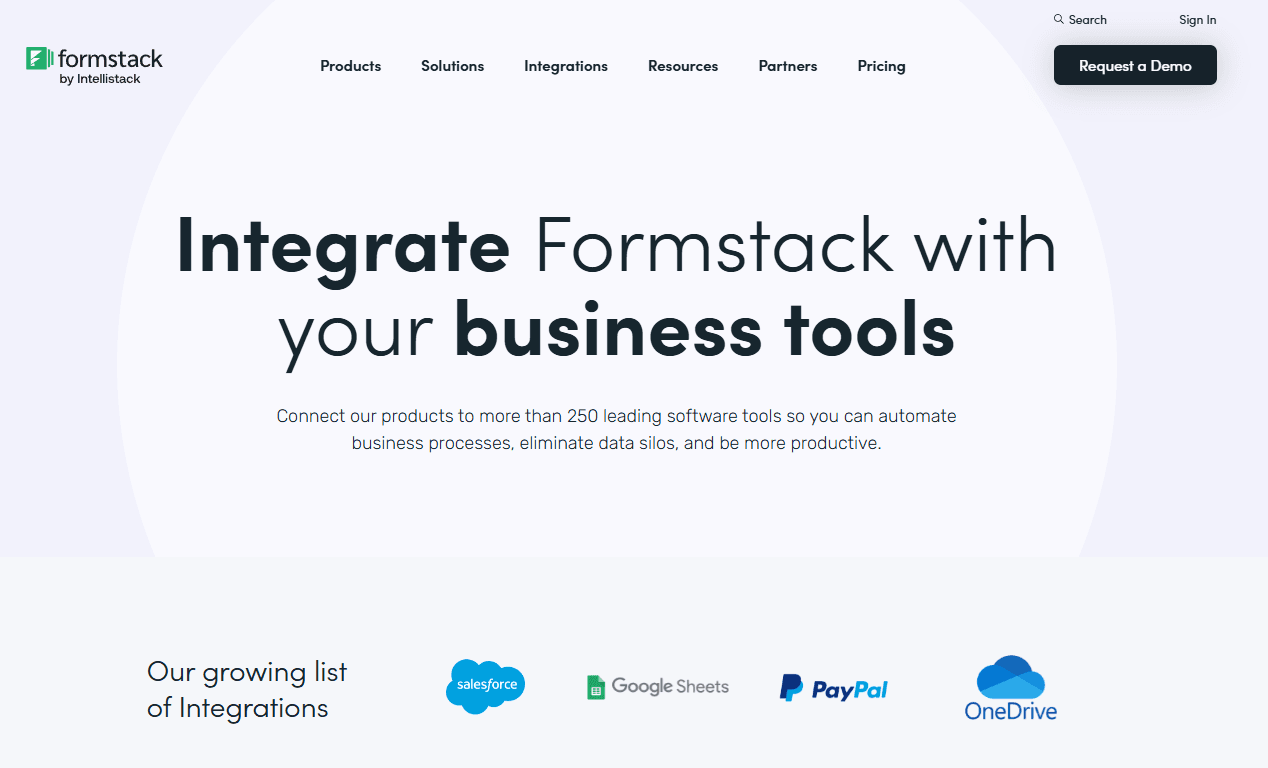
Formstack is straightforward for your team to use, though it can be a bit overwhelming due to its extensive features and options. Users appreciate its intuitive navigation and user-friendly interface, which make data collection and management tasks simpler. However, some users find the learning curve steep due to the numerous functionalities available. Despite this, Formstack support resources, including chat and clear documentation, help ease the transition and empower you to efficiently manage customer data.
Integrations
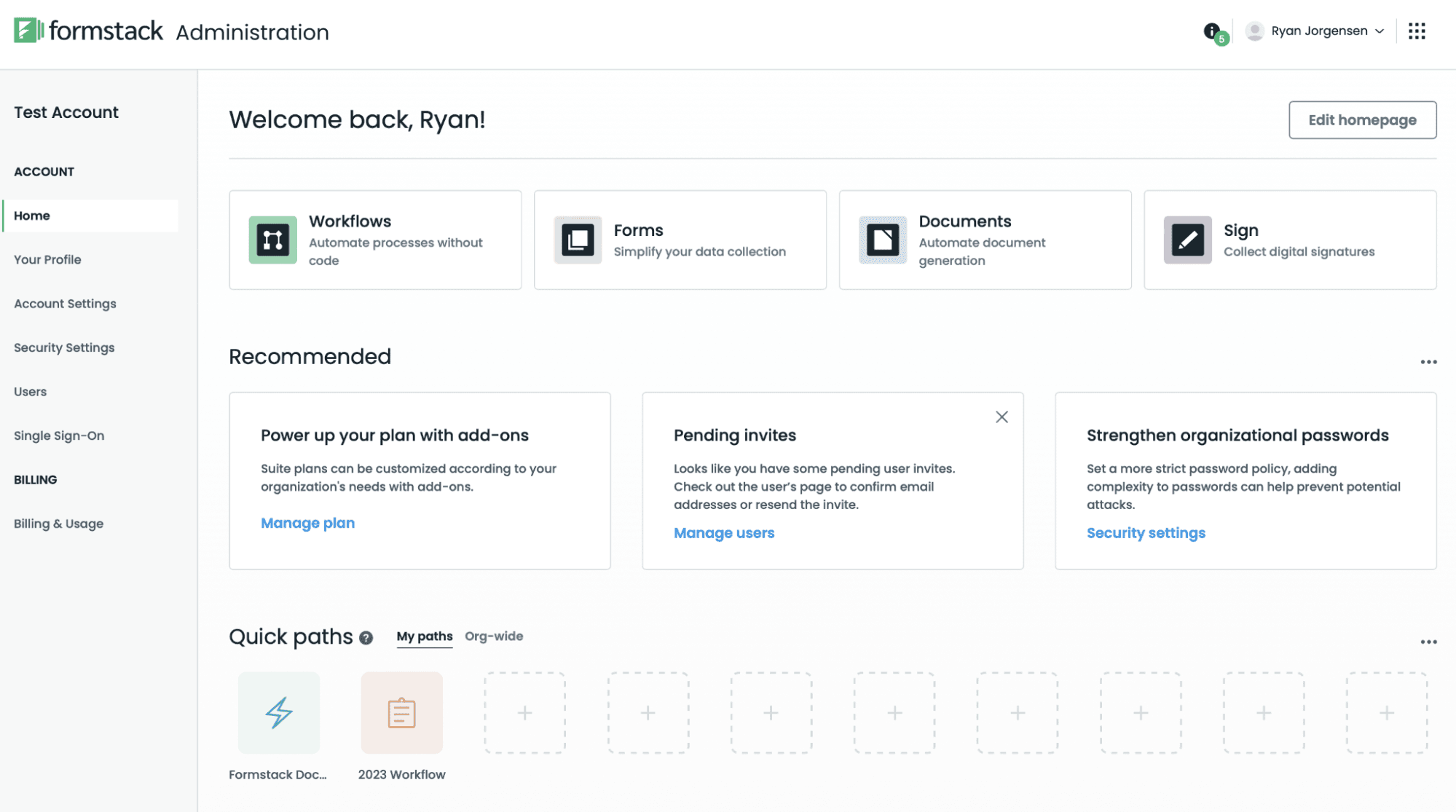
Formstack integrates with Salesforce, Google Sheets, PayPal, Microsoft OneDrive, Google Drive, Dropbox, Stripe, Zapier, Smartsheet, HubSpot, and Zendesk. You can also import from Google Forms, Typeform, Mailchimp, or even older builders using the importer, or trigger actions to other apps through Zapier, which helps bridge data into your CRM and marketing stack.
Formstack Specs
- Analytics: No
- API: Yes
- Calendar Management: No
- Chat: No
- Click-to-Dial: No
- CRM Integration: No
- Customer Management: No
- Customer Service: No
- Dashboard: No
- Dashboards: No
- Data Export: Yes
- Data Import: No
- Data Visualization: No
- External Integrations: Yes
- Feedback Management: No
- Knowledge Base: No
- Lead Management: No
- Lead Scoring: No
- Multi-Source Feedback: No
- Multi-User: Yes
- Net Promoter Score: No
- Notifications: Yes
- Omnichannel Referrals: No
- Online Surveys: Yes
- Review Moderation: No
- Scheduling: No
- Sentiment Analysis: No
- Social Media Monitoring: No


