

Kissmetrics-anmeldelse: Fordele, ulemper, funktioner og priser
Kissmetrics udmærker sig ved at tilbyde handlingsorienteret analyse og brugerindsigt, hvilket gør det til et oplagt valg for teams, der fokuserer på at forbedre kundeengagementet.

We review tools independently, and commissions help fund our testing. See our transparency policy, our methodology, or suggest a tool.
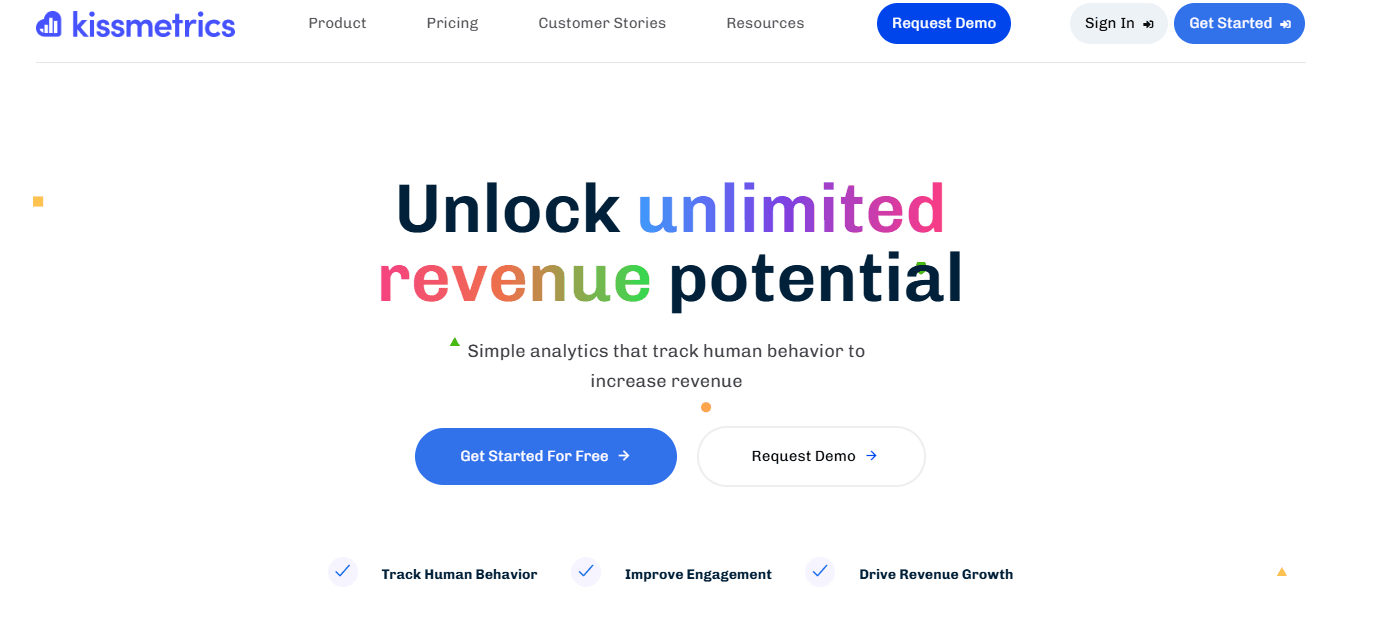
Kissmetrics is a customer journey analytics software that tracks individual user behavior across the full lifecycle—from acquisition through conversion and retention. I'd consider it when your team needs to connect what users do to revenue outcomes like MRR and churn, not just page-level activity. If you've evaluated Mixpanel, Kissmetrics takes a more revenue-focused approach, which makes it a better fit for SaaS and ecommerce teams who need behavioral data tied directly to business performance.
Kissmetrics Evaluation Summary
4.1/5
- From $99/month
- 7-day free trial + free demo available
Why Trust Our Software Recommendations
6,700+
Reviews
20
Industry experts
16+
Evaluation factors
14
Years
Our team has been testing and reviewing software since 2012. As CX leaders ourselves, we know how difficult—and important—it is to choose the right software.
For this guide, we evaluated tools using hands-on testing and independent research, scoring tools using our selection criteria.
Our reviews reflect our human editorial judgment, not a sales pitch.
 Gui DrusinaCreative Director
 Tim FisherVP of AI
Kissmetrics Overview
In my opinion, Kissmetrics serves as a competent customer journey analytics platform for businesses looking to dive into customer analytics. Its standout features, like detailed segmentation and funnel reports, offer valuable insights that are crucial for data-driven decisions. While the interface might not be the easiest to navigate, the comprehensive help resources mitigate this challenge. Compared to competitors like Google Analytics and Mixpanel, Kissmetrics excels in data depth but can lag in user-friendliness. It's best suited for teams that prioritize data insights over ease of use. If your team is prepared to invest time in learning the platform, you'll find the value for money quite compelling.
Pros
- You can track user behavior across multiple devices.
- The funnel reports help you identify where users drop off.
- The cohort analysis lets you see how user behavior changes over time.
Cons
- It lacks real-time data reporting.
- Your team might find the interface outdated compared to competitors.
- You may experience a steep learning curve initially.
Is Kissmetrics Right For Your Needs?
Who Would be a Good Fit for Kissmetrics?
If you're part of a marketing team or a product manager focused on understanding customer behavior, Kissmetrics is a solid choice as a metrics and analytics solution. It offers detailed data analysis that helps track user engagement and conversion rates, giving you the data needed to make informed decisions. With features like cohort analysis and funnel reporting, businesses can use Kissmetrics to dive deep into customer journeys and optimize their marketing strategies.
- E-commerceTrack customer behavior and optimize sales funnels with Kissmetrics's detailed analytics.
- SaaS CompaniesUse cohort analysis to understand user interaction, retention and improve product features.
- Marketing TeamsAnalyze campaign performance and refine strategies with real-time data insights to see instant results of your marketing efforts.
- Product ManagersLeverage funnel reports to enhance user experience and boost conversion rates.
- StartupsBenefit from actionable insights to accelerate growth and understand market fit.
- Data AnalystsUtilize comprehensive reports to support data-driven decision-making processes.
Who Would be a Bad Fit for Kissmetrics?
If you're a small business or startup with limited resources, Kissmetrics might not be the best choice. The platform's advanced analytics features may be more than you need, making it difficult to justify the cost. Additionally, companies seeking extensive integrations might find Kissmetrics lacking, as its integration options can be limited. If your team isn't focused on detailed customer behavior analysis, you might not fully leverage its capabilities.
- Small StartupsKissmetrics can be too costly and complex for small startups that don't need in-depth analytics.
- Budget-Conscious TeamsIf budget is a concern, Kissmetrics's pricing might not be sustainable for your team.
- Simple Reporting NeedsFor teams that only need basic reporting, Kissmetrics's advanced features are unnecessary.
- Limited Tech ResourcesCompanies with small tech teams might struggle with the setup and maintenance of Kissmetrics.
- Non-Analytical DepartmentsDepartments that don't focus on customer behavior analysis might not benefit from Kissmetrics.
- Integration-Heavy EnvironmentsIf your work relies on numerous integrations, Kissmetrics's limited options could be a barrier.
How We Test & Score Tools
We’ve spent years building, refining, and improving our software testing and scoring system. The rubric is designed to capture the nuances of software selection and what makes a tool effective, focusing on critical aspects of the decision-making process.
Below, you can see exactly how our testing and scoring works across seven criteria. It allows us to provide an unbiased evaluation of the software based on core functionality, standout features, ease of use, onboarding, customer support, integrations, customer reviews, and value for money.
Core Functionality (25% of final scoring)
The starting point of our evaluation is always the core functionality of the tool. Does it have the basic features and functions that a user would expect to see? Are any of those core features locked to higher-tiered pricing plans? At its core, we expect a tool to stand up against the baseline capabilities of its competitors.
Standout Features (25% of final scoring)
Next, we evaluate uncommon standout features that go above and beyond the core functionality typically found in tools of its kind. A high score reflects specialized or unique features that make the product faster, more efficient, or offer additional value to the user.
We also evaluate how easy it is to integrate with other tools typically found in the tech stack to expand the functionality and utility of the software. Tools offering plentiful native integrations, 3rd party connections, and API access to build custom integrations score best.
Ease of Use (10% of final scoring)
We consider how quick and easy it is to execute the tasks defined in the core functionality using the tool. High scoring software is well designed, intuitive to use, offers mobile apps, provides templates, and makes relatively complex tasks seem simple.
Onboarding (10% of final scoring)
We know how important rapid team adoption is for a new platform, so we evaluate how easy it is to learn and use a tool with minimal training. We evaluate how quickly a team member can get set up and start using the tool with no experience. High scoring solutions indicate little or no support is required.
Customer Support (10% of final scoring)
We review how quick and easy it is to get unstuck and find help by phone, live chat, or knowledge base. Tools and companies that provide real-time support score best, while chatbots score worst.
Customer Reviews (10% of final scoring)
Beyond our own testing and evaluation, we consider the net promoter score from current and past customers. We review their likelihood, given the option, to choose the tool again for the core functionality. A high scoring software reflects a high net promoter score from current or past customers.
Value for Money (10% of final scoring)
Lastly, in consideration of all the other criteria, we review the average price of entry level plans against the core features and consider the value of the other evaluation criteria. Software that delivers more, for less, will score higher.
Core Features
User Segmentation: Kissmetrics lets you dive into customer data and segment it by behavior, location, or other attributes. This helps your team tailor marketing strategies to match each audience's needs.
Funnel Reports: With Kissmetrics, you can track page views, active users and their journeys, and identify where customers drop off in the buying process. This insight allows your team to improve conversion rates by addressing those pain points.
Cohort Analysis: You can compare different user groups over time to understand behavior changes and retention rates. This analysis helps your team make data-driven decisions for customer engagement.
Event Tracking: Kissmetrics offers robust event tracking to monitor specific user actions on your site. Your team can use this to measure the effectiveness of features or campaigns.
Revenue Reporting: The platform ties user actions to revenue, giving you a clear picture of your ROI. This helps your team focus on the most profitable customer interactions.
A/B Testing: Kissmetrics allows you to test different strategies and see which performs better. Your team can optimize user experiences based on real data.

Ease of Use
Kissmetrics isn't the easiest tool to navigate. Users often find its interface a bit complex, requiring some time to get accustomed to its functionalities. Unlike some other platforms that offer more intuitive navigation, you might need to rely on customer support to fully leverage Kissmetrics’ capabilities. The lack of straightforward navigation can be a hurdle, but once you get the hang of it, the robust data and web analytics tools become a significant asset for your team.

Integrations
Kissmetrics integrates with Shopify, HubSpot, MailChimp, Paypal, Callrail, social media like Facebook and Twitter, and more.
Kissmetrics also provides an API and connects with third-party integration tools such as Albato.

Kissmetrics Specs
- A/B Testing: Yes
- AI Integration: Yes
- Analytics: Yes
- API: Yes
- Big Data: Yes
- Campaign Management: Yes
- Conversion Tracking: Yes
- Custom Reports: Yes
- Dashboard: Yes
- Data Export: Yes
- Data Import: Yes
- Data Visualization: Yes
- External Integrations: Yes
- Feedback Management: Yes
- Keyword Tracking: Yes
- Landing Pages: Yes
- Link Tracking: Yes
- Multi-User: Yes
- Notifications: Yes
- Process Reporting: Yes
- Referral Tracking: Yes
- Sentiment Analysis: Yes
- SEO: Yes
- Workflow Management: Yes


