

SparrowDesk-anmeldelse: Fordele, ulemper, funktioner og prisoversigt
Is SparrowDesk the secret weapon for streamlined support—or just another ticketing tool? I dive deep to reveal where it shines, stumbles, and if it’s worth your switch this 2026.

We review tools independently, and commissions help fund our testing. See our transparency policy, our methodology, or suggest a tool.
SparrowDesk is a customer service software for support teams that want a shared ticketing workspace with built-in automation, SLA tracking, and multi-channel inboxes across email, chat, and social. I'd point you toward it if you want something more structured than a plain shared inbox, but less heavy to configure and maintain than Zendesk. You get the routing rules, reporting, and knowledge base features your team needs to scale, without the long implementation cycle that comes with enterprise-grade help desks. That middle ground is where most SMBs actually live.
SparrowDesk Evaluation Summary
4.6/5
- From $16/user/month
- Free plan available; 14-day free trial
Why Trust Our Software Recommendations
6,700+
Reviews
20
Industry experts
16+
Evaluation factors
14
Years
Our team has been testing and reviewing software since 2012. As CX leaders ourselves, we know how difficult—and important—it is to choose the right software.
For this guide, we evaluated tools using hands-on testing and independent research, scoring tools using our selection criteria.
Our reviews reflect our human editorial judgment, not a sales pitch.
 Gui DrusinaCreative Director
 Tim FisherVP of AI
SparrowDesk Overview
If you’re judging SparrowDesk against others, I think it stands out for its fast setup, clear interface, and automation that’s easy for most teams to use right away. I like that you get useful reporting, multi-channel support, and knowledge base features without a long learning curve or complex configuration. Pricing feels fair for what’s included, especially if you want more control than a shared inbox but don’t need deep customization. What you won’t find is an AI-first helpdesk pitch—the automation here is rules-based rather than predictive. I’d suggest SparrowDesk is best if you want structure, solid ticketing, and automation—without the bloat. It’s strongest for growing support teams who want to scale smoothly.
Pros
- Automation features work well for routing and SLAs.
- Native multi-channel inbox covers email, chat, and social.
- Reporting tools give actionable support team insights.
Cons
- Limited advanced workflow configuration for complex needs.
- No built-in community or forum support module.
- Knowledge base editor lacks advanced formatting options.
Is SparrowDesk Right For Your Needs?
Who Would be a Good Fit for SparrowDesk?
SparrowDesk is a strong match for smaller teams, fast-moving startups, and service departments that want minimal IT involvement and quick onboarding. Teams in industries with multichannel support needs and moderate customization demands will appreciate its intuitive automation, responsive customer support, and broad integrations. You’re likely to get the most value if you need straightforward helpdesk software that covers ticketing, inbox management, and core workflows without an overwhelming learning curve.
- SaaS StartupsQuick onboarding and easy automation setup let growing SaaS teams support customers across chat, email, and integrations without IT bottlenecks.
- SMB Customer ServiceSmall and midsize businesses can use SparrowDesk’s core ticketing, tagging, and inbox tools right out of the box and scale up as they grow.
- Nonprofit HelpdesksNonprofit teams can set up ticket routing and respond via multiple channels without advanced technical resources or high ongoing costs.
- Internal IT SupportInternal teams needing to track, assign, and escalate support tickets benefit from simple automation rules and easy-to-use inboxes.
- Agencies With Diverse ClientsMarketing or support agencies handling multiple brands can organize tickets, tag them, and route everything through team chat and other channels in one interface.
- Sales Operations TeamsSales support teams can connect with Salesforce and HubSpot for smooth ticket resolution and customer communication without advanced setup requirements.
Who Would be a Bad Fit for SparrowDesk?
SparrowDesk likely won’t meet the needs of large, complex operations or businesses demanding specialized workflows and heavy customization. Enterprises with layered security, regulated environments, or global teams needing highly tailored interfaces and advanced analytics may face limitations. If your roadmap runs through agentic AI or workforce management, this isn’t the platform that gets you there. It’s not ideal for organizations where deep configuration, custom development, or niche industry compliance are non-negotiable.
- Large Global EnterprisesOrganizations with thousands of users, complex divisions, and strict IT controls will find SparrowDesk’s customization and security options too limited.
- Regulated Financial ServicesBanks and finance firms with demanding compliance and data handling requirements may require more rigorous security features and audit trails than SparrowDesk offers.
- High-Volume E-commerceLarge-scale e-commerce brands with very high ticket loads and specialized order management workflows may hit process and reporting limitations.
- Call Center OperationsTraditional call centers needing telephony integration or real-time queue management will find SparrowDesk’s focus on chat, email, and messaging integrations insufficient.
- Healthcare Support TeamsHealthcare organizations often need HIPAA-ready features and tighter privacy controls, which SparrowDesk does not provide out of the box.
- Enterprise ITSM DepartmentsIT service management teams in big companies needing advanced workflow automation, ITIL alignment, and asset management will outgrow SparrowDesk’s core feature set.
How We Test & Score Tools
We’ve spent years building, refining, and improving our software testing and scoring system. The rubric is designed to capture the nuances of software selection and what makes a tool effective, focusing on critical aspects of the decision-making process.
Below, you can see exactly how our testing and scoring works across seven criteria. It allows us to provide an unbiased evaluation of the software based on core functionality, standout features, ease of use, onboarding, customer support, integrations, customer reviews, and value for money.
Core Functionality (25% of final scoring)
The starting point of our evaluation is always the core functionality of the tool. Does it have the basic features and functions that a user would expect to see? Are any of those core features locked to higher-tiered pricing plans? At its core, we expect a tool to stand up against the baseline capabilities of its competitors.
Standout Features (25% of final scoring)
Next, we evaluate uncommon standout features that go above and beyond the core functionality typically found in tools of its kind. A high score reflects specialized or unique features that make the product faster, more efficient, or offer additional value to the user.
We also evaluate how easy it is to integrate with other tools typically found in the tech stack to expand the functionality and utility of the software. Tools offering plentiful native integrations, 3rd party connections, and API access to build custom integrations score best.
Ease of Use (10% of final scoring)
We consider how quick and easy it is to execute the tasks defined in the core functionality using the tool. High scoring software is well designed, intuitive to use, offers mobile apps, provides templates, and makes relatively complex tasks seem simple.
Onboarding (10% of final scoring)
We know how important rapid team adoption is for a new platform, so we evaluate how easy it is to learn and use a tool with minimal training. We evaluate how quickly a team member can get set up and start using the tool with no experience. High scoring solutions indicate little or no support is required.
Customer Support (10% of final scoring)
We review how quick and easy it is to get unstuck and find help by phone, live chat, or knowledge base. Tools and companies that provide real-time support score best, while chatbots score worst.
Customer Reviews (10% of final scoring)
Beyond our own testing and evaluation, we consider the net promoter score from current and past customers. We review their likelihood, given the option, to choose the tool again for the core functionality. A high scoring software reflects a high net promoter score from current or past customers.
Value for Money (10% of final scoring)
Lastly, in consideration of all the other criteria, we review the average price of entry level plans against the core features and consider the value of the other evaluation criteria. Software that delivers more, for less, will score higher.
Core Features
Shared Ticketing Inbox
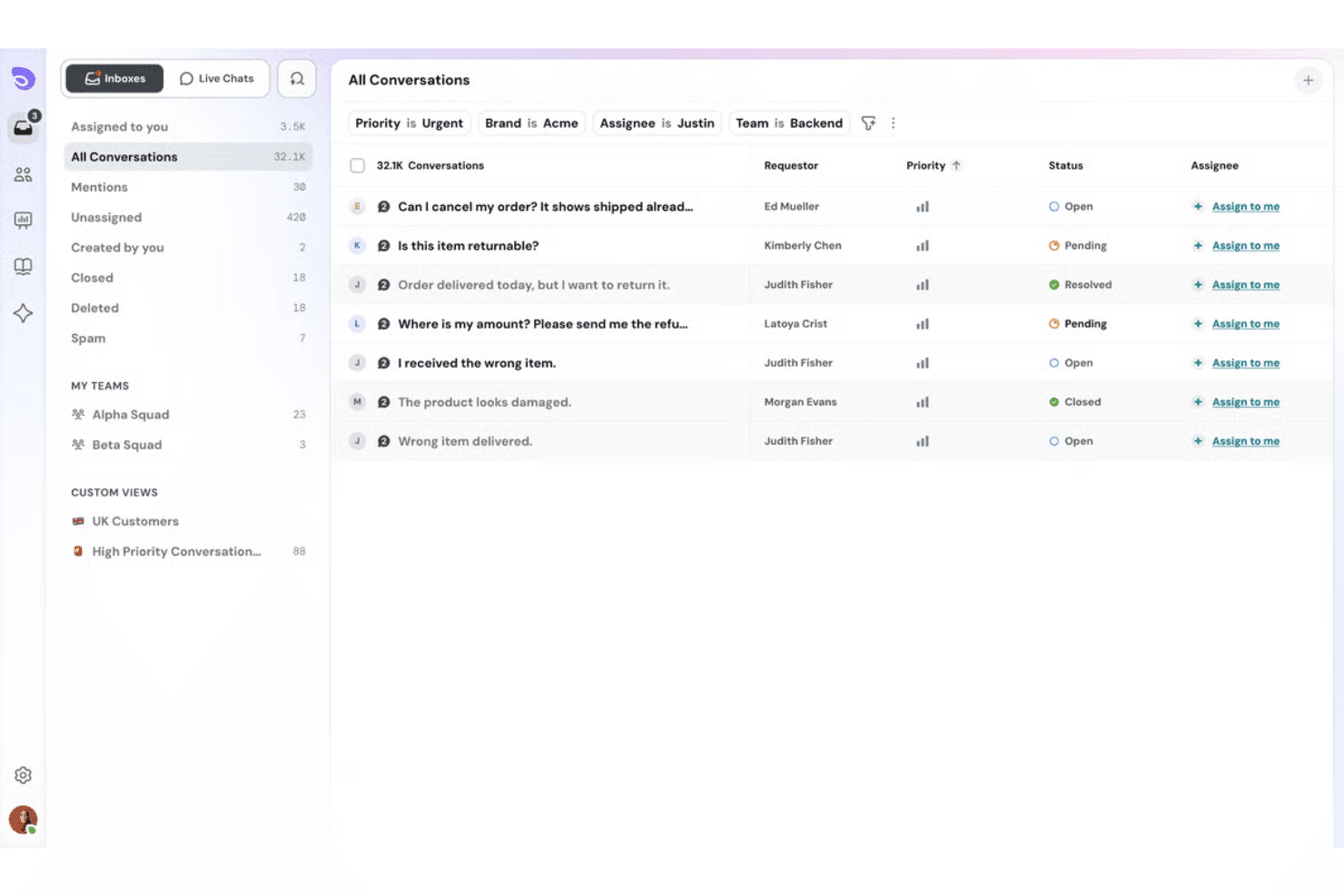
A single omnichannel inbox for tickets from email, chat, and social. Assign and reply together, keeping every conversation organized and visible.
Automation and Ticket Routing
Route tickets by priority, keywords, or SLA need. Macros and rules send the right ticket to the right agent, so response times drop without extra headcount.
SLA Management
Track and enforce response times with customizable SLAs tied to your business hours. Get warned before a ticket breaches, so commitments hold.
Knowledge Base
Build a searchable, self-serve help center for customers and agents. Good articles drive auto-resolution; the editor covers basic formatting only.
Reporting and Analytics
Dashboards break down agent productivity, resolution times, ticket trends, and CSAT. Use them to spot issues, cut response times, and plan capacity.
Multi-Channel Support
Handle email, live chat, and social messages in one unified inbox. No tool-switching—every conversation sits in one place with full context.
Ease of Use
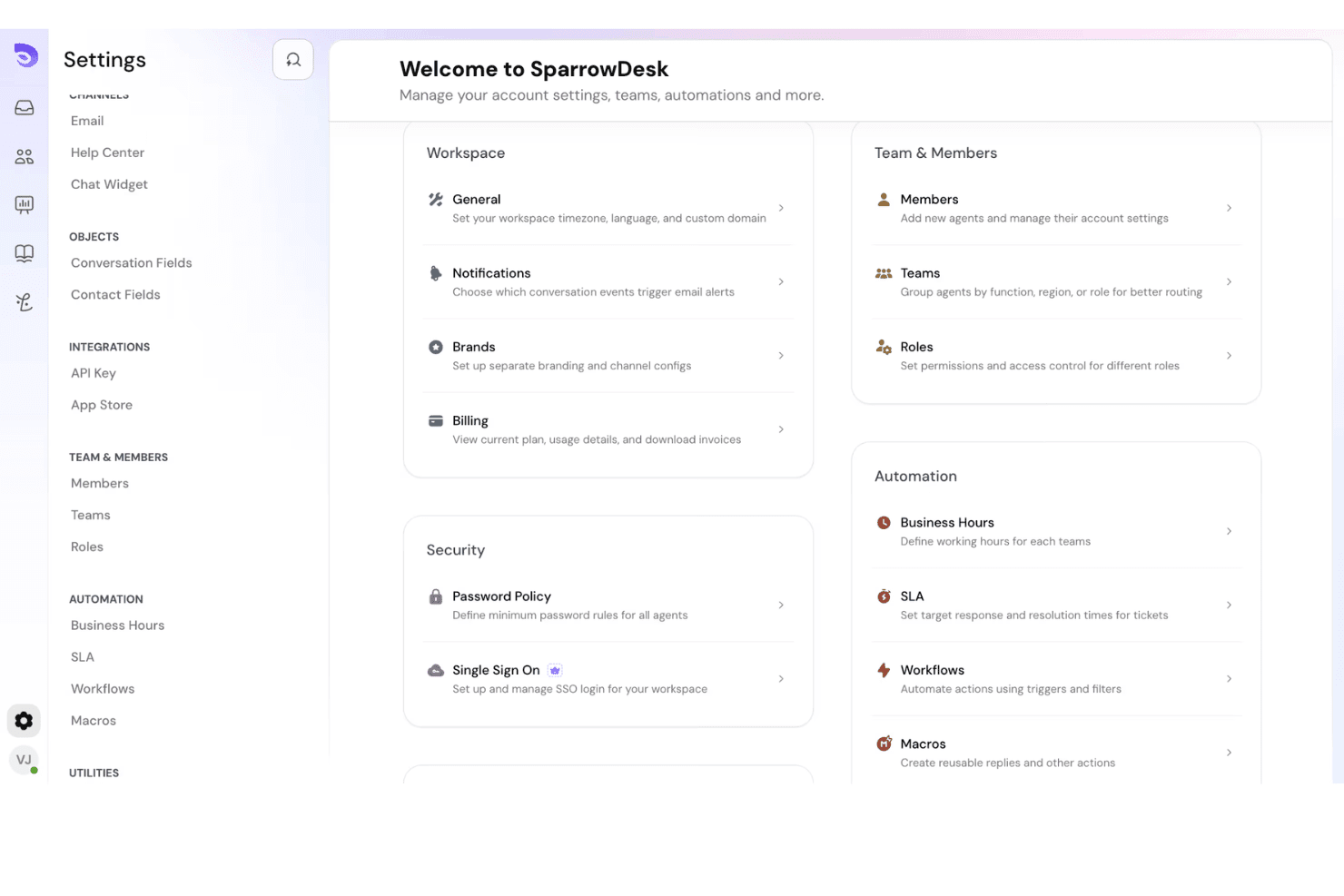
SparrowDesk is easy to pick up thanks to its clean interface and low setup requirements. Setting up automation and SLA rules feels intuitive, and most teams can get started without IT support. The multi-channel inbox keeps tickets organized, and common actions like assigning, tagging, or escalating tickets are simple. There’s no AI copilot drafting replies and no AI agent deflecting tickets before an agent sees them, so expect to do the work yourself—just with less friction. Some users wish for more customization, but overall, you’re not going to get bogged down in menus or confusing workflows.
Integrations
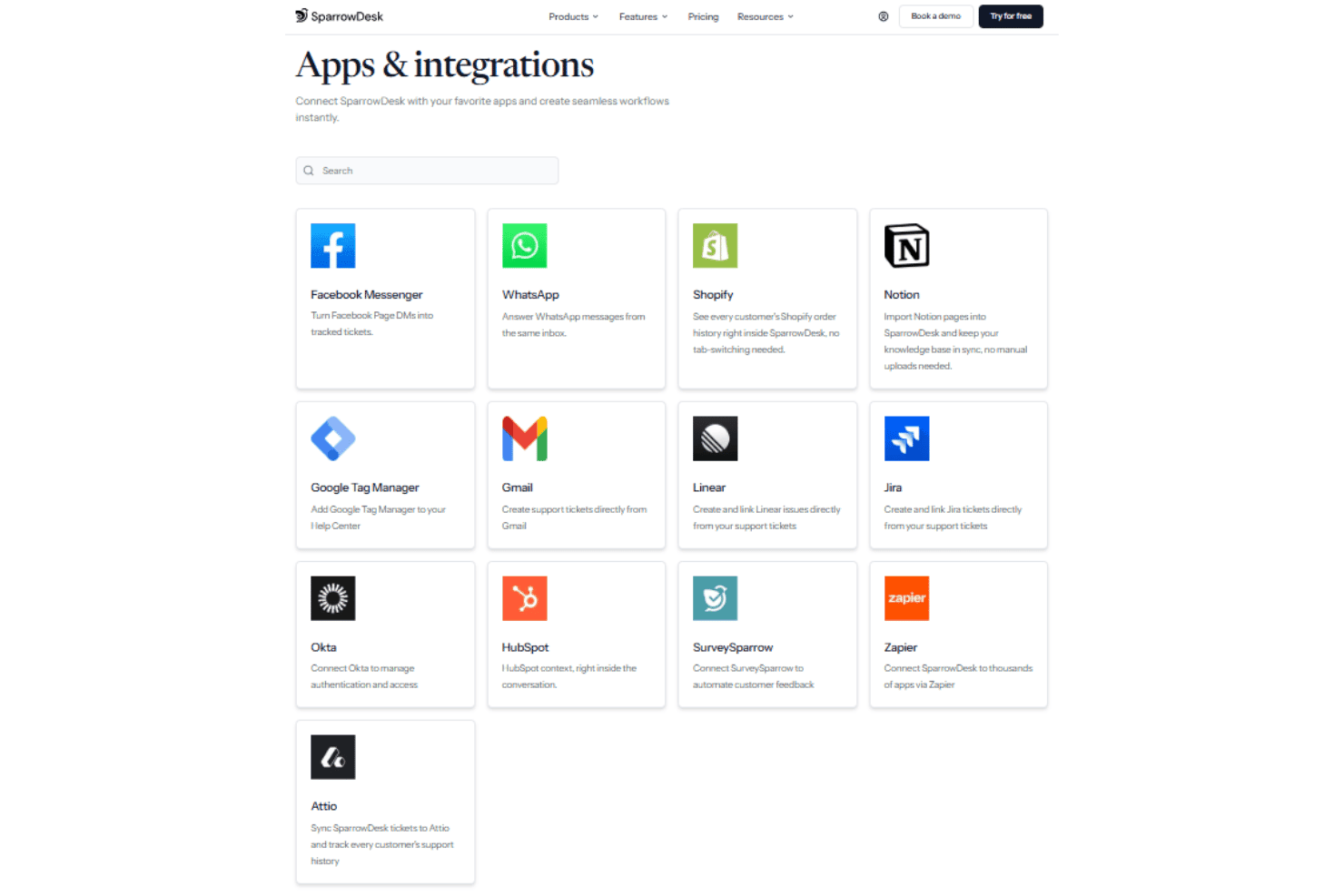
SparrowDesk integrates with email, Slack, Microsoft Teams, Google Workspace, Salesforce, HubSpot, Jira, Zendesk, Facebook Messenger, and WhatsApp, among others, so your CRM, chat, and issue tracker all feed the same queue. SparrowDesk also offers an API and supports connections with third-party integration tools.
SparrowDesk Specs
- Analytics: Yes
- API: Yes
- Call Integration: Yes
- Chat: Yes
- Contact Management: Yes
- CRM Integration: Yes
- Customer Management: Yes
- Dashboard: Yes
- Data Export: Yes
- Data Import: Yes
- Data Visualization: Yes
- Email Integration: Yes
- External Integrations: Yes
- Instant Chat Integration: Yes
- Knowledge Base: Yes
- Lead Management: Yes
- Lead Scoring: Yes
- Multi-User: Yes
- Notifications: Yes
- Real-time Alerts: Yes
- Scheduling: Yes
- Self-service Portal: Yes
- Social Media Integration: Yes
- Support Forum: Yes
- Ticket Management: Yes
- Workflow Management: Yes


