


Moxo-Bewertung: Vor- und Nachteile, Funktionen und Preise



Moxo is a customer service software built around managing structured client workflows through a branded portal. That includes onboarding, document collection, task assignments, and approvals. I'd consider it if your team handles complex, multi-step client interactions and needs more than a standard help desk. If Zendesk feels too narrowly focused on high-volume ticket management for that kind of work, Moxo is the better fit. It's purpose-built for ongoing, relationship-driven client collaboration.
Moxo Evaluation Summary

- From $99/month
- Free plan available
Warum Sie unseren Software-Empfehlungen vertrauen können
Unser Team testet und bewertet Software seit 2012. Als CX-Führungskräfte selbst wissen wir, wie schwierig – und wichtig – es ist, die richtige Software auszuwählen.
Für diesen Leitfaden haben wir Tools mithilfe von praktischen Tests und unabhängiger Recherche bewertet und dabei unsere Bewertungskriterien angewendet.
Unsere Bewertungen spiegeln unser menschliches redaktionelles Urteilsvermögen wider, keine Verkaufsstrategie.
Moxo Overview
In my opinion, Moxo offers a solid suite of features for customer service operations, with standout features that can help organizations gain an edge over competitors. The only downside is Moxo’s usability and onboarding process, which could be smoother, especially for team members not accustomed to complex systems. And while customer support is reliable, it doesn't excel compared to other platforms.
In terms of pricing, Moxo might seem steep at first glance, but it’s often justified for larger enterprises that need advanced functionalities. For smaller businesses, the price may not be worth it, especially if only core features are needed.
In short, if your team prefers having all the tools you need in one powerful platform (even if it’s not the cheapest or simplest option), then Moxo could be a great fit.
pros
-
You can easily collaborate with your team using Moxo's intuitive interface and process templates.
-
Moxo's task management tools help you stay organized and on top of your work.
-
You can quickly share files and documents within the platform.
cons
-
Some users find the initial setup a bit tricky.
-
Moxo's mobile app could use some improvements.
-
You may experience occasional lags with large data sets.
Is Moxo Right For Your Needs?
Who Would be a Good Fit for Moxo?
Moxo is ideal for businesses in finance, legal, and healthcare that need to manage client interactions efficiently. If your work involves complex client onboarding and document management, Moxo's secure messaging, video meetings, and e-signature capabilities make it a solid choice. Its workflow automation also helps reduce manual tasks (like invoicing and file sharing) so you can maintain consistent service delivery, which is crucial for keeping stakeholders engaged and happy.
-
Finance Teams
Moxo's automated alerts and secure portals simplify client communications and document management, helping you stay compliant and efficient.
-
Legal Firms
Use Moxo for client onboarding and case management with its e-signature and secure messaging features.
-
Healthcare Providers
Moxo supports patient onboarding and document sharing securely, making it easier for you to manage sensitive information.
-
Real Estate Agencies
Streamline client interactions with Moxo's customizable portals, perfect for managing property documents and client communications.
-
Consulting Firms
Moxo's collaboration tools and workflow automation features help you manage client projects efficiently and stay on track.
-
Marketing Agencies
With Moxo, you can manage client campaigns and communications in one platform, reducing email clutter and improving project tracking.
Who Would be a Bad Fit for Moxo?
Moxo’s reliance on continuous internet connectivity can be limiting for businesses with poor internet access. Additionally, if your work doesn't require a heavy focus on client engagement or collaboration features, Moxo's extensive client interaction tools might be unnecessarily complex.
-
Small Teams
Moxo might be too complex and feature-rich for small teams that don't need extensive client interaction tools.
-
Offline Work Environments
If your team often works offline, Moxo's need for constant internet access could be limiting.
-
Basic Task Management
For those needing only simple task management, Moxo's comprehensive set of features may be overwhelming.
-
Limited Budget Companies
Moxo's advanced features might not justify its cost for companies with tight budgets.
-
Non-Collaborative Roles
Roles that don't involve collaboration or client interaction may not fully benefit from a comprehensive platform like Moxo.
-
Industries with Minimal Client Interaction
Industries that don't engage much with clients might find Moxo's client-focused features unnecessary.
Wie wir Tools testen & bewerten
Wir haben jahrelang unser System zur Softwarebewertung entwickelt, verfeinert und verbessert. Unser Bewertungsraster ist darauf ausgelegt, die Nuancen der Softwareauswahl und Merkmale eines effektiven Tools abzubilden, wobei der Fokus auf den entscheidenden Aspekten des Entscheidungsprozesses liegt. Nachfolgend sehen Sie, wie unser Test- und Bewertungssystem anhand von sieben Kriterien funktioniert. Es ermöglicht uns, eine unabhängige Bewertung der Software basierend auf Kernfunktionen, besonderen Merkmalen, Benutzerfreundlichkeit, Onboarding, Kundensupport, Integrationen, Kundenbewertungen und Preis-Leistungs-Verhältnis zu geben.
Kernfunktionen (25% der Gesamtnote)
Der Ausgangspunkt unserer Bewertung ist immer die grundlegende Funktionalität eines Tools. Verfügt es über die Basisfunktionen, die ein Benutzer erwarten würde? Sind einige dieser Kernfunktionen nur in teureren Preisplänen verfügbar? Im Kern erwarten wir, dass ein Tool mit den Grundfunktionen seiner Konkurrenten mithalten kann.
Besondere Merkmale (25% der Gesamtnote)
Anschließend bewerten wir außergewöhnliche Funktionen, die über die üblichen Kernfunktionen hinausgehen. Eine hohe Punktzahl spiegelt spezialisierte oder einzigartige Features wider, die das Produkt schneller, effizienter oder für den Endnutzer besonders wertvoll machen. Wir prüfen außerdem, wie einfach es ist, das Tool mit anderen typischerweise verwendeten Programmen zu integrieren, um die Funktionalität und den Nutzen zu erweitern. Tools mit vielen nativen Integrationen, Verbindungen zu Drittanbietern und API-Zugang für eigene Integrationen erhalten die besten Bewertungen.
Benutzerfreundlichkeit (10% der Gesamtnote)
Wir berücksichtigen, wie schnell und einfach sich Aufgaben ausführen lassen, die zur Kernfunktionalität gehören. Software mit hoher Punktzahl ist gut gestaltet, intuitiv zu bedienen, bietet mobile Apps, stellt Vorlagen bereit und erleichtert auch relativ komplexe Aufgaben erheblich.
Onboarding (10% der Gesamtnote)
Wir wissen, wie wichtig eine schnelle Team-Akzeptanz einer neuen Plattform ist. Deshalb bewerten wir, wie leicht sich ein Tool mit minimalem Training erlernen und benutzen lässt. Wir prüfen, wie schnell ein Teammitglied ohne Vorkenntnisse eingerichtet ist und das Tool nutzen kann. Lösungen mit hoher Bewertung erfordern wenig oder keine Unterstützung.
Kundensupport (10% der Gesamtnote)
Wir beurteilen, wie schnell und einfach man telefonisch, per Live-Chat oder Wissensdatenbank Unterstützung erhält. Tools und Anbieter mit echtem Echtzeit-Support bekommen die besten Bewertungen, während Chatbots am schlechtesten abschneiden.
Kundenbewertungen (10% der Gesamtnote)
Neben unseren eigenen Tests berücksichtigen wir den Net Promoter Score von aktuellen und ehemaligen Nutzern. Wir prüfen, ob sie sich wieder für das Tool entscheiden würden. Software mit hoher Bewertung weist auch einen hohen Net Promoter Score auf.
Preis-Leistungs-Verhältnis (10% der Gesamtnote)
Schließlich bewerten wir unter Berücksichtigung aller anderen Kriterien den durchschnittlichen Preis der Einstiegspläne in Bezug auf die Kernfunktionen und vergleichen den Nutzen der anderen Bewertungskriterien. Software, die mehr für weniger bietet, erhält eine höhere Bewertung.
Core Features
Task Management: Moxo allows you to assign, track, and update tasks in real-time. This helps your team stay in full alignment so that nothing falls through the cracks.
Document Sharing: You can share documents securely within Moxo, which reduces the need for external tools and helps keep your files organized. You’ll find this feature handy for maintaining a single source of truth for your project documents.
Video Conferencing: You can conduct video meetings directly from the platform without having to switch between apps. This is perfect for remote teams needing regular interaction.
Client Engagement: Moxo offers tools for managing client relationships via dedicated client portals. This feature enhances client communication and satisfaction by providing them with a personalized service experience.
Reporting and Analytics Dashboard: Get insights into your operations with Moxo’s reporting tools. This allows you to track key performance metrics and make informed decisions based on real-time data.
Secure Messaging: Communicate securely with your team and clients through Moxo’s encrypted messaging system. This ensures sensitive information remains confidential and protected.

Standout Features
Unified Interface: Moxo stands out with its unified interface that combines multiple communication and collaboration tools in one place. This simplifies your workflow by reducing the need to juggle multiple applications.
Workflow Automation: Automate repetitive project management and account management tasks with Moxo’s workflow automation capabilities. This feature saves time and reduces human error, allowing your team to focus on more critical tasks.
Ease of Use
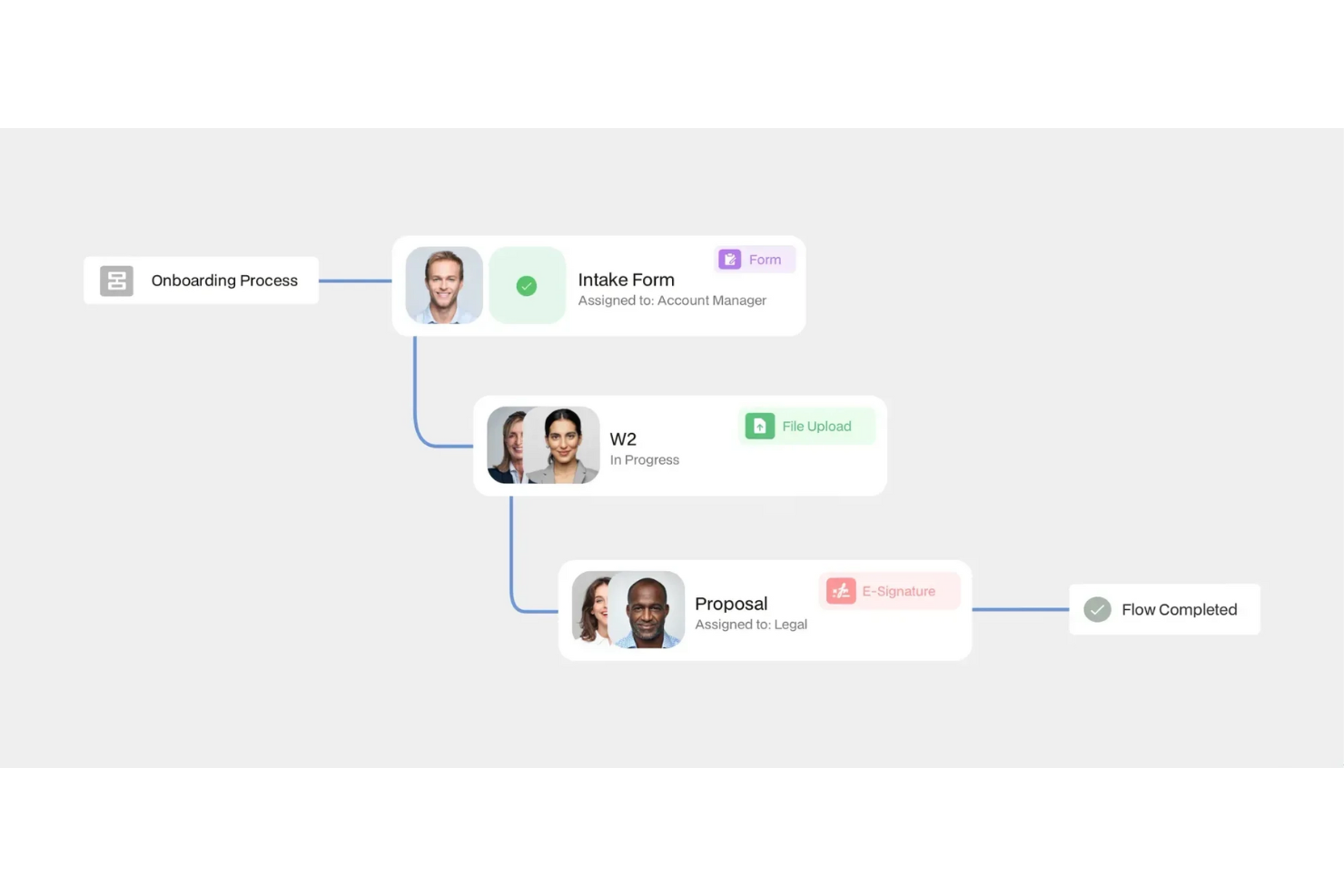
Moxo is relatively user-friendly, with even first-time users often finding its user interface easy to navigate. The layout is organized with clear menus and logical pathways, allowing you to access features without unnecessary clicks. Users also appreciate how tasks can be completed in fewer steps, making it an efficient tool for managing customer interactions.

Onboarding
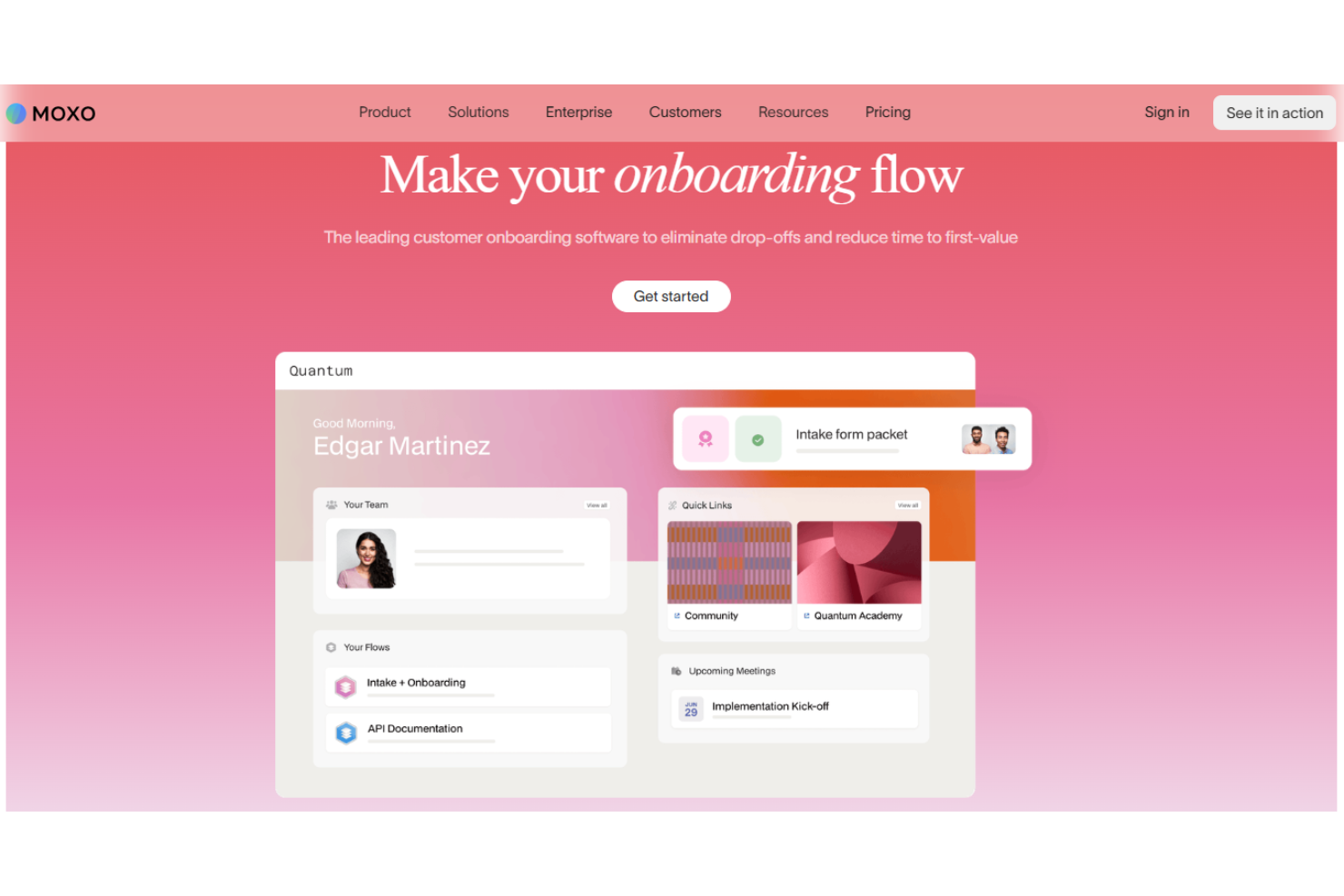
Moxo's onboarding earns moderate praise, with users noting it as adequate but not exceptional. The setup process is clear and straightforward, however, some users wish support was a bit more in depth, interactive, and timely.
These gaps in onboarding support are a big reason why it can take longer to see real value from the platform compared to other workflow automation tools.
Customer Support
Moxo's customer support earns mixed reviews, with users noting a standardized support experience. While some appreciate the accessible contact options, others find them lacking in depth. The support team is reachable, but the overall experience isn't exceptional. Users have access to basic resources, but the level of personalization and proactive assistance doesn't stand out compared to other customer service software. This results in an average experience, leaving room for improvement in terms of responsiveness and customized support.
Integrations
Moxo integrates with Salesforce, HubSpot, Microsoft Dynamics, Zoho, Wealthbox, Redtail, Filevine, Global Relay, Smarsh, and Google Drive.
Moxo also provides an API for creating custom integrations and connects with third-party integration tools like Zapier.

Value for Money
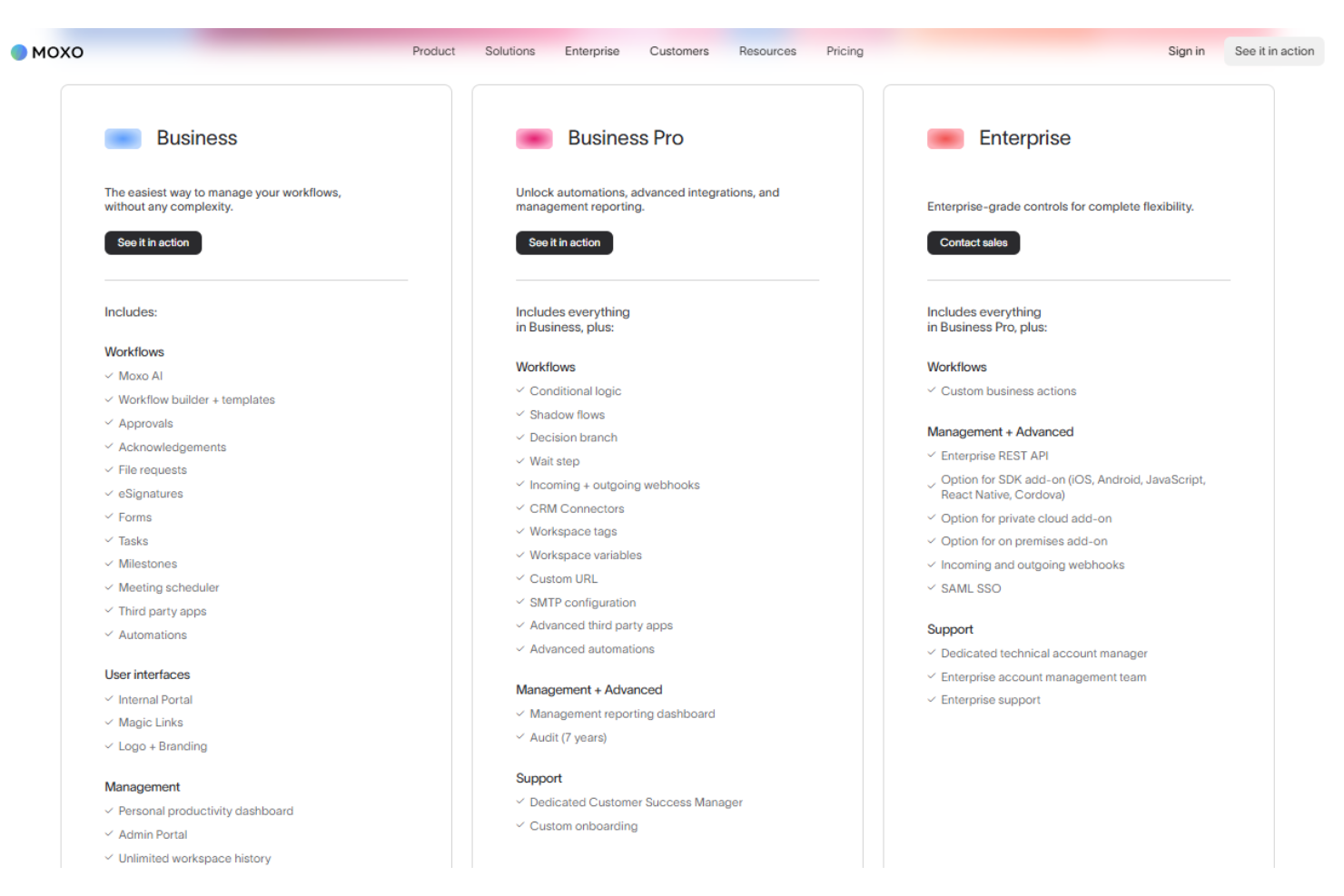
Moxo provides solid value for its price, with user reviews highlighting its cost-effectiveness compared to similar tools. Its pricing model offers different tiers to cater to various team sizes and needs, making it adaptable for diverse business requirements. The availability of a free demo also allows teams to evaluate the software before committing to a purchase.
- Business: Entry-level features for small teams, starting around $100 per month.
- Business Pro: More advanced tools for growing teams, starting around $480 per month.
- Enterprise: Enhanced capabilities and support for larger organizations, custom pricing.
Moxo Specs
- Access Management
- Analytics
- API
- Approval Workflows
- Audit Trail
- Batch Permissions & Access
- Business Rules Mining
- Compliance Tracking
- Custom Reports
- Customer Management
- Data Export
- Data Import
- Document Management
- External Integrations
- Form Builder
- Multi-User
- Notifications
- Process Modeling
- Process Reporting
- Project Management
- Reports
- Risk Assessment
- Roadmapping
- White-label
- Workflow Management
Moxo FAQs
How does Moxo handle data security and compliance?
What support does Moxo offer for onboarding my team?
Can Moxo assist in managing customer service workflows?
How does Moxo ensure effective team collaboration?
Is Moxo customizable to fit our specific needs?
How reliable is Moxo's customer support?
What measures does Moxo take to ensure data integrity?
How does Moxo handle verified users and access control?
Moxo Company Overview & History
Moxo, originally known as Moxtra, is co-founded by Subrah Iyar and Stanley Huang and is built around the idea of using AI and human oversight to simplify business processes. The company is based in Cupertino, CA and serves industries like marketing, technology, financial services, and healthcare. The company is known for collaborating with notable organizations like Procore, Savills, Emirates Bank, and Scotiabank, among its users.
Moxo Major Milestones
- 2012: Co-founded as Moxtra by Subrah Iyar and Stanley Huang.
- 2022: Rebranded as Moxo.