

Reseña de Quickbase: ventajas, desventajas, funciones y precios
Quickbase permite que tu equipo cree aplicaciones personalizadas con facilidad, lo que la convierte en una opción destacada entre las plataformas de datos de clientes.

Revisamos las herramientas de manera independiente, y las comisiones ayudan a financiar nuestras pruebas. Consulta nuestra política de transparencia, nuestra metodología o sugiere una herramienta.
Quickbase is a no-code customer data platform for teams that need to build custom workflows around their customer data without depending on developers to do it. I'd consider it over something like HubSpot if your data model doesn't fit neatly into a standard CRM structure and you need the flexibility to design your own from scratch. It's a strong fit for operations-heavy teams managing complex, multi-step customer processes that off-the-shelf tools just can't accommodate.
Quickbase Evaluation Summary
4.4/5
- From $35/user/month (billed annually)
- 30-day free trial
Por qué confiar en nuestras recomendaciones de software
6,700+
Reviews
20
Industry experts
16+
Evaluation factors
14
Years
Nuestro equipo lleva probando y evaluando software desde 2012. Como líderes de CX, sabemos lo difícil —y lo importante— que es elegir el software adecuado.
Para esta guía, evaluamos las herramientas mediante pruebas prácticas e investigación independiente, puntuando las herramientas según nuestros criterios de selección.
Nuestras reseñas reflejan nuestro criterio editorial humano, no un discurso de ventas.
 Gui DrusinaCreative Director
 Tim FisherVP of AI
Quickbase Overview
In my opinion, Quickbase shines as a customer data platform with its customizable and flexible features, making it ideal for industries like construction and healthcare that require tailored solutions. Its ease of use could be better, but the platform's ability to integrate with existing systems and provide strong customer support makes up for it.
Compared to other platforms, Quickbase offers a reliable mix of basic and advanced features without overwhelming users, though its value for money might not be the best for smaller teams. If your team needs a platform that adapts to complex workflows, Quickbase is worth considering.
Pros
- You can customize Quickbase to fit your team's unique workflows.
- It excels in handling complex project management tasks.
- The platform offers strong customer support to assist your team.
Cons
- Your team might face a learning curve due to its complex user interface.
- It can be less intuitive compared to other platforms.
- Some users find onboarding a bit challenging without prior experience.
Is Quickbase Right For Your Needs?
Who Would be a Good Fit for Quickbase?
Quickbase is perfect for industries like construction, healthcare, and manufacturing where teams need tailored solutions due to complex workflows. If your team requires a no-code or low-code platform that adapts to specific project management needs and offers customization, Quickbase is a great choice. Its flexibility and strong customer support make it ideal for departments that manage intricate processes and need reliable assistance.
- Construction ProjectsQuickbase handles complex project management tasks, making it ideal for construction teams needing to track multiple project variables.
- Healthcare ManagementIt's great for healthcare teams that require customized data management solutions to handle patient and operational data effectively.
- Manufacturing OperationsManufacturing teams benefit from Quickbase's ability to customize workflows and manage intricate operational processes.
- IT DepartmentsIT teams can use Quickbase’s template library to create custom applications that suit their specific needs without heavy coding.
- Marketing TeamsMarketing teams can track campaigns and data analytics efficiently with Quickbase's customizable dashboards and reporting tools.
- Project ManagersProject managers will find Quickbase useful for organizing tasks, timelines, and resources in a flexible, adaptable environment.
Who Would be a Bad Fit for Quickbase?
Quickbase isn't ideal for small businesses with limited budgets or teams that need a simple, intuitive interface. If your team values user experience over customization, Quickbase might feel cumbersome. It can be overwhelming for departments with straightforward processes that don't benefit from its extensive customization options. Teams with minimal tech support may struggle with its learning curve.
- Small StartupsQuickbase's complexity and cost can be too much for startups needing simple, affordable solutions.
- Retail ShopsFor retail, Quickbase's features might be overkill, as simpler point-of-sale systems suffice.
- Non-Tech TeamsTeams with little tech experience may find Quickbase's interface challenging and cumbersome.
- FreelancersFreelancers usually need straightforward tools, making Quickbase's capabilities excessive for solo projects.
- Simple OperationsFor processes that don't require complex customization, Quickbase's features may be unnecessary.
- Educational InstitutionsSchools might find Quickbase's focus on business applications and processes unsuitable for educational management needs.
Cómo Probamos y Evaluamos Herramientas
Hemos pasado años construyendo, refinando y perfeccionando nuestro sistema de evaluación y puntuación de software. La rúbrica está diseñada para capturar los matices de la selección de software y lo que hace que una herramienta sea eficaz, centrándose en los aspectos críticos del proceso de toma de decisiones. A continuación, puedes ver exactamente cómo funcionan nuestras pruebas y puntuaciones en siete criterios. Esto nos permite ofrecer una evaluación imparcial del software basada en funcionalidad principal, características destacadas, facilidad de uso, incorporación, soporte al cliente, integraciones, opiniones de clientes y la relación calidad-precio.
Funcionalidad Principal (25% de la puntuación final)
El punto de partida de nuestra evaluación siempre es la funcionalidad principal de la herramienta. ¿Tiene las funciones básicas que un usuario esperaría? ¿Alguna de esas funciones principales está bloqueada en planes de precios más altos? Consideramos que una herramienta debe estar a la par de las capacidades básicas de sus competidores.
Características Destacadas (25% de la puntuación final)
A continuación, evaluamos aquellas características poco comunes y destacadas que superan la funcionalidad principal típica de herramientas de ese tipo. Una puntuación alta refleja funciones especializadas o únicas que hacen que el producto sea más rápido, eficiente o que aporte un valor adicional al usuario. También evaluamos lo fácil que es integrar la herramienta con otras que típicamente se utilizan en el ecosistema tecnológico para ampliar la funcionalidad y utilidad del software. Las herramientas que ofrecen abundantes integraciones nativas, conexiones de terceros y acceso a API para integraciones personalizadas obtienen la mejor puntuación.
Facilidad de Uso (10% de la puntuación final)
Consideramos lo rápido y sencillo que es ejecutar las tareas definidas en la funcionalidad principal usando la herramienta. El software que puntúa alto está bien diseñado, es intuitivo, ofrece aplicaciones móviles, proporciona plantillas y hace que tareas relativamente complejas parezcan sencillas.
Incorporación (10% de la puntuación final)
Sabemos lo importante que es la rápida adopción del equipo en una nueva plataforma, así que evaluamos lo fácil que es aprender y usar una herramienta con poca formación. Evaluamos cuán rápido un miembro del equipo puede configurarse y comenzar a usar la herramienta sin experiencia. Las soluciones mejor puntuadas requieren poco o ningún soporte.
Soporte al Cliente (10% de la puntuación final)
Revisamos lo rápido y sencillo que es salir de un atasco y encontrar ayuda por teléfono, chat en vivo o una base de conocimientos. Las herramientas y empresas que brindan soporte en tiempo real obtienen la mejor puntuación, mientras que los chatbots obtienen la peor.
Opiniones de Clientes (10% de la puntuación final)
Más allá de nuestras propias pruebas, consideramos el puntaje neto del promotor de los clientes actuales y anteriores. Revisamos la probabilidad de que elijan la herramienta nuevamente para la funcionalidad principal. Un software con alta puntuación refleja un alto puntaje neto del promotor por parte de clientes actuales o anteriores.
Relación Calidad-Precio (10% de la puntuación final)
Por último, considerando todos los demás criterios, analizamos el precio promedio de los planes de nivel inicial frente a las funciones principales y valoramos el resto de los criterios de evaluación. El software que ofrece más por menos obtiene una mayor puntuación.
Core Features
Customizable Dashboards: You can tailor dashboards to fit your team’s specific needs, allowing for easy tracking of key metrics. This flexibility lets you focus on the data that matters most to your projects.
Automated Workflows: Quickbase automates repetitive tasks, freeing up time for your team to focus on more important work. Set up triggers and actions to keep business processes running smoothly without manual intervention.
Reporting and Analytics: Generate detailed reports and analyze data trends to make informed decisions. These tools help you visualize and understand your data better.
Role-Based Access Control: Assign permissions based on user roles to ensure data security and integrity. This feature keeps your sensitive information protected while maintaining team collaboration.
Mobile Access: Access Quickbase on the go with its mobile-friendly interface. It keeps your team connected and productive, no matter where they are. Use its mobile apps for Android and iOS to receive notifications.
Data Import and Export: Easily import data from various sources and export it as needed. This feature ensures your data is always up-to-date and accessible.

Ease of Use
Quickbase is somewhat user-friendly, but it takes time to master due to its complex interface. While the no-code application builder is a plus, users often need time to adjust to its customizable features. Your team might find the learning curve challenging at first, especially if they're used to simpler platforms. However, once familiar, Quickbase's flexibility becomes a significant advantage, allowing your team to tailor solutions to specific needs efficiently.

Integrations
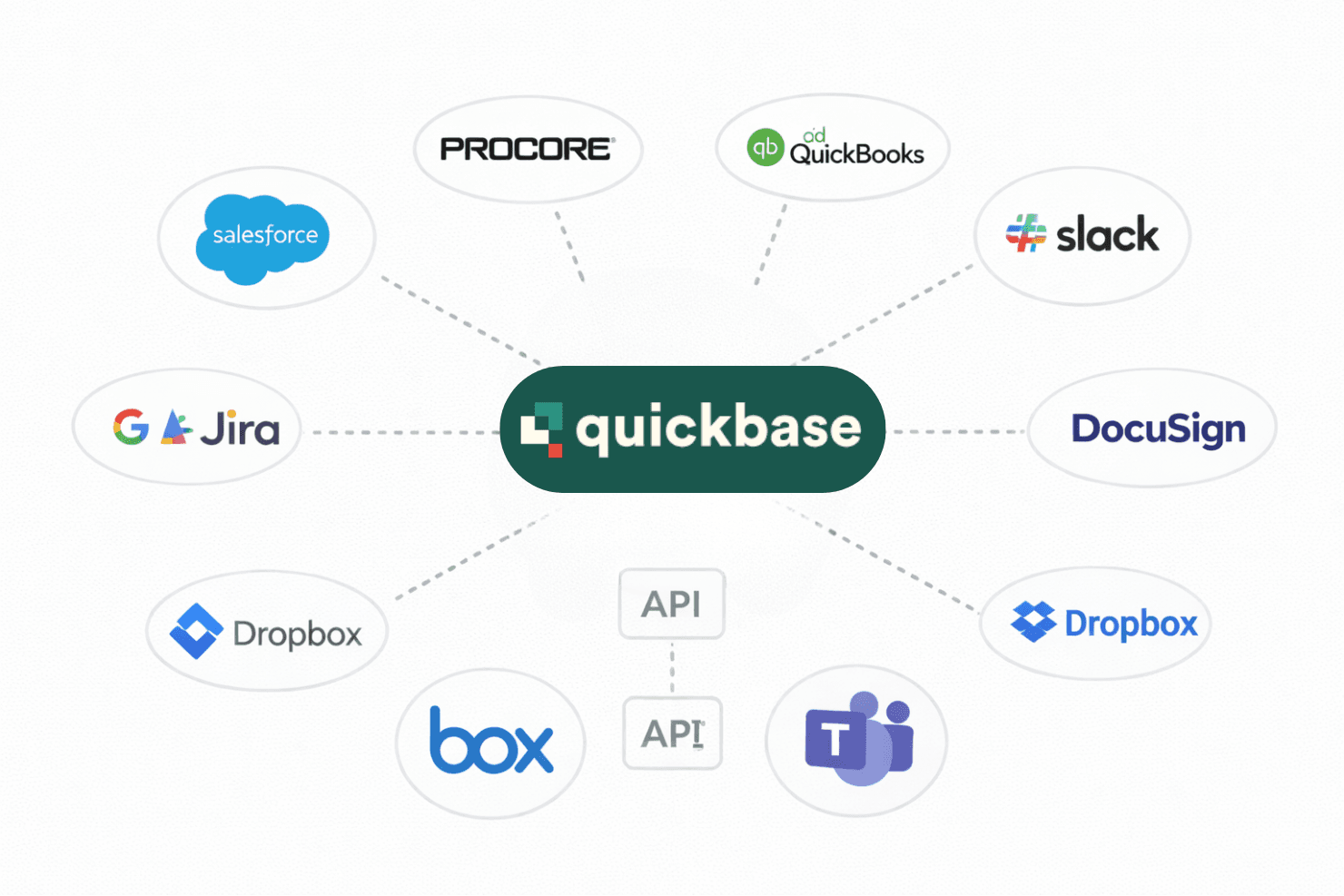
Quickbase integrates with Salesforce, Procore, QuickBooks, Slack, DocuSign, Dropbox, Google Workspace, Jira, Box, and Microsoft Teams.
Quickbase also provides a range of APIs and third-party integration tools, including Quickbase pipelines, which allow users to manage data, report insights, and automate workflows through a user-friendly visual builder.
Quickbase Specs
- A/B Testing: No
- API: Yes
- External Integrations: Yes
- Multi-User: No
- Third-Party Plugins/Add-Ons: No

