

Confluent Review: Pros, Cons, Features and Pricing
Confluent excels in real-time data streaming, offering your team unmatched flexibility in managing customer data efficiently.

We review tools independently, and commissions help fund our testing. See our transparency policy, our methodology, or suggest a tool.
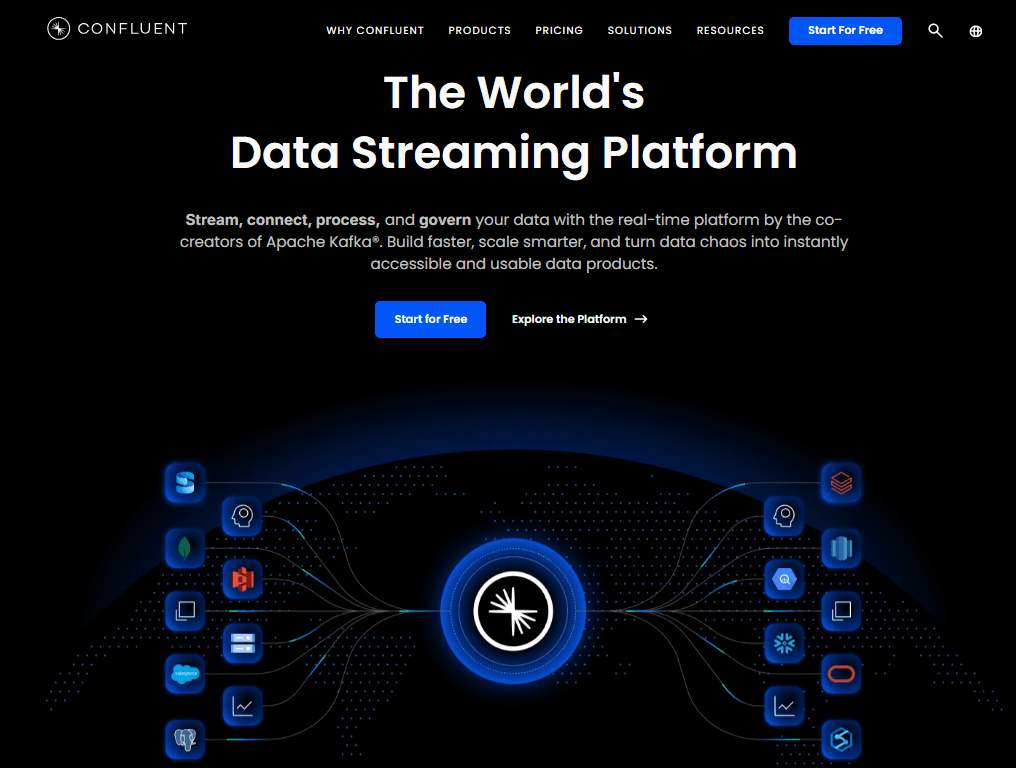
Confluent is a data streaming platform that enables businesses to stream, connect, process, and govern data in real-time, built on Apache Kafka. It best serves industries that require robust data handling capabilities, such as finance, retail, and technology, where real-time analytics and data integration are crucial. Confluent delivers a unified platform for managing continuous data streams, enhancing operational efficiency.
Confluent addresses common pain points like data silos and integration challenges for IT and data teams, enabling seamless data flow across systems. In this article, I'll cover Confluent's features, pros and cons, use cases, and pricing to help you decide if it aligns with your data management needs and organizational goals.
Confluent Evaluation Summary
0/5
- Starts at $1.75/hour
- Free forever plan available
Why Trust Our Software Recommendations
6,700+
Reviews
20
Industry experts
16+
Evaluation factors
14
Years
Our team has been testing and reviewing software since 2012. As CX leaders ourselves, we know how difficult—and important—it is to choose the right software.
For this guide, we evaluated tools using hands-on testing and independent research, scoring tools using our selection criteria.
Our reviews reflect our human editorial judgment, not a sales pitch.
 Gui DrusinaCreative Director
 Tim FisherVP of AI
Confluent Overview
In my opinion, Confluent serves as a solid customer data streaming platform with notable strengths and some room for improvement. Its standout features, like real-time data streaming, set it apart in the market. However, the onboarding process could be more intuitive compared to competitors. While the platform offers good value for money, its customer support might not be as responsive as some users would prefer. If your team values real-time data capabilities and robust integrations, Confluent could be a great match. However, if ease of onboarding and immediate support are priorities, you might want to explore other options.
Pros
- You can handle real-time data streams with ease.
- It supports a wide range of connectors for different data sources.
- Your team can rely on its strong security features.
Cons
- You might find the learning curve steep.
- It can be resource-intensive for your systems.
- Your team might need time to fully leverage its capabilities.
Is Confluent Right For Your Needs?
Who Would be a Good Fit for Confluent?
Confluent is ideal for businesses that need to handle large volumes of real-time data. It's particularly suited for industries like financial services and telecommunications, where instant data processing is crucial. If your team relies on event-driven microservices or needs robust data streaming capabilities, Confluent's advanced features and deployment options can support your goals effectively.
- Financial ServicesConfluent excels in real-time data streaming, making it perfect for financial services needing immediate transaction processing.
- Retail AnalyticsRetailers benefit from Confluent's data integration features, which enhance inventory management and customer insights.
- TelecommunicationsConfluent supports the massive data flows in telecoms, optimizing network performance and customer service.
- Event-Driven MicroservicesConfluent’s platform enables seamless integration and communication between microservices, improving application responsiveness.
- AI ApplicationsFor AI-driven businesses, Confluent facilitates data processing that powers AI insights and decision-making.
- Fraud DetectionConfluent offers real-time data processing capabilities essential for detecting and preventing fraudulent activities.
Who Would be a Bad Fit for Confluent?
If your team doesn't handle real-time data streams, Confluent might not be the best choice. It's designed for managing and integrating data streams, which can be overkill for businesses focused solely on batch data processing or less complex data needs. For example, small businesses or departments that don't require complex data integration might find Confluent's capabilities excessive and its setup unnecessarily complicated.
- Small RetailersConfluent's robust data streaming capabilities are too advanced and costly for small retailers who don't need real-time data analytics.
- Non-Tech StartupsNon-tech startups without a dedicated IT team might struggle with Confluent's complexity, making simpler tools a better fit.
- Local Government OfficesThese offices often have simple data needs and might find Confluent's advanced features unnecessary.
- Traditional ManufacturingManufacturing sectors focused on physical production rather than data-centric processes won't benefit from Confluent's streaming services.
- Basic Customer Support TeamsTeams handling straightforward customer inquiries don't need Confluent's data integration and streaming abilities.
- Educational InstitutionsUnless involved in tech research, educational institutions may not leverage Confluent's full capabilities, making it an inefficient choice.
How We Test & Score Tools
We’ve spent years building, refining, and improving our software testing and scoring system. The rubric is designed to capture the nuances of software selection and what makes a tool effective, focusing on critical aspects of the decision-making process.
Below, you can see exactly how our testing and scoring works across seven criteria. It allows us to provide an unbiased evaluation of the software based on core functionality, standout features, ease of use, onboarding, customer support, integrations, customer reviews, and value for money.
Core Functionality (25% of final scoring)
The starting point of our evaluation is always the core functionality of the tool. Does it have the basic features and functions that a user would expect to see? Are any of those core features locked to higher-tiered pricing plans? At its core, we expect a tool to stand up against the baseline capabilities of its competitors.
Standout Features (25% of final scoring)
Next, we evaluate uncommon standout features that go above and beyond the core functionality typically found in tools of its kind. A high score reflects specialized or unique features that make the product faster, more efficient, or offer additional value to the user.
We also evaluate how easy it is to integrate with other tools typically found in the tech stack to expand the functionality and utility of the software. Tools offering plentiful native integrations, 3rd party connections, and API access to build custom integrations score best.
Ease of Use (10% of final scoring)
We consider how quick and easy it is to execute the tasks defined in the core functionality using the tool. High scoring software is well designed, intuitive to use, offers mobile apps, provides templates, and makes relatively complex tasks seem simple.
Onboarding (10% of final scoring)
We know how important rapid team adoption is for a new platform, so we evaluate how easy it is to learn and use a tool with minimal training. We evaluate how quickly a team member can get set up and start using the tool with no experience. High scoring solutions indicate little or no support is required.
Customer Support (10% of final scoring)
We review how quick and easy it is to get unstuck and find help by phone, live chat, or knowledge base. Tools and companies that provide real-time support score best, while chatbots score worst.
Customer Reviews (10% of final scoring)
Beyond our own testing and evaluation, we consider the net promoter score from current and past customers. We review their likelihood, given the option, to choose the tool again for the core functionality. A high scoring software reflects a high net promoter score from current or past customers.
Value for Money (10% of final scoring)
Lastly, in consideration of all the other criteria, we review the average price of entry level plans against the core features and consider the value of the other evaluation criteria. Software that delivers more, for less, will score higher.
Core Features
Real-Time Data Processing: Confluent lets you process data as it's generated, so your team can react instantly. This capability is crucial for businesses needing immediate insights from customer interactions.
Event Streaming: This feature allows you to stream events from various sources, maintaining a continuous flow of data. Your team can build real-time applications that respond to customer actions as they happen.
Scalable Architecture: Confluent's platform is built to grow with your business, handling increasing amounts of data effortlessly. You won't need to worry about performance drops as your customer base expands.
Data Integration: With Confluent, you can connect disparate data sources into a unified view. This helps your team make informed decisions by having all necessary data at their fingertips.
Security and Compliance: The platform includes built-in security features to protect sensitive customer data. Your team can ensure compliance with industry standards, giving peace of mind regarding data privacy.
Data Transformation: Confluent provides tools to transform raw data into actionable insights. This means your team can tailor data outputs to fit specific business needs quickly.

Ease of Use
Confluent's user interface can be complex, making it difficult for new users to navigate. Despite this, its robust features and extensive integration capabilities make it a powerful tool for managing customer data. The platform's detailed customer support can help you overcome usability challenges. If your team is tech-savvy, Confluent's feature set will likely be beneficial, but expect a learning curve compared to other platforms.

Integrations
Confluent integrates with popular platforms and services including Salesforce, AWS Lambda, Microsoft Azure Blob Storage, MongoDB Atlas, Google BigQuery, Snowflake, Oracle Database, Elasticsearch, IBM MQ, and Datadog.
Confluent also offers an API and connects with third-party integration tools. For more detailed information, users can explore the Confluent Hub.

Confluent Specs
- 2-Factor Authentication: No
- A/B Testing: No
- Analytics: Yes
- API: Yes
- Calendar Management: No
- Contact Management: No
- Dashboard: Yes
- Data Export: Yes
- Data Import: Yes
- Data Mining: No
- Data Visualization: Yes
- External Integrations: Yes
- Forecasting: No
- Keyword Tracking: No
- Multi-User: Yes
- Notifications: Yes
- Scheduling: No
- SEO: No


