

Os sistemas de automatização da experiência do cliente com IA são plataformas de software que utilizam inteligência artificial para automatizar, personalizar e gerir as interações com os clientes através dos canais de suporte, serviço e envolvimento. Se procura formas de gerir volumes maiores, fornecer respostas mais rápidas e aprofundar as relações sem sobrecarregar a sua equipa, estas soluções foram concebidas para si.
Sei como pode ser difícil equilibrar a qualidade com a eficiência e acompanhar as expectativas cada vez maiores dos clientes. Neste guia, encontrará as opções mais eficazes e completas em termos de funcionalidades para o ajudar a escolher o sistema de automatização com IA adequado às necessidades da sua equipa em 2026.
Why Trust Our Software Recommendations
6,700+
Reviews
20
Industry experts
16+
Evaluation factors
14
Years
Our team has been testing and reviewing software since 2012. As CX leaders ourselves, we know how difficult—and important—it is to choose the right software.
For this guide, we evaluated tools using hands-on testing and independent research, scoring tools using our selection criteria.
Our reviews reflect our human editorial judgment, not a sales pitch.
 Gui DrusinaCreative Director
 Tim FisherVP of AI
Tabela comparativa dos sistemas de automatização da experiência do cliente com IA
Esta tabela comparativa resume os detalhes de preços das minhas principais escolhas de sistemas de automatização da experiência do cliente com IA:
| Tool | Best For | Trial Info | Price | ||
|---|---|---|---|---|---|
| 1 | Best for aligning AI and contact center staffing | Free demo available | Pricing upon request | Website | |
| 2 | Best for regulated financial case resolution | Free demo available | Pricing upon request | Website | |
| 3 | Best with instant helpdesk integration | 30-day free trial | From $199/month | Website | |
| 4 | Best voice AI for modern contact centers | Free demo available | Pricing upon request | Website | |
| 5 | Best low-code CX automations for scaling teams | 14-day free trial + free demo available | From $29/user/month (billed annually) | Website | |
| 6 | Best for unified omnichannel journey orchestration | Free trial available | From $75/user/month (billed annually) | Website | |
| 7 | Best for real-time sentiment detection on social | Free demo available | Pricing upon request | Website | |
| 8 | Best analytics suite for actionable CX insights | Free demo available | From $110/agent/month (proactive AI extra) | Website | |
| 9 | Best outbound and predictive dialer capabilities | Free demo available | From $119/seat/month | Website | |
| 10 | Best for workflow automation in chat and messaging | Free demo available | Pricing upon request | Website |


Análises dos melhores sistemas de automatização da experiência do cliente com IA
Apresento abaixo os meus resumos detalhados dos melhores sistemas de automatização da experiência do cliente com IA que entraram na minha lista restrita. As minhas análises oferecem uma perspetiva detalhada sobre as funcionalidades, capacidades e integrações de cada plataforma, para o ajudar a encontrar a melhor opção para si.
 Best for aligning AI and contact center staffing
- Free demo available
- Pricing upon request
Visit WebsiteCustomer Rating:3.7/5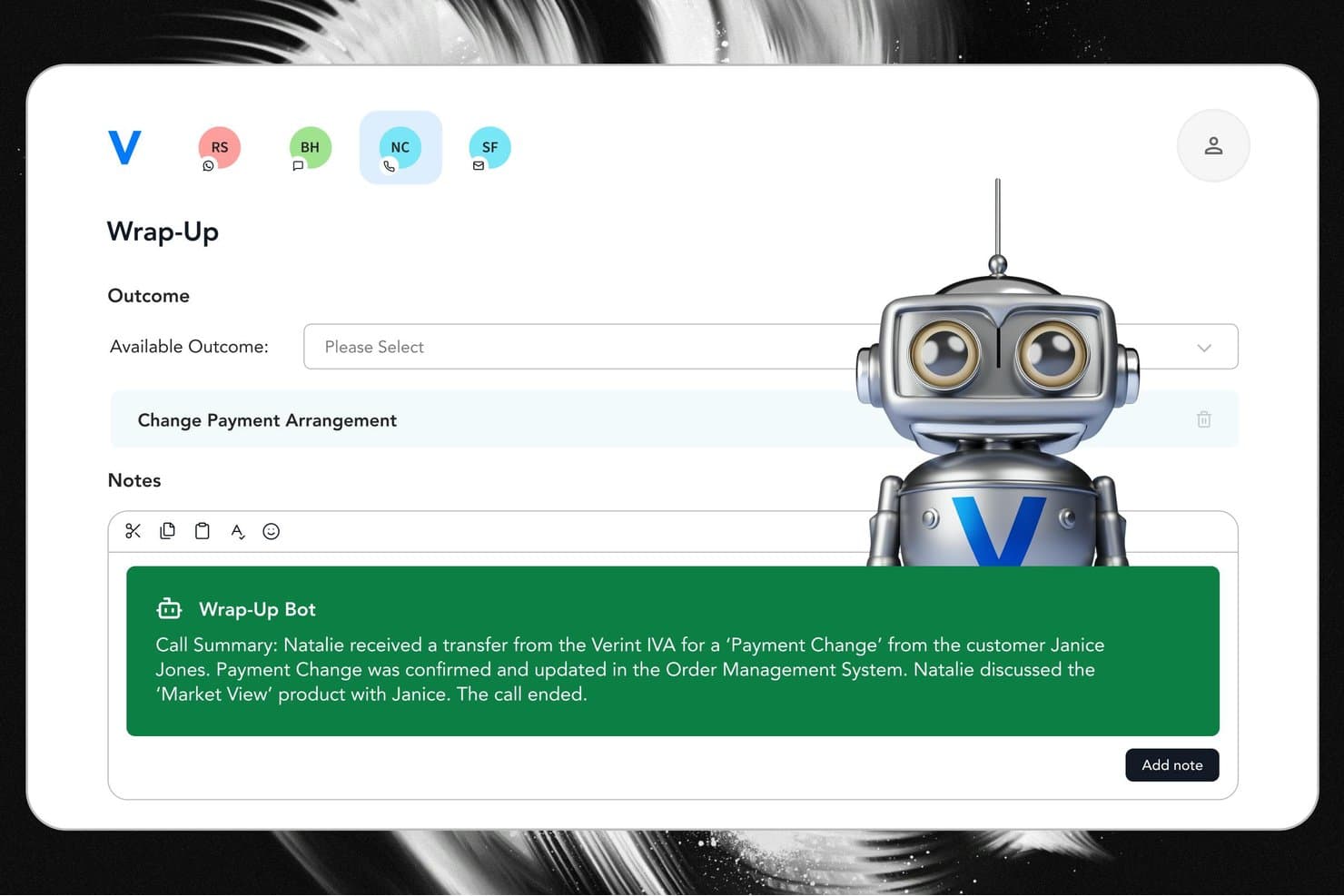
Verint offers an AI-powered Wrap-Up Bot that automatically generates call summaries and suggested outcomes to streamline agent after-call work. Verint is a contact center AI platform that brings together conversational AI agents, workforce engagement management, omnichannel orchestration, and CX analytics to automate customer interactions and workflows across voice and digital channels.
Who Is Verint Best For?
Verint is a strong fit for enterprise contact centers that need to coordinate AI agents and human staffing across high-volume, omnichannel environments.
Why I Picked Verint
I picked Verint as one of the best because no other platform on this list treats AI agents and human staffing as a single, coordinated system. Verint's Workforce Management module forecasts demand and adjusts schedules in real time, while its conversational AI agents handle authentication, payments, and account updates across voice and digital channels, so human agents are freed for higher-complexity work. Its TimeFlex Bot lets agents initiate their own schedule changes using live CX data, which keeps staffing aligned without constant supervisor intervention.
Verint Key Features
- Conversational AI agents: AI agents handle customer authentication, payments, and account updates across IVR, telephony, web chat, mobile app, and messaging channels.
- Agent Factory: A low-code, drag-and-drop environment for building, configuring, and deploying AI agents connected to CRM, billing, and payment systems.
- CX Analytics: Analyzes voice and digital interactions using speech analytics, text analytics, and Voice of the Customer to surface trends and friction points.
- Integration Studio: Connects Verint with third-party applications across more than 500 connectors spanning 300 vendors, including Salesforce, Microsoft, and Workday.
Verint Integrations
Verint offers marketplace integrations with Salesforce, Microsoft, Workday, and ServiceNow, with more than 500 application connectors across 300 vendors. It also provides open APIs and Integration Studio for low-code or pro-code custom integrations, deployment, and monitoring.
Pros and Cons
Pros:
- Workforce scheduling aligns staffing with demand
- Call summaries reduce after-call documentation
- Automated quality monitoring covers all interactions
Cons:
- Reporting filters and exports limit analysis
- Reviewers report lag and inaccurate AI responses
Learn more about Verint: Best for regulated financial case resolution
- Free demo available
- Pricing upon request
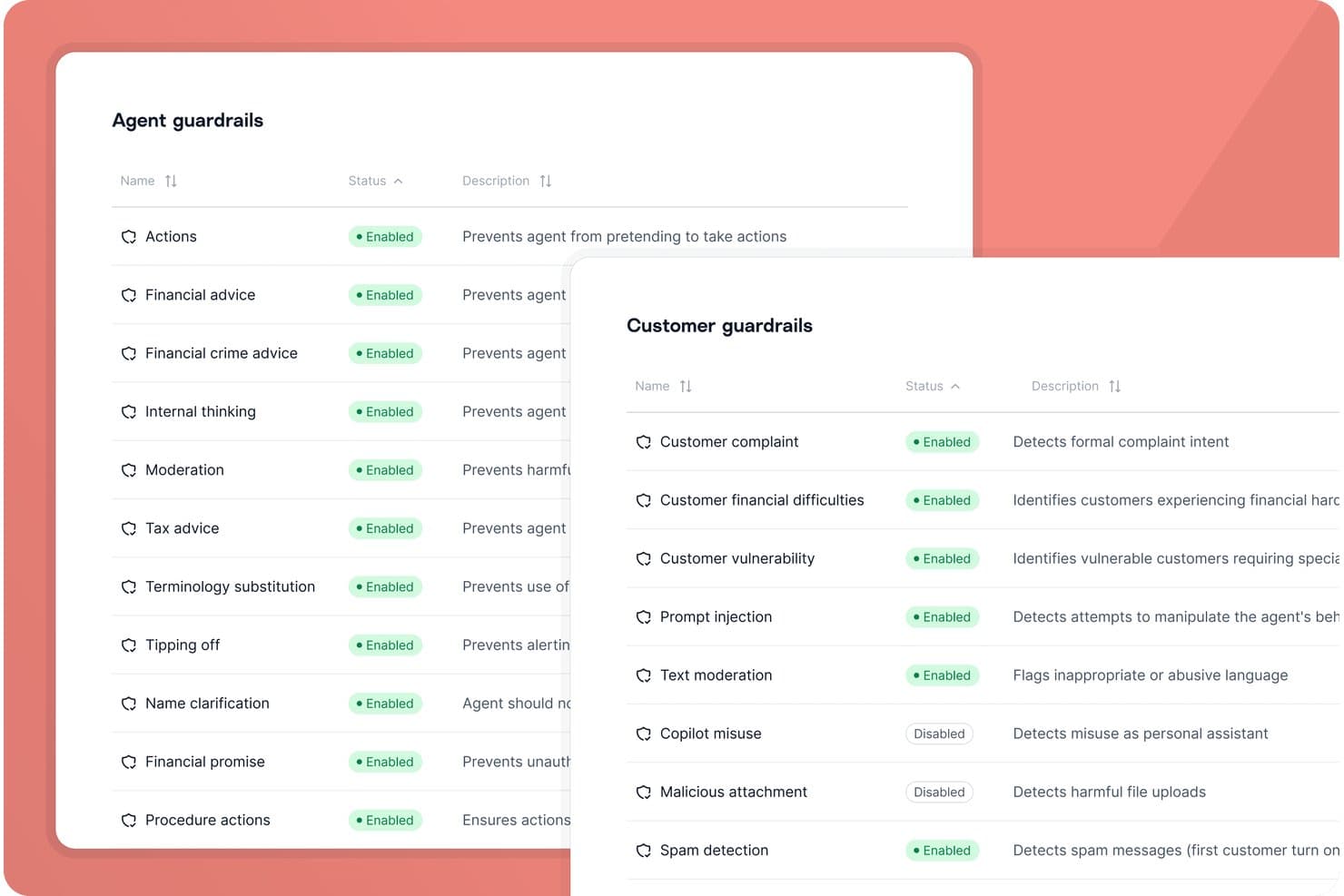
Gradient Labs lets users configure agent and customer guardrails. Gradient Labs is an AI customer operations platform built specifically for financial services, handling inbound and outbound conversations across voice, chat, email, SMS, and social media, alongside back-office case work like dispute resolution and lending support.
Who Is Gradient Labs Best For?
Gradient Labs is a strong fit for financial services operations teams that need AI agents to handle regulated customer cases like disputes, lending support, and collections.
Why I Picked Gradient Labs
I picked Gradient Labs as one of the best because it's purpose-built for the kind of regulated case work that general-purpose AI agents can't safely touch. The disputes agent is what stands out to me: it classifies chargebacks against card-scheme reason codes, applies configured decision logic, and submits approved cases directly to Mastercard or Visa, all with a human-approval step and a full audit trail. The lending agent adds another layer I find compelling, applying more than 20 lending-specific guardrails per conversation turn to handle collections, hardship assessment, and forbearance within FDCPA, TCPA, and FCA Consumer Duty requirements.
Gradient Labs Key Features
- Omnichannel conversation handling: The AI agent manages customer conversations across phone, chat, email, SMS, and social media from a single platform.
- Outbound AI outreach: The agent proactively initiates calls, texts, and emails, handles replies conversationally, and can leave voicemails or manage callback requests.
- Collaborate module: Teams can draft, batch-test, and preview agent changes before they go live, then request sign-off and roll back updates in one click.
- Usage-based pricing: Gradient Labs charges only for successful query resolutions, with no platform fees.
Gradient Labs Integrations
Gradient Labs offers native integrations with Intercom, Zendesk, and Freshdesk, plus integrations with Mastercard and Visa Resolve Online for dispute processing. It also provides a public API and custom API tools for connecting core banking, CRM, and case-management systems.
Pros and Cons
Pros:
- Disputes include human approval and audit trails
- Financial guardrails support regulated case handling
- Reviewers report 70–80% ticket resolution
Cons:
- Narrow financial-services focus limits broader CX fit
- Resolution gains require ongoing workflow tuning
Learn more about Gradient Labs: Best with instant helpdesk integration
- 30-day free trial
- From $199/month
Visit WebsiteCustomer Rating:4.5/5
My AskAI displays a chat interface on HubSpot with AI-powered responses, a session-end message, and a prompt to start a new chat. My AskAI is an AI customer service agent platform that deploys generative AI agents inside your existing help desk to handle support tickets, automate in-conversation actions, and surface conversational insights across chat and email channels.
Who Is My AskAI Best For?
It's a strong fit for support operations teams at SaaS and ecommerce companies that want AI-driven ticket deflection without replacing their existing help desk.
Why I Picked My AskAI
I picked My AskAI because it deploys a generative AI agent directly inside Zendesk, Intercom, or Gorgias without any migration. Beyond answering questions, it executes in-conversation tasks like refunds and order changes using plain-language instructions. I also love the Knowledge Improvement Studio, which scans past tickets to identify documentation gaps and auto-generates new knowledge snippets.
My AskAI Key Features
- Multi-language responses: AI agent detects language automatically and replies in over 95 supported languages.
- Real-time conversational insights: Generates analytics and alerts when new topics or patterns emerge in customer interactions.
- Automated Zendesk ticket tagging: Applies AI-powered tags to tickets for improved categorization and reporting.
- Internal Slack and Teams bots: Lets employees ask questions and get instant answers from internal knowledge sources via chat.
My AskAI Integrations
My AskAI offers native integrations with Zendesk, Intercom, Gorgias, Freshdesk, HubSpot, and Freshchat.
Pros and Cons
Pros:
- Executes in-conversation actions like refunds autonomously
- Auto-detects knowledge gaps from past tickets
- Deploys inside existing help desks instantly
Cons:
- Predictive customer intelligence features are limited
- No native voice bot or IVR capability
Learn more about My AskAI: Best voice AI for modern contact centers
- Free demo available
- Pricing upon request
Visit WebsiteCustomer Rating:4.4/5
Talkdesk offers a visual AI agent builder with an orchestrator, condition routing, and specialized sub-agents for FAQs, customer accounts, and orders. Talkdesk is a cloud-native CCaaS and CX automation platform that combines AI virtual agents, omnichannel engagement, interaction analytics, and workforce management into a unified contact center system.
Who Is Talkdesk Best For?
Talkdesk is a strong fit for mid-market and enterprise contact centers in regulated industries like financial services, healthcare, and retail.
Why I Picked Talkdesk
I've included Talkdesk in my top picks because its voice AI capabilities go well beyond basic IVR. Talkdesk Autopilot can autonomously handle end-to-end voice interactions, resolving customer issues without any agent involvement. I also find Talkdesk Identity genuinely useful, as it performs real-time voice biometrics authentication mid-call, eliminating manual verification steps. Talkdesk Navigator routes calls using natural conversation and live context rather than rigid menu trees.
Talkdesk Key Features
- Industry experience clouds: Pre-built workflows, dashboards, and automations for financial services, healthcare, retail, and other regulated sectors.
- Studio workflow designer: Low-code visual tool to customize customer journeys and automate cross-channel processes.
- Interaction and quality analytics: AI-powered transcription and analysis of every conversation for topic, intent, and agent performance insights.
- Native CRM integrations: Certified connectors for Salesforce, Microsoft Teams, Zendesk, ServiceNow, and HubSpot for unified customer context.
Talkdesk Integrations
Talkdesk offers 60+ native integrations, including Salesforce, HubSpot, Zendesk, Microsoft Teams, ServiceNow, Zoom, Slack, Microsoft Dynamics 365, Oracle Service Cloud, and SAP C4C. An API is available for custom integrations.
Pros and Cons
Pros:
- Low-code visual workflow designer
- Autopilot resolves customer issues without agent involvement
- Real-time voice biometric authentication
Cons:
- Enterprise setup requires dedicated IT resources
- Default reporting templates lack custom options
Learn more about Talkdesk: Best low-code CX automations for scaling teams
- 14-day free trial + free demo available
- From $29/user/month (billed annually)
Visit WebsiteCustomer Rating:4.4/5
Freshdesk Omni offers an AI-powered customer support inbox with bot conversation summaries, tone enhancement tools, and order details panel for streamlined agent workflows. Freshdesk Omni is an AI-powered omnichannel customer service platform that unifies email, chat, voice, and messaging into a single command center, with built-in AI agents, copilot assistance, and low-code workflow automations.
Who Is Freshdesk Omni Best For?
It's a strong fit for mid-size to enterprise support teams that need to scale customer service operations across multiple channels without heavy developer involvement.
Why I Picked Freshdesk Omni
I've included Freshdesk Omni in my top picks because its low-code automation layer lets scaling teams build and adjust CX workflows without needing engineering support. Freddy AI Agent resolves inquiries autonomously across chat, email, and messaging right out of the box. I also like that IntelliAssign and skill-based routing dynamically redistribute workloads as agent headcount grows, so you're not rebuilding your routing logic every time the team changes.
Freshdesk Omni Key Features
- Freddy AI Copilot: Provides live agent assistance by suggesting replies, surfacing knowledge, and drafting conversation summaries.
- Omnichannel command center: Centralizes tickets and conversations from chat, email, phone, and social in a single workspace.
- Sentiment and intent detection: Uses AI to analyze customer messages for urgency, emotion, and intent across channels.
- Extensive CX integrations: Connects natively to tools like HubSpot, Shopify, Jira, and telephony platforms through the Freshworks Marketplace.
Freshdesk Omni Integrations
Freshdesk Omni offers over 150 native integrations, including HubSpot, Shopify, Jira, Slack, MS Teams, Stripe, WhatsApp, Facebook Messenger, Instagram, and LINE. An API is available for custom integrations.
Pros and Cons
Pros:
- Omnichannel inbox retains full conversation context
- Low-code automation builder needs no developer support
- Handles multi-channel ticket resolution autonomously
Cons:
- Voice AI requires third-party telephony providers
- Advanced predictive features require external tools
Learn more about Freshdesk Omni: Best for unified omnichannel journey orchestration
- Free trial available
- From $75/user/month (billed annually)
Visit WebsiteCustomer Rating:4.4/5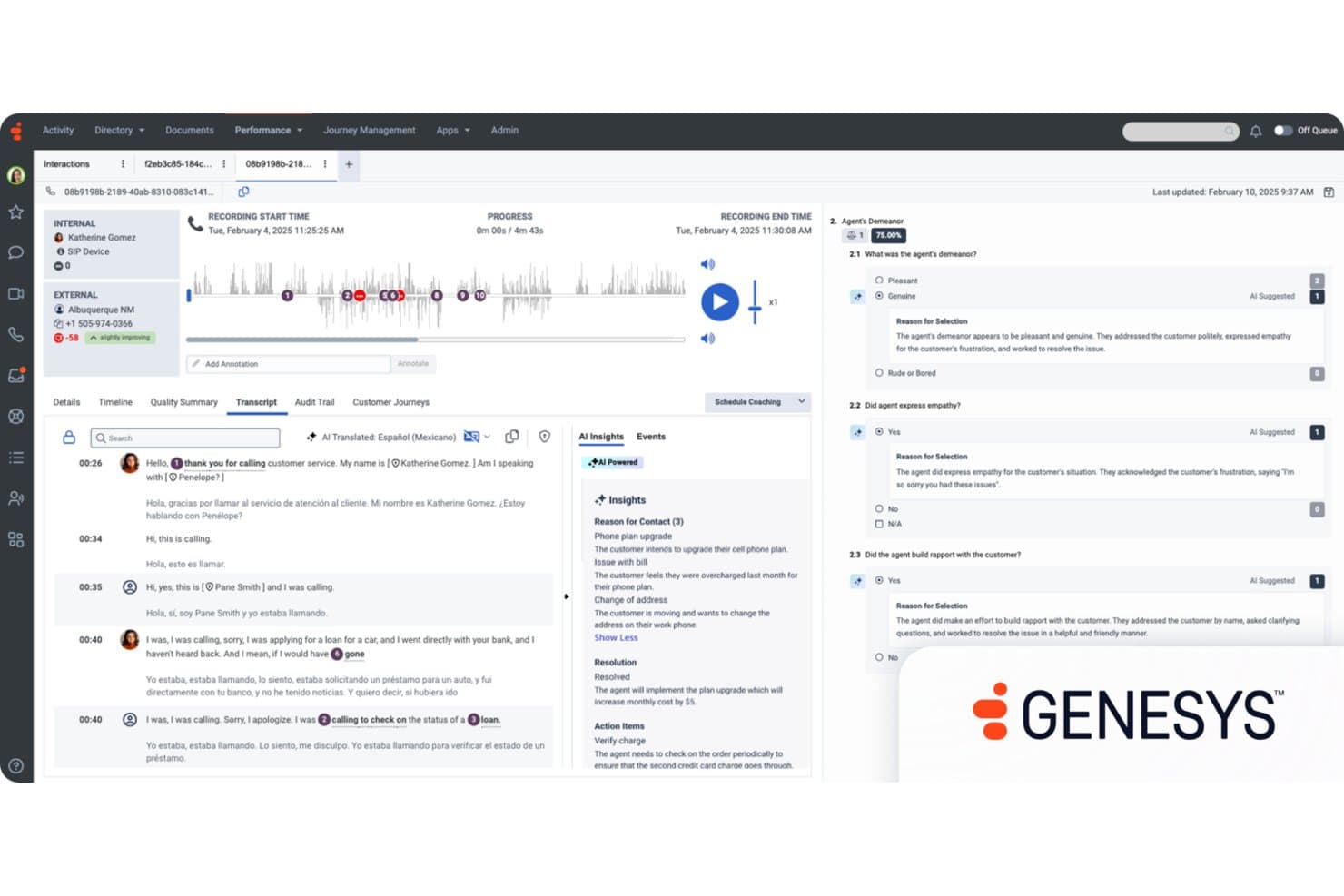
Genesys Cloud CX offers AI-powered quality evaluation with automated agent demeanor scoring, empathy detection, and real-time call transcript translation for customer experience management. Genesys Cloud CX is a cloud-native contact center platform that combines AI-powered virtual agents, omnichannel routing, workforce engagement management, predictive analytics, and journey orchestration across voice, chat, email, SMS, and social channels.
Who Is Genesys Cloud CX Best For?
Genesys Cloud CX is a strong fit for enterprise and mid-market contact centers managing high interaction volumes across multiple channels and agent teams.
Why I Picked Genesys Cloud CX
Genesys Cloud CX earns its spot on my shortlist because of how its single orchestration engine connects every channel, from voice to WhatsApp to SMS, without losing customer context mid-journey. I particularly like predictive routing combined with journey management, which lets my team build real-time flows that adapt to customer behaviour, not just queue logic. Architect and AI Studio make it possible to design and adjust those journeys without heavy developer involvement.
Genesys Cloud CX Key Features
- Agent Assist Copilot: AI supports agents in real time with reply suggestions, context, and knowledge surfacing.
- Sentiment and intent analytics: AI analyzes customer conversations to detect emotion, urgency, and intent across channels.
- Voice AI and conversational IVR: Natural language bots handle spoken interactions and transcribe calls for analytics.
- Generative knowledge management: AI generates, updates, and optimizes help articles from real agent and customer conversations.
Genesys Cloud CX Integrations
Genesys Cloud CX offers native integrations with Salesforce, ServiceNow, Zoom, Microsoft Teams, 8x8, Amazon Lex, and Google Dialogflow, and features over 450 marketplace integrations via the AppFoundry. An open API is available for custom integrations.
Pros and Cons
Pros:
- Predictive routing improves queue and agent matching
- Journey orchestration adapts in real time
- Unified contact center platform across channels
Cons:
- Custom reports require developer setup
- Initial Architect configuration is time-consuming
Learn more about Genesys Cloud CX: Best for real-time sentiment detection on social
- Free demo available
- Pricing upon request
Visit WebsiteCustomer Rating:4.2/5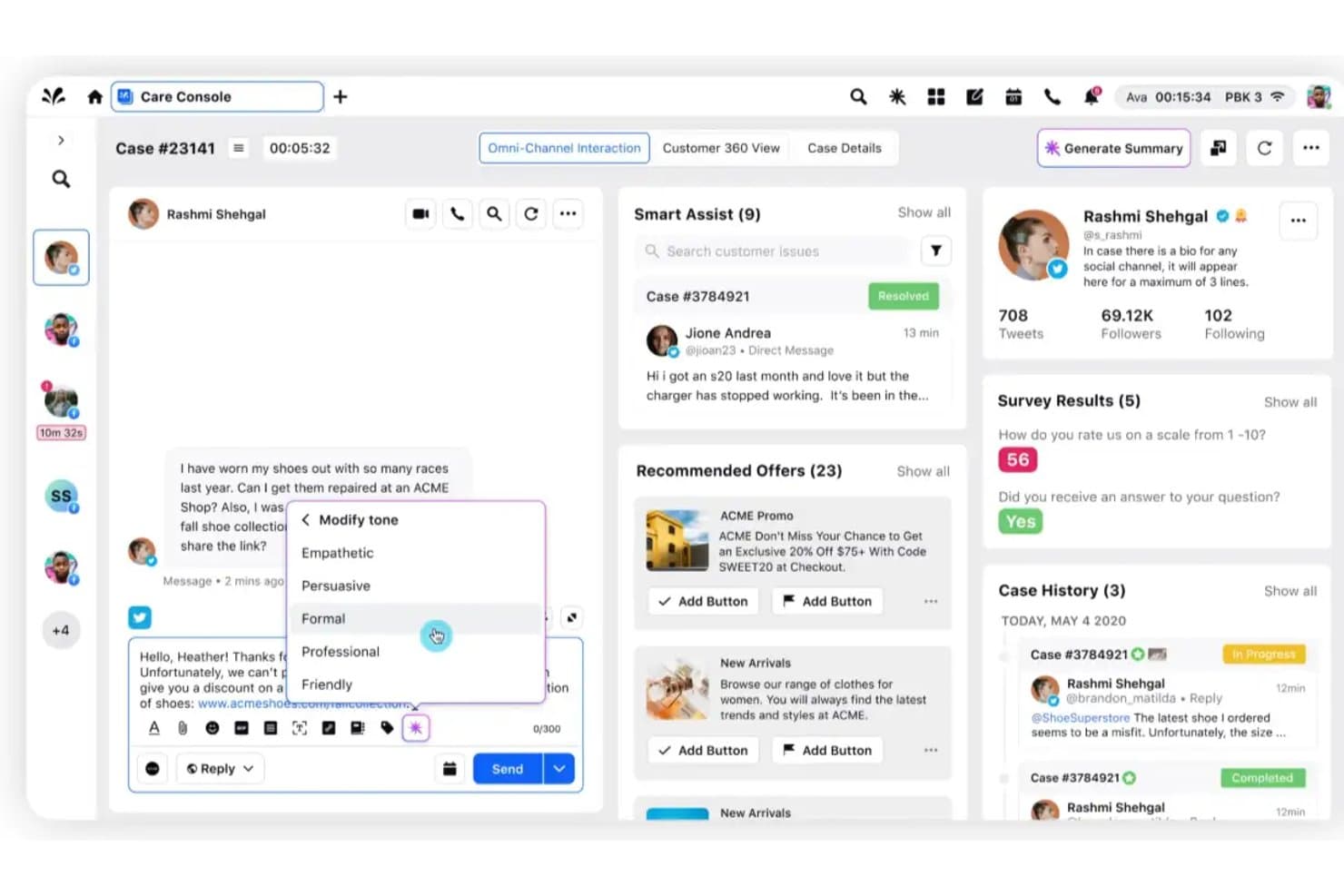
Sprinklr Service offers an AI-powered Care Console with tone modification, smart assist, and omni-channel interaction tools for customer support automation. Sprinklr Service is an AI-native contact center platform that unifies voice, chat, social, and email interactions with conversational AI, omnichannel routing, agent assist, automated quality management, and real-time conversational analytics.
Who Is Sprinklr Service Best For?
Sprinklr Service is a strong fit for large enterprise teams managing high-volume, multi-channel customer interactions across global markets.
Why I Picked Sprinklr Service
Sprinklr Service earns its spot on my shortlist because of how it handles social at a scale most platforms can't match. I picked it specifically for its real-time sentiment detection across 25+ social channels from a single unified dashboard. What I find genuinely impressive is that the AI classifies incoming queries by intent, urgency, and sentiment simultaneously, so my team can catch negative trends before they escalate into reputation issues.
Sprinklr Service Key Features
- Agent Copilot: AI-powered assistant that drafts case summaries, suggests replies, and automates repetitive tasks for agents.
- Unified agent desktop: Single interface for managing conversations across voice, chat, email, and 25+ social channels.
- AI quality management: Automatically evaluates 100% of customer interactions for compliance and coaching opportunities.
- Conversational IVR: Natural language voice bot that replaces traditional IVR menus and guides callers using spoken interactions.
Sprinklr Service Integrations
Sprinklr Service offers native integrations with Salesforce, Zendesk, Freshdesk, Dynamics 365, Jira, ServiceNow, Slack, Twilio, Trustpilot, and Reddit. An open API is available for custom integrations.
Pros and Cons
Pros:
- Unifies voice, chat, and social channels natively
- Evaluates every agent interaction for quality automatically
- Monitors sentiment across 25+ channels simultaneously
Cons:
- Dashboard reporting is difficult to customize
- Enterprise onboarding requires technical staff
Learn more about Sprinklr Service: Best analytics suite for actionable CX insights
- Free demo available
- From $110/agent/month (proactive AI extra)
Visit WebsiteCustomer Rating:4.3/5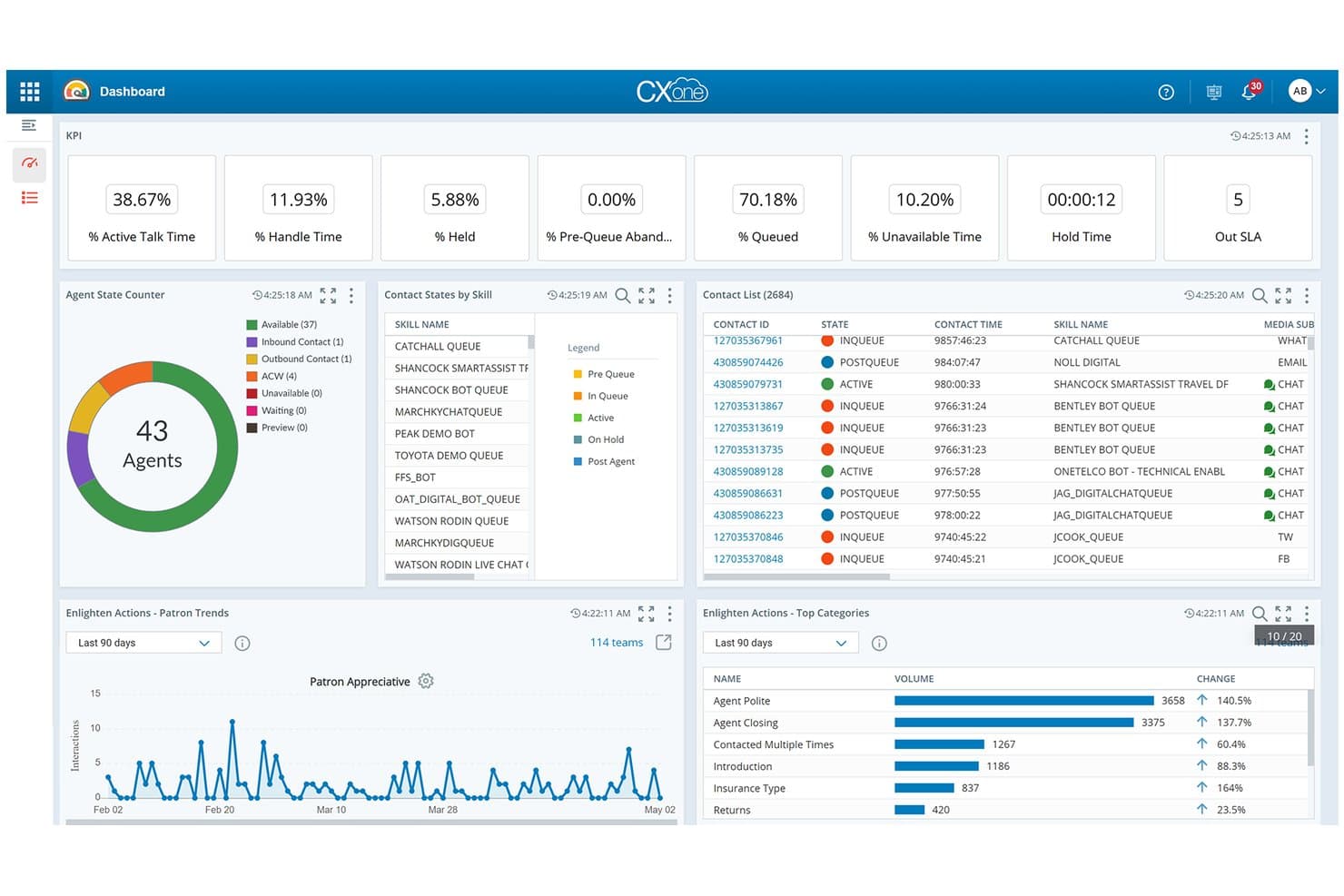
NiCE CXone offers a real-time AI-powered dashboard with KPI metrics, agent state tracking, contact lists, and Enlighten Actions analytics for automated customer experience management. NiCE CXone is an enterprise CCaaS platform that combines AI conversational automation, omnichannel orchestration, workforce engagement, and interaction analytics across voice, chat, email, and digital channels.
Who Is NiCE CXone Best For?
NiCE CXone is a strong fit for enterprise contact centers that need a unified platform to manage high interaction volumes across large agent teams.
Why I Picked NiCE CXone
I picked NiCE CXone as one of the best because its Interaction Analytics module goes well beyond standard sentiment scoring. It surfaces emotion, intent, and topic trends across every conversation, with Copilot for Supervisors delivering real-time sentiment alerts on live calls. I also like how agentic analytics connects those insights to root-cause analysis, so my team can act on patterns rather than just observe them.
NiCE CXone Key Features
- Omnichannel routing and queueing: Routes and manages customer interactions across voice, chat, email, SMS, and social channels from one platform.
- Voice AI & conversational IVR: Natural language voice bots replace traditional menus, handling spoken requests and capturing detailed interaction transcripts.
- Generative knowledge management: AI updates and creates knowledge base articles automatically from agent conversations and resolved tickets.
- Pre-built CRM and service integrations: Connects natively to systems like Salesforce, Microsoft Dynamics, and Zendesk for unified customer profiles.
NiCE CXone Integrations
NiCE CXone offers native integrations with Salesforce, Microsoft Dynamics, Oracle, Zendesk, ServiceNow, SAP, HubSpot, Freshdesk, Zoho CRM, and SugarCRM. An API is available for custom integrations.
Pros and Cons
Pros:
- AI agents handle complex multilingual voice interactions
- Real-time sentiment alerts during live calls
- Deep interaction analytics across all channels
Cons:
- Report customization has a steep configuration curve
- Implementation requires significant IT involvement
Learn more about NiCE CXone: Best outbound and predictive dialer capabilities
- Free demo available
- From $119/seat/month
Visit WebsiteCustomer Rating:4.1/5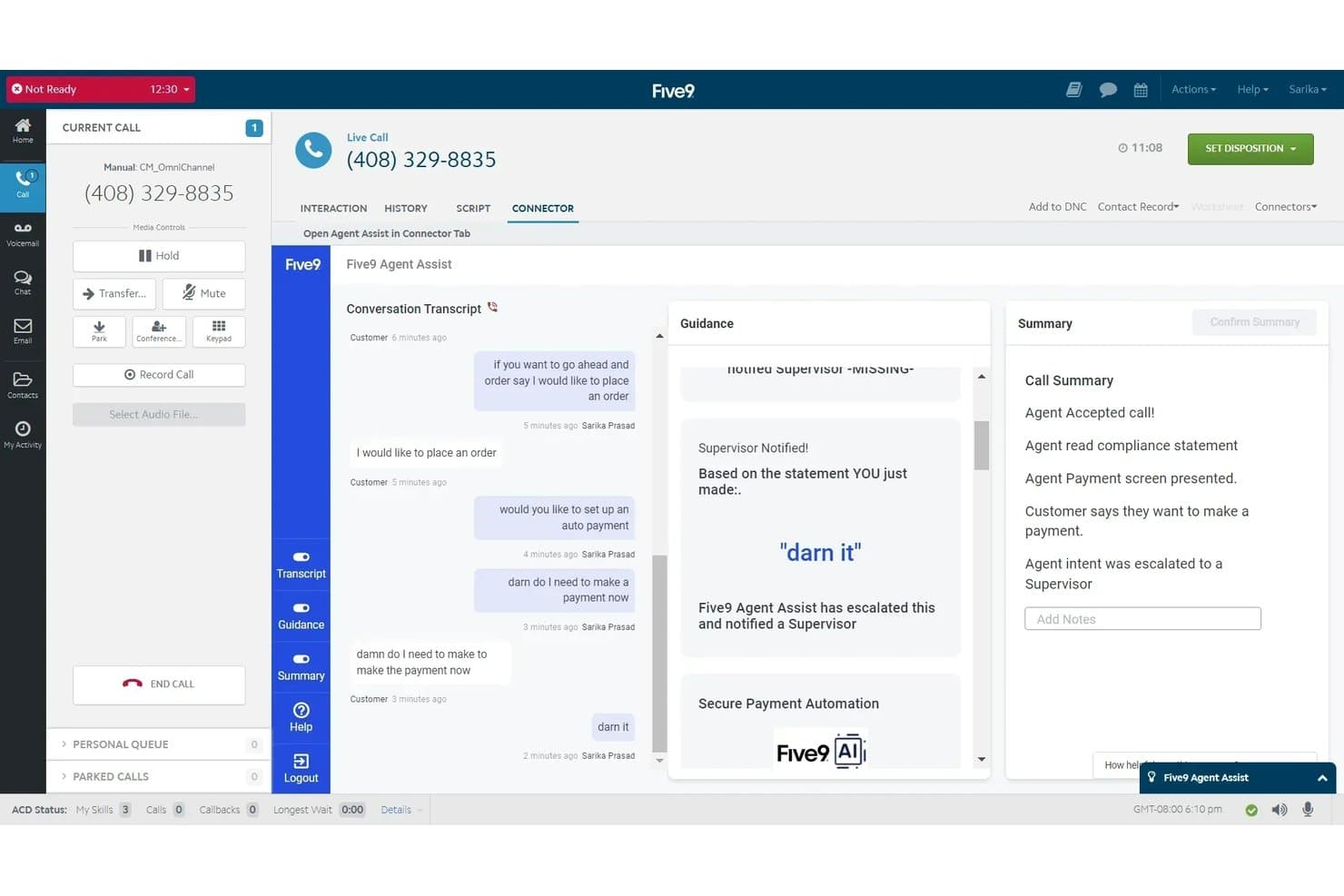
Five9 offers an AI-powered Agent Assist tool that provides real-time conversation transcripts, supervisor escalation alerts, and automated call summaries during live customer calls. Five9 is a cloud-based contact center platform that combines AI-powered virtual agents, omnichannel customer engagement, predictive dialling, workforce management, and real-time interaction analytics across voice, chat, email, SMS, and social channels.
Who Is Five9 Best For?
Five9 is built for mid-market and enterprise contact centers running high-volume inbound and outbound operations across multiple channels.
Why I Picked Five9
Five9 earns its spot as one of the best on my shortlist because its predictive dialer is genuinely AI-driven, not just automated. I like that it supports four distinct dialling modes (predictive, progressive, power, and preview), so outbound teams can match the dialling approach to the campaign type. The Proactive Notification feature uses predictive analytics to determine the optimal time to place outbound calls automatically, which increases live contact rates without adding manual effort.
Five9 Key Features
- AI-powered virtual agents: Handle customer interactions autonomously across multiple channels with natural language understanding.
- Omnichannel agent desktop: Unifies voice, chat, email, SMS, and social messages into a single agent interface.
- Real-time sentiment analytics: Surfaces customer sentiment, emotion, and intent throughout live conversations for agents and supervisors.
- Workforce engagement management: Includes built-in tools for quality monitoring, performance dashboards, and agent scheduling.
Five9 Integrations
Five9 offers native integrations with Salesforce, ServiceNow, Microsoft Dynamics, Oracle, Zendesk, Zoom, Microsoft Teams, RingCentral, AT&T Office@Hand, Verint, and Calabrio. An API is available for custom integrations.
Pros and Cons
Pros:
- Four distinct outbound dialling modes
- Real-time sentiment analytics surface insights mid-call
- Predictive dialer supports four distinct outbound modes
Cons:
- Minimum seat count excludes small team deployments
- Journey workflow sequences lack multi-day scheduling capability
Learn more about Five9: 10Best for workflow automation in chat and messaging
Ada
- Free demo available
- Pricing upon request
Visit WebsiteCustomer Rating:4.7/5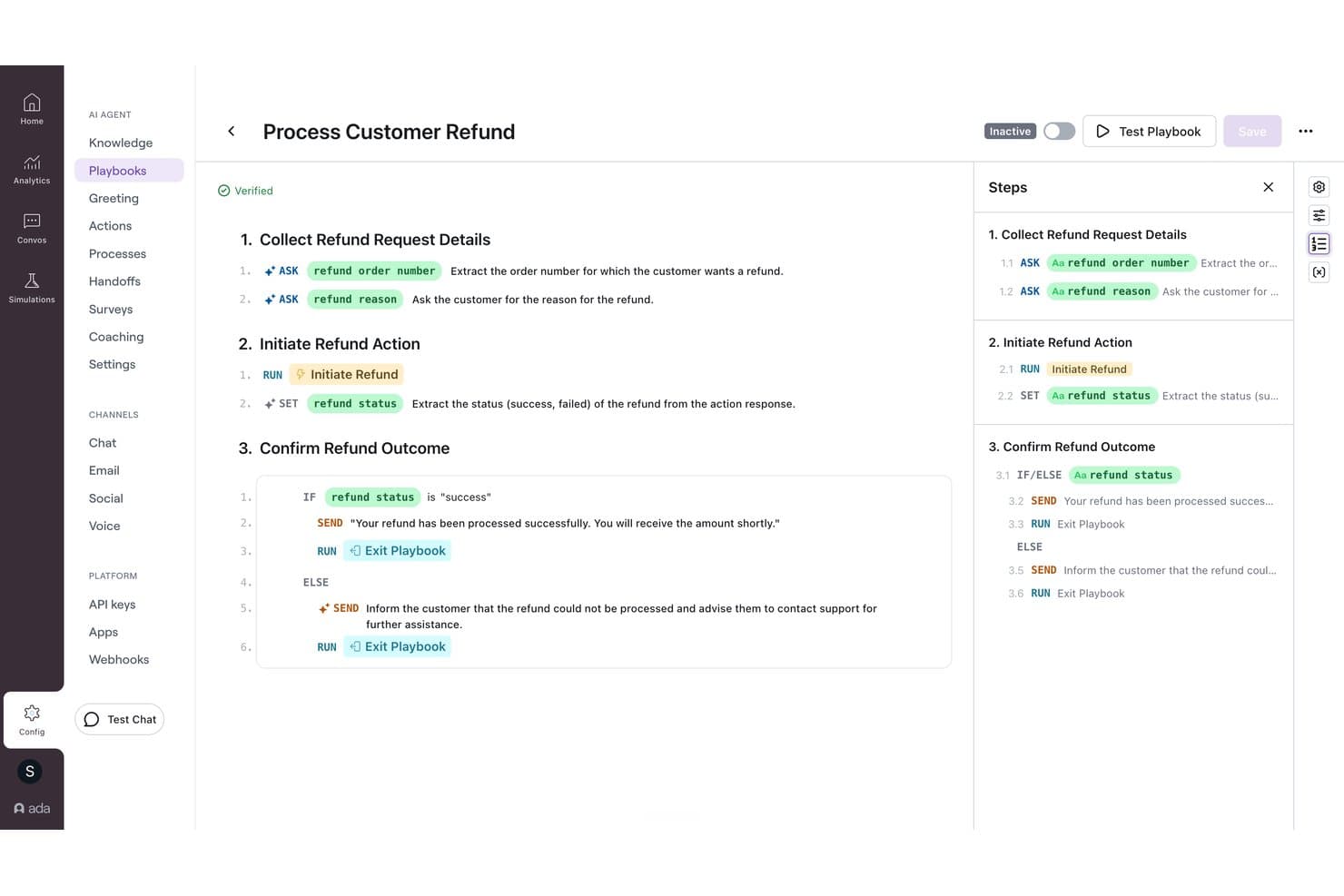
Ada offers a visual playbook builder that automates customer refund workflows with conditional logic and step-by-step AI-driven actions. Ada is an agentic customer experience platform that automates customer interactions across chat, voice, and email using generative AI agents, multi-step Playbooks, and omnichannel workflow orchestration.
Who Is Ada Best For?
Ada is a strong fit for enterprise contact centers in industries like financial services, travel, and insurance that handle high volumes of customer interactions across multiple service channels.
Why I Picked Ada
I've included Ada in my top picks because its Playbooks feature handles multi-step service logic that most chatbots can't. A single Playbook can retrieve an order, verify its shipping status, collect a new address, update the record, and confirm the change, all within one chat conversation. The Reasoning Engine, launched in early 2026, extends that same workflow logic into voice channels, so automation you build once runs consistently across web chat, WhatsApp, Instagram DMs, and phone.
Ada Key Features
- Voice AI agent: Handles inbound and outbound phone conversations using natural language understanding and automated call resolution.
- Multilingual support: Delivers conversations and workflow automation in over 50 languages with built-in translation.
- Native CX integrations: Connects directly with platforms like Salesforce, Zendesk, NICE CXone, and ServiceNow for unified customer data and escalation.
- Coaching feedback loop: Gathers feedback after each conversation to refine automations and improve AI agent performance over time.
Ada Integrations
Ada offers native integrations with Salesforce, Zendesk, NICE CXone, ServiceNow, Microsoft Dynamics, Genesys, Twilio Flex, Amazon Connect, Freshworks, Kustomer, and Contentful. An API is available for custom integrations.
Pros and Cons
Pros:
- High automation containment rates
- Consistent automation across voice and chat
- Playbooks automate complex multi-step conversations
Cons:
- No built-in predictive churn scoring model
- Reporting lacks depth for advanced analytics needs
Learn more about Ada:
Outros sistemas de automatização da experiência do cliente com IA
Eis algumas opções adicionais de sistemas de automatização da experiência do cliente com IA que não entraram na minha lista restrita, mas que vale a pena consultar:
- 11Fin.aiBest generative agent copilot for support teams
- 12Yellow.aiBest for multilingual conversational AI at scale
- 13Salesforce Agentforce ServiceBest for deep CRM and service integration
- 14ZendeskBest for automated omnichannel ticket deflection
- 15LivePersonBest for open, enterprise conversational AI stack
- 16MedalliaBest for AI action from real-time feedback
- 17Observe.AIBest for multi-agent CX lifecycle orchestration
- 18Kore.aiBest for pre-built AI agents across industries
- 19Qualtrics XMBest for unified experience profiles
- 20CrestaBest for coaching with live AI insights
How I Evaluate AI Customer Experience Automation Systems
Every platform here needs to deliver real AI value—actually reducing agent workload and personalizing journeys, not just adding a chatbot layer. I evaluate each one across two layers: the core functionality required to qualify and the differentiating factors that set leaders apart.
Core Functionality (Table Stakes For This List)
When I'm selecting tools for my list, I rank each one on a scale from 0 (does not offer the functionality) to 5 (excels in this area) for each core functionality listed below. Then, I calculate the tool's total score as a percentage. Each tool needs to achieve a minimum total score of 75% to be considered for inclusion.
- AI Conversational Automation: I look for bots that handle multi-turn conversations—like processing a return and upselling a replacement—without needing a live agent.
- Omnichannel Orchestration: Context persistence matters most here. A customer who starts on chat and calls back shouldn't have to repeat their issue.
- Predictive Customer Intelligence: I evaluate whether the platform can score churn risk or surface next-best-actions from real interaction data, not just static segments.
- Sentiment & Interaction Analytics: Each tool should detect emotion and intent in real time, so agents or workflows can adapt before a frustrated customer escalates.
- Automated Journey Workflows: I check for AI-triggered journeys that respond to live behaviour—like sending a proactive message when a user stalls during onboarding.
- CX Systems Integration: The platform should connect to your CRM, help desk, and contact center natively, keeping customer profiles unified across tools.
Once I have a list of tools that meet the criteria, I consider what sets each platform apart.
Differentiating Factors (What Sets Vendors Apart)
Here's how I compare and contrast different vendors:
Standout Features
Agent assist copilots are a big differentiator—I look for AI that suggests replies and drafts summaries mid-conversation, not just after the fact. Voice AI matters too, especially platforms that replace rigid IVR menus with natural language bots that can handle spoken requests like rebooking a delivery. I also evaluate generative knowledge management, where the system auto-creates and updates help articles from resolved tickets. This keeps self-service content fresh without manual effort from your team.
Beyond Features
AI model transparency is something I evaluate closely—can you set guardrails on tone and brand voice for customer-facing bot responses? That matters when a virtual agent handles thousands of conversations daily. Deployment model plays a role too. Platforms with pre-built intents and low-code workflow builders let CX ops teams launch faster without waiting on engineering. I also check data privacy controls like PII redaction and data residency options, especially for teams in regulated industries like healthcare or finance.
Como escolher sistemas de automatização da experiência do cliente com IA
É fácil perder-se em listas extensas de funcionalidades e estruturas de preços complexas. Para o ajudar a manter o foco enquanto analisa o seu processo específico de seleção de software, eis uma lista de fatores a ter em conta:
| Fator | O que deve considerar |
|---|---|
| FatorEscalabilidade | O que deve considerarA plataforma consegue gerir picos no volume de interações à medida que a sua equipa ou empresa cresce — em todos os canais pretendidos? |
| FatorIntegrações | O que deve considerarO sistema liga-se nativamente ao seu CRM, sistema de assistência e soluções de voz, ou será necessário um trabalho personalizado complexo? |
| FatorPossibilidade de personalização | O que deve considerarA sua equipa poderá ajustar fluxos de trabalho, o comportamento dos bots e os relatórios sem o envolvimento de programadores? |
| FatorFacilidade de utilização | O que deve considerarA interface é suficientemente intuitiva para que os gestores de CX e os agentes a possam configurar, utilizar e adaptar rapidamente por si próprios? |
| FatorImplementação e integração inicial | O que deve considerarQuanto tempo demorará a implementação e de que recursos ou assistência do fornecedor necessitará para obter o valor total? |
| FatorCusto | O que deve considerarO modelo de preços (por agente, por conversa, por resolução) aumenta de forma previsível de acordo com a utilização prevista? |
| FatorMedidas de segurança | O que deve considerarA privacidade dos dados, a encriptação e os controlos de acesso baseados em funções estão alinhados com os requisitos do seu setor? |
| FatorRequisitos de conformidade | O que deve considerarA plataforma cumpre as certificações (SOC 2, GDPR, HIPAA) necessárias para o seu setor ou regiões de operação? |
O que são sistemas de automatização da experiência do cliente com IA?
Os sistemas de automatização da experiência do cliente com IA são plataformas de software que utilizam inteligência artificial para gerir, personalizar e analisar as interações com os clientes através de vários canais. Estes sistemas podem automatizar conversas, prever a intenção e orientar os clientes ao longo das suas jornadas, proporcionando às equipas de CX as ferramentas necessárias para aumentar a eficiência e fornecer um suporte mais personalizado em grande escala.
Funcionalidades dos Sistemas de Automatização da Experiência do Cliente com IA
Ao selecionar sistemas de automatização da experiência do cliente com IA, tenha em atenção as seguintes funcionalidades principais:
- Bots conversacionais com IA: Automatize as interações com os clientes através de chatbots e agentes virtuais capazes de compreender e responder a linguagem natural em vários canais.
- Encaminhamento omnicanal: Gira as conversas com os clientes através de chat, e-mail, telefone, SMS e redes sociais — com contexto e histórico consistentes.
- Análise de sentimentos: Utilize a IA para detetar as emoções, a urgência e a intenção dos clientes em tempo real, permitindo às equipas definir prioridades ou encaminhar os casos conforme necessário.
- Análise preditiva: Analise dados de conversas e comportamentais para antecipar as necessidades dos clientes, a possível perda de clientes e recomendar as melhores ações seguintes.
- Orquestração automatizada de fluxos de trabalho: Crie e acione jornadas complexas de clientes, compostas por várias etapas, com base em comportamentos em tempo real, eventos do ciclo de vida ou segmentação.
- Integração com sistemas de CX: Ligue-se facilmente a tecnologias de CRM, apoio técnico e centros de contacto para garantir um perfil unificado do cliente e fluxos de trabalho interligados.
- Ferramentas de assistência aos agentes: Forneça aos agentes sugestões durante as conversas, campos preenchidos automaticamente e acesso contextualizado ao conhecimento para reduzir o tempo de atendimento e melhorar a consistência.
- Gestão de conteúdos de autosserviço: Gere, atualize e verifique automaticamente lacunas nos artigos de conhecimento, utilizando informações obtidas de interações anteriores com os clientes.
- Controlos de segurança e conformidade: Proteja os dados sensíveis dos clientes através de encriptação, acesso baseado em funções e conformidade com as normas relevantes do setor.
- Painéis de relatórios e análises: Visualize as interações com os clientes, o desempenho dos canais e os resultados da automatização para orientar a melhoria contínua e acompanhar o ROI.
A implementação de sistemas de automatização da experiência do cliente com IA proporciona várias vantagens à sua equipa e à sua empresa. Eis algumas das que pode esperar:
Vantagens dos Sistemas de Automatização da Experiência do Cliente com IA
- Tempos de resposta mais reduzidos: Os bots automatizados e o encaminhamento inteligente ajudam os clientes a obter respostas rapidamente, reduzindo os tempos de espera e a carga de trabalho dos agentes.
- Experiências personalizadas: A análise preditiva e a deteção de sentimentos adaptam as conversas e os contactos com base nas necessidades e nos comportamentos únicos de cada cliente.
- Maior consistência: A orquestração omnicanal e as ferramentas integradas de assistência aos agentes mantêm as mensagens, o tom e os processos de apoio consistentes em todos os canais.
- Autosserviço melhorado: A gestão de conteúdos orientada por IA mantém as bases de conhecimento atualizadas, ajudando os clientes a encontrar respostas autonomamente, 24 horas por dia, 7 dias por semana.
- Escalabilidade para o crescimento: Os fluxos de trabalho automatizados e as integrações com a sua estrutura de CX permitem-lhe gerir maiores volumes de interações sem sacrificar a qualidade do serviço.
- Informações acionáveis: As análises e os relatórios em tempo real destacam tendências, pontos problemáticos e resultados, facilitando o aperfeiçoamento das jornadas e a demonstração do ROI.
- Maior segurança dos dados: As salvaguardas integradas e os controlos de conformidade reduzem os riscos e mantêm protegidas as informações sensíveis dos clientes à medida que automatiza mais processos.
Custos e Preços dos Sistemas de Automatização da Experiência do Cliente com IA
A seleção de sistemas de automatização da experiência do cliente com IA exige uma compreensão dos vários modelos de preços e planos disponíveis. Os custos variam consoante as funcionalidades, o tamanho da equipa, os complementos e outros fatores. A tabela abaixo resume os planos comuns, os respetivos preços médios e as funcionalidades normalmente incluídas nas soluções de sistemas de automatização da experiência do cliente com IA:
Tabela de Comparação de Planos para Sistemas de Automatização da Experiência do Cliente com IA
| Tipo de plano | Preço médio | Funcionalidades comuns |
|---|---|---|
| Tipo de planoPlano gratuito | Preço médio$0 | Funcionalidades comunsBots conversacionais básicos, suporte limitado de canais, relatórios básicos e apoio da comunidade. |
| Tipo de planoPlano pessoal | Preço médio$20-$50/utilizador/mês | Funcionalidades comunsAutomatização multicanal, integrações limitadas, fluxos de trabalho simples, apoio por e-mail e análises iniciais. |
| Tipo de planoPlano empresarial | Preço médio$60-$150/utilizador/mês | Funcionalidades comunsBots de IA avançados, orquestração omnicanal, integrações com sistemas de CX, ferramentas de assistência aos agentes e análises. |
| Tipo de planoPlano empresarial de grande dimensão | Preço médio$200+/utilizador/mês | Funcionalidades comunsFluxos de trabalho personalizados, segurança avançada, controlos de conformidade, integração inicial dedicada, apoio prioritário e acesso à API. |
Perguntas frequentes sobre os Sistemas de Automatização da Experiência do Cliente com IA
Eis algumas respostas a perguntas comuns sobre os sistemas de automatização da experiência do cliente com IA:
Em que diferem os sistemas de automatização da experiência do cliente com IA dos chatbots tradicionais?
Ao contrário de um bot simples, os sistemas baseados em IA e os assistentes virtuais de IA generativa utilizam inteligência artificial, aprendizagem automática e IA conversacional para gerir interações complexas com os clientes, com várias trocas de mensagens. Analisam a intenção, o sentimento e as preferências dos clientes em tempo real, através de pontos de contacto omnicanal, para otimizar os tempos de resposta e elevar a satisfação dos clientes.
É possível integrar os sistemas de automatização da experiência do cliente com IA com plataformas de CRM ou de suporte técnico existentes?
Sim, as plataformas de orquestração orientadas por IA disponibilizam APIs abertas e conectores pré-construídos para software de CRM, tecnologia de centros de contacto e ferramentas de bases de conhecimento. A integração destes sistemas liga o seu ecossistema de dados, unifica os dados dos clientes, simplifica o encaminhamento e ajuda os agentes de IA a apoiar os agentes humanos ao longo de toda a jornada do cliente, para responder às necessidades específicas dos clientes.
Quais são os riscos ou as limitações da utilização da automatização na experiência do cliente?
A automatização deve complementar — e não substituir — o contacto humano. Depender inteiramente de modelos de IA sem supervisão pode causar o encaminhamento incorreto de questões complexas ou respostas imprecisas a pedidos sensíveis. A manutenção de um serviço de qualidade exige monitorização de ponta a ponta, análise preditiva e otimização regular por parte de agentes humanos, para proteger a fidelização dos clientes e corresponder às suas expectativas.
Quanto tempo demora a implementar um sistema de automatização da experiência do cliente com IA?
Os prazos variam consoante o caso de utilização. As configurações simples que utilizam modelos pré-construídos para perguntas frequentes, tarefas de rotina e mensagens básicas demoram algumas semanas. As implementações empresariais personalizadas, que envolvem tomada de decisões baseada em dados, ferramentas avançadas de assistência e personalização complexa de fluxos de trabalho nos canais de apoio ao cliente, podem demorar vários meses, mas proporcionam eficiência operacional e poupanças de custos a longo prazo.
Estes sistemas são adequados para equipas pequenas ou apenas para grandes empresas?
São benéficos para equipas de qualquer dimensão. As equipas pequenas podem utilizar agentes de IA escaláveis para tratar tarefas repetitivas e pedidos de autosserviço, reduzindo os tempos de espera e de tratamento, ao mesmo tempo que diminuem os custos operacionais. As grandes empresas podem analisar o comportamento dos clientes, as métricas e os conhecimentos sobre os clientes para proporcionar experiências personalizadas em grande escala, aumentando a retenção e a confiança na relação com os clientes.