

Running a small business often means wearing many hats, especially when it comes to customer support. You want to keep your customers happy, but managing inquiries can be overwhelming. That's where help desk software comes in, offering a lifeline to your team by organizing and prioritizing tasks.
In my experience as a software reviewer, I've seen how the right tools can transform your customer experience efforts. I'll share the top help desk software options that I believe can make a real difference for your business.
You'll find insights into features, pricing, and what makes each tool unique. This guide aims to help you choose the right solution to ease your support challenges and boost your team's efficiency.
Why Trust Our Software Recommendations
6,700+
Reviews
20
Industry experts
16+
Evaluation factors
14
Years
Our team has been testing and reviewing software since 2012. As CX leaders ourselves, we know how difficult—and important—it is to choose the right software.
For this guide, we evaluated tools using hands-on testing and independent research, scoring tools using our selection criteria.
Our reviews reflect our human editorial judgment, not a sales pitch.
 Gui DrusinaCreative Director
 Tim FisherVP of AI
Help Desk Software For Small Business Comparison Table
This comparison table summarizes pricing details for my top help desk software for small business selections:
| Tool | Best For | Trial Info | Price | ||
|---|---|---|---|---|---|
| 1 | Best for automated troubleshooting suggestions | 30-day free trial available | From $209/month/technician (billed annually) | Website | |
| 2 | Best for fast, no-training setup | Free plan available | From $35/user/month | Website | |
| 3 | Best for IT service management | 14-day free trial | Pricing upon request | Website | |
| 4 | Best for AI-driven support automation | 14-day free trial | From $19/user/month (billed annually) | Website | |
| 5 | Best small business help desk software for multi-channel ticket support | 15-day free trial | Pricing upon request | Website | |
| 6 | Best for scheduling send times | Free plan available | From $25/user/month | Website | |
| 7 | Best for ecommerce unified inbox management | 14-day free trial + free demo available | From $39/user/month (billed annually) | Website | |
| 8 | Best for AI-driven ticket auto-resolution | Free plan available; 14-day free trial | From $16/user/month | Website | |
| 9 | Best for AI-driven ticket handling | Free plan + free demo available | From $150/month (billed annually) | Website | |
| 10 | Best for managing shared inboxes | 30-day free trial | From $24/user/month (billed annually) | Website |


Overviews of the 20 Best Help Desk Software for Small Business
Here’s a brief description of each help desk software for small business, showcasing each tool’s best use case, their noteworthy features, and some pros and cons. I’ve also included screenshots to give you a snapshot of their user interface.
 Best for automated troubleshooting suggestions
- 30-day free trial available
- From $209/month/technician (billed annually)
Visit WebsiteCustomer Rating:4.5/5
Robin performing autonomous computer analysis to identify high memory usage and system performance issues in real time. Robin Autonomous IT is an AI-driven IT help desk agent built on the Atera platform that autonomously handles ticket intake, troubleshooting diagnostics, and issue resolution through natural language conversations across email, Slack, and Microsoft Teams.
Who Is Robin Autonomous IT Best For?
Robin Autonomous IT is a strong fit for small IT teams and MSPs that need to handle a high volume of internal IT support requests without adding more technician headcount.
Why I Picked Robin Autonomous IT
I've included Robin Autonomous IT in my top picks because its automated troubleshooting goes well beyond surfacing suggestions. When a ticket comes in, Robin analyzes the issue like a human technician, checks CPU and memory usage, tests DNS resolution, resets network adapters, and runs disk cleanup on its own. It also detects patterns across existing tickets and suggests new knowledge base articles and playbooks, which means your troubleshooting logic gets sharper over time without manual upkeep.
Robin Autonomous IT Key Features
- Multi-channel ticket intake: Employees can submit IT support requests through email, Microsoft Teams, Slack, or a self-service portal.
- Autonomous password reset: Robin handles password reset requests end-to-end without technician involvement, including identity verification steps.
- AI ticket categorization and routing: Incoming tickets are automatically categorized by issue type and routed to the right queue or technician.
- SLA tracking: Built-in SLA management monitors response and resolution time targets across all open tickets.
Robin Autonomous IT Integrations
Robin offers built-in integrations with identity providers like Google, Azure AD, and Okta, plus channels including Slack, Microsoft Teams, WhatsApp, and HubSpot. It also supports connectivity via MCP, custom API-based cloud actions, and Zapier.
Pros and Cons
Pros:
- AI drafts context-aware replies from history
- Per-technician pricing covers unlimited devices
- Resolves tickets autonomously at the endpoint
Cons:
- Popular non-AI feature requests remain unaddressed
- Reporting options limited on lower-tier plans
Learn more about Robin Autonomous IT: Best for fast, no-training setup
- Free plan available
- From $35/user/month
Visit WebsiteCustomer Rating:4.7/5
Hiver chat analytics can be viewed straight from Gmail. Hiver transforms Gmail into a shared help desk, giving small businesses and support teams a way to manage customer queries, assign emails, and track conversations without leaving their inbox.
Who Is Hiver Best For?
Hiver is a strong fit for small support teams that already run on Google Workspace and want a shared inbox without switching to a new platform.
Why I Picked Hiver
Hiver earns its spot on my shortlist because it's genuinely the fastest help desk to get off the ground—no new interface to learn, no migration headaches. Since it runs as a Chrome extension inside Gmail, my team was handling tickets from day one without a single training session. I particularly like the collision alerts feature, which flags when two agents are looking at the same email, so no one sends a duplicate reply. The automatic assignment rules also mean incoming queries get routed to the right person without anyone manually triaging the queue. For a small support team that can't afford downtime or a long ramp-up period, that combination is hard to beat.
Hiver Key Features
- Shared inbox: Manage customer emails from a single Gmail inbox that your whole support team can access and act on.
- Email notes: Leave internal comments on customer threads so teammates can share context without sending external replies.
- SLA alerts: Set response time targets and get notified when conversations are at risk of breaching those deadlines.
- Analytics dashboard: Track open conversations, response times, and team workload from a built-in reporting view.
Hiver Integrations
Integrations include Salesforce, HubSpot, Slack, QuickBooks, Okta, Jira, Asana, Shopify, NetSuite, and WhatsApp.
Pros and Cons
Pros:
- Strong internal collaboration features
- Customer support from real humans available 24/7 via chat or email, across all plans (including free one)
- AI-features embedded at all stages of customer support journey
Cons:
- Mobile experience isn’t as strong as the desktop one
- Compared to some other platforms, Hiver offers fewer third party integrations
Learn more about Hiver: Best for IT service management
- 14-day free trial
- Pricing upon request
Visit WebsiteCustomer Rating:4.6/5
SuperOps recommends AI-generated solutions to IT tickets directly within the service desk view. SuperOps is a cloud-based help desk platform built for small IT teams and managed service providers who need to manage tickets, automate workflows, and keep client information organized in one place.
Who Is SuperOps Best For?
SuperOps is a strong fit for small managed service providers and internal IT teams that handle multi-client support and need a unified platform for ticketing and service delivery.
Why I Picked SuperOps
SuperOps earns its spot on my shortlist because it's one of the few help desk platforms that genuinely bridges ticketing and IT service management in a single, unified system. I like how the service desk ties directly into asset and endpoint data, so when a ticket comes in, technicians already have device context without switching tools. The unified runbooks feature is particularly useful—you can convert your SOPs into automated, step-by-step processes that trigger on specific ticket types, which cuts resolution time on repeat issues. Monica AI also adds real value here by surfacing relevant fixes from similar past tickets right inside the active ticket view.
SuperOps Key Features
- SLA management: Set and track response and resolution time targets across tickets to keep service delivery on schedule.
- Client portal: Give end users a branded self-service portal to submit tickets, check status, and access knowledge base articles.
- Canned responses: Build a library of pre-written replies that technicians can insert into tickets to speed up common interactions.
- Reporting and analytics: Generate reports on ticket volume, technician performance, and SLA compliance to monitor team output.
SuperOps Integrations
Integrations include TeamViewer, Splashtop, ConnectWise Control, Xero, QuickBooks Online, Bitdefender, Webroot, Stripe, Entra ID, and Pax8.
Pros and Cons
Pros:
- Monica AI assists in ticket resolution by suggesting fixes
- Built-in time tracker ensures accurate logging of time spent on tickets
- Manages resource allocation and technician availability
Cons:
- Compared to competitors, SuperOps offers fewer third-party integrations
- While powerful, customization options can be complex to navigate
Learn more about SuperOps: Best for AI-driven support automation
- 14-day free trial
- From $19/user/month (billed annually)
Visit WebsiteCustomer Rating:4.4/5
Freshdesk provides a ticketing system that captures customer queries from various channels and presents them in an intuitive interface. Freshdesk is a cloud-based help desk platform designed for small businesses that need to manage customer inquiries across email, chat, phone, and social channels from one place.
Who Is Freshdesk Best For?
Freshdesk is a good fit for small support teams that need a straightforward, multichannel help desk without a steep learning curve or a large IT budget.
Why I Picked Freshdesk
Freshdesk is one of my top picks because I love how its Freddy AI suite handles repetitive, high-volume tasks that bog down small support teams. Freddy AI Agent uses pre-built agentic workflows to auto-resolve most incoming queries across chat, email, and messaging apps—and it goes live in minutes, which matters when you don't have a dedicated IT team to manage setup. I also rely on Freddy AI Copilot day-to-day: it suggests replies, summarizes conversations, and translates messages in real time, all inside the agent workspace, so there's no context-switching. For a small team handling a big ticket volume, this in-the-moment assistance noticeably improves response quality and speed.
Freshdesk Key Features
- Shared inbox: Consolidates customer emails from multiple support addresses into one queue so agents can triage and respond without switching between accounts.
- Skill-based ticket assignment: Routes incoming tickets to agents based on their specific expertise, so the right person handles each issue from the start.
- Knowledge base: Provides a multilingual self-service portal where customers can find answers to common questions without submitting a ticket.
- SLA policies: Sets response and resolution time targets by ticket priority, with automatic escalations when deadlines are at risk.
Freshdesk Integrations
Integrations include Slack, Microsoft Teams, Shopify, Salesforce, Jira, Playvox, and connector apps for custom integrations via API.
Pros and Cons
Pros:
- Designed to scale with growing businesses
- Offers continuous development of new features
- Easy-to-use interface
- Provides customizable features
- Easy-to-use interface
Cons:
- Limited flexibility for creating custom reports
- Pricing structure can be confusing
Learn more about Freshdesk: Best small business help desk software for multi-channel ticket support
- 15-day free trial
- Pricing upon request
Visit WebsiteCustomer Rating:4.4/5
Zoho Desk Ticket Peek allows agents to quickly see the customer’s support history. Zoho Desk is a cloud-based help desk platform for small businesses that manage customer support across multiple channels and streamline ticket resolution.
Who Is Zoho Desk Best For?
Zoho Desk is a great fit for small support teams that handle customer inquiries across email, chat, social media, and phone from a single platform.
Why I Picked Zoho Desk
Zoho Desk earns its spot on my shortlist because of how well it handles multi-channel ticket support in one place. I like that tickets from email, live chat, social media, and phone all land in a single queue, so my team isn't jumping between tools to track conversations. The channel-specific ticket views let us filter and prioritize by source, which helps when social tickets need faster turnaround than email. I also rely on the multi-channel SLA policies, which let me set different response time rules depending on where a ticket came from.
Zoho Desk Key Features
- AI assistant (Zia): Zia automatically tags incoming tickets, suggests relevant knowledge base articles to agents, and flags tickets with negative sentiment.
- Workflow automation: Set up rule-based automations to assign, escalate, or update tickets based on conditions like ticket source, priority, or customer type.
- Self-service portal: Build a branded help center with a knowledge base and community forums so customers can find answers without submitting a ticket.
- Reports and dashboards: Track ticket volume, agent performance, and response times using pre-built and customizable reports.
Zoho Desk Integrations
Integrations include Zoho CRM, Zoho Books, Zoho Analytics, Slack, Microsoft Teams, Jira, Trello, Shopify, Salesforce, and Google Workspace.
Pros and Cons
Pros:
- Customizable ticketing system
- Multichannel capabilities
- Detailed dashboard provides context
Cons:
- Steep learning curve
- Limited customization on some web forms
Learn more about Zoho Desk: Best for scheduling send times
- Free plan available
- From $25/user/month
Visit WebsiteCustomer Rating:4.5/5
Help Scout offers a comprehensive customer conversations platform. Help Scout gives small businesses and support teams a shared inbox, automation, and customer management tools to organize conversations, respond faster, and deliver a more personal customer experience.
Who Is Help Scout Best For?
Help Scout is a great fit for small support teams that need a straightforward, collaborative help desk without a steep learning curve.
Why I Picked Help Scout
Help Scout earns its spot on my shortlist because of how well its send later feature handles the reality of distributed support teams. I can draft a reply at any hour and schedule it to land in a customer's inbox at exactly the right time—whether that's their business hours, a follow-up window, or just a moment when they're more likely to respond. Paired with the snooze feature, which lets me set a reminder to revisit a conversation later, my team stays on top of pending threads without losing track of anything. For small teams juggling multiple time zones or working outside of 9-to-5 hours, these two features alone change how you manage your inbox day to day.
Help Scout Key Features
- Shared inbox: Route incoming emails to a shared team inbox where agents can assign, reply to, and collaborate on customer conversations.
- Saved replies: Store pre-written responses to common questions that agents can insert into replies with a single click.
- Customer profiles: View a customer's full conversation history and profile data alongside every support thread.
- Workflows: Set up automated rules to assign, tag, or prioritize conversations based on conditions like sender, subject, or keyword.
Help Scout Integrations
Integrations include Salesforce, Shopify, HubSpot, Jira, Slack, Stripe, Mailchimp, WhatsApp, FullStory, and WooCommerce.
Pros and Cons
Pros:
- Built-in AI tools for faster replies
- Comprehensive reporting and analytics
- Easy multi-channel message consolidation
Cons:
- Limited customization in lower tiers
- Some advanced features on higher plans
Learn more about Help Scout: Best for ecommerce unified inbox management
- 14-day free trial + free demo available
- From $39/user/month (billed annually)
Visit WebsiteCustomer Rating:4.4/5
eDesk centralizes marketplace, email, and order-related support messages into a single inbox. eDesk is a help desk platform built for e-commerce businesses and online retailers who need to manage customer conversations, orders, and support tickets across multiple sales channels from one place.
Who Is eDesk Best For?
eDesk is a strong fit for small ecommerce businesses selling across multiple marketplaces like Amazon, eBay, and Shopify who need a single place to handle all customer support.
Why I Picked eDesk
eDesk earns its spot on my shortlist because of how well its unified inbox handles the reality of selling across multiple e-commerce channels at once. I like that when a ticket comes in from Amazon, eBay, or Shopify, the inbox automatically pulls in the relevant order details, shipping status, and customer history right alongside the message—so my team isn't switching between tabs or logging into separate portals to piece together context. The AI ticket classification also does a lot of the organizational heavy lifting, automatically sorting and grouping incoming messages so nothing slips through. For a small team managing high message volumes across several storefronts, that kind of built-in structure makes a real operational difference.
eDesk Key Features
- SLA tracking: Monitors response time targets across channels so your team detects and addresses compliance gaps before they affect customers.
- AI chatbot: Answers common customer questions about orders, products, and shipping without agent involvement.
- CSAT reporting: Collects and surfaces customer satisfaction scores to measure support quality and identify where agent performance needs attention.
- Knowledge base: Publishes self-service help articles on your website to reduce incoming ticket volume.
eDesk Integrations
Integrations include Amazon, eBay, Shopify, Walmart, WooCommerce, BigCommerce, Magento, Facebook, Instagram, and Klaviyo.
Pros and Cons
Pros:
- Designed to handle high volumes of ecommerce inquiries
- AI-powered automations improve response efficiency
- Integrates rich order data for enhanced customer service
Cons:
- Reporting customization is limited for complex analysis
- Primarily built for ecommerce, less flexible for other industries
Learn more about eDesk: Best for AI-driven ticket auto-resolution
- Free plan available; 14-day free trial
- From $16/user/month
Visit WebsiteCustomer Rating:4.6/5
SparrowDesk uses AI-powered workflows to automate customer support responses. SparrowDesk is an AI-native help desk platform for small businesses that unifies email, live chat, WhatsApp, Facebook Messenger, and Slack into a single inbox, with built-in workflow automation, a self-service knowledge base, and autonomous ticket resolution.
Who Is SparrowDesk Best For?
SparrowDesk is a strong fit for small teams that want AI to handle routine tickets autonomously, freeing agents to focus on complex issues without growing headcount.
Why I Picked SparrowDesk
SparrowDesk earns its spot on my shortlist because its Zoona AI agent doesn't just draft replies, it fully resolves tickets without any agent involvement. I'm particularly impressed by how Zoona trains itself on real resolved conversations, spots knowledge gaps, and queues drafted articles for one-click approval. In practice, a three-person support team can handle ticket volumes that would otherwise require hiring, with users reporting 60–67% auto-resolution rates on routine requests.
SparrowDesk Key Features
- Omnichannel inbox: Routes tickets from email, live chat, WhatsApp, Facebook Messenger, and Slack into a single shared queue with unified workflow rules.
- CSAT surveys: Automatically sends customizable satisfaction surveys after every resolved ticket, with scores linked to individual conversations and segmentable by agent or channel.
- SLA policies: Lets you set response and resolution targets by priority, channel, or customer type, with business-hours-aware timers that pause and resume automatically.
- AI Copilot: Gives agents on escalated tickets AI-drafted replies, thread summaries, and next-step suggestions directly within the ticket view.
SparrowDesk Integrations
SparrowDesk offers native integrations with Gmail, Slack, WhatsApp, Facebook Messenger, HubSpot, Shopify, Notion, Jira, and Linear. It also provides a developer API and Zapier integration for custom connectivity.
Pros and Cons
Pros:
- Fast setup with clean, intuitive interface
- Self-service articles drafted from real conversations
- AI resolves most routine tickets autonomously
Cons:
- Advanced analytics only available on Enterprise
- AI Copilot charged as separate add-on
Learn more about SparrowDesk: Best for AI-driven ticket handling
- Free plan + free demo available
- From $150/month (billed annually)
Visit WebsiteCustomer Rating:4.5/5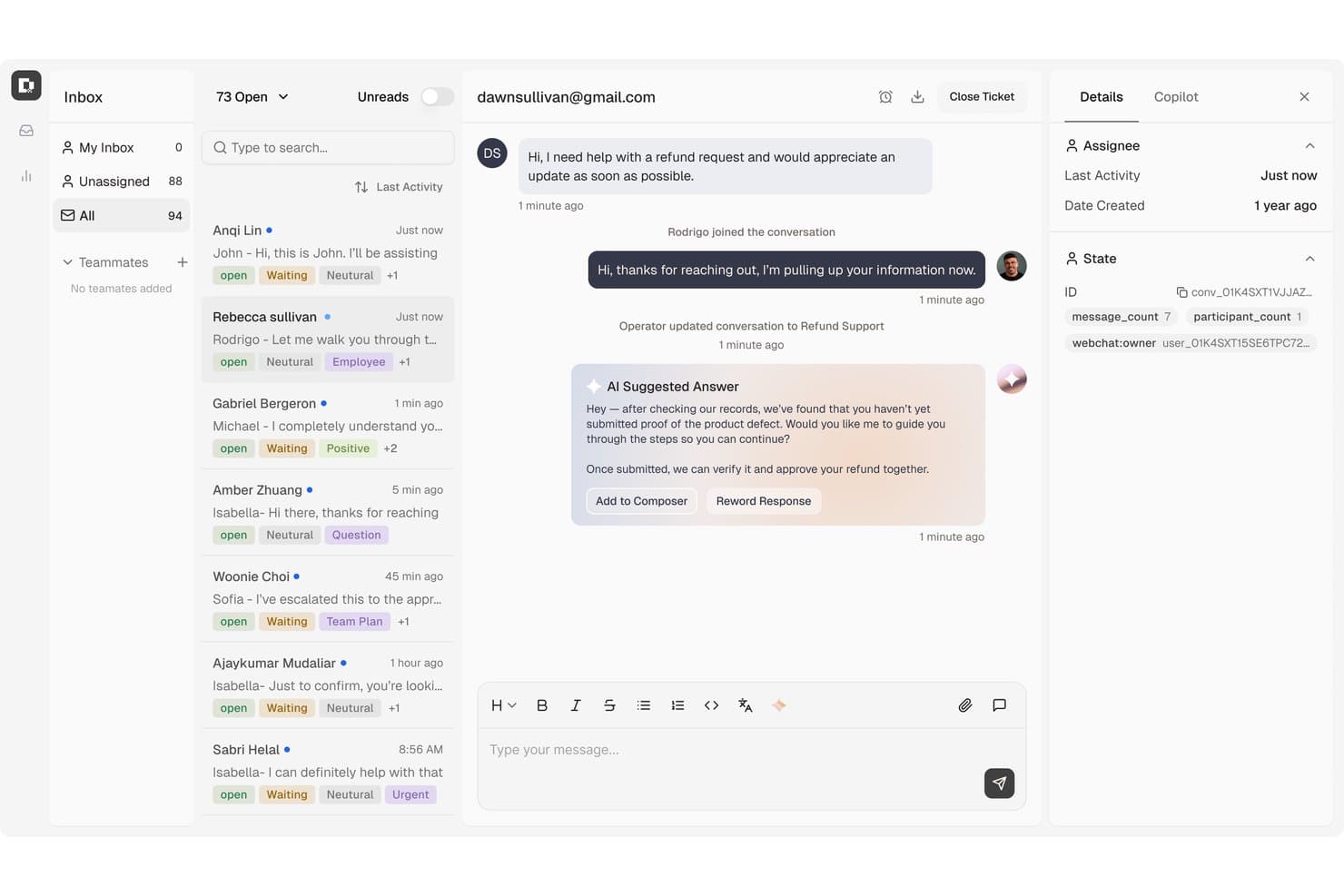
Botpress centralizes customer support tickets with AI-suggested replies. Botpress Desk is an AI-powered help desk that handles customer support tickets across L1, L2, and L3, with built-in automation, multi-channel intake, a self-service Help Center, and native connections to Zendesk and Intercom.
Who Is Botpress Best For?
Botpress Desk suits customer service teams that want AI to resolve tickets autonomously across multiple tiers without paying more as headcount grows.
Why I Picked Botpress
I've included Botpress in my top picks because it's one of the few help desk platforms that charges zero per-seat fees, so your support costs don't spike as you add agents. What I really like is how its AI handles tickets across L1, L2, and L3 autonomously, including multi-step workflows like issuing refunds or checking account status, without routing everything to a human. The built-in Help Center also lets AI reference published content mid-conversation, cutting repeat ticket volume at the source.
Botpress Key Features
- CSAT surveys: Sends localized customer satisfaction surveys after ticket resolution, with language-matched questions and rating labels.
- Conversation organization tools: Agents can apply priorities, tags, custom fields, snooze options, and threaded replies to manage tickets.
- Public Help Center: A branded, customer-facing knowledge base your team publishes and AI references live during support conversations.
- Zendesk and Intercom sync: Connects to your existing helpdesk so actions taken on either platform stay in sync without a full migration.
Botpress Integrations
Botpress Desk has native integrations with Zendesk and Intercom, helping small teams retain existing helpdesk data. Marketplace integrations include Slack, HubSpot, Shopify, Stripe, and WhatsApp; APIs support custom connections, and Zapier is available.
Pros and Cons
Pros:
- Help Center gives customers self-service answers
- Multi-step workflows handle refunds and account checks
- AI handles repetitive customer inquiries
Cons:
- Desk access requires a request
- Complex flows can be difficult to debug
Learn more about Botpress: 10Best for managing shared inboxes
Missive
- 30-day free trial
- From $24/user/month (billed annually)
Visit WebsiteCustomer Rating:4.8/5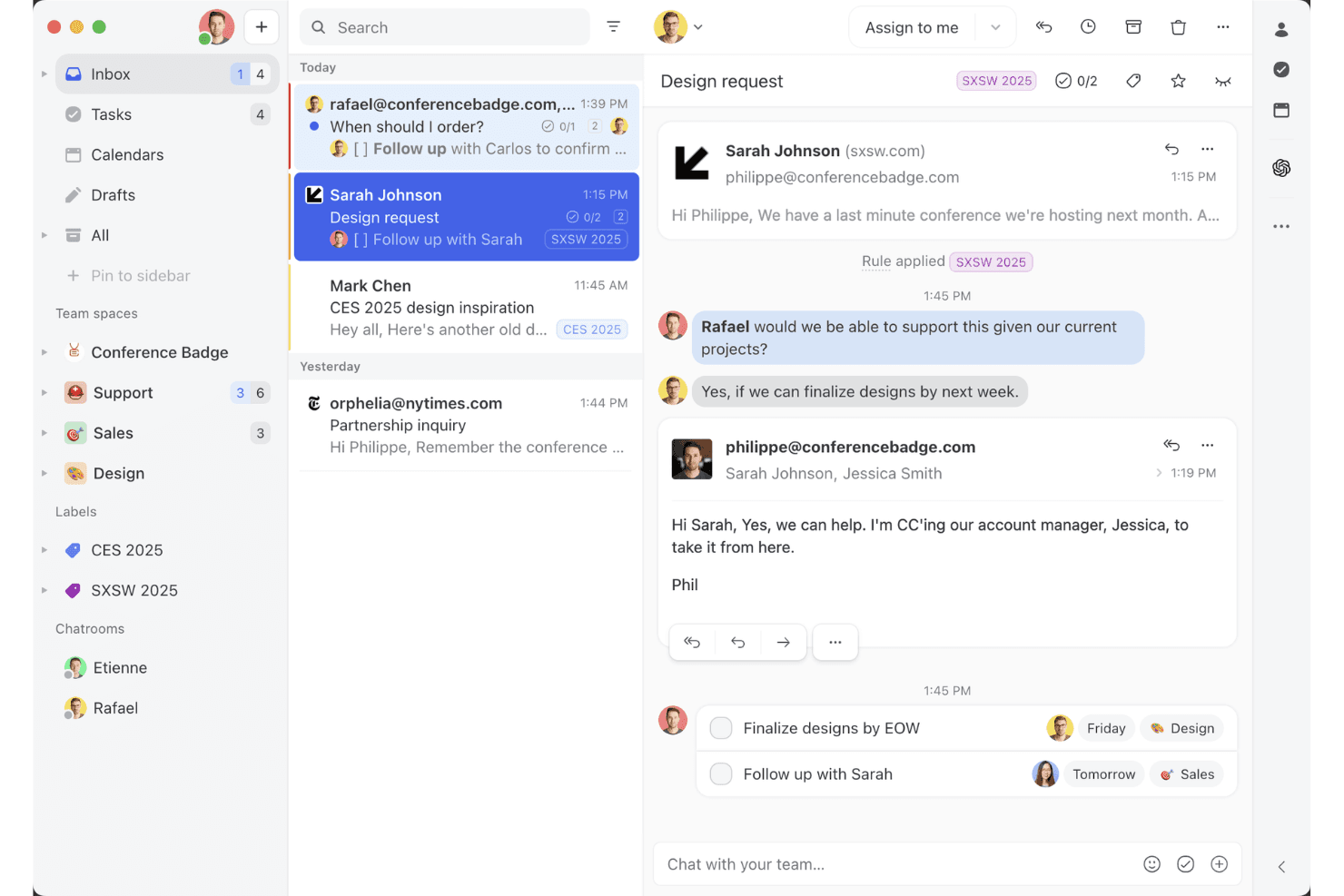
Missive’s shared inbox view shows how teams can collaborate on email threads, assign tasks, and manage client conversations in one workspace. Missive is a shared inbox and collaborative messaging platform that brings email, SMS, WhatsApp, Instagram DMs, and live chat into a single team workspace.
Who Is Missive Best For?
Missive is a great fit for small teams and solo founders who manage customer conversations across email, SMS, and social channels and need a shared inbox that multiple people can work in together.
Why I Picked Missive
Missive earns its spot on my shortlist because real-time collaborative drafting sets it apart from every other shared inbox tool I've tested. When two agents open the same conversation, they co-write the reply simultaneously, like a Google Doc, and collision detection blocks duplicate sends automatically. I also love that internal comment threads sit inline within the conversation, so my team can debate a tricky reply without cluttering the customer's inbox with accidental "reply all" messages.
Missive Key Features
- Multi-channel inbox: Consolidates email, SMS, WhatsApp, Instagram DMs, Facebook Messenger, and live chat into a single shared workspace.
- Automation rules engine: Supports up to 1,000 rules for auto-assignment, routing, labeling, and follow-up triggers on Productive and Business plans.
- AI reply drafting: Generates draft replies using full conversation context, with support for OpenAI, Anthropic, and Google Gemini via your own API key.
- Canned responses: Pre-built reply templates with variable fields let agents send consistent, personalized replies in seconds.
- Missive MCP Server: Connect external AI tools (like Claude or ChatGPT) to query help desk threads, check calendars, and draft replies—while keeping agent review required before sending.
Missive Integrations
Missive offers 25+ native integrations, including HubSpot, Salesforce, Shopify, Asana, ClickUp, Trello, and Aircall. Productive and Business plans include an open API, Zapier connectivity, and its new MCP Server (requires admin activation).
Pros and Cons
Pros:
- Mobile apps support full inbox management
- Multi-channel inbox on entry-level plan
- Real-time collaborative drafting for faster replies
Cons:
- No native CSAT or NPS surveys
- No built-in knowledge base for customers
Learn more about Missive:
Other Options
Here are a few more worthwhile options that didn’t make the list of best help desk software for small business:
- 11ZendeskBest AI-powered help desk software for scaling businesses
- 12Agentforce Service (formerly Service Cloud)Best for AI-powered personalization
- 13TidioBest small business help desk software for live visitor tracking
- 14EngageBayBest small business help desk software for scalability
- 15HaloBest small business help desk software for customer self-service portals
- 16monday serviceBest for tracking and managing support queries
- 17GorgiasBest small business help desk software for monitoring agent performance
- 18FrontBest for automating repetitive tasks
- 19IssuetrakBest for omnichannel help desk support
- 20AvochatoBest small business help desk software for mobile functionality
How I Evaluate Help Desk Software
I split my evaluation into two layers: baseline capabilities every help desk needs—like ticket management and SLA enforcement—and the differentiators that set tools apart for specific CX teams.
Core Functionality (Table Stakes For This List)
When I'm selecting tools for my list, I rank each one on a scale from 0 (does not offer the functionality) to 5 (excels in this area) for each core functionality listed below. Then, I calculate the tool's total score into a percentage. Each tool needs to achieve a minimum total score of 75% to be considered for inclusion.
- Ticket Management System: I look at the full ticket lifecycle—creation, assignment, prioritization, tagging, and resolution—plus whether agents can merge, split, or link related tickets.
- Multi-Channel Support: Each tool should unify email, chat, phone, social, and web form inquiries in one inbox so agents aren't toggling between separate queues.
- Automation & Workflows: I evaluate whether routing rules, escalation triggers, and macros can handle real scenarios like auto-assigning billing tickets to a specialized team.
- Knowledge Base & Self-Service: A built-in help center with search, categorization, and public publishing matters—especially for deflecting common "how do I reset my password" tickets.
- Reporting & Analytics: Dashboards should cover core KPIs like first response time, resolution rate, and CSAT, with filtering by agent, team, or ticket category.
- SLA Management: I check whether you can set up SLA policies with business-hours rules and escalation alerts, like flagging tickets that approach a breach threshold.
Once I have a list of tools that meet the criteria, I consider what sets each platform apart.
Differentiating Factors (What Sets Vendors Apart)
Here's how I compare and contrast different vendors:
Standout Features
AI-powered features are a major differentiator. I check whether a tool can draft reply suggestions, summarize long threads, or surface relevant knowledge base articles mid-conversation. A customer context panel also matters—agents who can see prior tickets, account details, and purchase history alongside the active issue deliver more personal support. Built-in collaboration tools like side conversations and @mentions help agents loop in product or engineering teams without leaving the ticket.
Beyond Features
Integrations shape how well a help desk fits your existing stack. I evaluate whether a tool connects natively with CRMs like Salesforce or HubSpot, ecommerce platforms like Shopify, and team communication tools like Slack. Pricing structure also matters—per-agent models can get costly for growing teams, so I check whether vendors offer volume-based or tiered alternatives. Implementation speed is another factor I weigh, especially migration tools that let you import tickets and workflows from a previous platform without starting from scratch.
How to Choose Help Desk Software for Small Business
It’s easy to get bogged down in long feature lists and complex pricing structures. To help you stay focused as you work through your unique software selection process, here’s a checklist of factors to keep in mind:
| Factor | What to Consider |
|---|---|
| FactorScalability | What to ConsiderEnsure the software can grow with your business. Look for options that allow you to add users or features as your needs expand without major disruptions. |
| FactorIntegrations | What to ConsiderCheck if the software integrates with tools your team already uses, like CRMs, email platforms, or social media channels, to keep everything connected. |
| FactorCustomizability | What to ConsiderConsider how much you can tailor the software to fit your workflow. Flexible settings and options can make it a better fit for your unique needs. |
| FactorEase of Use | What to ConsiderLook for an intuitive interface that your team can navigate without extensive training. A user-friendly design will save time and reduce frustration. |
| FactorBudget | What to ConsiderAssess the total cost, including any hidden fees. Compare features and pricing tiers to ensure you get the best value for your investment. |
| FactorSecurity Safeguards | What to ConsiderEnsure the software complies with industry standards for data protection. Features like encryption and access controls are essential for safeguarding information. |
Trends in Help Desk Software for Small Business
In my research, I sourced countless product updates, press releases, and release logs from different help desk software for small businesses vendors. Here are some of the emerging trends I’m keeping an eye on:
- AI Help Desk Tools: 70% of organizations believe AI will significantly improve their customer service operations. More tools are integrating AI to analyze customer interactions and provide actionable insights. For instance, some vendors offer AI-driven analytics to highlight common issues and suggest solutions.
- Self-Service Portals: There's a growing move towards empowering customers with self-service options. These portals let users find answers on their own, reducing the load on support teams. Vendors are enhancing these with intuitive interfaces and comprehensive knowledge bases.
- Omnichannel Support: Businesses are now expected to manage customer interactions across multiple channels seamlessly. This trend sees vendors offering integrated platforms to handle emails, chats, social media, and more, all from a single dashboard.
- Remote Support Capabilities: As remote work becomes more common, help desk solutions are focusing on features that support remote troubleshooting. This includes virtual assistance tools and remote desktop access to resolve issues efficiently without physical presence.
- Data-Driven Personalization: Customizing the customer experience using data insights is becoming crucial. Tools are now offering features to personalize interactions based on past behaviors and preferences, enhancing user satisfaction and loyalty.
What Is Help Desk Software for Small Business?
Help desk software for small businesses is a tool designed to manage customer inquiries and support requests efficiently. These tools are generally used by customer service professionals, IT staff, and small business owners to improve customer satisfaction and streamline support operations.
Ticket management, self-service portals, and omni-channel support features help with organizing requests, empowering customers, and handling interactions across different channels. Overall, these tools provide businesses with the ability to deliver better and more responsive customer support.
Features of Help Desk Software for Small Businesses
When selecting help desk software for small businesses, keep an eye out for the following key features:
- Ticket management: Organizes customer inquiries into manageable tickets, allowing your team to prioritize and address issues efficiently.
- Self-service portals: Empowers customers to find answers on their own, reducing the workload on your support team and improving response times.
- Omni-channel support: Enables handling of customer interactions across multiple platforms like email, chat, and social media from a single interface.
- AI tools in help desks: From AI data analysis, AI chatbots, to generative AI assistance for agents, AI is a powerful tool to support customer service.
- Remote support capabilities: Offers tools like virtual assistance and remote desktop access to resolve issues for remote users effectively.
- Data-driven personalization: Customizes customer interactions based on past behaviors, enhancing user satisfaction and fostering loyalty.
- Customizable dashboards: Allows teams to tailor the interface to fit their specific workflow needs, improving usability and efficiency.
- Integration with CRM systems: Ensures seamless data flow between your help desk and customer relationship management tools, enhancing customer insights.
- Reporting and analytics: Delivers detailed insights into performance metrics, helping teams track efficiency and identify areas for improvement.
- Automation features: Ways to automate repetitive and time consuming tasks, freeing up your team for more creative and strategic work.
Help Desk Software: Security and Compliance Considerations
When choosing help desk software, security and compliance are crucial to protect sensitive data and meet industry regulations. Here are key considerations:
- Data Encryption: Ensure data is encrypted in transit (SSL/TLS) and at rest to prevent unauthorized access.
- Access Controls: Use role-based permissions and multi-factor authentication (MFA) to restrict access.
- Audit Logs: Maintain detailed logs of user activities to track changes and detect security incidents.
- Compliance Standards: Verify adherence to industry regulations like GDPR, HIPAA, or ISO 27001, depending on your business.
- Data Backups & Recovery: Regular backups and disaster recovery plans protect against data loss.
- Secure Integrations: Ensure third-party integrations follow security best practices to prevent vulnerabilities.
- User Privacy Protection: Implement policies to safeguard customer data and limit unnecessary data collection.
- Incident Response Plan: Have a strategy to detect, report, and respond to security breaches effectively.
These measures help keep your help desk secure while ensuring compliance with legal and industry requirements.
Benefits of Help Desk Software for Small Businesses
Implementing help desk software for small businesses provides several benefits for your team and your business. Here are a few you can look forward to:
- Improved efficiency: Ticket management and automation features help your team prioritize and resolve issues faster, saving time and resources.
- Enhanced customer satisfaction: Self-service portals and omni-channel support ensure customers receive timely, accurate assistance across their preferred platforms.
- Data-driven decisions: AI-powered insights and reporting tools provide valuable data to refine your support strategies and improve service quality.
- Cost savings: Efficient handling of inquiries and reduced workload on support teams can lead to lower operational costs over time.
- Increased flexibility: Customizable dashboards and integration with CRM systems allow your team to tailor the software to fit specific business needs.
- Better security: Security safeguards protect sensitive customer data, ensuring compliance with industry standards and building trust with your clients.
- Scalability: As your business grows, scalable solutions ensure your help desk software can expand alongside your needs without disruption.
Costs and Pricing of Help Desk Software for Small Businesses
Selecting help desk software for small businesses requires an understanding of the various pricing models and plans available. Costs vary based on features, team size, add-ons, and more. The table below summarizes common plans, their average prices, and typical features included in help desk software for small businesses solutions:
Plan Comparison Table for Help Desk Software for Small Businesses
| Plan Type | Average Price | Common Features |
|---|---|---|
| Plan TypeFree Plan | Average Price$0/user/month | Common FeaturesBasic ticketing, email support, and limited reporting. |
| Plan TypePersonal Plan | Average Price$5-$25/user/month | Common FeaturesAdvanced ticketing, self-service portal, and basic analytics. |
| Plan TypeBusiness Plan | Average Price$30-$60/user/month | Common FeaturesMulti-channel support, automation tools, and integration with CRM systems. |
| Plan TypeEnterprise Plan | Average Price$70-$120/user/month | Common FeaturesCustomizable dashboards, AI-powered insights, and enhanced security features. |
Frequently Asked Questions
If your small business is just beginning the search for a customer support solution, you probably have a number of questions about help desk software in general. I’ve gathered some of the most common FAQs here for clarity.
What type of help desk software is used in a small business?
Small businesses and startups have very different needs from those of a large enterprise. You probably won’t need hundreds of live agents to respond to thousands of support tickets on any given day. But you might need a way to safely store customer history data as your business grows, or the ability to delegate the more repetitive admin tasks to AI. All the customer service software platforms on this list cater to the unique needs of small businesses with a host of tailor-made features.
Before you dive into your selection process, I recommend reviewing these recommendations for how to choose the best help desk software first.
How does help desk software work?
A help desk is an online space in which customers can communicate with your small business to address concerns like:
- Product questions
- Help navigating your platform
- IT issues
The help desk interface presents your customers with an easy way to get in touch with you and receive support quickly, and can make a huge difference in increasing customer loyalty and satisfaction. Did you know that 80% of consumers would be willing to pay more to receive better customer support? Help desk software for small business can assist you in delivering an enhanced customer experience.
How can help desk software benefit a small business?
Help desk software can help small business by streamlining your customer service tasks, making it easier for your team to clearly communicate with customers and efficiently resolve their concerns.
When a customer encounters a problem and is quickly and kindly offered a solution, their trust in your brand grows. Sure, at first blush, helping someone navigate a 404 error may seem like no big deal. But it’s actually planting the seeds of brand loyalty, which is a critical factor in revenue growth for small businesses.
In this sense, help desk software for small business doesn’t just offer the practical elements of communication and analytics. It also offers the more intangible but immensely beneficial opportunity to nurture customer relationships.
How do I create a help desk system?
The good news is – you don’t have to! When you work with a help desk software for small business, they create the help desk system on your behalf. You just need to install the software and begin using the tool. After a little time spent onboarding and customizing the interface, you can get started interacting with customers via your new help desk system faster than you can say “5-star rating”.
What types of reporting and analytics should my help desk have?
Your help desk should have reporting and analytics that provide insights into performance, efficiency, and customer satisfaction. Here are key types to include:
- Ticket Volume Reports: Track the number of tickets received, resolved, and pending over time.
- Response & Resolution Time: Measure how quickly agents respond to and resolve issues.
- Agent Performance: Monitor individual agent workload, response time, and customer ratings.
- Customer Satisfaction (CSAT): Gather feedback through surveys to assess user experience.
- First Contact Resolution (FCR): Check how many tickets are resolved in the first response.
- Recurring Issues: Identify common problems to improve solutions and reduce repeat tickets.
- Service Level Agreement (SLA) Compliance: Ensure tickets are resolved within promised timeframes.
- Channel Effectiveness: Compare ticket sources (email, chat, phone) to optimize support methods.
- Peak Ticket Times: Identify busy periods to allocate resources effectively.
- Self-Service Effectiveness: Measure how often users resolve issues through knowledge base articles.
These insights help improve efficiency, customer experience, and overall help desk performance.
What are Self-Service Capabilities in a help desk?
Self-service capabilities in a help desk allow users to find answers and resolve issues on their own without contacting support. Here are the key features:
- Knowledge Base: A library of articles, FAQs, and guides that help users troubleshoot common issues.
- AI Chatbots: Automated assistants that provide instant answers and guide users through solutions.
- Community Forums: A space where users can ask questions and share solutions with each other.
- Automated Workflows: Predefined processes that help users reset passwords, request access, or submit forms.
- Self-Service Portal: A central hub where users can track ticket status, find resources, and request services.
- Troubleshooting Wizards: Step-by-step guides that help diagnose and fix problems.
- Service Catalog: A menu of IT services users can request without needing direct support.
- Mobile Access: Self-service tools optimized for mobile devices, allowing users to find help anytime, anywhere.
These features reduce support workload, improve response times, and empower users to solve problems independently.
What is customer support and training?
Customer Support and Training help users understand and effectively use a product or service. Here’s a breakdown of each:
- Customer Support: Assists users with troubleshooting, resolving issues, and answering questions through channels like phone, chat, email, or self-service portals.
- Training: Provides structured learning—such as tutorials, webinars, or in-person sessions—to help users maximize the product’s value.
Both ensure customers have a smooth experience, boosting satisfaction and product adoption.
Happy Customers = Return Customers
Statistically speaking, 65% of your revenue is likely to come from existing customers. When you nurture your customer relationships, you naturally increase their loyalty to your small business, and in turn create more sales.
Ensuring that your customer touchpoints are characterized by helpful, clear, kind, and efficient interactions will let your customers know how deeply you value them. An investment in help desk software for small business can dramatically improve the quality of your interactions within each touchpoint. So what are you waiting for?