

Kore Review: Pros, Cons, Features and Pricing
Kore excels with its advanced AI capabilities, making it a standout choice for teams looking to enhance their customer interaction with intelligent automation.

We review tools independently, and commissions help fund our testing. See our transparency policy, our methodology, or suggest a tool.
Kore.ai is a chatbot software for teams that need to build and deploy AI-powered virtual assistants across voice, chat, and digital channels. It's built for enterprise-scale use cases, including customer support automation, employee self-service, and conversational commerce. If you are also looking at IBM Watson Assistant, I'd go for Kore.ai if you want a more accessible no-code bot builder that still gives your team the NLP depth and multi-channel control that complex deployments require.
Kore Evaluation Summary

4.6/5
- Pricing upon request
- Free Demo
Why Trust Our Software Recommendations
6,700+
Reviews
20
Industry experts
16+
Evaluation factors
14
Years
Our team has been testing and reviewing software since 2012. As CX leaders ourselves, we know how difficult—and important—it is to choose the right software.
For this guide, we evaluated tools using hands-on testing and independent research, scoring tools using our selection criteria.
Our reviews reflect our human editorial judgment, not a sales pitch.
 Gui DrusinaCreative Director
 Tim FisherVP of AI
Kore Overview
From my perspective, Kore is a solid choice for chatbot software, particularly if you're looking for a platform that's easy to use and integrates well with other tools. The standout features, such as the drag-and-drop builder, make it accessible for teams without extensive coding expertise through its no-code and low-code AI tools. However, the integration process can be a bit cumbersome, which might slow down your team's workflow. Customer support is reliable but resolution times can vary. For teams prioritizing ease of use and robust features without breaking the bank, Kore is worth considering. It's best suited for environments where a balance of functionality and user-friendliness is needed.
Pros
- You can easily create conversational AI with its intuitive interface.
- It offers robust analytics to help you understand user interactions.
- The platform allows for extensive customization to fit your team's needs.
Cons
- You might find the initial setup process a bit complex.
- Some users report limited language support.
- Navigating through its advanced features can be overwhelming initially.
Is Kore Right For Your Needs?
Who Would be a Good Fit for Kore?
Kore is a conversational AI platform that is ideal for large businesses seeking to automate customer interactions. If your team needs an AI chatbot that integrates seamlessly with existing systems, Kore's robust API support is a big plus. It's especially useful for customer service departments looking to reduce manual work and improve response times. Kore's ability to handle complex queries with natural language processing makes it perfect for industries like finance or retail where detailed customer interactions are crucial.
- Customer ServiceKore excels in customer service by automating responses to common queries, freeing up your team for more complex issues.
- Finance SectorIts natural language processing capabilities make Kore an excellent choice for financial services, where accurate and secure interactions are vital.
- Retail IndustryRetailers benefit from Kore's integration capabilities, enabling seamless customer interactions across various platforms to enhance customer satisfaction.
- Human ResourcesIn HR, Kore can automate repetitive tasks like scheduling interviews, making your recruitment process more efficient.
- Healthcare ProvidersFor healthcare, Kore's secure data handling ensures patient interactions are both efficient and compliant with regulations.
- E-commerce PlatformsE-commerce businesses can leverage Kore to enhance customer engagement and streamline order management through chatbots.
Who Would be a Bad Fit for Kore?
Kore might not be the best choice for small businesses or startups with limited budgets and simple needs. Its advanced features, like AI-driven analytics and integration capabilities, are more suited for larger enterprises with complex operations. You might find Kore's extensive functionalities overwhelming and unnecessary if your team isn't ready to leverage its full potential. Additionally, if your primary need is a straightforward chatbot without deep analytics or integrations, Kore's feature-rich platform might be more than you need.
- Small Retail BusinessesKore's advanced analytics and integrations are overkill for simple retail needs, adding unnecessary complexity.
- FreelancersFreelancers won't benefit from Kore's enterprise-level features, which are designed for larger teams and collaborative efforts.
- Local RestaurantsLocal dining spots with straightforward customer interactions don't need Kore's intricate functionalities.
- Non-Tech Savvy TeamsTeams without technical expertise might struggle with Kore's setup, leading to underutilization of its capabilities.
- Basic Customer SupportIf your customer service needs are minimal, Kore's robust platform will likely be more than what's necessary.
- Budget-Conscious StartupsStartups with tight budgets may find Kore too expensive, especially if they require only basic chatbot features.
How We Test & Score Tools
We’ve spent years building, refining, and improving our software testing and scoring system. The rubric is designed to capture the nuances of software selection and what makes a tool effective, focusing on critical aspects of the decision-making process.
Below, you can see exactly how our testing and scoring works across seven criteria. It allows us to provide an unbiased evaluation of the software based on core functionality, standout features, ease of use, onboarding, customer support, integrations, customer reviews, and value for money.
Core Functionality (25% of final scoring)
The starting point of our evaluation is always the core functionality of the tool. Does it have the basic features and functions that a user would expect to see? Are any of those core features locked to higher-tiered pricing plans? At its core, we expect a tool to stand up against the baseline capabilities of its competitors.
Standout Features (25% of final scoring)
Next, we evaluate uncommon standout features that go above and beyond the core functionality typically found in tools of its kind. A high score reflects specialized or unique features that make the product faster, more efficient, or offer additional value to the user.
We also evaluate how easy it is to integrate with other tools typically found in the tech stack to expand the functionality and utility of the software. Tools offering plentiful native integrations, 3rd party connections, and API access to build custom integrations score best.
Ease of Use (10% of final scoring)
We consider how quick and easy it is to execute the tasks defined in the core functionality using the tool. High scoring software is well designed, intuitive to use, offers mobile apps, provides templates, and makes relatively complex tasks seem simple.
Onboarding (10% of final scoring)
We know how important rapid team adoption is for a new platform, so we evaluate how easy it is to learn and use a tool with minimal training. We evaluate how quickly a team member can get set up and start using the tool with no experience. High scoring solutions indicate little or no support is required.
Customer Support (10% of final scoring)
We review how quick and easy it is to get unstuck and find help by phone, live chat, or knowledge base. Tools and companies that provide real-time support score best, while chatbots score worst.
Customer Reviews (10% of final scoring)
Beyond our own testing and evaluation, we consider the net promoter score from current and past customers. We review their likelihood, given the option, to choose the tool again for the core functionality. A high scoring software reflects a high net promoter score from current or past customers.
Value for Money (10% of final scoring)
Lastly, in consideration of all the other criteria, we review the average price of entry level plans against the core features and consider the value of the other evaluation criteria. Software that delivers more, for less, will score higher.
Core Features
Natural Language Processing (NLP): Kore AI's advanced NLP allows your chatbot to understand and respond to user inquiries in multiple languages. This feature ensures effective communication by interpreting user intent accurately.
Low-Code Dialog Builder: With Kore AI's low-code dialog builder, you can create sophisticated chatbots and virtual assistants without needing deep technical skills. This tool simplifies the design process, enabling you to focus on refining user interactions.
AI-Powered Voice Assistants: Kore AI's voice-optimized assistants enhance customer interactions by providing automated voice support. This feature is particularly valuable for industries like healthcare and banking where real-time voice communication is crucial.
Omnichannel Support: Your team can deploy chatbots across various platforms like web, mobile, and social media, ensuring a consistent user experience. This flexibility helps meet your audience wherever they are.
Built-in Analytics: Kore AI provides comprehensive analytics tools to track and improve your chatbot's performance. These insights help you make data-driven decisions to enhance user satisfaction.
Compliance with Regulations: Kore AI ensures compliance with major regulations like GDPR and HIPAA, giving you peace of mind when handling sensitive data. This is particularly beneficial for businesses in regulated industries.
Ease of Use
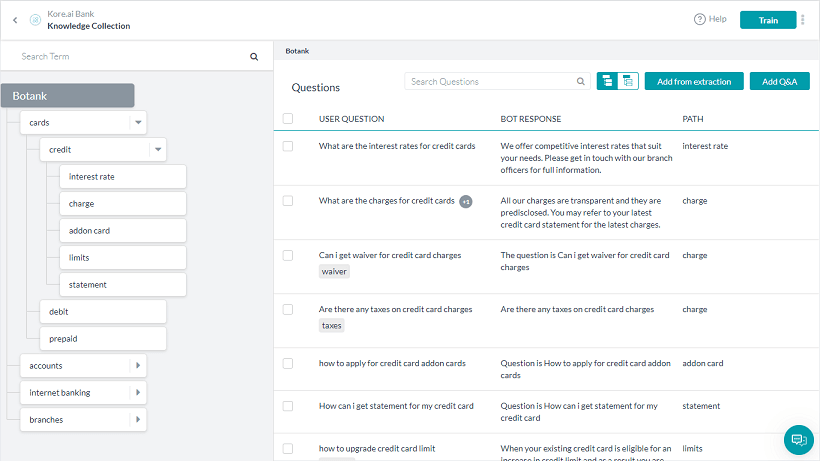
Kore's chatbot software can be challenging to navigate, as users often find its interface unintuitive and sometimes rigid. It requires multiple steps to access certain features, which can be cumbersome for your team. While the feature set is comprehensive, the lack of a straightforward layout makes it less user-friendly compared to other platforms. However, Kore's customer support is detailed, offering significant guidance to help you and your team navigate the software effectively.
Integrations
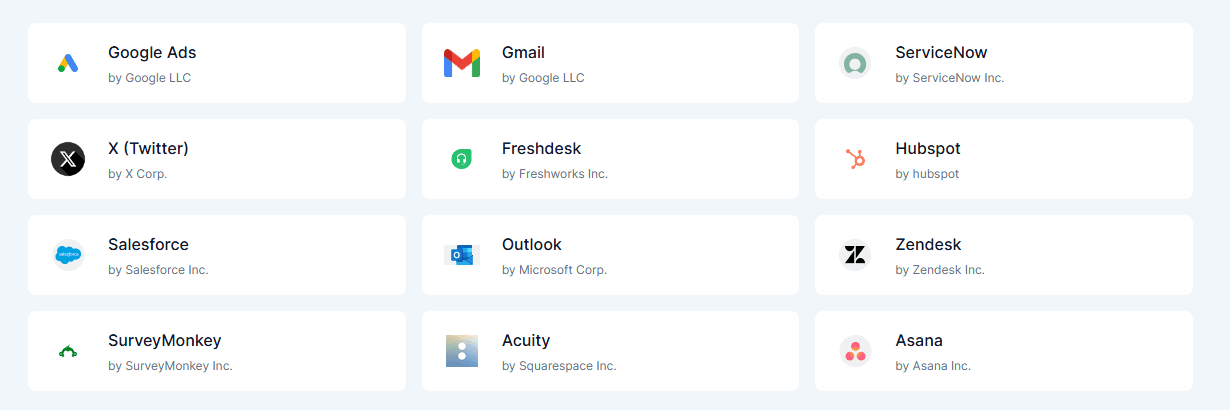
Kore integrates with Salesforce, ServiceNow, HubSpot, Zendesk, AWS, Microsoft Dynamics, Slack, WhatsApp, Google Calendar, and Facebook Messenger. Kore also provides robust API capabilities and supports third-party integration tools, allowing users to connect with various enterprise systems through its Agent Marketplace.
Kore Specs
- Analytics: Yes
- API: Yes
- Calendar Management: Yes
- Chat: Yes
- Click-to-Dial: Yes
- CRM Integration: Yes
- Customer Management: Yes
- Customer Service: Yes
- Dashboard: Yes
- Dashboards: No
- Data Export: Yes
- Data Import: Yes
- Data Visualization: Yes
- External Integrations: Yes
- Feedback Management: Yes
- Knowledge Base: Yes
- Lead Management: Yes
- Lead Scoring: Yes
- Multi-Source Feedback: Yes
- Multi-User: Yes
- Net Promoter Score: Yes
- Notifications: Yes
- Omnichannel Referrals: No
- Online Surveys: Yes
- Review Moderation: No
- Scheduling: Yes
- Sentiment Analysis: Yes
- Social Media Monitoring: Yes


