

Mixpanel Review: Pros, Cons, Features and Pricing
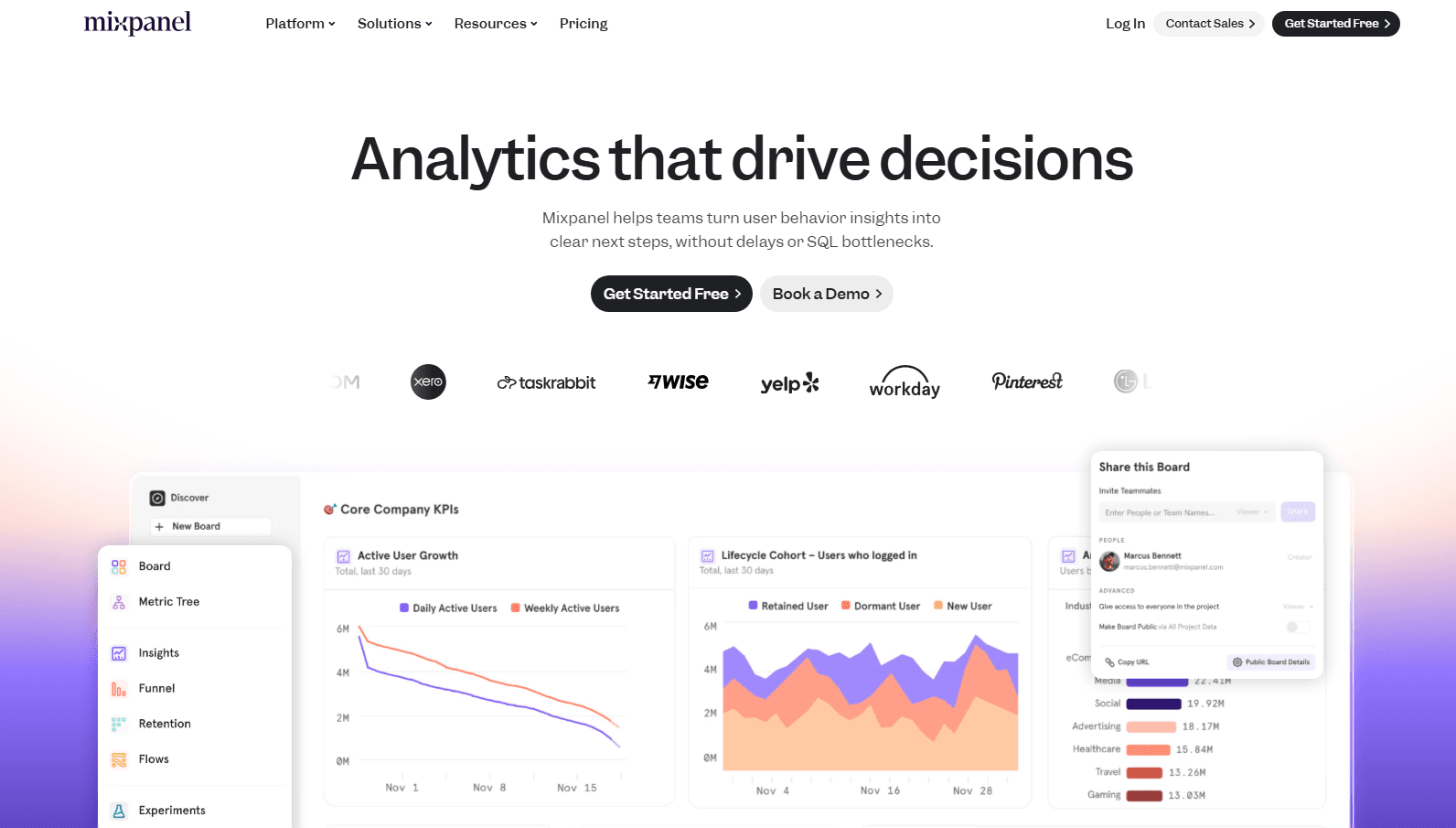
Mixpanel excels with intuitive analytics and real-time insights, making it a top choice for teams focused on user engagement.

We review tools independently, and commissions help fund our testing. See our transparency policy, our methodology, or suggest a tool.
Mixpanel is a customer data platform built around event-based product analytics—tracking what users do inside your product and where they fall off. This tool would be my choice if your team needs to run funnel analysis, measure retention, and segment users by behavior without filing a ticket to your data team every time. If you've weighed it against Amplitude, Mixpanel tends to be the easier choice for non-technical users to self-serve on, while still giving analysts the query depth and flexibility they need.
Mixpanel Evaluation Summary
4.5/5
- From $120/month (billed annually)
- Free plan available
Why Trust Our Software Recommendations
6,700+
Reviews
20
Industry experts
16+
Evaluation factors
14
Years
Our team has been testing and reviewing software since 2012. As CX leaders ourselves, we know how difficult—and important—it is to choose the right software.
For this guide, we evaluated tools using hands-on testing and independent research, scoring tools using our selection criteria.
Our reviews reflect our human editorial judgment, not a sales pitch.
 Gui DrusinaCreative Director
 Tim FisherVP of AI
Mixpanel Overview
In my opinion, Mixpanel is a powerful tool in the customer data platform space, especially for tech-savvy teams focused on product analytics. Its standout features, like real-time data and intuitive reports, make it appealing for digital marketing and product teams looking to streamline decision making. While its interface is user-friendly, onboarding can be a bit challenging for those new to data analytics platforms.
Compared to other software in the same category, Mixpanel excels in offering detailed insights but might fall short in customer support and price flexibility. Overall, it’s a strong fit for small to mid-sized tech teams that want to dig deeper into how users interact with their product. If your team prioritizes in-depth analytics and smooth integrations, Mixpanel is definitely worth a look.
Pros
- You get real-time insights to quickly understand user behavior.
- Its intuitive reports make it easy for your team to analyze data.
- You can customize visual dashboards to fit your specific needs.
Cons
- Your team might find the onboarding process a bit challenging.
- Customer support isn't as responsive as you'd hope.
- It can be complex for those new to data analytics platforms.
Is Mixpanel Right For Your Needs?
Who Would be a Good Fit for Mixpanel?
Mixpanel is great for tech startups, product teams, and digital marketing departments needing detailed user insights. If your work revolves around user behavior analysis, Mixpanel's real-time data and customizable reports will serve you well. The dashboards are also easy to navigate, making it simple for your team to follow user interactions and refine engagement strategies. For any industry focused on digital growth and user experience, Mixpanel can give you the insights you need to make smarter decisions, faster.
- Tech StartupsMixpanel helps you analyze user data to refine your product quickly.
- Product TeamsProduct managers can use Mixpanel's customizable reports to track things like feature adoption, page views, and in-app behaviors.
- Digital MarketingYou can leverage real-time insights to optimize your campaigns effectively.
- E-commerceMixpanel provides your team with user behavior data to enhance shopping experiences.
- Mobile App DevelopersWith Mixpanel, you can easily track app usage and user engagement.
- SaaS CompaniesMixpanel supports your efforts to understand customer journeys and improve retention.
Who Would be a Bad Fit for Mixpanel?
Mixpanel isn't ideal for small businesses with limited technical expertise or resources. For example, if your team lacks experience in data analytics, you might find Mixpanel's setup and dashboard overwhelming. Companies needing extensive customer support will also face challenges, as Mixpanel's support isn't the most responsive. Industries that don’t depend much on user behavior data may find that Mixpanel’s features are more than they need, and not really worth the extra cost.
- Small RetailersYour team might not need Mixpanel's powerful analytics capabilities for basic sales tracking.
- Brick-and-Mortar StoresBecause Mixpanel is built for digital products, its strengths don’t really translate to in-person customer interactions.
- Non-Tech IndustriesIf your work doesn't involve digital user engagement, Mixpanel's features won't offer much value.
- Non-Profit OrganizationsMixpanel may feel overly complex (and potentially too expensive) if your data analysis needs are relatively simple.
- FreelancersIf you’re working on individual projects, you likely won’t get much value from Mixpanel’s more advanced, large-scale features.
How We Test & Score Tools
We’ve spent years building, refining, and improving our software testing and scoring system. The rubric is designed to capture the nuances of software selection and what makes a tool effective, focusing on critical aspects of the decision-making process.
Below, you can see exactly how our testing and scoring works across seven criteria. It allows us to provide an unbiased evaluation of the software based on core functionality, standout features, ease of use, onboarding, customer support, integrations, customer reviews, and value for money.
Core Functionality (25% of final scoring)
The starting point of our evaluation is always the core functionality of the tool. Does it have the basic features and functions that a user would expect to see? Are any of those core features locked to higher-tiered pricing plans? At its core, we expect a tool to stand up against the baseline capabilities of its competitors.
Standout Features (25% of final scoring)
Next, we evaluate uncommon standout features that go above and beyond the core functionality typically found in tools of its kind. A high score reflects specialized or unique features that make the product faster, more efficient, or offer additional value to the user.
We also evaluate how easy it is to integrate with other tools typically found in the tech stack to expand the functionality and utility of the software. Tools offering plentiful native integrations, 3rd party connections, and API access to build custom integrations score best.
Ease of Use (10% of final scoring)
We consider how quick and easy it is to execute the tasks defined in the core functionality using the tool. High scoring software is well designed, intuitive to use, offers mobile apps, provides templates, and makes relatively complex tasks seem simple.
Onboarding (10% of final scoring)
We know how important rapid team adoption is for a new platform, so we evaluate how easy it is to learn and use a tool with minimal training. We evaluate how quickly a team member can get set up and start using the tool with no experience. High scoring solutions indicate little or no support is required.
Customer Support (10% of final scoring)
We review how quick and easy it is to get unstuck and find help by phone, live chat, or knowledge base. Tools and companies that provide real-time support score best, while chatbots score worst.
Customer Reviews (10% of final scoring)
Beyond our own testing and evaluation, we consider the net promoter score from current and past customers. We review their likelihood, given the option, to choose the tool again for the core functionality. A high scoring software reflects a high net promoter score from current or past customers.
Value for Money (10% of final scoring)
Lastly, in consideration of all the other criteria, we review the average price of entry level plans against the core features and consider the value of the other evaluation criteria. Software that delivers more, for less, will score higher.
Core Features
User Analytics: Track user interactions across your digital platforms. This allows you to see how users engage with your websites and apps, so you can identify trends to improve your products.
Custom Dashboards: Create customized dashboards that actually fit your team's needs and workflows.
Event Tracking: Monitor specific user actions like clicks and views. This helps you better understand user journeys, so you can optimize their experience.
Funnel Analysis: Visualize user paths and drop-off points. Your team can use this to refine user flows and drive better conversion rates.
A/B Testing: Test different versions of your features or content. This allows you to see what works best, so you can make more informed, data-driven decisions.
Cohort Analysis: Group users based on shared characteristics or behaviors. This lets you target different segments with more personalized strategies.

Ease of Use
Mixpanel's user interface is relatively intuitive, making it easy for tech-savvy teams to navigate and analyze data. Its customizable dashboards allow you to focus on the metrics that matter most to your team, which can help streamline workflows. However, while the platform is user-friendly for those familiar with data analytics, new users might find the initial setup a bit challenging. Once you're up and running though, MixPanel’s real-time data and straightforward reports make it a solid choice for teams looking to enhance user engagement.

Integrations
Mixpanel integrates with platforms like HubSpot, Mailchimp, Planhat, ChurnZero, Usermind, and Intercom.
Mixpanel also has an API and connects with third-party integration tools, allowing you to connect with additional platforms like PostHog and Google Analytics.

Mixpanel Specs
- A/B Testing: Yes
- AI Integration: Yes
- Analytics: Yes
- API: Yes
- Comparative Reporting: Yes
- Conversion Tracking: Yes
- Custom Reports: Yes
- Dashboard: Yes
- Dashboards: Yes
- Data Export: Yes
- Data Import: Yes
- Data Mining: Yes
- Data Visualization: Yes
- External Integrations: Yes
- Feedback Management: Yes
- Forecasting: Yes
- Historical Data Analysis: Yes
- Keyword Tracking: Yes
- Link Tracking: Yes
- Multi-Site: Yes
- Multi-User: Yes
- Notifications: Yes
- Process Reporting: Yes
- Real-time Alerts: Yes
- Referral Tracking: Yes
- Reports: Yes
- Scenario Planning: Yes
- SEO: Yes
- Time Series Modeling: Yes
- Visualization: Yes
- Workflow Management: Yes


