

How Clay Kept Reading Every Piece of Customer Feedback as It Scaled With Unwrap


Key Takeaways
- Facing hypergrowth, Clay's lean team could no longer read every piece of customer feedback by hand; Unwrap consolidated feedback from every channel — including AI-deflected tickets the team had never seen — into one synthesized view.
- Unwrap's Assistant replaced manual polling for feature decisions: the product team now asks how big a problem is directly, instead of canvassing support.
- Adoption spread across support, product, and engineering, and Unwrap became part of Clay's weekly product-review ritual, keeping customer feedback in front of the people making roadmap decisions.
The Story
Clay was growing fast — the kind of fast where the systems that worked last quarter quietly stop working this one. Customer feedback was arriving through more channels and in greater volume than a lean team could keep up with by hand. Support agents were spotting the same issues independently with no shared view, AI was quietly deflecting a large share of tickets that no one on the team ever saw, and the product team was spending real time polling colleagues just to gauge how widespread a problem was. Clay brought in Unwrap to gather all of that scattered feedback into one synthesized view — and the shift showed up not just in a dashboard but in how the team makes decisions.
About Clay
Clay is a New York–based AI go-to-market platform that helps revenue teams enrich data and automate outbound at scale, serving more than 10,000 customers as one of the faster-growing companies in its category. That growth is exactly what makes its story relevant to any product or support leader at a scaling software company: the volume of customer signal eventually outpaces the human capacity to read it, and the teams closest to customers are the first to feel it. Clay's product organization is deliberately lean, and its support team had grown to around 20 people by the time feedback volume became unmanageable by hand.
The Challenge
Before Unwrap, Clay's feedback lived wherever it happened to land. Observations got dropped into Slack channels—"a little bit scattered," as George Dilthey, Head of Support, put it—with no reliable data on how many customers were actually raising a given issue. With roughly 20 people on the support team, the same problem might surface for several agents separately, and there was no straightforward way to combine those observations into a single story.
Two gaps made it worse. AI was already deflecting a meaningful share of incoming tickets—resolving them before a human was involved—which meant that entire slice of customer feedback was invisible to the team. And when the product team needed to weigh a feature decision, gauging demand meant asking around: canvassing the support team ate up "a lot more time," Abbie Kouzmanoff, Product Lead, noted, from an already lean product schedule. At Clay's growth rate, reading every piece of feedback by hand was simply no longer scalable.
The Solution
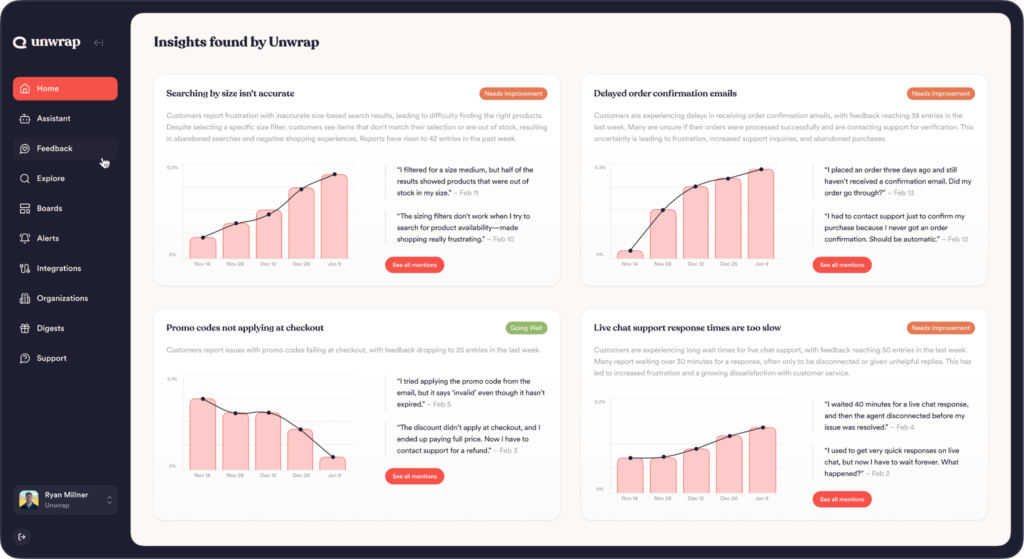
Unwrap connects to the tools where customer feedback already lives and uses AI to automatically categorize and synthesize it, surfacing aggregated insights rather than leaving teams to tag entries and build dashboards by hand. For Clay, that turned a scattered pile of signals into a single place where feedback from every channel—including the tickets AI had been resolving out of sight—comes through together.
The capability that changed the product team's day-to-day is Unwrap's Assistant, which answers natural-language questions about the feedback set. When an engineer asks whether a given feature is worth building, Abbie can query Unwrap directly rather than canvassing colleagues—asking, in her words, "how big of a problem is this?" The answer that used to take a round of conversations now takes a question.
Adoption spread beyond the teams that usually own feedback. Clay's engineering team is now in Unwrap as well, giving engineers a direct line to what customers are seeing and saying rather than receiving it secondhand. And the product team folded it into a weekly ritual: they open Unwrap during their product review and look at the incoming issues together, which keeps customer reality in front of the people making roadmap calls.
The Implementation
This story's source focuses on outcomes more than on the mechanics of rollout, and the clearest signal of a successful implementation is where the tool ended up: not confined to one team, but in active use across support, product, and engineering, and built into a recurring weekly meeting. That kind of cross-functional pickup is usually the hardest part of adopting a new system, and at Clay it happened.
The Results
Clay's clearest outcome is one the team describes in terms of confidence rather than a number. With feedback aggregated and synthesized for them, the team can again "feel like we're reading every single piece of feedback," Abbie said—a direct answer to the wall they had hit.
The other changes are concrete even where they aren't yet quantified. The feedback that AI had been deflecting is now visible to the team for the first time. Engineers have direct insight into customer sentiment instead of hearing it thirdhand. And feature-prioritization questions that once required polling several people now resolve with a single query, giving a lean product team back time it had been spending on manual legwork. Clay's stated next step is to keep widening who inside the company works directly from customer feedback.
Customer Quotes
Even our engineering team is on it now, and that’s giving them a lot more insight into what customers are seeing and hearing directly.
We have a lot of tickets that are being deflected with AI, and those we weren’t seeing at all. Having this one place where all of that feedback is coming through at the same time was extremely helpful.
Next Steps
If your team is hitting the point where customer feedback arrives faster than anyone can read it, Clay's experience is a useful reference for what consolidating it into one place can change. You can explore the platform behind this story at Unwrap or read our in-depth Unwrap review for a fuller breakdown of where it fits in your tech stack.
 or read our in-depth
