

10 Best AI Customer Engagement Software in 2026

Best AI Customer Engagement Software Shortlist


AI customer engagement software uses artificial intelligence to personalize interactions, automate support, and coordinate customer journeys across channels. The best platforms connect marketing, service, and support data while giving teams control over automation and human handoffs. This guide compares leading tools by journey orchestration, personalization, contact center capabilities, integrations, analytics, and retention use cases.
Why Trust Our Software Recommendations
Our team has been testing and reviewing software since 2012. As CX leaders ourselves, we know how difficult—and important—it is to choose the right software.
For this guide, we evaluated tools using hands-on testing and independent research, scoring tools using our selection criteria.
Our reviews reflect our human editorial judgment, not a sales pitch.
Comparison Table: AI Customer Engagement Software
Compare pricing and specs side by side for the agentic customer engagement tools that made it onto my shortlist.
| Tool | Best For | Trial Info | Price | ||
|---|---|---|---|---|---|
| 1 | Best for support resolution at scale | Free demo + 14-day free trial available | From $29/user/month (billed annually) | Website | |
| 2 | Best for developer-built AI across voice and data | Free plan available | Pricing upon request | Website | |
| 3 | Best for agentic journey orchestration | Free demo available | Pricing upon request | Website | |
| 4 | Best for contact center conversational AI at scale | Not available | From $110/agent/month | Website | |
| 5 | Best for enterprise next-best-action decisioning | Free demo available | Pricing upon request | Website | |
| 6 | Best for self-learning cross-channel optimization | 14-day free trial | Pricing upon request | Website | |
| 7 | Best for CRM-native support and outreach | Free demo + 14-day free trial | From CAD $10/user/month (billed annually) | Website | |
| 8 | Best for marketer-controlled AI journey triggers | Free demo available | Pricing upon request | Website | |
| 9 | Best for multichannel journeys in APAC markets | Free demo + 30-day free trial available | Pricing upon request | Website | |
| 10 | Best for enterprise campaign creation | Not available | $1,500/org/month (billed annually) | Website |
AI Customer Engagement Software Reviews
Below are my summaries of the best AI customer engagement software on my shortlist. My reviews examine each platform’s features, best use cases, and integrations to help you find the right fit.

Intercom
Best for support resolution at scale
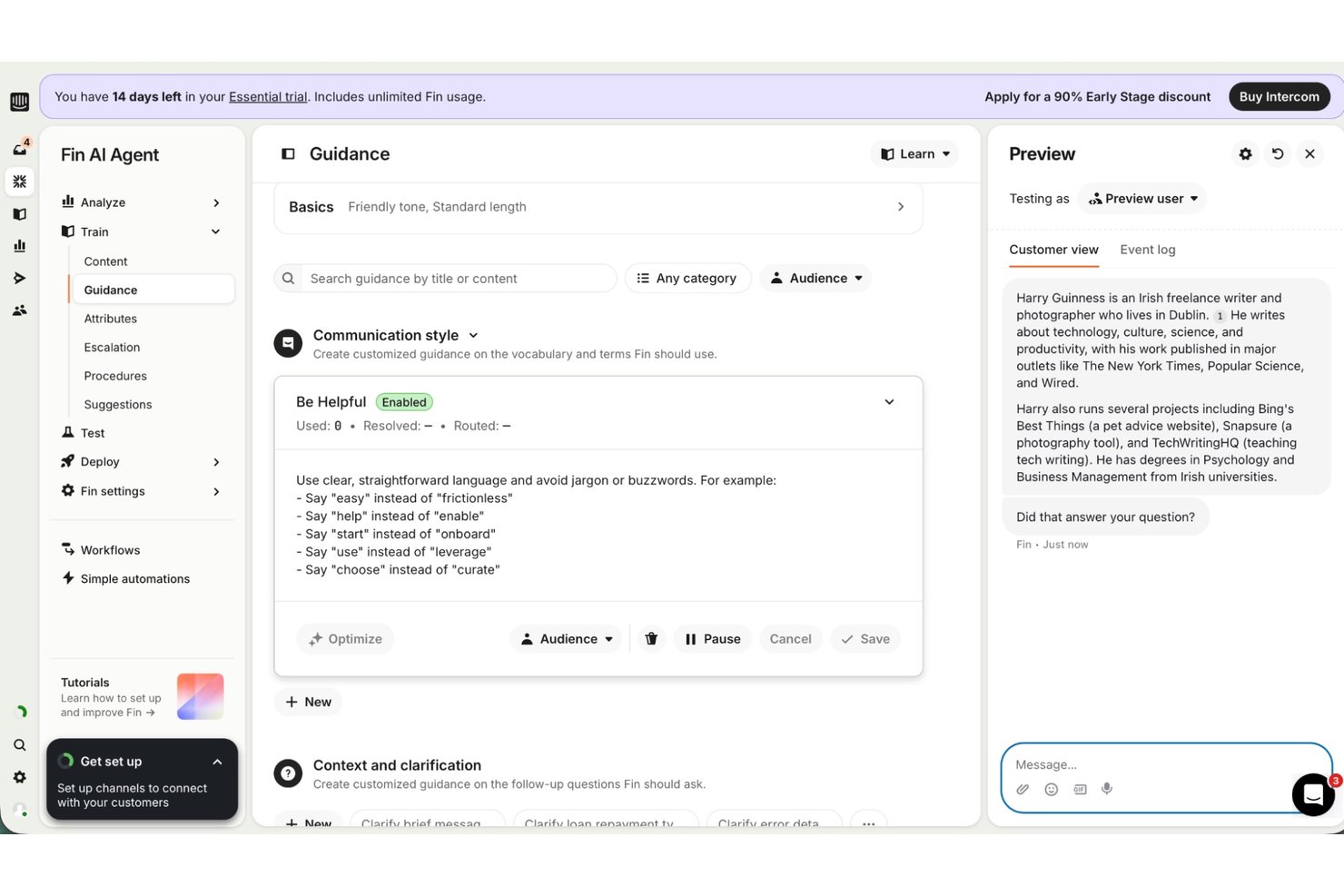
Intercom is an AI-first customer service platform that combines a conversational AI agent (Fin), an omnichannel helpdesk, ticketing system, proactive messaging, and a shared inbox for human agents across chat, email, phone, and social channels.
Who Is Intercom Best For?
Intercom is a strong fit for customer support teams at mid-market and enterprise companies that need to handle high conversation volumes with AI before routing to human agents.
Why I Picked Intercom
I've included Intercom in my top picks because it handles support resolution at scale better than almost anything else I've tested. Fin AI Agent resolves over 76% of conversations on average across 12,000+ customers, handling multi-turn, multi-step exchanges across chat, email, voice, and WhatsApp without dropping context. I also like that Fin uses live Data Connectors to pull in order details from Shopify or Stripe mid-conversation, so it can process a refund or subscription change without escalating to a human agent.
Intercom Key Features
- Fin Copilot: An AI assistant that drafts suggested replies for human agents by pulling from past conversations, help articles, PDFs, and synced content from Notion, Guru, and Confluence.
- Series campaign builder: A no-code visual builder for multi-step message sequences across in-app, email, mobile push, and SMS channels, with A/B testing and goal tracking built in.
- CX Score: A machine learning (ML) model that rates every closed conversation on a 1–5 scale without relying on surveys, surfacing signals like customer effort, answer quality, and sentiment.
- Knowledge Hub: A centralized content layer that pulls in articles from Zendesk, Guru, Confluence, and Notion, giving Fin and human agents one shared knowledge source.
Intercom Integrations
Intercom offers 450+ integrations, including Salesforce, Shopify, Stripe, Jira, Slack, Discord, and Amazon Connect. It also supports REST APIs, webhooks, and MCP-compliant tools for custom connections.
Pros and Cons
Pros:
- Series supports behavior-based proactive engagement
- Preserves context across multiple customer channels
- Fin resolves complex, multi-turn conversations
Cons:
- Predictive churn scoring requires third-party tools
- Support-first design limits marketing optimization

Twilio
Best for developer-built AI across voice and data
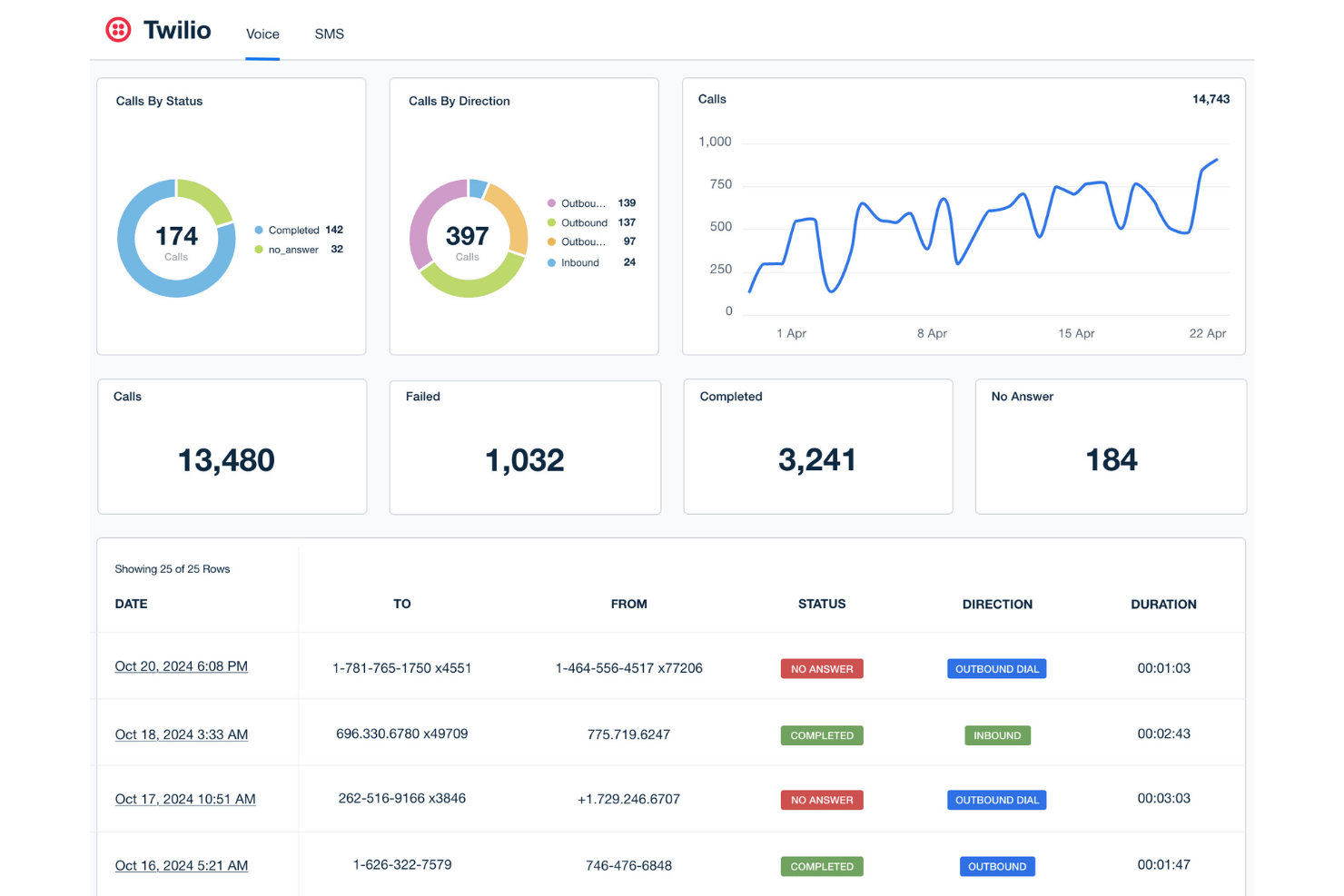
Twilio is a modular AI customer engagement platform that combines a customer data platform (Segment), conversational AI tools, a contact center (Flex), and communications channel APIs across voice, SMS, WhatsApp, and email.
Who Is Twilio Best For?
Twilio is a strong fit for engineering-led teams that want to build custom AI engagement workflows across channels rather than deploy a pre-packaged solution.
Why I Picked Twilio
I've included Twilio in my top picks because it's the only platform here that lets engineering teams build custom AI engagement workflows directly on top of their own LLMs, rather than adopting a packaged bot. ConversationRelay handles real-time voice AI with sub-0.5-second median latency, while Conversation Orchestrator threads voice, SMS, WhatsApp, and chat into a single context-aware session. Segment Predictions then feeds churn scores and purchase likelihood into those journeys automatically.
Twilio Key Features
- Segment Predictions: No-code predictive models score each customer on likelihood to purchase, churn, or hit a custom goal, with refresh windows from 15 to 120 days.
- Conversation Intelligence: Analyzes 100% of voice, SMS, and chat conversations in real time, flagging sentiment shifts, churn risk, and upsell opportunities with custom scoring rules.
- Engage Journeys: Triggers personalized messages across email, SMS, push, and ads based on real-time events, predictive traits, or audience membership.
- Generative Audiences: Builds targetable customer segments from plain-language prompts, without requiring manual filter configuration or SQL.
Twilio Integrations
Twilio integrates with Snowflake, Salesforce, Zendesk, Zapier, Yotpo, CommandBar, and Vero. It also provides APIs and webhooks for custom connections.
Pros and Cons
Pros:
- Explainable predictions expose contributing events
- Low-latency voice conversations support interruptions
- Builds AI journeys around your data
Cons:
- Beta copilots limit production confidence
- Developer build-out precedes conversational deployment

Best for agentic journey orchestration
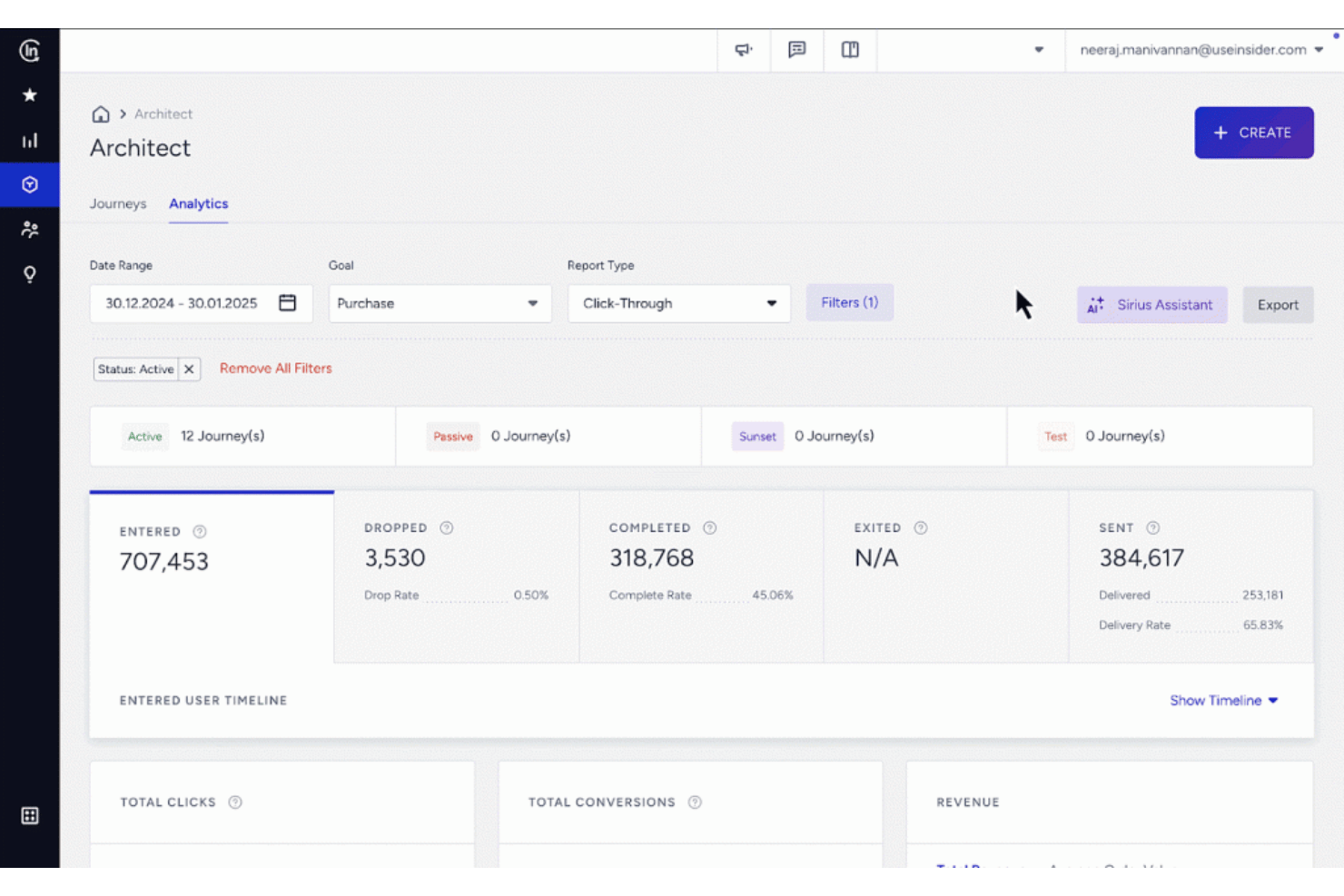
Insider One is an agentic AI customer engagement platform that combines a built-in CDP, multichannel journey orchestration, conversational AI, and real-time personalization.
Who Is Insider One Best For?
Insider One is a strong fit for B2C brands in retail, travel, and financial services that need a single platform to unify customer data.
Why I Picked Insider One
I picked Insider One as one of the best because its Agent One system takes journey orchestration further than any other platform I've seen, moving from human-directed execution to fully autonomous planning and optimization within guardrails you define. In practice, that means my team can set campaign goals, brand rules, and approval thresholds once, then let Agent One build, run, and self-optimize journeys across 12+ channels without touching the canvas again. The four autonomy modes, from Command to Autonomous, make that level of AI control genuinely usable rather than a feature you never trust enough to turn on.
Insider One Key Features
- Native CDP with 360° profiles: Unified customer profiles pull from behavioral, transactional, and third-party data sources, with identity resolution across brands and devices.
- Multichannel journey builder: Design and trigger journeys across channels with real-time behavioral events, conditional branches, and pre-built templates.
- Predictive segmentation: AI-generated segments use 120+ attributes plus models for purchase likelihood, churn risk, and engagement likelihood to define and target audiences automatically.
- Insights Agent: Ask plain-language questions about campaign and channel performance to get forward-looking analysis, early risk flags, and optimization suggestions.
Insider One Integrations
Insider One offers 100+ integrations, including Salesforce, Kustomer, Snowflake, Databricks, BigQuery, Pipedrive, and Shopify. It also supports unlimited APIs and webhooks for custom connections.
Pros and Cons
Pros:
- Native CDP powers predictive personalization
- Architect coordinates engagement across multiple channels
- Autonomously optimizes customer journeys
Cons:
- Reporting depth trails campaign execution needs
- Advanced setup needs dedicated marketing operations

Best for contact center conversational AI at scale
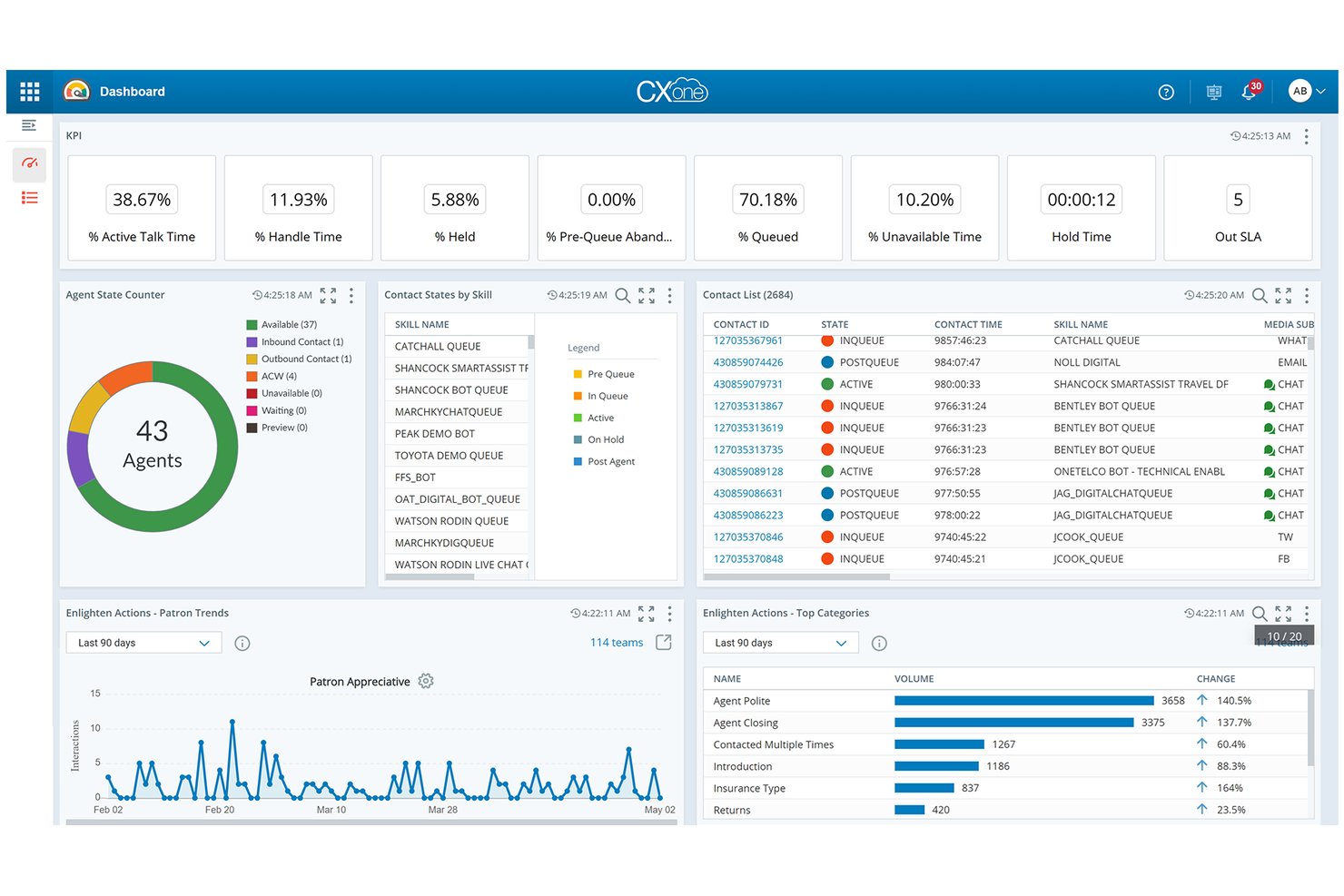
NiCE CXone is an AI-first cloud contact center platform that brings together conversational AI agents, omnichannel routing, interaction analytics, workforce management, and proactive outbound engagement in one suite.
Who Is NiCE CXone Best For?
NiCE CXone is a strong fit for mid-market and enterprise customer support directors who need AI agents, workforce management, and analytics in one platform.
Why I Picked NiCE CXone
I picked NiCE CXone as one of the best because its conversational AI operates at a scale most platforms can't match, resolving over 1 billion requests annually across 1,000+ brands. I'm particularly impressed by AI Agent Studio, which lets you build LLM-agnostic agents that handle multi-turn voice and chat conversations, call external APIs, and hand off to humans without losing context. The Proactive AI Agent goes further, running outreach journeys that span days or weeks using behavioral and sentiment data to personalize every touchpoint.
NiCE CXone Key Features
- Interaction analytics: Scores 100% of interactions for sentiment, churn risk, and CSAT using speech and text analysis.
- Copilot for agents: Surfaces next-best-action suggestions and AI-generated responses to agents during live conversations.
- Omnichannel routing: Assigns interactions to the right human or AI agent based on skills, context, and customer data.
- Prebuilt CRM integrations: Connects to Salesforce, Microsoft Dynamics, ServiceNow, and Zendesk for a unified customer view.
NiCE CXone Integrations
NiCE CXone offers integrations with Salesforce, Ada, Microsoft Dynamics 365, Condado, ServiceNow, Zendesk, and Kustomer. REST APIs and an SDK are also available for custom integrations.
Pros and Cons
Pros:
- Analytics scores every interaction for sentiment
- Multi-turn agents preserve conversation context
- Proactive AI agents sustain long journeys
Cons:
- Reviewers report occasional lag and dropped calls
- Implementation and migration can be labor-intensive

Best for enterprise next-best-action decisioning
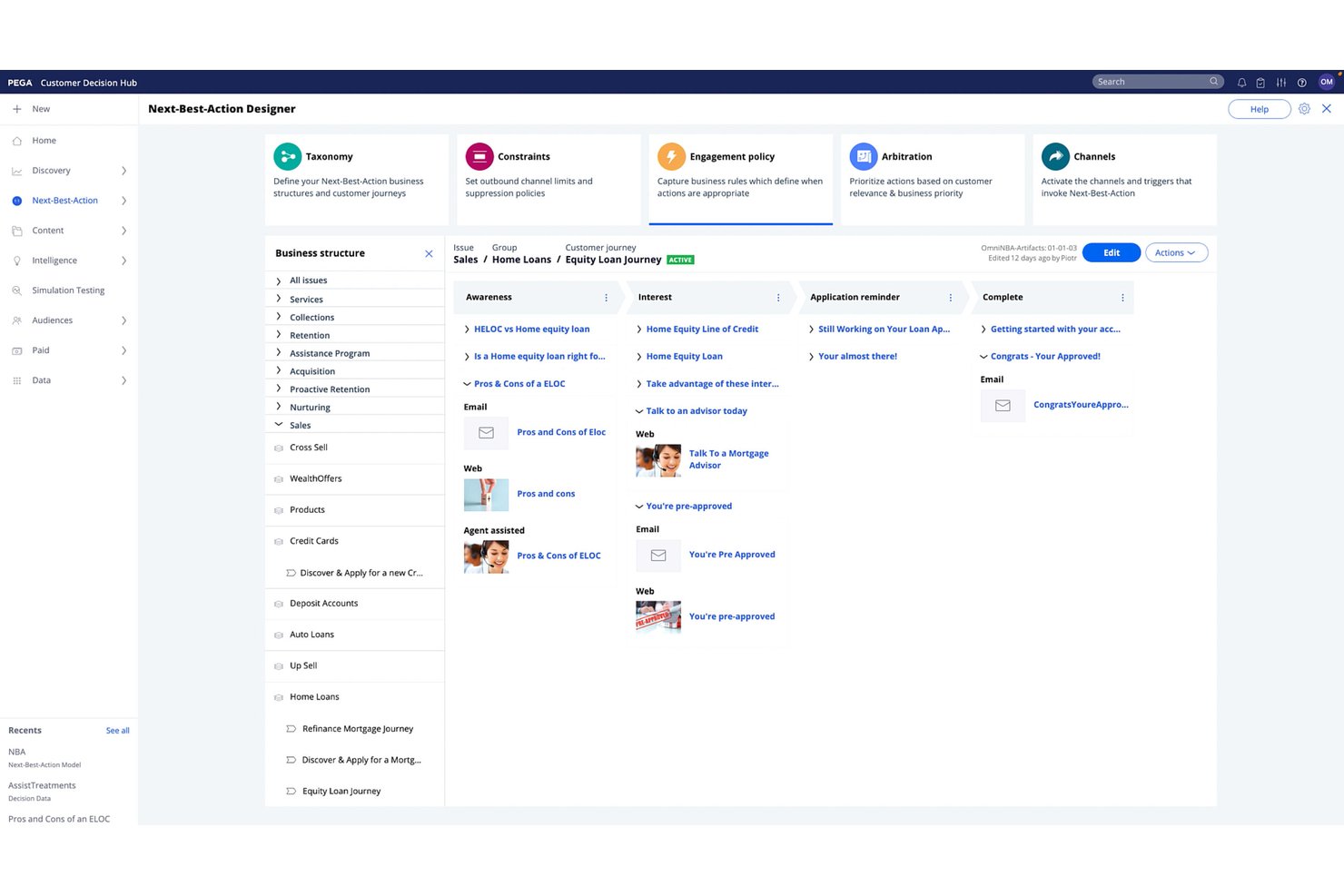
Pega Customer Decision Hub is an enterprise AI decisioning platform that uses predictive and adaptive models to orchestrate next-best-action recommendations across 20+ channels, including web, email, SMS, paid media, and the contact center agent desktop.
Who Is Pega Customer Decision Hub Best For?
Pega Customer Decision Hub is built for large enterprises in financial services, telecoms, and retail that need a single AI decisioning engine to coordinate personalized customer actions.
Why I Picked Pega Customer Decision Hub
I picked Pega Customer Decision Hub as one of the best because no other platform I've seen matches its depth of enterprise next-best-action decisioning across 20+ channels from a single AI engine. I love how the Next-Best-Action Designer weighs thousands of possible actions against real-time customer context, returning a ranked decision in under 200ms, whether that's a retention offer surfaced to a contact center agent or a personalized loan price generated through adaptive models. The Always-On Insights layer pulls in streaming CDP signals and continuously recalibrates those recommendations mid-journey as customer behavior shifts.
Pega Customer Decision Hub Key Features
- Generative AI content creation: Drafts and rewrites treatment variants—including subject lines, headlines, and body copy—directly within the platform.
- Customer Profile Designer: Collects and maps streaming behavioral and third-party data into unified customer profiles in real time.
- Engagement policy controls: Eligibility rules check segment membership directly, so you can define who qualifies for which actions without importing data into a separate cache.
- Customer Engagement Strategy Blueprint: Uses GenAI to help teams map and build engagement strategies, with a round-trip link to push designs back into CDH.
Pega Customer Decision Hub Integrations
Pega Customer Decision Hub integrates with Salesforce, Movable Ink, Adobe, Google, Snowflake, BigQuery, Stripo, and Meta. It also provides pre-built connectors for customer data platforms and supports existing CRM, marketing, data warehouse, and channel systems.
Pros and Cons
Pros:
- Self-learning models adjust to behavior shifts
- Explainable recommendations guide agent conversations
- One decision engine spans 20+ channels
Cons:
- Conversational AI requires a separate product
- Business-rule customization can become expensive

Braze
Best for self-learning cross-channel optimization
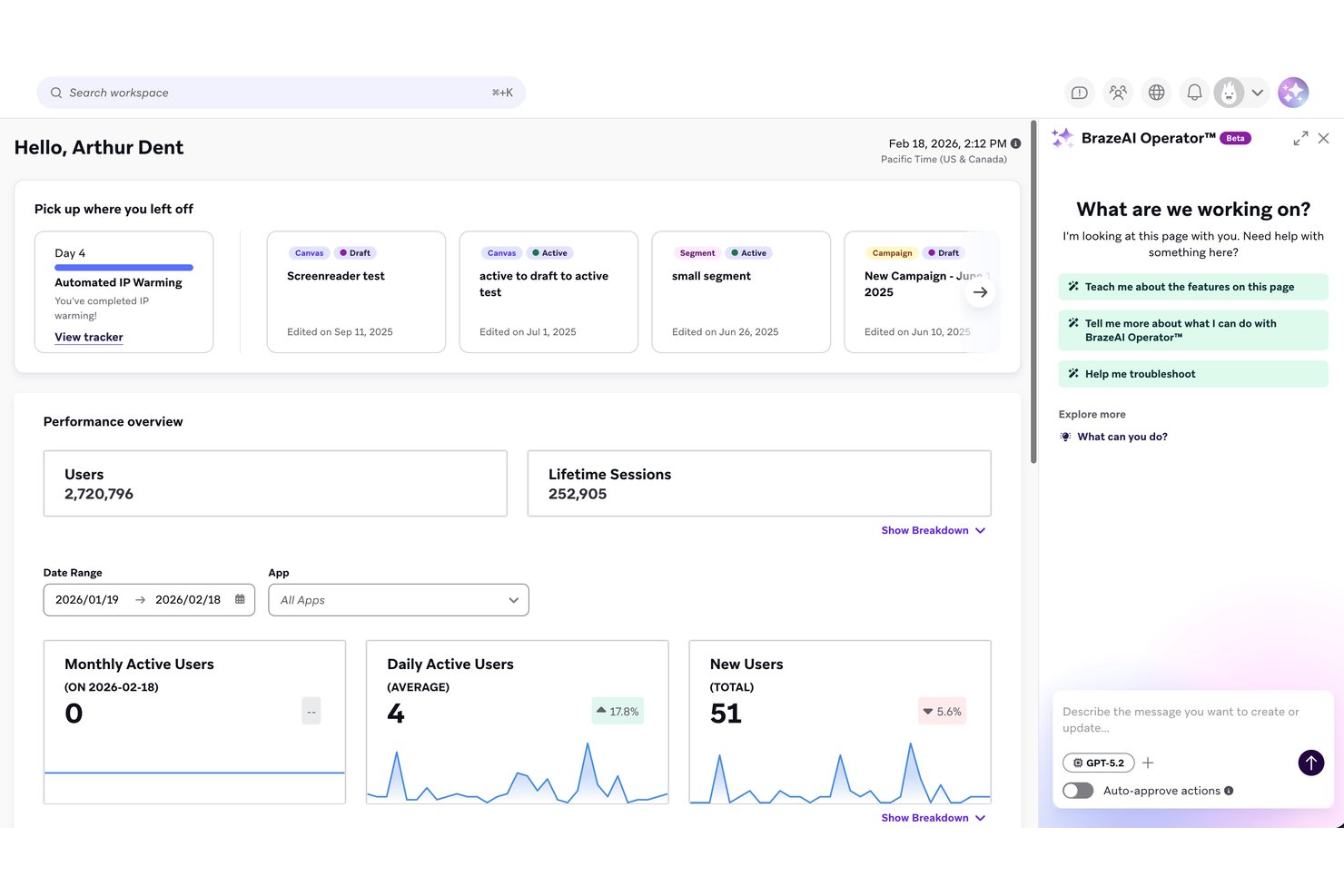
Braze is an AI-powered customer engagement platform built around multichannel journey orchestration, predictive analytics, and self-learning decisioning.
Who Is Braze Best For?
Braze is ideal for mid-market, enterprise marketing, and customer experience teams managing large, multichannel campaigns through email, SMS, push notifications, and WhatsApp.
Why I Picked Braze
I've included Braze in my top picks because its self-learning optimization actually compounds over time—Decisioning Studio uses reinforcement learning to personalize channel, offer, timing, and frequency for each customer individually, without requiring manual tuning. I also love how Intelligent Channel and Winning Path continuously route users based on real engagement patterns across email, SMS, WhatsApp, and push.
Braze Key Features
- AI Item Recommendations: A deep-learning model trained on up to six months of purchase or event data to surface personalized, trending, or popular items for each user.
- Cloud Data Ingestion: Syncs directly from Snowflake, Redshift, BigQuery, Databricks, and Microsoft Fabric—with zero-copy querying so your warehouse data never has to move into Braze.
- Predictive Suite: Scores each user's churn risk from 0 to 100 using gradient-boosted decision trees, with up to three active predictions running at once.
- Canvas journey triggers: Supports action-based, audience-based, location, and geofence triggers, with frequency capping and warehouse-driven events that fire journeys without manual setup.
Braze Integrations
Braze supports integrations through its Alloys partner ecosystem, including Front, Snowflake, Redshift, Databricks, Segment, and Regal. It also offers REST APIs, SDKs, and webhooks for custom connections.
Pros and Cons
Pros:
- Broad cross-channel journey orchestration
- Explainable next-best-action recommendations
- Self-learning channel and timing optimization
Cons:
- Advanced AI needs substantial behavioral data
- Conversational agents remain in beta

Best for CRM-native support and outreach
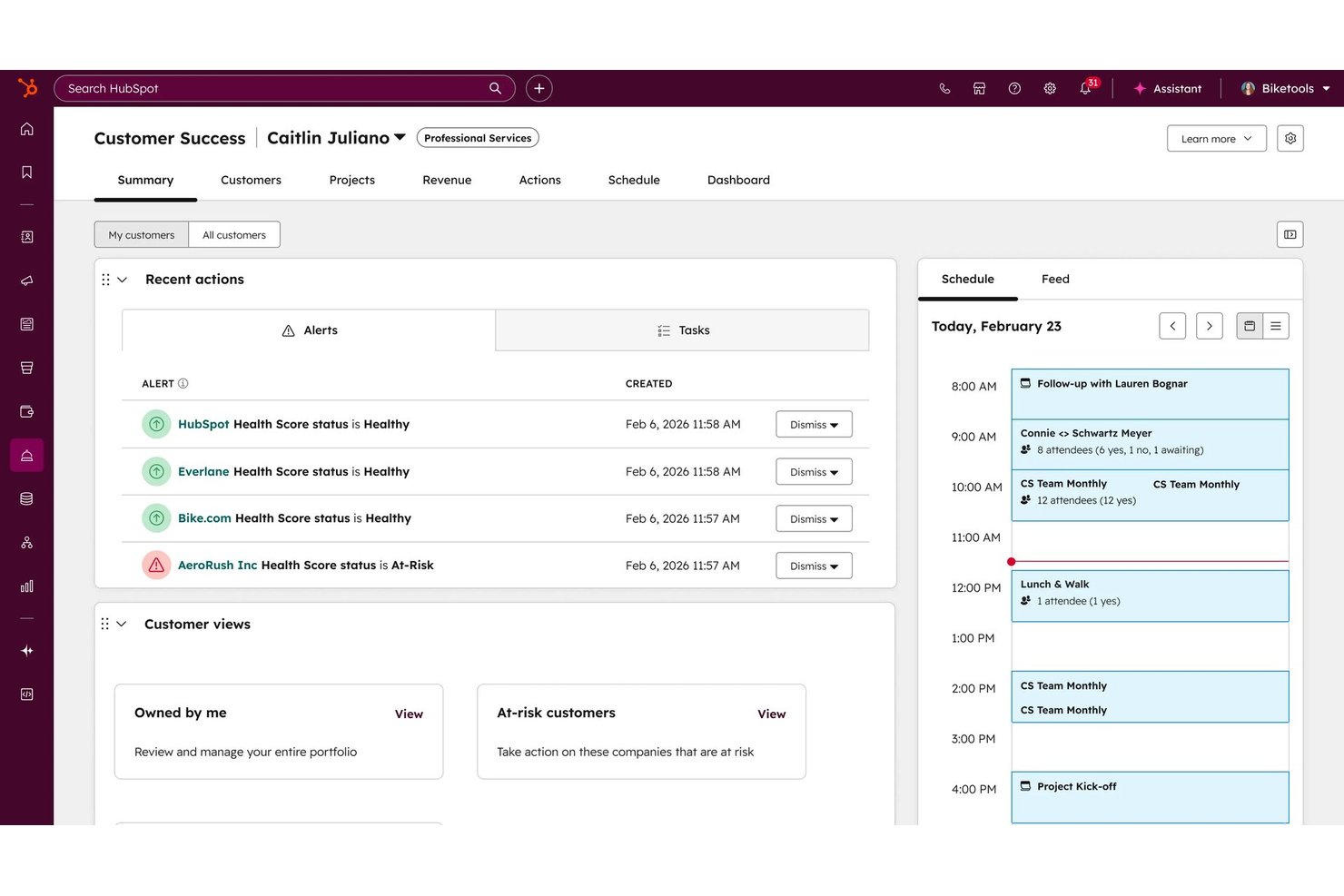
HubSpot Service Hub is a CRM-native customer engagement platform that combines AI-powered support automation, multichannel conversation management, help desk ticketing, and customer success tooling across chat, email, voice, WhatsApp, and social channels.
Who Is HubSpot Service Hub Best For?
HubSpot Service Hub is a strong fit for teams that already use HubSpot's CRM and want their support, success, and AI tooling to run on the same customer record.
Why I Picked HubSpot Service Hub
HubSpot Service Hub earns its spot on my shortlist because every AI feature, from the Breeze Customer Agent to lead scoring and Conversation Intelligence, runs on the same customer record your sales and marketing teams already use. I love that the Customer Agent handles live chat, email, inbound voice, WhatsApp, and Messenger in one place, with documented resolution rates around 65–70%, and hands off to a human agent with full context when needed. That CRM-native foundation is what makes the outreach side work too: nurture emails, Lookalike Lists, and campaign automation all pull from the same live data.
HubSpot Service Hub Key Features
- Lookalike Lists: Breeze analyzes your best contacts and builds new audience segments of similar people, with editable criteria.
- Conversation Intelligence: Records, transcribes, and analyzes sales and support calls to surface coaching moments, objections, and competitor mentions.
- Agent Builder: A no-code tool for building custom AI agents using your own prompts, knowledge sources, and live CRM data, with event-based triggers and built-in testing.
- Customer success workspace: A dedicated space in Service Hub for tracking account health scores, managing renewals, and monitoring customer lifecycle milestones.
HubSpot Service Hub Integrations
HubSpot has 2,000+ Marketplace apps, including Salesforce, Google Workspace, Microsoft 365, Slack, Shopify, Jira, SurveyMonkey, and Facebook Messenger. Salesforce supports native two-way sync, while Data Hub offers 100+ real-time sync integrations and APIs that support custom connections.
Pros and Cons
Pros:
- AI campaign and list personalization from behavior
- Customer Agent handles multimodal conversations with handoff
- CRM-native context across service and marketing
Cons:
- Ticketing customization draws mixed reviews
- Many useful AI features remain beta

Iterable
Best for marketer-controlled AI journey triggers
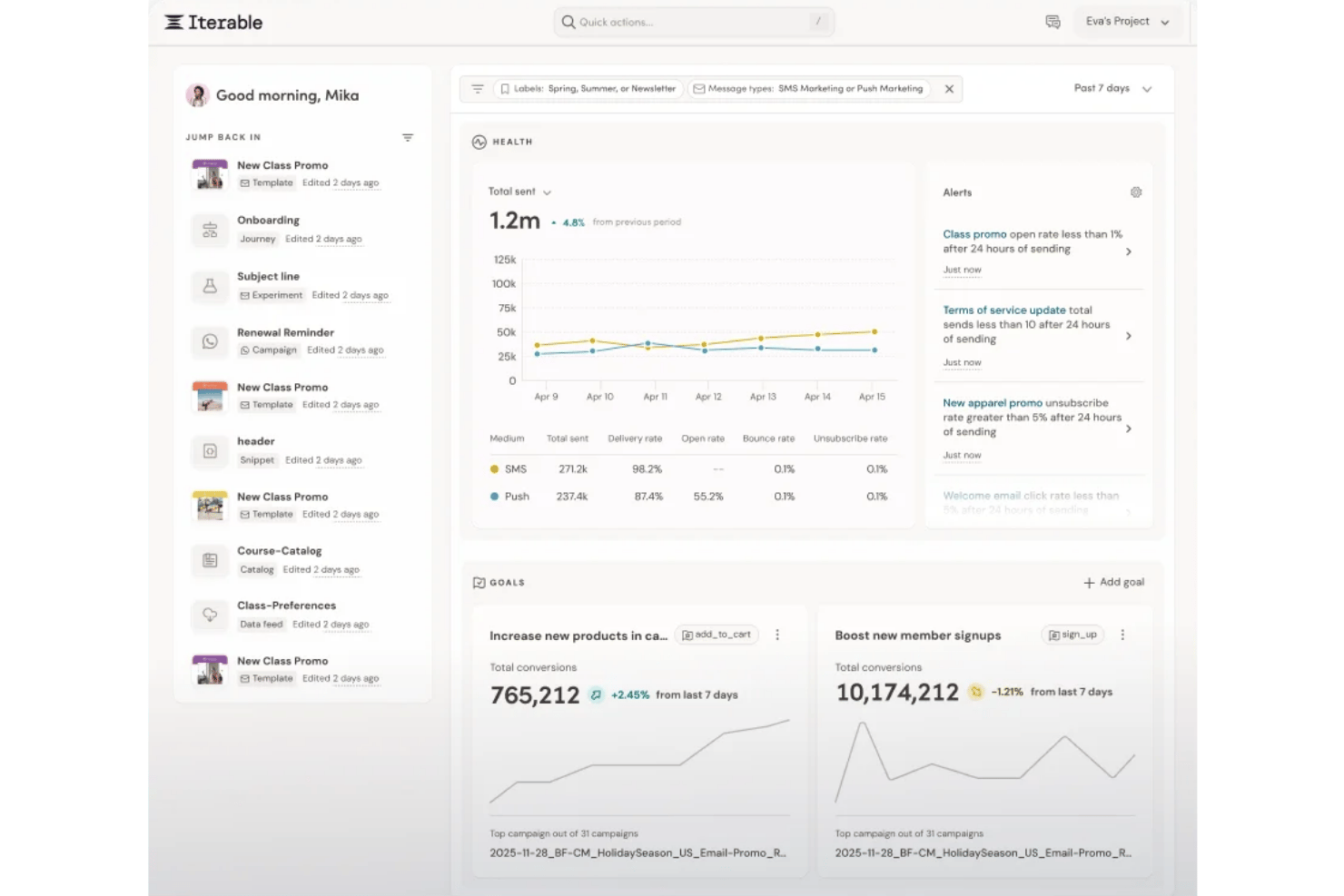
Iterable is an AI-powered customer engagement platform that combines cross-channel journey orchestration, predictive audience segmentation, and AI-driven send-time and channel decisioning.
Who Is Iterable Best For?
Iterable is a strong fit for marketing and lifecycle teams that need to orchestrate cross-channel journeys with AI-driven controls.
Why I Picked Iterable
I picked Iterable as one of the best because it gives marketers direct, visible control over how AI drives journey decisions. Its Nova Decisioning layer picks the next best action for each customer based on live behavior, but always within guardrails you define. Channel Decisioning takes it further, routing each person to email, SMS, or push within a single journey step. What I appreciate most is the "Glassbox AI" approach: every decision is explainable, not a black box.
Iterable Key Features
- Predictive Audiences: AI scores each user's likelihood to convert or churn, letting you build segments directly from those scores without writing SQL.
- Brand Affinity scoring: Automatically classifies users as Loyal, Positive, Neutral, or Negative based on email, push, and in-app engagement, then exposes those labels in segments and journey splits.
- Experimentation Agent: Creates, tests, and promotes message variants automatically, reducing the manual work of running A/B tests across campaigns.
- Smart Ingest: Pulls data from 23+ warehouse sources, including Snowflake, BigQuery, and Databricks, into user profiles with syncs running as often as every 15 minutes.
Iterable Integrations
Iterable integrates with Salesforce, Google Ads, Zendesk, Meta Ads, Movable Ink, Snowflake, and Kustomer. It also provides REST APIs, webhooks, and SDKs for custom connections.
Pros and Cons
Pros:
- Predictive audiences trigger conversion and churn journeys
- Cross-channel orchestration spans eight messaging channels
- Marketer-controlled next-best-action journey decisions
Cons:
- Reporting lacks depth for attribution decisions
- Customer-facing conversational AI remains private beta

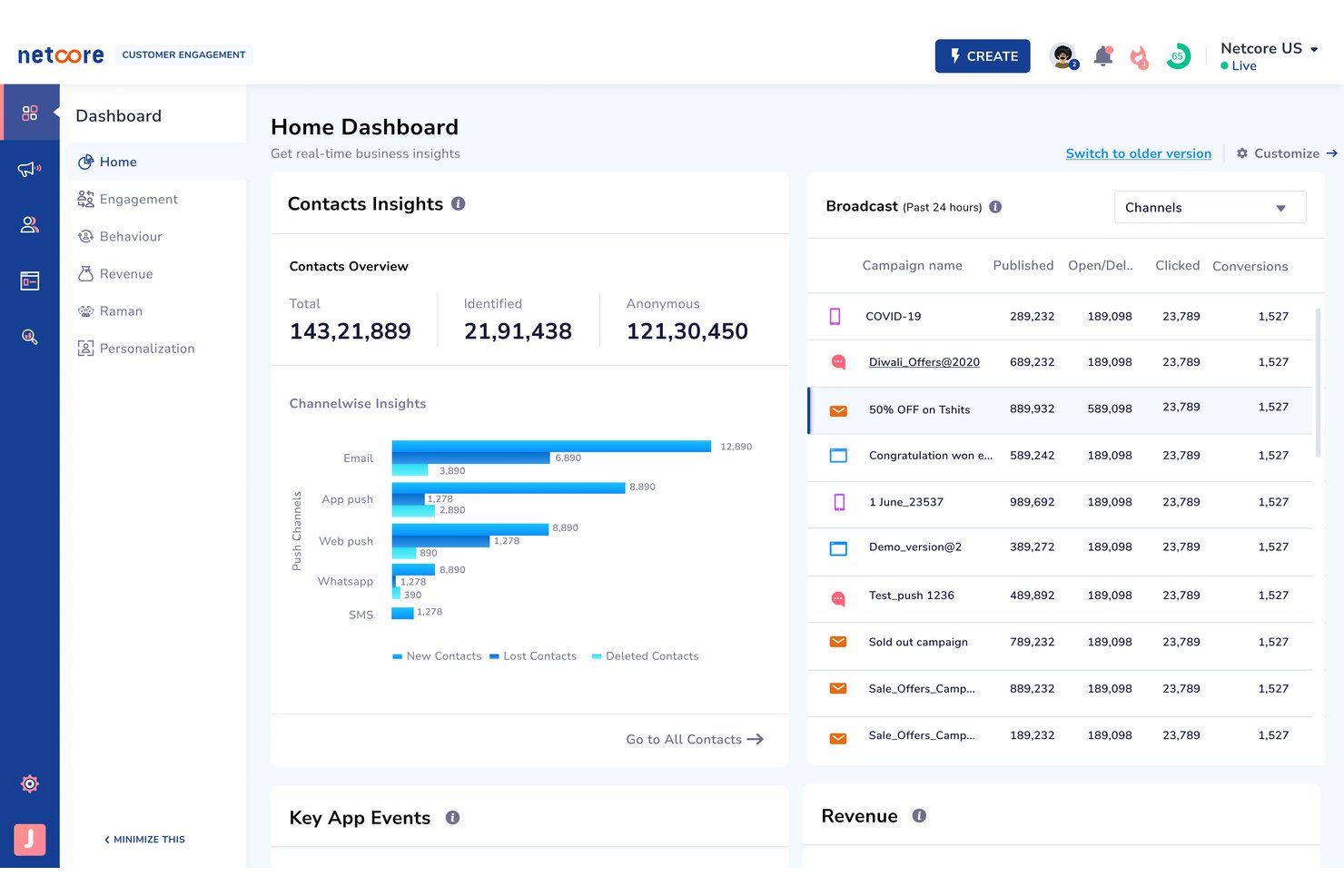
Netcore Cloud is an AI customer engagement platform that combines a built-in CDP, nine-channel journey orchestration, predictive analytics, and a suite of named AI agents for content generation, audience building, and send-time decisioning.
Who Is Netcore Cloud Best For?
Netcore Cloud is a strong fit for marketing and CX teams in India and Asia-Pacific that run high-volume, multichannel campaigns across email, WhatsApp, SMS, and push.
Why I Picked Netcore Cloud
I picked Netcore Cloud as one of the best because no other platform on this list matches its depth across nine channels, with WhatsApp, RCS, and SMS built in from day one, which is a real advantage for APAC-market campaigns. I love how the Decisioning Agent picks the right message, channel, and send time per customer without manual A/B testing, and how the Journey Path Optimizer continuously shifts audiences toward higher-converting paths. The Identity Resolution Cloud stitching 16M+ profiles in real time, as Adidas proved, is what makes that orchestration actually land.
Netcore Cloud Key Features
- Content Agent: Writes subject lines, copy, and channel-specific variations using generative AI, and learns from past campaign performance to improve future output.
- Catalog-event triggers: Automatically fires messages when a product drops in price, comes back in stock, or hits low inventory, targeting only users who previously engaged with that item.
- Identity Resolution Cloud: Links a customer's identities across devices and channels in real time to build a single, unified profile.
- Add-on packs: Modular AI, analytics, personalization, recommendations, and security packs let you expand capabilities on either plan without upgrading your entire contract.
Netcore Cloud Integrations
Netcore Cloud offers 100+ native integrations, including Salesforce, AppsFlyer, Adjust, Branch, Databricks, Snowflake, Shopify, and Zapier. An API for custom connections is also available.
Pros and Cons
Pros:
- Named agents support auditable decisions
- Predictive models personalize customer outreach
- Nine-channel journey orchestration
Cons:
- Support-focused conversational AI remains limited
- Reporting dashboards can feel slow
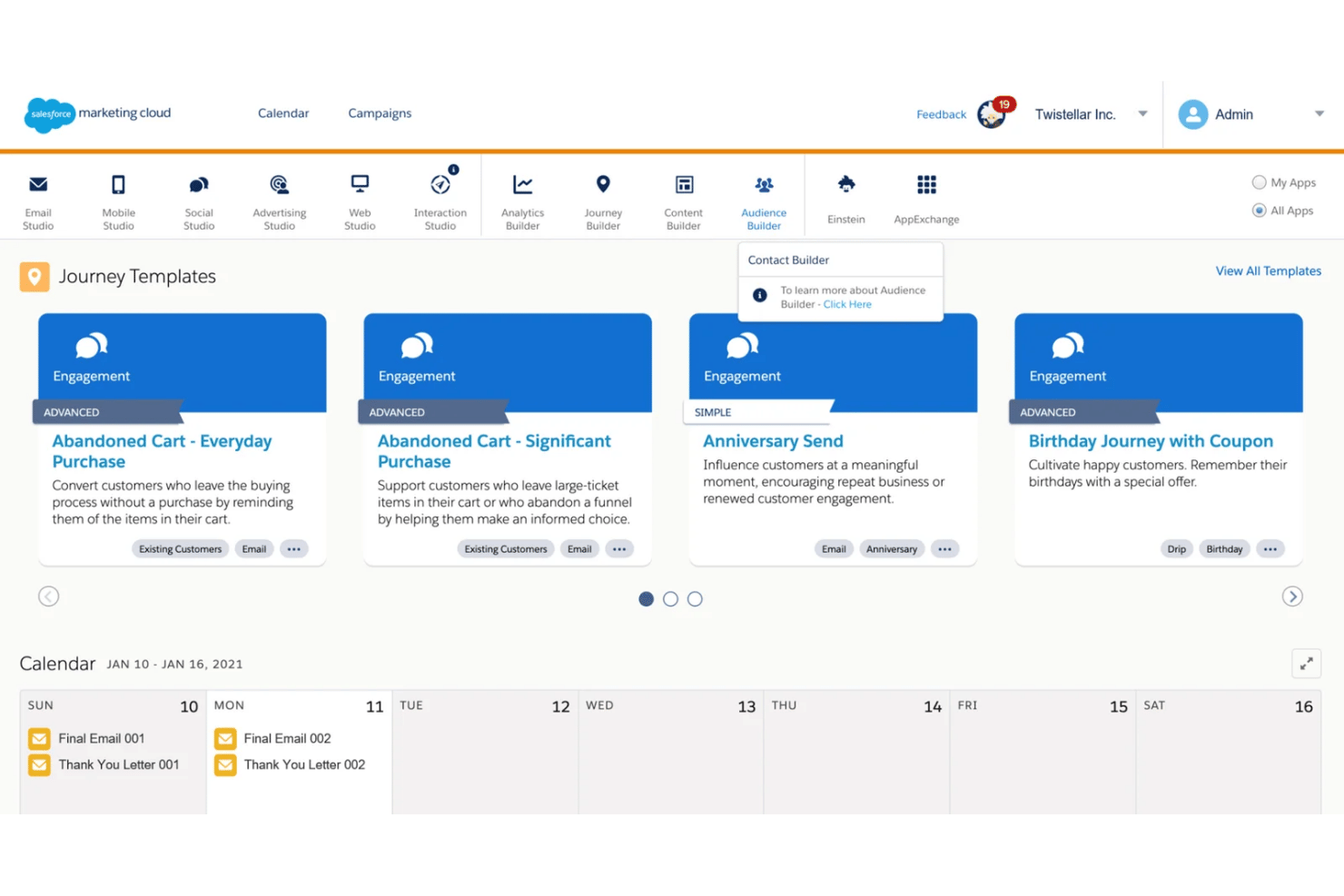
Salesforce Marketing Cloud is an AI-driven marketing platform that combines multichannel campaign orchestration, real-time customer data unification, predictive analytics, and generative AI tools for email, SMS, push, web, and paid ad engagement.
Who Is Salesforce Marketing Cloud Best For?
Salesforce Marketing Cloud is a strong fit for enterprise marketing teams running high-volume, multichannel campaigns across channels.
Why I Picked Salesforce Marketing Cloud
I picked Salesforce Marketing Cloud as one of the best because Agentforce Campaign Creation is genuinely unlike anything else I've seen at this scale: give it a natural-language prompt and it drafts the segment, email and SMS copy, and the entire journey flow. For enterprise teams running high-volume campaigns across email, SMS, push, and paid ads simultaneously, Data 360's Zero Copy architecture keeps every channel pulling from the same real-time customer profile, while Einstein Send Time Optimization scores all 168 hours of the week per contact to hit the right moment.
Salesforce Marketing Cloud Key Features
- Einstein Content Selection: Picks the best content asset for each contact based on their profile and category affinity, automatically adapting what each person sees in email and push messages.
- Two-way SMS and WhatsApp conversations: Turns outbound messages into real-time two-way exchanges, with Agentforce handling replies and escalating to a human agent when needed.
- Einstein Engagement Frequency: Identifies the optimal number of messages to send each contact, reducing the risk of over-messaging based on individual engagement patterns.
- Agentforce Paid Media Optimization: Monitors ad performance continuously, pauses underperforming ads, and surfaces spend reallocation suggestions across connected ad platforms.
Salesforce Marketing Cloud Integrations
Salesforce Marketing Cloud integrates with the Salesforce ecosystem, Snowflake, BigQuery, Databricks, Google Workspace, Meta, and LinkedIn. A REST API is also available for custom connections.
Pros and Cons
Pros:
- Predicts engagement timing and message frequency
- Generates campaign briefs, copy, and journeys
- Unifies real-time customer data across channels
Cons:
- Complex campaigns often require SQL or AMPscript
- Marketing Cloud Next has unfinished workflows
Other AI Customer Engagement Software
Here are a few additional options that didn’t make my top list, but are still good to check out:
- Bloomreach
For AI-driven personalization
- Klaviyo
For customer engagement and retention
- Customer.io
For behavior-triggered journeys
- Medallia
For VoC-led predictive engagement
- MoEngage
For campaign creation and control
- Genesys Cloud CX
For native compliance governance
- Blueshift
For B2C lifecycle management with built-in CDP
- Optimove
For customer retention marketing
- Adobe Journey Optimizer
For real-time multichannel journey governance


How I Evaluate AI Customer Engagement Software
To make this list, a tool’s AI needs to handle real customer engagement work, like personalizing messages or handling customer conversations. From there, I evaluate three things. Core functionality carries the most weight, like coordinating journeys and unifying customer data. Then I look at standout features, like generative AI content creation, and how well it fits your existing tech stack.
Core Functionality (Table Stakes For This List)
When I'm selecting tools for my list, I score each one on a scale from 0 (does not offer the functionality) to 5 (excels in this area) for each core functionality listed below. I then convert the total into a percentage to help assess each tool’s overall fit, with extra weight on any functionalities I’ve deemed essential.
- AI Personalization (Essential): I look for behavioral and contextual data that tailor content, offers, or messages across email, web, and in-app interactions.
- Conversational AI (Essential): I evaluate how well virtual agents handle multi-turn questions, understand intent, and hand off complex cases to people.
- Predictive Analytics: I check whether models forecast churn, purchase intent, or next-best actions and turn those predictions into useful engagement decisions.
- Multichannel Orchestration: I assess coordinated journeys across email, messaging, chat, voice, and in-app channels with consistent customer context.
- Unified Customer Data: I look for profiles that combine CRM, service, behavioral, and transactional data to inform timely engagement.
- Automated Journey Triggers: I evaluate triggers that respond to lifecycle stages, browsing behavior, purchases, support events, or changing customer intent.
Once I have a list of tools that meet the criteria, I consider what sets each platform apart.
Differentiating Factors (What Sets Vendors Apart)
Here's how I compare and contrast different vendors:
Standout Features
I look for next-best-action recommendations that go beyond generic suggestions. Platforms like Pega and Braze use real-time decisioning to tell agents or marketers which channel, message, and timing to use for a specific customer. Sentiment analysis also matters—I evaluate whether the AI can read emotional cues mid-conversation and escalate before a frustrated customer churns. A self-learning optimization engine rounds this out, automatically refining send times and content variants so your team isn't manually A/B testing every campaign.
Beyond Features
I evaluate how well each platform integrates with your existing CRM, CDP, and help desk tools. Pre-built connectors between systems like Salesforce, HubSpot, or Zendesk save weeks of setup compared to custom API work. I also check whether AI decisions are explainable and overridable—your team needs to see why a model recommended a specific action and adjust it when context demands. Scalability matters too: I look at whether pricing stays predictable as your contact volume or channel count grows.
How to Choose AI Customer Engagement Software
Choose the platform that can prove its AI decisions, data handling, and human handoffs match your service standards.
| If your priority is | Look for |
|---|---|
| Consistent customer context | A documented data map showing sources, ownership, and update timing |
| Safe human handoffs | A sample escalation workflow with roles, triggers, and transcript history |
| Explainable AI decisions | Decision records that show inputs, rationale, and override controls |
| Cross-channel governance | A consent matrix covering email, messaging, chat, and voice |
How to Vet Your Shortlist
- Request an evidence pack: Ask for a data-flow diagram, retention policy, and AI decision documentation within five business days.
- Run a defined trial task: Give each vendor the same anonymized customer scenario and compare the resulting journey, escalation, and audit record.
- Test a support handoff: File one ticket with a deliberately ambiguous request, then document the response, escalation path, and human context provided.
- Get commitments in writing: Ask vendors to add data ownership, human review, model-change notice, and export requirements to the contract or order form.
- Choose the governing tradeoff: Decide whether your team values centralized control over customer decisions or greater marketer and service-team autonomy.
What Is AI Customer Engagement Software?
AI customer engagement software uses artificial intelligence to personalize interactions, answer customer questions, and coordinate communication across channels. It combines customer data with automation to trigger relevant messages, recommend next actions, and route complex conversations to human teams. Customer experience, support, success, and marketing teams use these platforms to manage journeys across email, chat, messaging, voice, and in-app experiences.
Features
Here are the main features I look for in any great AI customer engagement software:
- AI personalization: Uses customer behavior, preferences, and context to tailor messages, offers, content, and recommendations across digital channels.
- Conversational AI: Understands customer questions, maintains conversation context, provides answers, and routes complex issues to the right team member.
- Predictive analytics: Analyzes customer data to forecast churn, purchase intent, satisfaction, or support needs, then recommends suitable engagement actions.
- Multichannel orchestration: Coordinates email, messaging, chat, voice, web, and in-app messaging within connected customer journeys.
- Unified customer profiles: Combines CRM, service, behavioral, transactional, and engagement data into one profile for more informed interactions.
- Automated journey triggers: Starts or adjusts workflows when customers browse products, complete purchases, submit requests, reach lifecycle stages, or change engagement patterns.
- Next-best-action recommendations: Evaluates customer context and suggests the appropriate message, channel, timing, or follow-up for each interaction.
- Human handoffs: Transfers conversations to team members with relevant transcripts, customer history, intent details, and recommended next steps.
- Engagement analytics: Tracks campaign performance, conversation outcomes, journey progression, retention signals, and customer feedback through reports and dashboards.
Benefits
Here are a few common benefits you can expect from using AI customer engagement software:
- More personalized experiences: AI personalization uses behavioral, transactional, and contextual data to tailor messages, offers, and recommendations across customer touchpoints.
- Faster customer support: Conversational AI answers routine questions, maintains context across multiple turns, and routes complex issues to the appropriate team member.
- Earlier retention opportunities: Predictive analytics identifies churn risk, purchase intent, satisfaction changes, and other signals that guide timely engagement actions.
- Consistent multichannel journeys: Journey orchestration coordinates email, messaging, chat, voice, web, and in-app interactions around shared customer context.
- Better-informed decisions: Unified customer profiles combine CRM, service, behavioral, transactional, and engagement data for more accurate next-best-action recommendations.
- More responsive workflow automation: Automated triggers adjust journeys when customers browse products, complete purchases, submit requests, or change their engagement patterns.
- Stronger handoffs: Human handoff features provide team members with conversation transcripts, customer history, intent details, and recommended next steps.
Costs and Pricing
Costs vary based on features, team size, add-ons, and customer volume. Here are the pricing ranges you can typically expect from these platforms:
Plan Comparison Table for AI Customer Engagement Software
| Plan Type | Average Price | Common Features |
|---|---|---|
| Free Plan | $0/user/month | Basic contact profiles, email campaigns, simple chatbot support, and limited analytics. |
| Personal Plan | $20-$100/user/month | Customer segmentation, automated messaging, basic journey triggers, and standard reporting. |
| Business Plan | $100-$300/user/month | Multichannel orchestration, predictive analytics, conversational AI, and CRM integrations. |
| Enterprise Plan | $500-$5,000/month | Unified customer data, advanced personalization, custom automation, dedicated support, and governance controls. |
FAQs
Some answers to common questions about AI customer engagement software:
Does AI customer engagement software replace customer service agents?
No, these platforms support human agents. Virtual agents can answer routine questions and collect initial details. Human team members can handle sensitive, complex, or unusual cases. Look for handoffs that include the transcript, customer history, intent, and recommended next steps. Before choosing a platform, test an ambiguous request. Check whether the system recognizes uncertainty and routes the conversation to the right person.
How does AI customer engagement software connect with existing systems?
AI customer engagement tool connects with existing systems through native integrations, APIs, data imports, or middleware. Common connection points include your CRM, CDP, help desk, commerce platform, and messaging tools. Ask vendors which systems support two-way syncing. Confirm how often records update and which system owns each field. Also test whether customer consent, conversation history, and profile changes pass between platforms correctly.
What customer data does AI engagement software need?
AI engagement software usually needs customer profiles, behavioral activity, transaction history, service interactions, and consent information. Start with the data required for one defined journey, such as onboarding or renewal outreach. Then verify data quality, update timing, access permissions, and retention rules. Avoid sending every available field into the platform. Unnecessary data can complicate governance and make model decisions harder to review.
How should you measure an AI customer engagement platform?
Measure the platform against customer and operational outcomes tied to specific workflows. Track resolution rates, escalation rates, response times, journey completion, retention signals, and customer feedback. Compare AI-assisted interactions with a baseline from before implementation. Review results by channel and customer segment. Also monitor incorrect answers, failed handoffs, consent errors, and agent overrides. These measures show whether the platform supports your service standards.