

Custify Review: Pros, Cons, Features, and Pricing Explained
Custify stands out for its intuitive automation and actionable insights, making it ideal for SaaS teams seeking efficient, data-driven customer success without overwhelming complexity.

We review tools independently, and commissions help fund our testing. See our transparency policy, our methodology, or suggest a tool.
Custify is a customer success software built for B2B SaaS teams that need to track customer health, manage onboarding, and intervene before accounts churn. I'd consider it if your team is outgrowing spreadsheets but doesn't need the complexity of an enterprise platform like Gainsight—Custify gives you health scoring, lifecycle automation, and task management in a setup that smaller or mid-market teams can actually own without a dedicated ops specialist.
Custify Evaluation Summary

4.9/5
- Pricing upon request
- Free demo available
Why Trust Our Software Recommendations
6,700+
Reviews
20
Industry experts
16+
Evaluation factors
14
Years
Our team has been testing and reviewing software since 2012. As CX leaders ourselves, we know how difficult—and important—it is to choose the right software.
For this guide, we evaluated tools using hands-on testing and independent research, scoring tools using our selection criteria.
Our reviews reflect our human editorial judgment, not a sales pitch.
 Gui DrusinaCreative Director
 Tim FisherVP of AI
Custify Overview
In my experience, Custify strikes a strong balance between usability and depth, with a clean interface and automation that’s easy to set up. Its customer health scoring and playbooks are more actionable than most, and the onboarding support is responsive. While its integrations list isn’t as long as some, the core options cover most SaaS needs.
If you’re judging solutions for fast onboarding, clear reporting, and hands-on support, Custify is a top pick for SaaS companies that want actionable insights without a steep learning curve.
Pros
- Custify provides intuitive data visualization that makes it easy for your team to identify key customer insights.
- It offers excellent customer support, ensuring your team gets quick and helpful responses when needed.
- The software's onboarding process is smooth, helping your team get up to speed without hassle.
Cons
- Some users find the platform's learning curve steep, requiring time to master all functionalities.
- The system may overwhelm small teams with features they don't need, making it less ideal for smaller businesses.
- The software may lack certain advanced customization options compared to other tools.
Is Custify Right For Your Needs?
Who Would be a Good Fit for Custify?
Custify is ideal for SaaS companies and subscription-based businesses that need to enhance customer retention. Your team will benefit from its data visualization tools, which provide clear insights into customer behaviors and trends. Tech startups and online service providers will find its intuitive interface valuable for managing customer interactions efficiently. These functionalities enable your team to focus on building and maintaining strong customer relationships, which are crucial for sustained growth.
- SaaS CompaniesCustify helps your team track customer engagement and product usage effectively.
- Tech StartupsYour startup can leverage Custify’s insights to optimize customer retention strategies.
- Customer Success TeamsCustify supports your team’s efforts with actionable data and efficient workflows.
- Online Service ProvidersYou can use Custify to enhance customer interaction and satisfaction.
- Mid-Sized BusinessesCustify’s scalable features accommodate your growing customer base seamlessly.
- Subscription-Based ModelsCustify provides the tools you need to manage subscriptions and reduce churn.
Who Would be a Bad Fit for Custify?
Custify isn’t ideal for small businesses or teams that don’t have a dedicated customer success function. The platform’s robust features might overwhelm your team if you don’t need in-depth analytics or extensive customer management tools. Companies in industries that don’t rely on subscription models or those that require significant customization might find Custify’s offerings unnecessary. If your business doesn’t focus on long-term customer engagement, Custify might not be the right fit.
- Small RetailersCustify’s features may be excessive for your straightforward sales needs.
- FreelancersYou likely won’t need Custify’s advanced customer success functionalities for solo work.
- Non-Subscription ServicesYour business model doesn’t align with Custify’s focus on subscription management.
- Highly Specialized IndustriesYou might find Custify lacks the customization options you need.
- Minimal Customer InteractionIf customer engagement isn’t a priority, Custify’s tools might be irrelevant.
- Budget-Conscious StartupsCustify’s comprehensive features might not justify the investment for your tight budget.
How We Test & Score Tools
We’ve spent years building, refining, and improving our software testing and scoring system. The rubric is designed to capture the nuances of software selection and what makes a tool effective, focusing on critical aspects of the decision-making process.
Below, you can see exactly how our testing and scoring works across seven criteria. It allows us to provide an unbiased evaluation of the software based on core functionality, standout features, ease of use, onboarding, customer support, integrations, customer reviews, and value for money.
Core Functionality (25% of final scoring)
The starting point of our evaluation is always the core functionality of the tool. Does it have the basic features and functions that a user would expect to see? Are any of those core features locked to higher-tiered pricing plans? At its core, we expect a tool to stand up against the baseline capabilities of its competitors.
Standout Features (25% of final scoring)
Next, we evaluate uncommon standout features that go above and beyond the core functionality typically found in tools of its kind. A high score reflects specialized or unique features that make the product faster, more efficient, or offer additional value to the user.
We also evaluate how easy it is to integrate with other tools typically found in the tech stack to expand the functionality and utility of the software. Tools offering plentiful native integrations, 3rd party connections, and API access to build custom integrations score best.
Ease of Use (10% of final scoring)
We consider how quick and easy it is to execute the tasks defined in the core functionality using the tool. High scoring software is well designed, intuitive to use, offers mobile apps, provides templates, and makes relatively complex tasks seem simple.
Onboarding (10% of final scoring)
We know how important rapid team adoption is for a new platform, so we evaluate how easy it is to learn and use a tool with minimal training. We evaluate how quickly a team member can get set up and start using the tool with no experience. High scoring solutions indicate little or no support is required.
Customer Support (10% of final scoring)
We review how quick and easy it is to get unstuck and find help by phone, live chat, or knowledge base. Tools and companies that provide real-time support score best, while chatbots score worst.
Customer Reviews (10% of final scoring)
Beyond our own testing and evaluation, we consider the net promoter score from current and past customers. We review their likelihood, given the option, to choose the tool again for the core functionality. A high scoring software reflects a high net promoter score from current or past customers.
Value for Money (10% of final scoring)
Lastly, in consideration of all the other criteria, we review the average price of entry level plans against the core features and consider the value of the other evaluation criteria. Software that delivers more, for less, will score higher.
Core Features
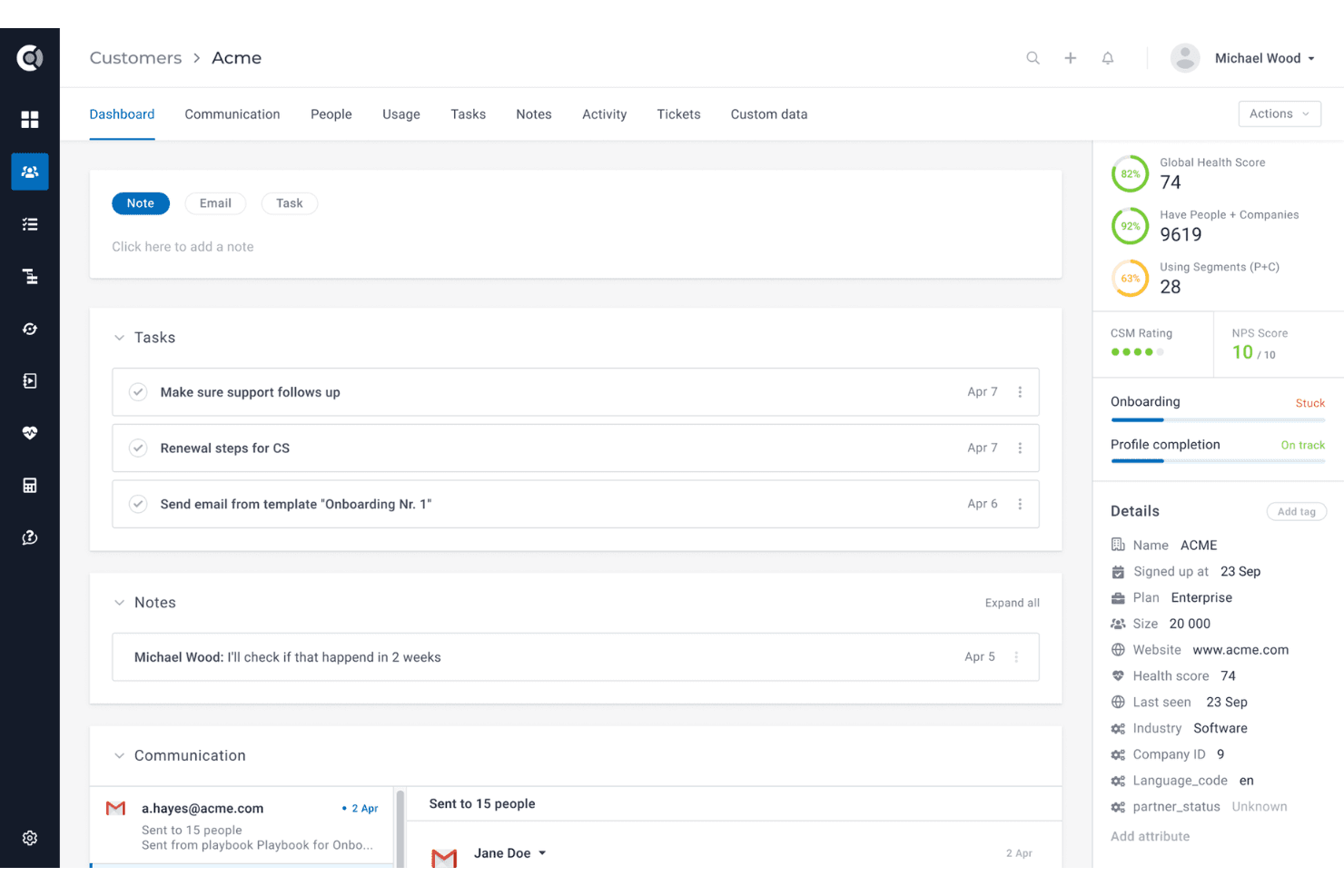
Customer 360
See all customer data, product usage, and lifecycle stages in one dashboard. This gives teams a complete, real-time view of every account.
Health Scoring
Define custom KPIs and track customer health with dynamic scoring. Instantly spot churn risks and upsell opportunities.
Playbooks and Automation
Automate repetitive workflows and trigger playbooks for onboarding, renewals, or at-risk accounts. Teams can focus on high-value tasks while routine actions run in the background.
Task Management and Alerts
Automatically generate actionable tasks and alerts based on customer activity. Never miss a follow-up or renewal deadline.
Dashboards and Reporting
Build custom dashboards to track KPIs and customer success metrics. Visualize trends and performance at a glance.
Customer Segmentation
Custify lets you categorize your customers based on behavior and engagement, helping your team target specific groups with tailored strategies.

Ease of Use
Custify is refreshingly straightforward, with a clean interface and intuitive navigation that lets teams get up and running quickly. Users often mention how easy it is to set up health scores, automate playbooks, and customize dashboards without technical help. The onboarding process is guided and hands-on, which reduces setup friction.
Compared to many customer success platforms, Custify’s usability stands out for busy teams who want actionable insights without a steep learning curve.
Integrations
Custify integrates with HubSpot, Salesforce, Pipedrive, Intercom, Zendesk, Jira, Slack, Stripe, Google Sheets, and Calendly, among others.
Custify also offers a comprehensive API and connects with third-party integration tools like Segment and Make.

Custify Specs
- Analytics: Yes
- API: Yes
- Calendar Management: Yes
- Chat: No
- Click-to-Dial: Yes
- CRM Integration: Yes
- Customer Management: Yes
- Customer Service: Yes
- Dashboard: Yes
- Dashboards: No
- Data Export: Yes
- Data Import: No
- Data Visualization: Yes
- External Integrations: Yes
- Feedback Management: Yes
- Knowledge Base: Yes
- Lead Management: Yes
- Lead Scoring: No
- Multi-Source Feedback: Yes
- Multi-User: Yes
- Net Promoter Score: Yes
- Notifications: Yes
- Omnichannel Referrals: No
- Online Surveys: Yes
- Review Moderation: Yes
- Scheduling: Yes
- Sentiment Analysis: No
- Social Media Monitoring: No


