

E-ticaret müşteri hizmetleri yazılımı, ekibinize farklı kanallardaki müşteri sorularını, şikâyetlerini ve taleplerini yönetmesi için gereken araçları sunar; böylece daha hızlı destek, doğru sipariş bilgileri ve geniş ölçekte kişisel bir hizmet sağlayabilirsiniz. Kaliteden ödün vermeden verimliliği artırmak istiyorsanız doğru platform önem taşır. Bu rehberde nelere dikkat etmeniz gerektiğini açıklayacak ve iş akışınıza, müşteri ihtiyaçlarınıza ve ekip hedeflerinize uygun seçenekleri daraltmanıza yardımcı olacağım.
Why Trust Our Software Recommendations
6,700+
Reviews
20
Industry experts
16+
Evaluation factors
14
Years
Our team has been testing and reviewing software since 2012. As CX leaders ourselves, we know how difficult—and important—it is to choose the right software.
For this guide, we evaluated tools using hands-on testing and independent research, scoring tools using our selection criteria.
Our reviews reflect our human editorial judgment, not a sales pitch.
 Gui DrusinaCreative Director
 Tim FisherVP of AI
E-ticaret Müşteri Hizmetleri Yazılımları Karşılaştırma Tablosu
Bu karşılaştırma tablosu, en iyi e-ticaret müşteri hizmetleri yazılımı seçimlerimin fiyatlandırma ayrıntılarını özetler:
Score legend (out of 5)
- Excellent4.5–5
- Good4–4.4
- Average3–3.9
- Below average2–2.9
- Poor1–1.9
Sorted by: Default
| Tool | Starting Price | Website | |||||||
|---|---|---|---|---|---|---|---|---|---|
Best for ecommerce self-service portals | 4.7 out of 5 | 5 | 5 | 4 | 5 | 5 | 4 | $69/user/month Free plan available | Website |
Best for multichannel chat and chatbot tools | 4.0 out of 5 | 4 | 3 | 4 | 5 | 4 | 4 | $26.1/user/month 14-day free trial + free demo available | Website |
Best for Shopify-native order actions | 4.5 out of 5 | 5 | 4 | 4 | 5 | 5 | 4 | $10/month Free trial + free demo available | Website |
Best for natively integrated AI agents | 3.8 out of 5 | 4 | 3 | 4 | 4 | 5 | 3 | $19/user/month 14-day free trial + demo available | Website |
Best for unified customer context | 4.0 out of 5 | 4 | 2 | 4 | 5 | 5 | 4 | Pricing upon request Free demo available | Website |
Best for AI-driven order actions at checkout | 3.8 out of 5 | 4 | 3 | 3 | 5 | 5 | 3 | $49.50/month 14-day free trial | Website |
Best for marketplace and storefront integration | 3.8 out of 5 | 4 | 3 | 3 | 4 | 4 | 5 | $39/user/month 14-day free trial + free demo available | Website |
Best for lifelong conversation history | 4.5 out of 5 | 5 | 4 | 4 | 5 | 5 | 4 | Pricing upon request Free demo available | Website |
Best for no-code AI support automation | 3.7 out of 5 | 4 | 2 | 3 | 4 | 5 | 4 | Pricing upon request Free demo available | Website |
Best for advanced workflow customization | 4.0 out of 5 | 4 | 4 | 4 | 5 | 5 | 2 | $25/user/month 30-day free trial + free demo available | Website |


En İyi E-ticaret Müşteri Hizmetleri Yazılımları İncelemeleri
Aşağıda, kısa listeme giren en iyi e-ticaret müşteri hizmetleri yazılımlarına ilişkin ayrıntılı özetlerimi bulabilirsiniz. İncelemelerim, her platformun özelliklerini, entegrasyonlarını ve en uygun kullanım alanlarını ayrıntılı biçimde ele alarak sizin için en uygun seçeneği bulmanıza yardımcı olur.
 Best for ecommerce self-service portals
- Free plan available
- From $69/user/month (billed annually)
Visit WebsiteCustomer Rating:4.9/5
Richpanel offers a unified customer service inbox that displays customer conversations, tags, product interactions, and order history in a single dashboard. Richpanel is an AI-native ecommerce helpdesk that combines an omnichannel inbox, autonomous AI agents, order management actions, and self-service tools across Shopify, Magento, WooCommerce, and BigCommerce.
Who Is Richpanel Best For?
Richpanel is a strong fit for DTC brands and ecommerce support teams that want customers to resolve their own order issues without ever contacting an agent.
Why I Picked Richpanel
I picked Richpanel as one of the best because of how far its self-service portal goes beyond basic order tracking. Customers can initiate returns, trigger exchanges, and manage subscriptions without ever opening a ticket, and the exchange-first flow actively steers shoppers toward store credit instead of refunds. I also love that the AI takes real Shopify actions, like canceling orders or swapping items, directly inside the portal.
Richpanel Key Features
- Omnichannel inbox: Consolidates email, live chat, SMS, Facebook, Instagram, WhatsApp, TikTok, and Amazon messages into a single shared workspace.
- AI model selection: Choose from Claude, GPT, Gemini, DeepSeek, or Kimi as your AI engine, with each model verified against 10,000+ tests before activation.
- Voice of Customer AI: Surfaces your top customer intents and sentiment trends on a weekly basis so your team can spot patterns without manually reviewing tickets.
- Subscription management actions: Agents and AI can skip, pause, cancel, or reschedule subscription orders directly through Recharge, Loop, Skio, Appstle, and Stay.ai.
Richpanel Integrations
Richpanel offers 20+ integrations, including Shopify, Magento, WooCommerce, BigCommerce, Recharge, Loop Subscriptions, Skio, AfterShip, ShipHero, and Aircall. It also supports API and webhooks for custom integrations.
Pros and Cons
Pros:
- Exchange-first flows protect retained revenue
- AI performs real order actions
- Self-service resolves tracking and returns
Cons:
- New pricing model creates uncertainty
- Some actions require human approval
Learn more about Richpanel: Best for multichannel chat and chatbot tools
- 14-day free trial + free demo available
- From $26.1/user/month (billed annually)
Visit WebsiteCustomer Rating:4.7/5
Re:amaze offers a unified inbox interface with automated bot responses, customer activity tracking, and Shopify cart integration for ecommerce support. Re:amaze is an ecommerce customer service platform that brings together a shared omnichannel inbox, AI-powered chatbots, live chat, and native integrations with Shopify, BigCommerce, and WooCommerce.
Who Is Re:amaze Best For?
Re:amaze is a strong fit for DTC brands and ecommerce support teams running on Shopify, BigCommerce, or WooCommerce who need order management and chat tools in one place.
Why I Picked Re:amaze
I picked Re:amaze as one of the best because it handles more customer channels out of the box than almost anything else I've seen at this price point. The Hello Bot, Order Bot, and FAQ Bot cover the most common ecommerce questions automatically, while the AI Agent now answers across chat, email, and SMS. I especially like the AI Pre-Filter, which tags and routes incoming conversations before they even hit the queue.
Re:amaze Key Features
- Shopify order actions: Agents can refund, cancel, create draft orders, and edit customer addresses directly inside a conversation without leaving the inbox.
- Multi-brand support: One account manages several stores or brands across different ecommerce platforms, each with store-specific roles and settings.
- Cues and push campaigns: Triggered messages—including cart abandonment reminders and upsell prompts—fire automatically based on visitor behavior and shopping data.
- Shopify attributed orders report: Links support conversations to orders and refunds, giving teams a view of how support activity connects to revenue.
Re:amaze Integrations
Re:amaze offers native integrations with Shopify, BigCommerce, WooCommerce, ReCharge, Loop Returns, and ShipStation, plus ChannelReply for Amazon, eBay, Walmart, and Etsy. It also supports Twilio, Stripe, an API for custom integrations, and Zapier.
Pros and Cons
Pros:
- Multichannel inbox includes social and SMS
- Revenue attribution connects support activity to sales
- Refunds and cancellations happen inside conversations
Cons:
- AI quality remains inconsistent in reviews
- Search struggles with complex queries
Learn more about Re:amaze: Best for Shopify-native order actions
- Free trial + free demo available
- From $10/month
Visit WebsiteCustomer Rating:4.6/5
Gorgias offers a customer support inbox with ticket details, customer profile, and AI-assisted responses in a unified helpdesk interface. Gorgias is an ecommerce customer service platform that centralizes email, chat, SMS, voice, and social media into one inbox while giving agents direct access to order data, automation tools, and AI-driven ticket resolution.
Who Is Gorgias Best For?
Gorgias is a strong fit for Shopify-based ecommerce teams that need agents to take real order actions—refunds, edits, cancellations—directly from the support inbox.
Why I Picked Gorgias
Gorgias earns its spot on my shortlist because of how deeply it embeds Shopify order actions into the support workflow. I love that agents can issue refunds, edit orders, apply discounts, and cancel shipments without ever leaving the ticket view. On top of that, the AI Agent handles over 130 Shopify-specific actions autonomously, including live carrier tracking and return label generation, with a published 50% automation rate on WISMO tickets alone.
Gorgias Key Features
- Omnichannel inbox: Consolidates email, live chat, SMS, WhatsApp, Instagram, Facebook, and voice into a single shared helpdesk view.
- AutoQA scoring: AI automatically scores every agent interaction, giving team leads visibility into quality across all tickets without manual review.
- Revenue attribution reporting: Tracks pre-sale conversations, converted tickets, and total sales influenced by support, available on Pro and Advanced plans.
- Voice of Customer analysis: Scans conversations and reviews to surface trends and spikes—down to individual SKUs—so you can catch issues like shipping delays early.
Gorgias Integrations
Gorgias lists 100+ integrations, including native connections with Shopify, Shopify Plus, BigCommerce, and Magento 2. It also connects with Recharge, Loop Returns, AfterShip Tracking, Klaviyo, and Gorgias Voice, with API support for custom actions.
Pros and Cons
Pros:
- Revenue attribution connects support with sales
- AI handles refunds, returns, and tracking
- Shopify order actions happen inside tickets
Cons:
- Self-service requests still require agent approval
- AI automation can produce costly overages
Learn more about Gorgias: Best for natively integrated AI agents
- 14-day free trial + demo available
- From $19/user/month (billed annually)
Visit WebsiteCustomer Rating:4.4/5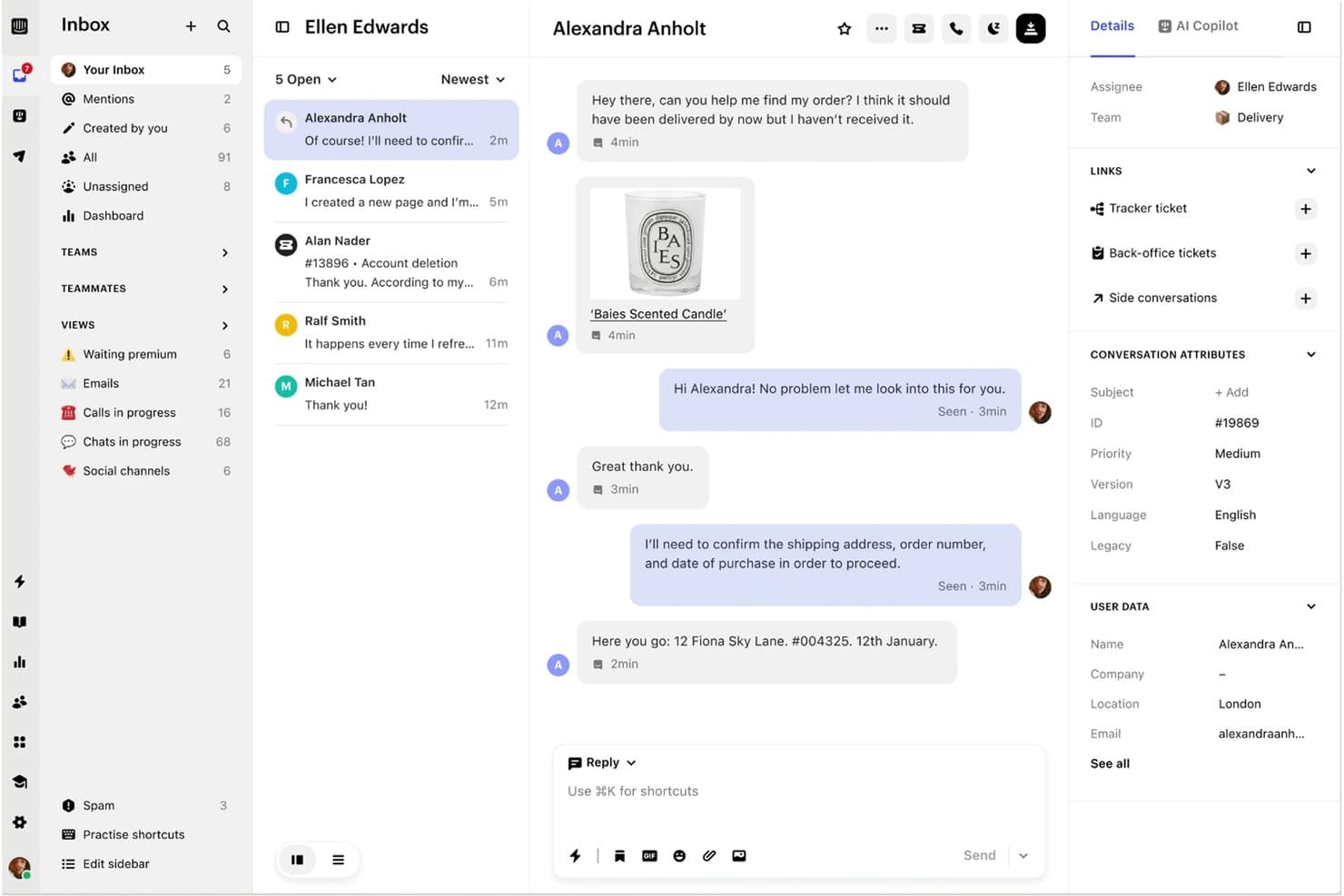
Intercom offers a shared inbox interface where agents can manage customer conversations, view conversation attributes, and access user data in a unified dashboard. Intercom is a customer service platform that combines an omnichannel inbox, AI-powered chat and voice agents, helpdesk automation, and Shopify-native order management tools into a single workspace.
Who Is Intercom Best For?
Intercom is a strong fit for CX operations teams at Shopify-based brands that want a single platform where AI agents handle resolution and human agents manage escalations.
Why I Picked Intercom
I picked Intercom as one of the best because its AI agent, Fin, is built directly into the helpdesk rather than bolted on. That means when Fin handles a WISMO question or initiates a refund, it's working from the same order data and conversation history your human agents see. I also love how Fin Procedures auto-draft ecommerce workflows for returns, exchanges, and cancellations based on your Shopify store's actual policies, so there's no scripting from scratch.
Intercom Key Features
- Omnichannel inbox: A single shared inbox that pulls conversations from chat, email, phone, SMS, WhatsApp, Instagram, Facebook, Discord, and Slack into one workspace.
- Revenue Attribution report: Tracks revenue Fin generates on Shopify by linking purchases to conversations where Fin discussed the product within a 14-day window.
- Order Status app: Lets customers look up their orders by order number and email directly in the Messenger widget, without starting a support conversation.
- Custom report builder: A drag-and-drop report builder with 10 chart types, custom filters, drill-downs, and period comparisons for tracking agent and AI performance.
Intercom Integrations
Intercom offers native integrations with Shopify, Stripe, Klaviyo, Salesforce, and HubSpot, plus Marketplace integrations such as Mirakl. It also supports API, Data Connectors, and MCP for custom ecommerce connections.
Pros and Cons
Pros:
- Revenue attribution links support to sales
- Human agents inherit complete conversation context
- Fin resolves routine ecommerce questions autonomously
Cons:
- Fin accuracy depends on knowledge quality
- Returns and exchanges lack dedicated portal
 Best for unified customer context
- Free demo available
- Pricing upon request
Visit WebsiteCustomer Rating:4.5/5
Kustomer offers a unified conversation view where support agents can read customer inquiries, draft email replies, and manage multiple open conversations from a single interface. Kustomer is a CRM-based customer service platform that unifies omnichannel conversations, order data, and AI automation into a single customer timeline.
Who Is Kustomer Best For?
Kustomer is a strong fit for CX operations managers and heads of customer experience at mid-to-large ecommerce brands who need a single view of every customer across channels, orders, and interactions.
Why I Picked Kustomer
I picked Kustomer because its customer timeline model is genuinely different from ticket-based tools. Every channel, order, and interaction for a given customer lives in one scrollable view, so agents never have to toggle between systems to understand context. I also love that agents can issue Shopify refunds, cancellations, and reships directly from that same view, without ever opening a separate tab. That combination of full history plus in-workspace order actions is what earns it the unified customer context label.
Kustomer Key Features
- Concierge AI agent: Handles end-to-end customer requests on chat, email, SMS, WhatsApp, and voice using the full customer timeline, with confidence thresholds that control when it acts or escalates.
- CSAT surveys: Deployable across every channel, with targeting by customer or conversation attributes, delayed sending, and multilingual support.
- Data Explorer: Lets you ask plain-language questions about your CX data and get AI-generated insights without building custom reports manually.
- Multi-brand support: Supports up to 300 brands with separate knowledge bases, themes, and language settings in a single workspace.
Kustomer Integrations
Kustomer offers native integrations with Shopify, Adobe Commerce, BigCommerce, TikTok Shop, Recharge, Loop Returns, AfterShip, Narvar, LoyaltyLion, and Amazon Connect. Its Open API, GraphQL, webhooks, and Cards SDK support custom ecommerce connections.
Pros and Cons
Pros:
- AI handles repetitive requests with guardrails
- Agents complete order actions in-workspace
- Unified customer timelines preserve full context
Cons:
- No native returns or tracking portal
- Reports of lag during busy periods
Learn more about Kustomer: 6Best for AI-driven order actions at checkout
Fin
- 14-day free trial
- From $49.50/month
Visit WebsiteCustomer Rating:4.5/5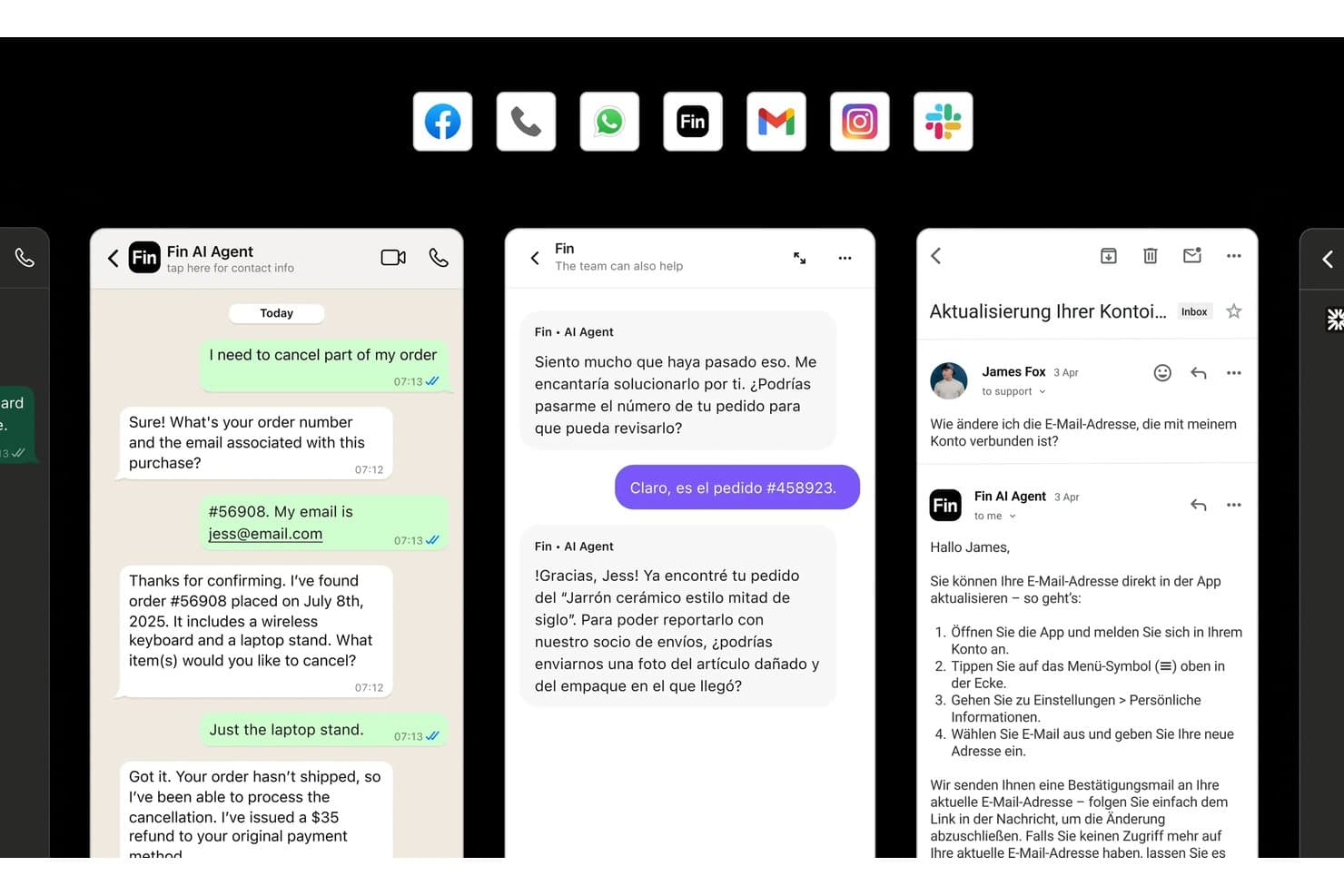
Fin handles customer support across WhatsApp, chat, and email in multiple languages. Fin is an AI-powered ecommerce customer service platform that handles support conversations, automates order actions like refunds and exchanges, and integrates with your existing helpdesk or Intercom's native inbox.
Who Is Fin Best For?
Fin is a strong fit for Shopify merchants who want AI to handle refunds, exchanges, and order changes without agent involvement.
Why I Picked Fin
I picked Fin as one of the best because its AI doesn't just suggest actions—it completes them. When a customer asks for a refund or exchange, Fin's multi-step Procedures verify the order, process the action in Shopify, and close the ticket without any agent involvement. I also love that it handles damaged-item claims by reviewing customer photos and auto-issuing refunds when eligible. That level of autonomous order execution is what sets it apart.
Fin Key Features
- Omnichannel inbox: Manages conversations from email, chat, WhatsApp, SMS, Instagram, voice, Slack, and more in one unified workspace.
- CX Score: Automatically scores sentiment across 100% of conversations without requiring customers to fill out surveys.
- Shopify agent sidebar: Gives human agents live access to order details, line items, addresses, and fulfillment status directly inside the inbox.
- 45+ language support: Handles customer conversations in over 45 languages with real-time translation built in.
Fin Integrations
Fin lists 59+ integrations, including Shopify, Intercom, Salesforce Service Cloud, HubSpot Service Hub, Zendesk, Gorgias, Freshdesk, WooCommerce, BigCommerce, and Stripe. It supports custom integrations through its REST API and Zapier.
Pros and Cons
Pros:
- Audits AI and human conversations
- Resolves ecommerce questions around the clock
- Completes refunds and exchanges autonomously
Cons:
- No dedicated returns or tracking portal
- Occasionally closes tickets with wrong answers
Learn more about Fin: Best for marketplace and storefront integration
- 14-day free trial + free demo available
- From $39/user/month (billed annually)

eDesk offers a unified mailbox view where support tickets are organized by query type, sender, and response deadline. eDesk is an ecommerce help desk that unifies marketplace messages, storefront orders, and customer conversations from email, live chat, and social channels into a single inbox.
Who Is eDesk Best For?
eDesk suits ecommerce support teams managing multiple storefronts and marketplace channels who need order context and customer messages in one place.
Why I Picked eDesk
I picked eDesk because no other help desk on my list pulls Amazon, eBay, Walmart, TikTok Shop, and Mirakl messages into a single inbox natively. When a customer messages you across three marketplaces about the same order, you see it all in one thread alongside full order history and shipping status. I also love that agents can issue full or partial Shopify refunds, cancel orders, and create replacements directly from the ticket panel without ever leaving eDesk.
eDesk Key Features
- AI Agent with guardrails: eDesk's AI Agent handles return, cancellation, and order-status queries using your approved procedures, then hands off to a human if it isn't confident enough.
- HandsFree auto-response: Automatically sorts incoming messages into 20+ question categories and replies using pre-approved templates, with no agent involvement required.
- Live chat with contextual prompts: The chat widget triggers targeted offers or social proof based on the page a shopper is currently viewing.
- eDesk Insights reporting: Tracks ticket volume, response times, agent performance, and AI resolution rates across channels, with CSAT surveys available on Growth and higher plans.
eDesk Integrations
eDesk connects with 300+ apps and channels, including Shopify, Amazon, eBay, Walmart, TikTok Shop, Mirakl, BigCommerce, WooCommerce, AfterShip, and ShipStation. Its REST API supports custom integrations, with advanced API features on Professional and custom APIs on Enterprise.
Pros and Cons
Pros:
- Support responds quickly to issues
- Resolves routine queries with guarded AI
- Centralizes complex ecommerce conversations clearly
Cons:
- Returns self-service remains incomplete
- Agent reporting lacks sufficient detail
Learn more about eDesk:

Gladly offers an AI-powered Sidekick assistant that summarizes customer issues and suggests next steps, enabling agents to resolve damaged delivery exchanges quickly with personalized VIP responses. Gladly is an ecommerce customer service platform that unifies chat, email, SMS, voice, and social channels into a single, ticket-free customer record, with agentic AI that autonomously handles returns, cancellations, and order tracking.
Who Is Gladly Best For?
Gladly is a strong fit for mid-market and enterprise ecommerce brands that need every customer interaction—across every channel—unified in one continuous, ticket-free record.
Why I Picked Gladly
I picked Gladly as one of the best because no other platform treats every customer interaction as a single, ongoing conversation rather than a series of disconnected tickets. Every channel—chat, email, SMS, voice, and social—feeds into one lifelong customer record, so when a shopper emails about a return they started in chat last month, your agent sees the full history instantly. I also love that Gladly's agentic AI can autonomously process that return, check eligibility, and close the loop without any human involvement.
Gladly Key Features
- Agentic AI resolution: Gladly's AI reasons through multi-step requests, calling tools like Loop and Recharge to process returns, cancellations, and subscription changes without agent involvement.
- People Match routing: Automatically connects customers to the most suitable human agent based on skills, history, and context when AI handoff is needed.
- Dual-outcome AI pricing: Charges separately for full AI resolutions and AI-assisted agent interactions, so you pay based on actual outcomes rather than seat counts or deflections.
- Multi-brand configuration: Run separate channel setups, routing rules, and knowledge bases for different brands or regions from a single Gladly instance.
Gladly Integrations
Gladly offers native integrations with Shopify, Magento, BigCommerce, Loop, Recharge, Recurly, ShipHero, AfterShip, and Narvar. It also provides a REST API and App Platform for custom integrations.
Pros and Cons
Pros:
- Native voice keeps support in one workspace
- Agentic AI resolves complex ecommerce requests
- Lifelong threads preserve complete customer context
Cons:
- Legacy ticket teams need workflow adjustment
- Reporting depth draws recurring reviewer criticism
Learn more about Gladly:

Zowie centralizes customer conversations with order history in one view. Zowie is an AI-powered ecommerce customer service platform that combines an omnichannel inbox, no-code automation tools, and order management actions to handle customer conversations across chat, email, SMS, voice, and social channels.
Who Is Zowie Best For?
Zowie is a strong fit for CX operations managers and heads of customer experience at mid-market to enterprise ecommerce brands who need to automate high volumes of support without involving engineering.
Why I Picked Zowie
I've included Zowie in my top picks because its no-code Agent Studio lets CX teams build and update automations without touching code, using plain-language Playbooks written the way you'd brief a new hire. I love that the AI doesn't just answer questions: it executes full return and refund flows inside the conversation, including order lookup, eligibility checks, and sending a return label via email and SMS. Supervisor then scores 100% of those AI-handled conversations automatically, so nothing slips through unreviewed.
Zowie Key Features
- Omnichannel inbox: A unified helpdesk that consolidates chat, email, SMS, voice, WhatsApp, and Instagram into a single view with full AI decision context at handoff.
- Live translation: Translates conversations in both directions across 175 languages directly inside the inbox, without a third-party tool.
- Supervisor conversation scoring: Automatically scores 100% of conversations handled by AI or human agents against custom scorecards covering tone, resolution, and policy adherence.
- Email CSAT surveys: Sends branded post-conversation satisfaction surveys by queue, with configurable send delays and topic-based exclusion rules.
Zowie Integrations
Zowie integrates with Shopify, Magento, BigCommerce, Salesforce Commerce Cloud, Zendesk, Salesforce, Freshdesk, Genesys, Stripe, and ReCharge. It also supports REST API, A2A, and JavaScript, Python, and Node.js SDKs for custom integrations.
Pros and Cons
Pros:
- Supervisor scores every conversation automatically
- AI executes returns and refunds end-to-end
- No-code Playbooks empower CX-owned automation
Cons:
- Complex workflows can introduce configuration issues
- No native tracking or returns portal
Learn more about Zowie: Best for advanced workflow customization
- 30-day free trial + free demo available
- From $25/user/month (billed annually)

Salesforce Agentforce Service guides reps with AI-driven case plans and suggested actions. Salesforce Agentforce Service is an enterprise customer service platform that brings together omnichannel case management, AI-powered autonomous agents, order management actions, self-service tools, and workforce analytics in a single console.
Who Is Salesforce Agentforce Service Best For?
It's a strong fit for mid-market and enterprise CX teams that need deep workflow customization across high-volume, omnichannel service operations.
Why I Picked Salesforce Agentforce Service
I picked Salesforce Agentforce Service because the depth of workflow customization here is unlike anything else on this list. Using Flow Builder, I can build order-specific automations, like triggering an immediate refund and credit memo when a return is approved, without writing a single line of code. I also love that agents can cancel, reship, discount, or issue RMAs directly from the Service Console, keeping the entire order resolution loop inside one workspace.
Salesforce Agentforce Service Key Features
- Omni-Channel Routing: automatically assigns incoming cases to agents based on skill, availability, and capacity across all connected channels.
- Agentforce Help Agent: a prebuilt autonomous AI agent that resolves customer inquiries on voice, web, portal, and messaging without human handoff.
- Feedback Management: deploys AI-generated surveys post-interaction, tracks CSAT and NPS trends, and can auto-escalate cases when scores fall below a threshold.
- Command Center dashboard: gives supervisors a real-time view of KPIs like first-contact resolution, average handle time, and customer sentiment across every channel.
Salesforce Agentforce Service Integrations
Native integrations include Salesforce Commerce Cloud, Order Management, POS, Slack, Marketing Cloud, Sales Cloud, Data 360, and Tableau. Shopify connects through AgentExchange marketplace apps or MuleSoft, while APIs support custom integrations.
Pros and Cons
Pros:
- Omnichannel routing balances agent capacity
- Flow automates complex return workflows
- Order actions stay inside service console
Cons:
- AI claims invite skeptical scrutiny
- Setup requires substantial administrator training
Learn more about Salesforce Agentforce Service:
Diğer E-ticaret Müşteri Hizmetleri Yazılımları
İşte kısa listeme giremeyen ancak yine de göz atmaya değer bazı ek e-ticaret müşteri hizmetleri yazılımı seçenekleri:
- 11SienaBest for AI-first agentless ticket resolution
- 12TidioBest for brand-aligned AI automation
- 13ZendeskBest for enterprise-grade AI automation
- 14FreshdeskBest for guided AI onboarding
- 15HappyFoxBest for multi-platform ecommerce store support
- 16Help ScoutBest for intuitive omnichannel inbox
- 17YumaBest for outcome-based AI ticket resolution
- 18DelightChatBest for WhatsApp and social commerce integration
- 19Outvio DeskBest for post-purchase experience management
- 20Rep AIBest for AI that sells and supports in one chat
How I Evaluate Ecommerce Customer Service Software
I split my evaluation into baseline requirements—like native Shopify integration and omnichannel inbox—and the differentiators that separate a good CX platform from a great one.
Core Functionality (Table Stakes For This List)
When I'm selecting tools for my list, I rank each one on a scale from 0 (does not offer the functionality) to 5 (excels in this area) for each core functionality listed below. Then, I calculate the tool's total score as a percentage. Each tool needs to achieve a minimum total score of 65% to be considered for inclusion.
- Omnichannel Inbox: I check whether email, chat, social DMs, and SMS funnel into one agent workspace so reps aren't toggling between tabs during a rush.
- Ecommerce Platform Integration: Native connectors to Shopify, BigCommerce, WooCommerce, or Magento should surface order and customer data right inside the ticket.
- Order Management Actions: Agents need to process refunds, cancellations, and exchanges without leaving the support interface to log into the store's admin panel.
- Automation & AI Assistance: I look for macros, routing rules, and AI-driven replies that handle repetitive WISMO and returns inquiries without agent involvement.
- Self-Service Tools: A branded help center, chatbot, or order tracking portal that lets customers resolve common questions on their own around the clock matters here.
- CX Analytics & Reporting: Dashboards should cover CSAT, first response time, resolution time, and agent performance tied to ecommerce-specific KPIs.
Once I have a list of tools that meet the criteria, I consider what sets each platform apart.
Differentiating Factors (What Sets Vendors Apart)
Here's how I compare and contrast different vendors:
Standout Features
AI-powered automation is where I see the widest gap between vendors. Some offer basic intent detection, while others deploy autonomous AI agents that resolve full WISMO and returns conversations end-to-end. Self-service portals matter just as much—branded return and exchange flows that customers complete without contacting an agent can drastically cut ticket volume during peak seasons. I also evaluate sentiment analytics that connect CSAT scores to revenue metrics like repeat purchase rate, giving CX leaders data they can bring to budget conversations.
Beyond Features
Pricing model is a big differentiator. I look at whether a vendor charges per agent, per ticket, or per conversation, since seasonal DTC brands can see ticket volume spike dramatically during holiday periods. Ecommerce platform compatibility goes deeper than just having a Shopify connector; I evaluate whether the integration supports two-way sync for refunds, subscriptions, and multi-store setups. Time-to-value also matters, especially whether a platform ships with pre-built macros and workflows for common ecommerce scenarios like WISMO and returns.
E-ticaret Müşteri Hizmetleri Yazılımı Nasıl Seçilir?
Uzun özellik listeleri ve karmaşık fiyatlandırma yapıları arasında kaybolmak kolaydır. Kendinize özgü yazılım seçim sürecinizi yürütürken odağınızı korumanıza yardımcı olmak için göz önünde bulundurmanız gereken faktörleri aşağıda bir kontrol listesi hâlinde bulabilirsiniz:
| Faktör | Dikkate Alınması Gerekenler |
|---|---|
| FaktörÖlçeklenebilirlik | Dikkate Alınması GerekenlerAraç hem sakin hem de yoğun sezonları destekleyebilecek mi? Büyüdükçe hız sınırlarını, kullanıcı limitlerini ve ek maliyetleri sorun. |
| FaktörEntegrasyonlar | Dikkate Alınması GerekenlerPlatform, e-ticaret altyapınıza ve pazarlama araçlarınıza yerel olarak bağlanıyor mu, yoksa üçüncü taraf bağlayıcılar mı gerektiriyor? |
| FaktörÖzelleştirilebilirlik | Dikkate Alınması Gerekenlerİş akışlarını, markalamayı ve otomasyonları marka hizmet deneyiminize uyacak şekilde uyarlayabiliyor musunuz? Bunun için hangi kaynaklar gerekecek? |
| FaktörKullanım kolaylığı | Dikkate Alınması GerekenlerTemsilciler ve yöneticiler hızla uyum sağlayabilecek mi? Ekip eğitim süresini ve yeni araçlarla ilgili geçmişte yaşanan sorunları göz önünde bulundurun. |
| FaktörUygulama ve kullanıma alma | Dikkate Alınması GerekenlerBaşlatma işlemi kendi kendine mi yapılacak, rehberli mi olacak, yoksa özel destekli mi yürütülecek? Canlıya geçiş için öngörülen takvim nedir ve kurulumu kim yönetecek? |
| FaktörMaliyet | Dikkate Alınması GerekenlerFiyatlandırma temsilciye, bilete, siparişe veya kullanıma göre mi ölçekleniyor? Kullanım aşımı ya da beklenmedik ücretler en çok nerede ortaya çıkabilir? |
| FaktörGüvenlik önlemleri | Dikkate Alınması GerekenlerMüşteri verilerini hangi kontroller koruyor? Şifreleme, sertifikalar ve yönetici izinleriyle ilgili belgeleri talep edin. |
| FaktörDestek erişilebilirliği | Dikkate Alınması GerekenlerSağlayıcı desteği ne zaman aktif ve onlara nasıl ulaşıyorsunuz? Yerel saat dilimleri ve yanıt hızları yıl boyunca ihtiyaçlarınızla örtüşecek mi? |
E-ticaret Müşteri Hizmetleri Yazılımı Nedir?
E-ticaret müşteri hizmetleri yazılımı, çevrim içi perakendecilerin e-posta, sohbet, sosyal medya ve SMS gibi birden fazla kanaldaki müşteri taleplerini yönetmesine, takip etmesine ve yanıtlamasına yardımcı olan dijital bir platformdur. Bu sistemler destek ekiplerine merkezi bir çalışma alanı sunar, sipariş verilerine doğrudan bağlanır, rutin sorulara verilen yanıtları otomatikleştirir ve hem temsilcilerin hem de müşterilerin sorunları hızlıca çözmesini sağlar.
E-ticaret Müşteri Hizmetleri Yazılımının Özellikleri
E-ticaret müşteri hizmetleri yazılımı seçerken aşağıdaki temel özelliklere dikkat edin:
- Çok kanallı gelen kutusu: E-posta, canlı sohbet, sosyal medya ve SMS'ten gelen müşteri mesajlarını temsilciler için tek bir birleşik kontrol panelinde toplar ve yönetir.
- Yerel e-ticaret entegrasyonları: Önemli e-ticaret platformlarına doğrudan bağlanarak temsilcilerin her görüşmenin yanında sipariş, ürün ve kargo bilgilerini görmesini sağlar.
- Sipariş yönetimi işlemleri: Temsilcilerin sistemler arasında geçiş yapmadan destek çalışma alanında doğrudan geri ödeme işlemlerini gerçekleştirmesine, iadeleri başlatmasına ve siparişleri değiştirmesine olanak tanır.
- Otomasyon ve yapay zekâ desteği: Yaygın sorulara verilen yanıtları otomatikleştirir, biletleri kurallara göre yönlendirir ve ekiplerin biletleri daha hızlı çözmesine yardımcı olmak için yanıt önerileri sunar.
- Kendi kendine hizmet portalları: Müşterilerin yardım makalelerine erişmesine, siparişlerini takip etmesine ve iade veya değişim taleplerini kendi başlarına başlatmasına olanak tanıyarak gelen bilet sayısını azaltır.
- Müşteri geçmişi takibi: Her müşterinin profili içinde geçmiş etkileşimlerin, satın alımların ve destek taleplerinin eksiksiz bir zaman çizelgesini sunar.
- CSAT ve geri bildirim anketleri: Destek etkileşimlerinden sonra müşteri memnuniyeti puanlarını ve geri bildirimleri toplar; temsilci performansı ve eğitim ihtiyaçları hakkında içgörü sağlar.
- Performans raporlaması: Bilet hacmini, ilk yanıt sürelerini, çözüm oranlarını ve ekibin etkinliğini izleyen ayrıntılı analiz panoları sunar.
- Çoklu dil desteği: Uluslararası müşterilere hizmet vermek ve bölgeler arasında tutarlılığı korumak için birden fazla dilde destek sunulmasını sağlar.
- Role dayalı izinler: Hassas müşteri bilgilerine kimlerin erişebileceğini, bunları kimlerin düzenleyebileceğini veya görüntüleyebileceğini kontrol eder ve belirli işlemleri belirli ekip üyeleriyle sınırlar.
E-ticaret Müşteri Hizmetleri Yazılımının Faydaları
E-ticaret müşteri hizmetleri yazılımını uygulamak ekibiniz ve işletmeniz için çeşitli faydalar sağlar. Yararlanabileceğiniz bazı avantajlar şunlardır:
- Daha hızlı yanıt süreleri: Merkezi gelen kutuları ve otomatik yönlendirme, temsilcilerin müşteri sorularını ve sorunlarını gereksiz gecikmeler olmadan ele almasına yardımcı olur.
- Daha kişiselleştirilmiş destek: Entegre sipariş verileri ve müşteri geçmişi, temsilcilerin yanıtlarını her müşteriye göre uyarlamasını sağlayarak genel deneyimi iyileştirir.
- Daha yüksek temsilci verimliliği: Yapay zekâ destekli yanıtlar, sipariş yönetimi araçları ve makrolar manuel görevleri en aza indirerek temsilcilerin daha kısa sürede daha fazla bileti çözmesini sağlar.
- Artan müşteri memnuniyeti: Kendi kendine hizmet araçları ve kanallar arasındaki tutarlı görüşme deneyimleri, müşterilerin istedikleri zaman ve istedikleri şekilde yanıt almasına yardımcı olur.
- Daha bilinçli karar verme: Yerleşik analizler ve CSAT geri bildirimleri, nelerin işe yaradığı, ekibinizin nerelerde gelişebileceği ve desteğin müşteriyi elde tutmayı nasıl etkilediği konusunda içgörüler sunar.
- Yoğun dönemler için ölçeklenebilirlik: Otomatik iş akışları ve kullanımı kolay panolar, ekiplerin sezonluk yoğunlukları ve beklenmedik hacim artışlarını aksama yaşamadan yönetmesine yardımcı olur.
- Geliştirilmiş veri güvenliği: Role dayalı izinler ve uyumluluk özellikleri, hassas müşteri bilgilerini korur ve işletmeniz büyürken güvenli operasyonları destekler.
E-ticaret Müşteri Hizmetleri Yazılımının Maliyetleri ve Fiyatlandırması
E-ticaret müşteri hizmetleri yazılımını seçmek, mevcut çeşitli fiyatlandırma modellerinin ve planların anlaşılmasını gerektirir. Maliyetler özelliklere, ekip büyüklüğüne, eklentilere ve daha fazlasına göre değişir. Aşağıdaki tabloda yaygın planlar, ortalama fiyatları ve e-ticaret müşteri hizmetleri yazılımı çözümlerinde genellikle bulunan özellikler özetlenmiştir:
E-ticaret Müşteri Hizmetleri Yazılımı İçin Plan Karşılaştırma Tablosu
| Plan Türü | Ortalama Fiyat | Yaygın Özellikler |
|---|---|---|
| Plan TürüÜcretsiz Plan | Ortalama Fiyat$0 | Yaygın ÖzelliklerTemel çok kanallı gelen kutusu, sınırlı entegrasyonlar, temel otomasyon ve topluluk veya yalnızca e-posta desteği. |
| Plan TürüKişisel Plan | Ortalama Fiyat$5-$25/kullanıcı/ay | Yaygın ÖzelliklerÇok kanallı gelen kutusu, standart otomasyon, temel raporlama, sınırlı e-ticaret entegrasyonları ve e-posta desteği. |
| Plan Türüİşletme Planı | Ortalama Fiyat$25-$75/kullanıcı/ay | Yaygın ÖzelliklerGelişmiş otomasyonlar, tam e-ticaret entegrasyonu, kendi kendine hizmet portalları, performans analizleri ve sohbet desteği. |
| Plan TürüKurumsal Plan | Ortalama Fiyat$75-$150/kullanıcı/ay | Yaygın ÖzelliklerÖzel iş akışları, özel hesap yöneticisi, gelişmiş güvenlik denetimleri, uyumluluk özellikleri ve öncelikli destek. |
E-ticaret Müşteri Hizmetleri Yazılımı Hakkında Sık Sorulan Sorular
E-ticaret müşteri hizmetleri yazılımı hakkında sık sorulan bazı soruların yanıtları:
E-ticaret müşteri hizmetleri yazılımı çözümleri çevrim içi mağazama nasıl entegre olur?
Çoğu yardım masası yazılımı platformu, Shopify, WooCommerce veya Magento gibi önde gelen e-ticaret sistemleriyle doğrudan entegrasyonlar sunar. Böylece ekibiniz siparişleri görüntüleyebilir, iadeleri işleme alabilir ve müşteri verilerini doğrudan merkezi talep yönetimi sistemi içinde yönetebilir. Bu, hem temsilciler hem de müşteriler için doğrudan bir e-ticaret müşteri destek iş akışı oluşturur.
E-ticaret müşteri hizmetleri yazılımı destek taleplerinin sayısını azaltmaya yardımcı olabilir mi?
Evet, modern araçlar self servis portalları ve yapay zekâ destekli sohbet robotlarının yanı sıra otomatik yanıtlar, hazır yanıtlar ve otomasyon kuralları kullanır. Alışveriş yapanlar yanıtları kendi başlarına bulduğunda, rutin soruların temsilcilere ulaşmasını önler, ortalama çözüm sürenizi kısaltır ve genel müşteri deneyimini iyileştirirsiniz.
Bir fiyatlandırma planı seçerken nelere dikkat etmeliyim?
Ekip büyüklüğünüzü, beklenen destek talebi hacmini ve gerekli entegrasyonları göz önünde bulundurun. Fiyatlandırmanın temsilci, destek talebi veya görüşme başına olup olmadığını ve gelişmiş çok kanallı destek ya da SLA yönetimi araçları için ek ücret alınıp alınmadığını değerlendirin. Hem bütçenize hem de uzun vadeli büyüme hedeflerinize uygun bir plan seçin.
Hassas müşteri ve sipariş verileri bu platformlarda güvende mi?
Evet, saygın e-ticaret müşteri hizmetleri yazılımları veri şifreleme, ekip iş birliği için rol tabanlı izinler ve GDPR veya PCI-DSS gibi standartlara uyumluluk gibi güvenlik önlemleri içerir. Çözümün gereksinimlerinizi karşıladığından emin olmak için her zaman sağlayıcının belgelerini ve sertifikalarını inceleyin.
Bu araçlar birden fazla mağazayı veya markayı destekleyebilir mi?
Birçok platform çok mağazalı veya çok markalı operasyonları destekler; farklı mağazalardan gelen soruları tek bir temsilci arayüzü ve müşteri veritabanı üzerinden yönetmenize olanak tanır. Çok mağazalı yönetim özellikleriyle ilgili ayrıntılar için her sağlayıcının belgelerini kontrol edin.