

10 Best Customer Service Chat Software For Small Businesses In 2026

Best Customer Service Chat Software For Small Businesses Shortlist


Customer service chat software gives small businesses a way to respond to customers quickly without adding unnecessary complexity to their support operation. But the right setup can vary widely: some teams need straightforward live chat, while others need a shared inbox, ticketing, AI-powered responses, or support across multiple channels. In this guide, I’ve reviewed the best customer service chat software for small businesses, focusing on tools that can help lean support teams manage conversations, reduce repetitive work, and keep customer queries from falling through the cracks.
Why Trust Our Software Recommendations
Our team has been testing and reviewing software since 2012. As CX leaders ourselves, we know how difficult—and important—it is to choose the right software.
For this guide, we evaluated tools using hands-on testing and independent research, scoring tools using our selection criteria.
Our reviews reflect our human editorial judgment, not a sales pitch.
Comparison Table: Customer Service Chat Software for Small Businesses
The table below compares pricing details for my top customer service chat software for small businesses.
| Tool | Best For | Trial Info | Price | ||
|---|---|---|---|---|---|
| 1 | Best for scalable customer support | 14-day free trial | From $19/user/month (billed annually) | Website | |
| 2 | Best for helpdesk auto-replies | 30-day free trial | From $199/month | Website | |
| 3 | Best for its focus on generating sales | Free plan available; 7-day free trial | From $24.17/month (billed annually) | Website | |
| 4 | Best for AI-driven reply drafting | Free plan available | From $25/user/month (billed annually) | Website | |
| 5 | Best for multilingual, secure chat automation | 7-day free trial + free plan + free demo available | From $32/month (billed annually) | Website | |
| 6 | Best for ecommerce platform integration | 14-day free trial + free demo available | From $39/user/month (billed annually) | Website | |
| 7 | Best for real-time commerce solutions | Free plan available | From $29/month (billed annually) | Website | |
| 8 | Best for Microsoft Teams integration | 21-day free trial + free demo available | From $12/agent/month (billed annually) | Website | |
| 9 | Best for multi-channel ticket management | 15-day free trial | Pricing upon request | Website | |
| 10 | Best for escalating live chats to phone calls | Free plan available | From €175/year (billed annually) | Website |

Best Customer Service Chat Software for Small Businesses Review
Below are my detailed summaries of the best customer service chat software for small businesses that made it onto my shortlist. My reviews offer a detailed look at the key features, pros & cons, integrations, and ideal use cases of each tool to help you find the best one for you.

Best for scalable customer support
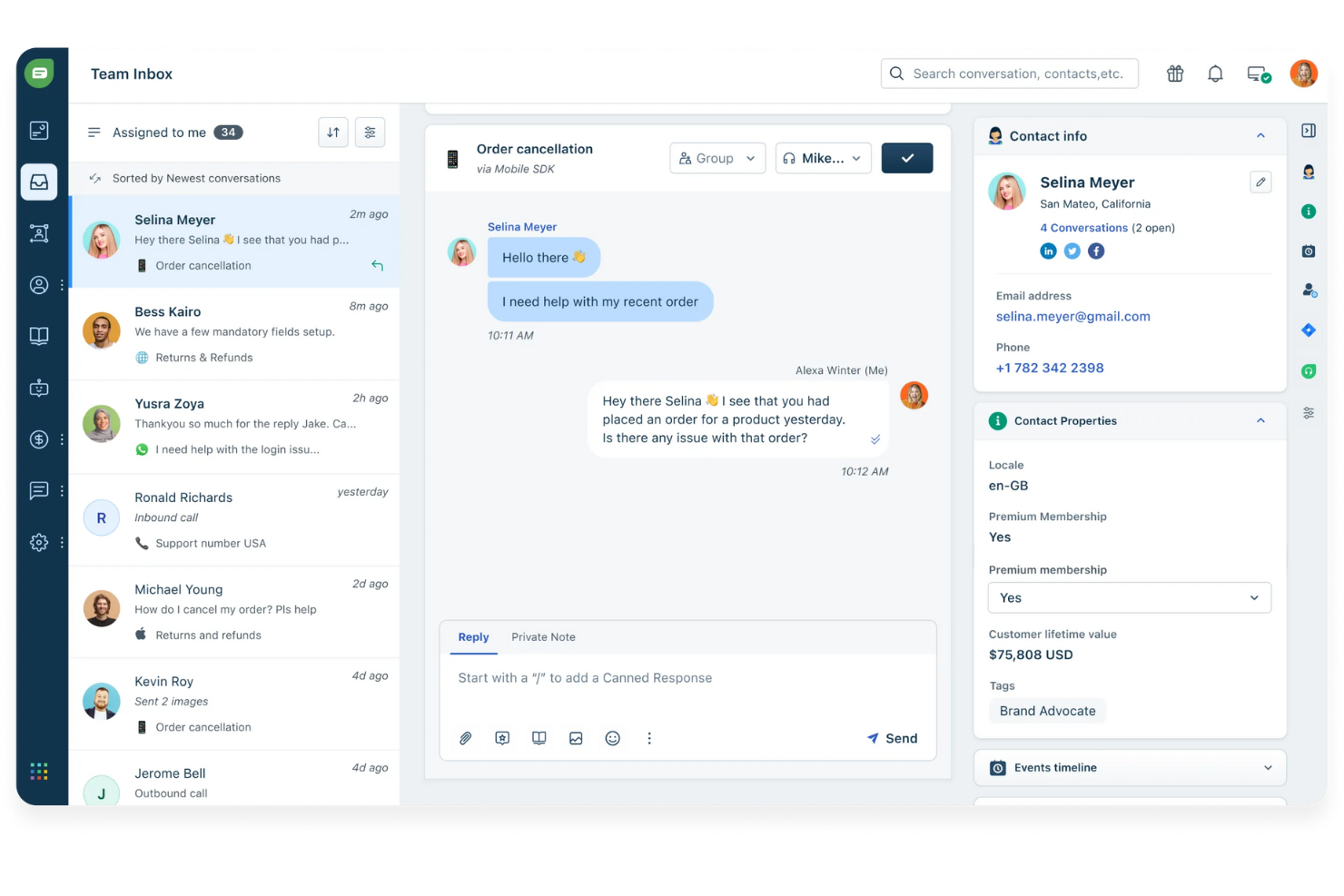
Freshdesk is an omnichannel customer support platform that combines live chat, a shared team inbox, AI-powered chatbots, and messaging across WhatsApp, Instagram, Facebook, SMS, and email into a single workspace.
Who Is Freshdesk Best For?
Freshdesk is a strong fit for small support teams that need to grow from a basic chat setup into a full multichannel operation without switching platforms.
Why I Picked Freshdesk
Freshdesk earns its spot on my shortlist because it's genuinely built to grow with you. I like how Freddy AI Agent can autonomously handle up to 80% of incoming conversations, which means a small team isn't forced to hire the moment ticket volume spikes. When more channels become necessary, admins can enable WhatsApp, Instagram, or SMS with channel-specific routing rules and SLAs configured in minutes, not weeks.
Freshdesk Key Features
- Knowledge base integration: Lets you create a branded help center and serve instant answers inside the chat.
- Multichannel inbox: Merges web, email, SMS, WhatsApp, Instagram, and Facebook messages in one ticketing workspace.
- Pre-built reporting dashboards: Includes analytics for CSAT, agent response times, and chat volume trends.
- Mobile agent apps: Allows your team to chat with customers and manage tickets from iOS and Android devices.
Freshdesk Integrations
Freshdesk offers native integrations with Shopify, WooCommerce, Salesforce, HubSpot, Slack, Google Workspace, Microsoft 365, Stripe, WhatsApp, and Facebook Messenger. It also connects with Zapier and provides an API for custom integrations.
Pros and Cons
Pros:
- Built-in CSAT surveys after every conversation
- Scales from chat to full omnichannel easily
- Freddy AI handles tickets without extra agents
Cons:
- Chat widget customization options are fairly limited
- Advanced automation locked behind higher-tier plans
New Product Updates from Freshdesk

Freshdesk Adds Voice AI Agents in Freshcaller
Freshdesk introduces Voice AI Agents available through Freshcaller Marketplace apps to handle routine calls and reduce queues. This feature enables automated call handling with real-time, conversational support. For more information, visit Freshdesk's official site.

My AskAI
Best for helpdesk auto-replies
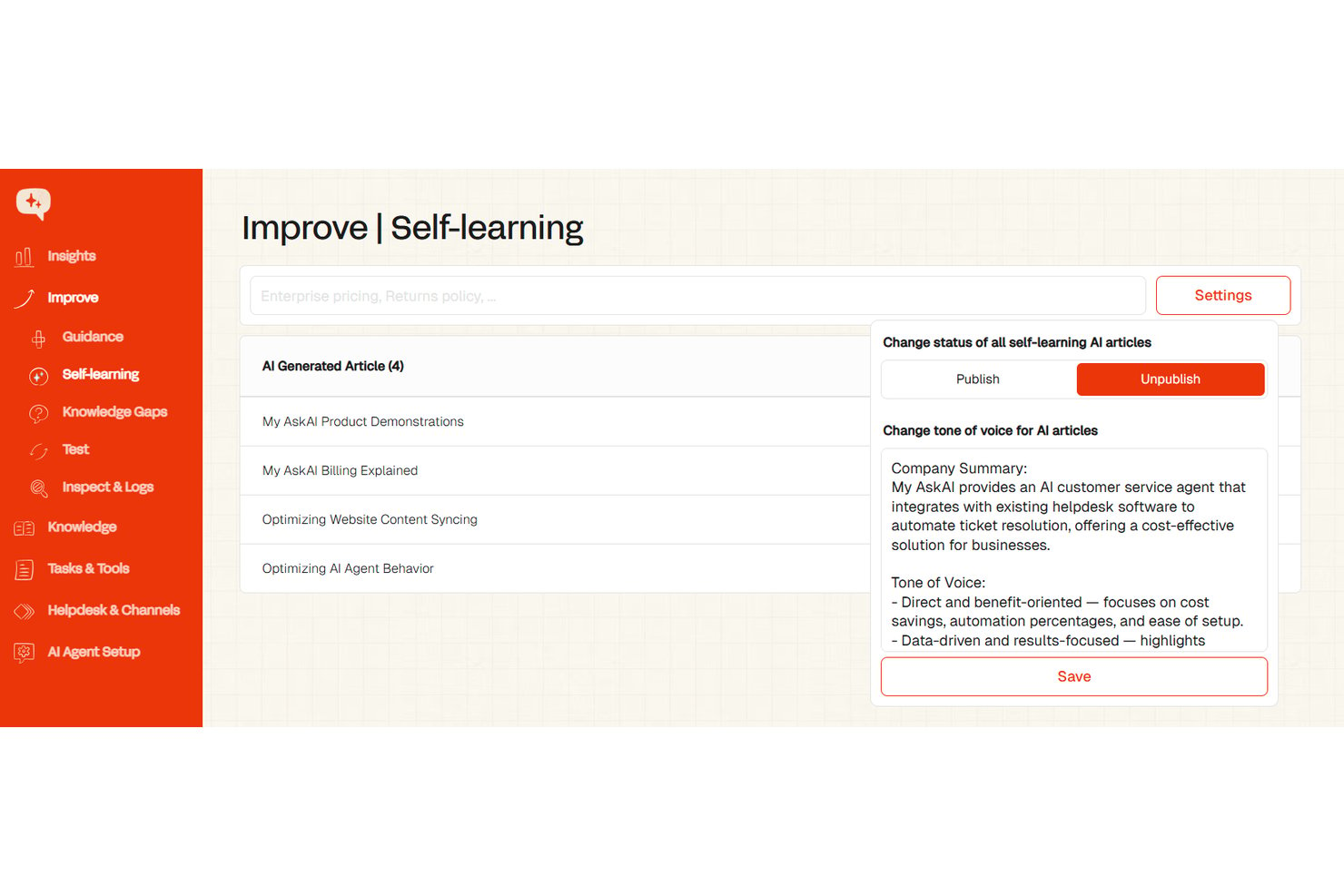
My AskAI is an AI customer support agent built to layer on top of helpdesks like Intercom, Zendesk, and Freshdesk, automatically handling and resolving incoming tickets using your existing knowledge base content.
Who Is My AskAI Best For?
It's a strong fit for small support teams in SaaS or ecommerce that already run Intercom, Zendesk, or Freshdesk and want to cut ticket volume without hiring more agents.
Why I Picked My AskAI
I've included My AskAI in my top picks because its self-learning feature is genuinely impressive: it monitors your human agents' replies and automatically updates the knowledge base, so deflection rates improve over time without any manual work. I also like that it cites the exact source paragraph behind every auto-reply, which makes it easy to audit what the AI sends before trusting it fully.
My AskAI Key Features
- RAG-powered answer generation: The AI responds to customer queries using content pulled directly from connected knowledge sources.
- Multilingual support: Handles training data and conversations in more than 95 languages for global teams.
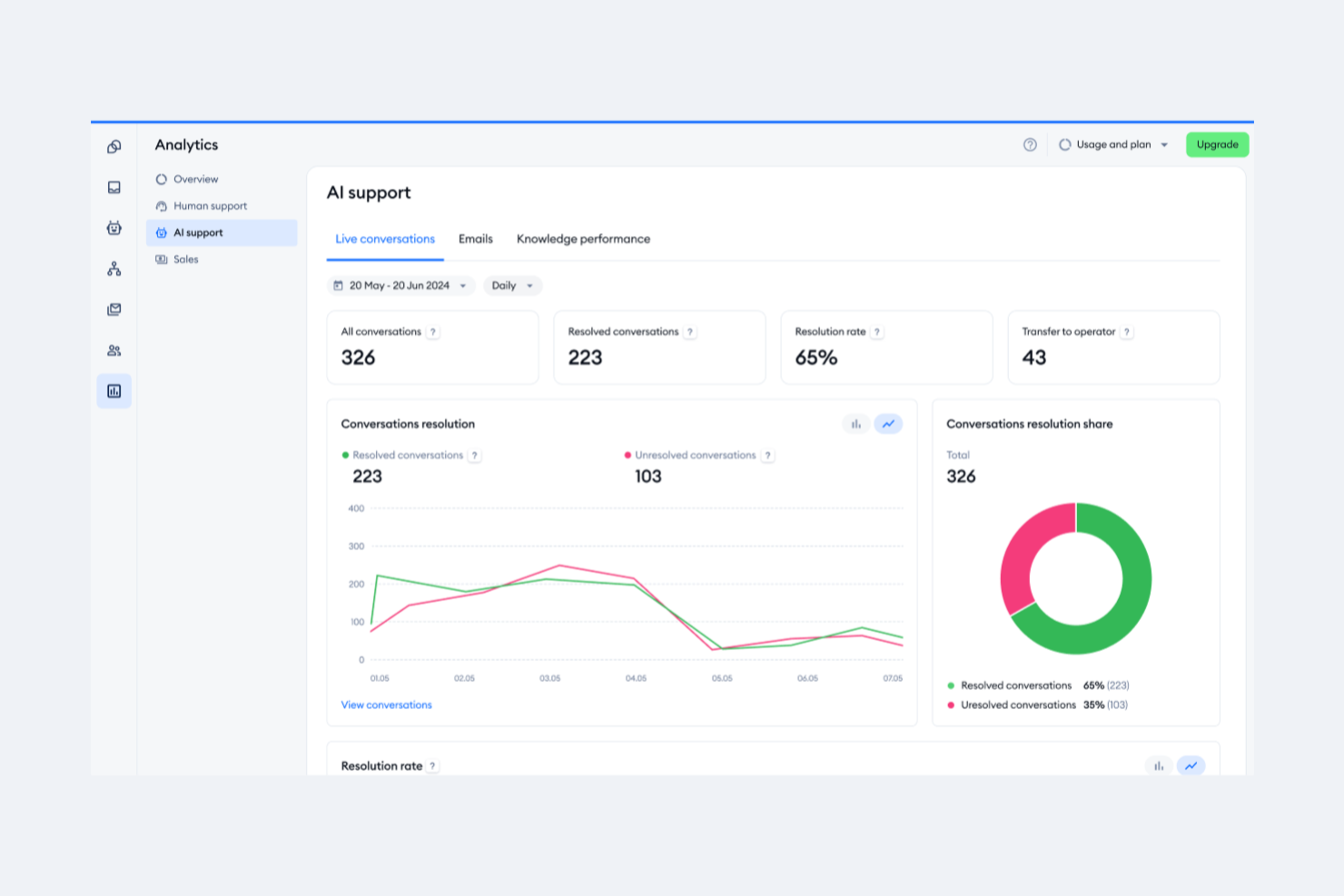
- Analytics dashboard: Offers insights into unanswered questions, escalation trends, and customer satisfaction ratings.
- Helpdesk and cloud integrations: Connects with Zendesk, Intercom, Freshdesk, Shopify, Google Drive, Notion, and more.
My AskAI Integrations
My AskAI offers native integrations with Zendesk, Intercom, Gorgias, Freshdesk, HubSpot, and Freshchat.
Pros and Cons
Pros:
- Cites sources behind every AI response
- Self-updates knowledge base from agent replies
- Auto-replies resolve tickets without agent involvement
Cons:
- Not built for proactive visitor engagement
- No native live chat widget included

Tidio
Best for its focus on generating sales
Tidio is a live chat and AI-powered customer service platform that combines a customizable chat widget, chatbot automation, a shared team inbox, and omnichannel messaging across email, social media, and website chat.
Who Is Tidio Best For?
Tidio is a strong fit for small ecommerce businesses that want to handle customer support and drive sales from the same platform.
Why I Picked Tidio
Tidio earns its spot on my shortlist because of how well it bridges customer support and active selling. I love that I can see exactly what a visitor has viewed and what's sitting in their cart, then trigger a proactive chat at the right moment with a personalized discount code. Lyro AI handles the conversation from there, recommending products and qualifying leads without an agent needing to step in.
Tidio Key Features
- Omnichannel inbox: Consolidates website chat, email, Messenger, Instagram, and WhatsApp conversations in one place.
- Ticketing and SLA management: Lets you track, assign, and prioritize support requests with built-in SLA tracking for faster response times.
- Visual automation builder: Provides a no-code interface to create chatbots and automated workflows with triggers and actions.
- Mobile apps for agents: Enables your team to respond, assign, and manage chats from iOS and Android devices.
Tidio Integrations
Tidio offers native integrations with Shopify, WooCommerce, Wix, WordPress, HubSpot, Zendesk, Mailchimp, Google Analytics, Messenger, and Instagram, and connects with Zapier. An API is available for custom integrations.
Pros and Cons
Pros:
- Ecommerce cart data visible inside the chat
- Proactive chat triggers based on visitor behavior
- Lyro AI handles FAQs without agent involvement
Cons:
- Reporting dashboard lacks depth for growing teams
- Lyro AI conversation limits on lower-tier plans

Best for AI-driven reply drafting
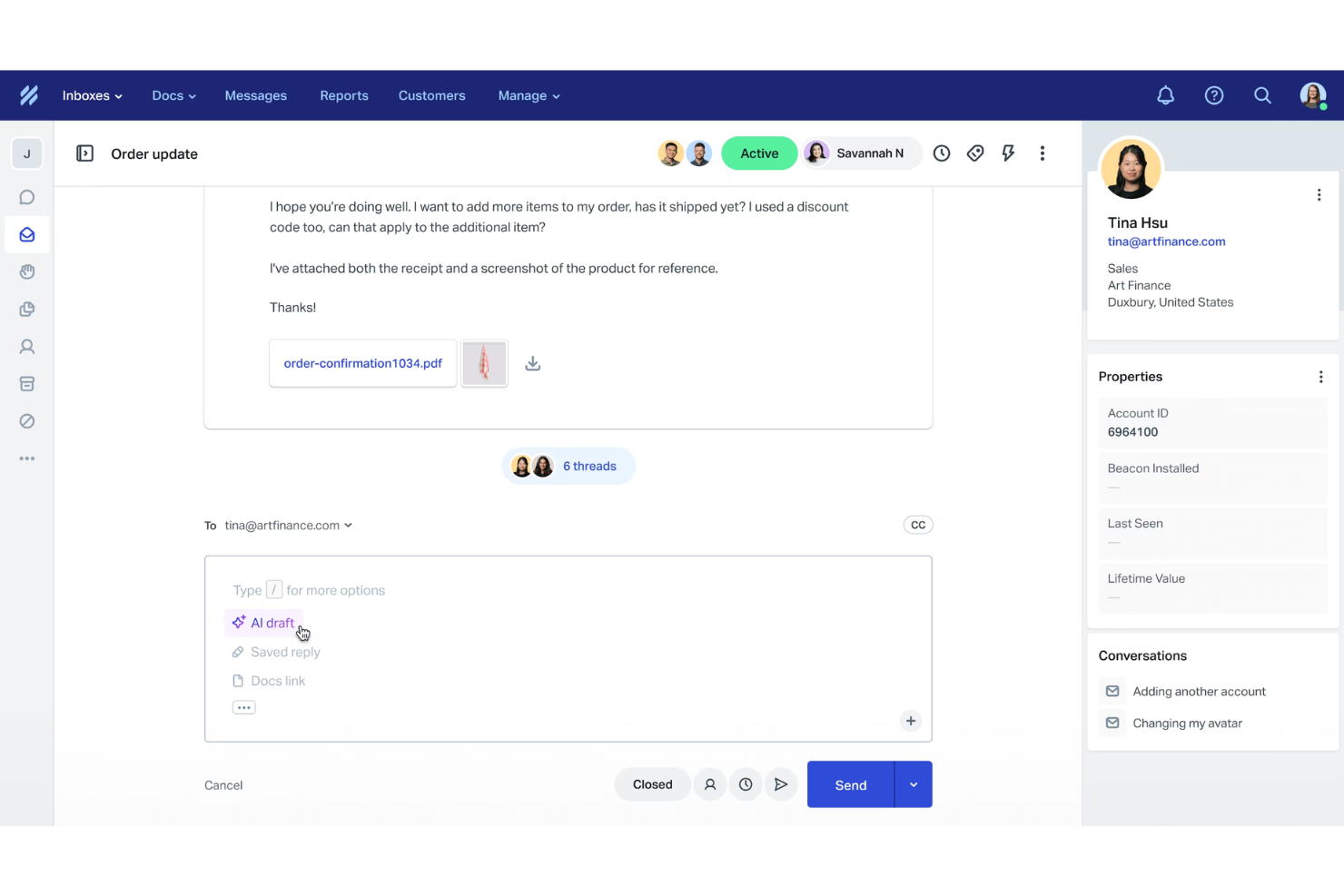
Help Scout is a customer support platform that combines a shared inbox, live chat widget, knowledge base, and omnichannel messaging with built-in AI tools designed for small and growing teams.
Who Is Help Scout Best For?
Help Scout suits small support teams that want a clean, easy-to-manage inbox without the complexity or cost of enterprise-grade platforms.
Why I Picked Help Scout
Help Scout earns its spot on my shortlist because of how AI Drafts removes the blank-page problem from chat support. It reads each incoming conversation, pulls context from your Docs articles and past replies, and generates a draft the agent reviews and sends. I also like AI Answers, which runs autonomously and resolves around 73% of conversations without any agent input, meaning my team handles only the conversations that actually need a human touch.
Help Scout Key Features
- Beacon live chat widget: Lets teams embed customizable chat and self-service support windows on any website or app.
- Unified team inbox: Centralizes email, chat, and social messaging for multi-agent management and collaboration.
- Knowledge base integration: Includes built-in Docs for creating searchable help articles and customer resource centers.
- Automated workflows: Enables triggered actions like tagging, assignment, and conversation routing without manual intervention.
Help Scout Integrations
Help Scout offers 100+ native integrations, including Shopify, Slack, HubSpot, Salesforce, Gmail, Outlook, Mailchimp, Jira, Trello, and Zapier. An API is available for custom integrations.
Pros and Cons
Pros:
- AI Answers resolves most conversations without agents
- Beacon widget installs via a copy-paste script
- AI drafts replies from your help content
Cons:
- Live chat reporting lacks detailed agent metrics
- Social messaging channels not natively supported
New Product Updates from Help Scout

Help Scout Adds Automatic Conversation Reassignment
Help Scout can now automatically unassign conversations when the assigned teammate has been away long enough, keeping replies moving so others can pick them up. For more information, visit Help Scout's official site.
 .
.
Chatbase
Best for multilingual, secure chat automation
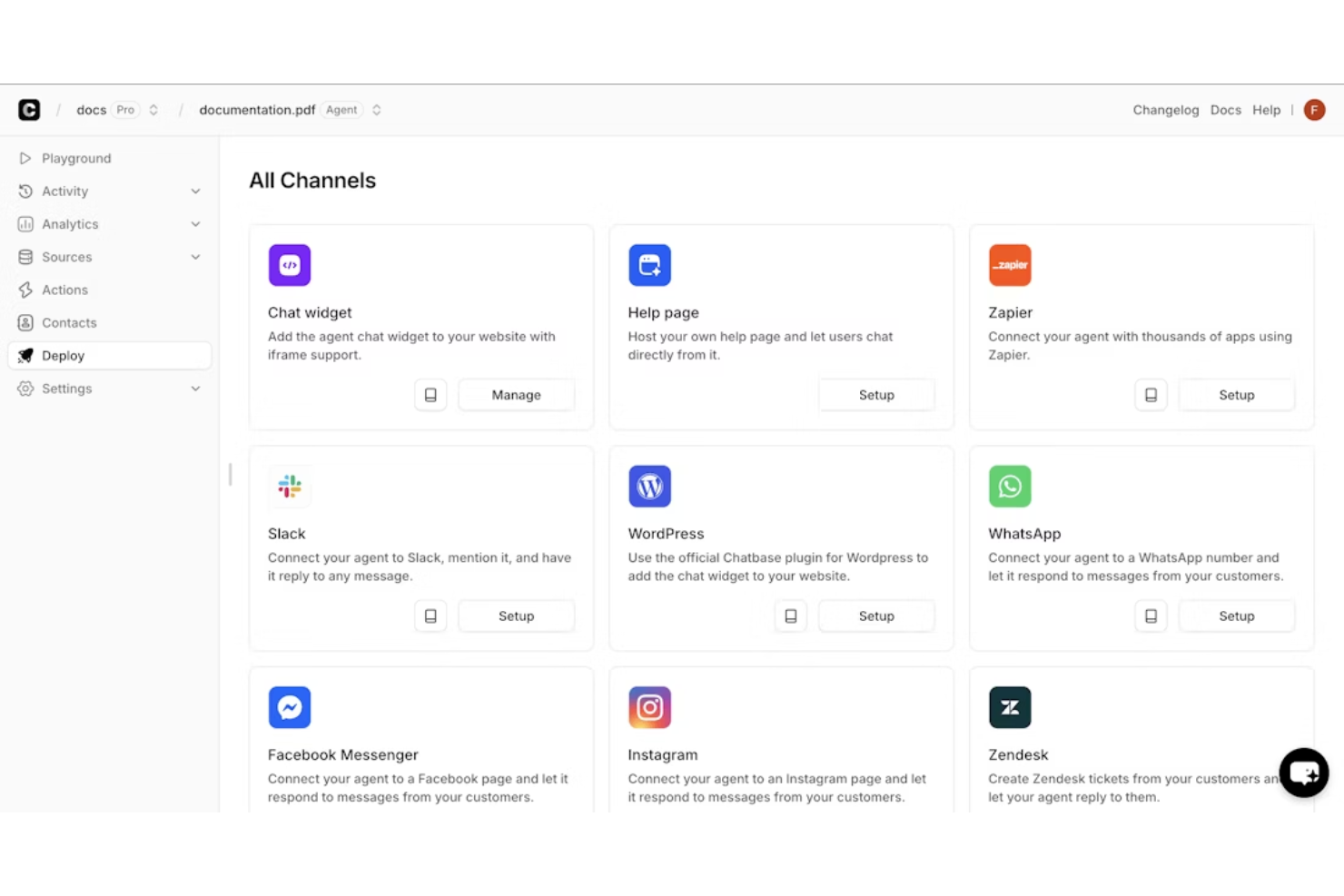
Chatbase is an AI-powered customer service chat platform that combines no-code chatbot building, a shared helpdesk, and omnichannel deployment across web, email, WhatsApp, Instagram, and voice.
Who Is Chatbase Best For?
Chatbase is a strong fit for small business owners and ecommerce teams that serve customers across multiple languages and need automated support without a development team.
Why I Picked Chatbase
Chatbase earns its spot on my shortlist because of how it handles multilingual chat at scale. Its AI agents respond in 80+ languages without any extra configuration, which means a small team can serve a global customer base without building separate bots for each region. I also like that it's SOC 2 Type II certified and HIPAA-eligible, so businesses in regulated industries can automate support without making compromises on data security.
Chatbase Key Features
- Helpdesk for AI and human agents: Manage chat, email, and voice conversations in a centralized shared inbox with manual and automated assignment to agents.
- Customizable chat widgets: Deploy branded, interactive chat widgets on your website with configuration options for color, position, and welcome message.
- Pre-built analytics dashboard: Track chat volume, top queries, fallback rates, and agent handoff with real-time reporting to identify trends and gaps.
- Direct integrations with ecommerce and CRM tools: Connect Shopify, HubSpot, Salesforce, Stripe, and more to enhance support and sync customer data.
Chatbase Integrations
Chatbase offers native integrations with Shopify, Stripe, HubSpot, Salesforce, Zoho, Zendesk, Intercom, Gorgias, and Slack. An API is available for custom integrations.
Pros and Cons
Pros:
- SOC 2 certified for regulated industries
- No-code chatbot setup requires no developer
- Supports AI chat in 80+ languages
Cons:
- Reporting depth is thin on lower plans
- Live agent handoff options feel limited

eDesk
Best for ecommerce platform integration
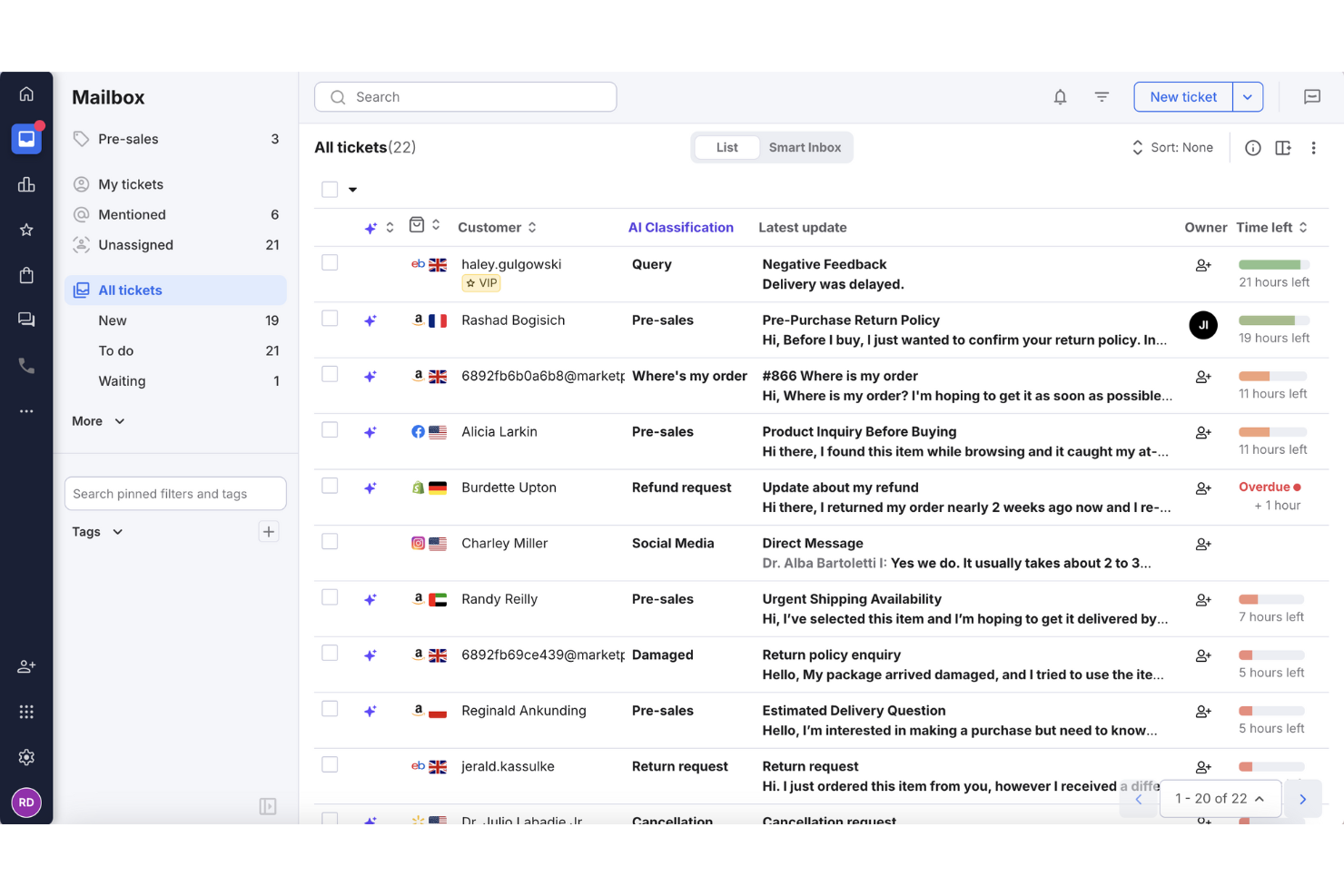
eDesk is an AI-powered customer service platform built for ecommerce sellers that unifies live chat, marketplace messages, and email into a single shared inbox.
Who Is eDesk Best For?
eDesk is a strong fit for small ecommerce businesses managing orders and customer messages across multiple marketplaces like Amazon, eBay, and Shopify simultaneously.
Why I Picked eDesk
eDesk earns its spot on my shortlist because of how deeply it connects to ecommerce marketplaces. When a customer messages about a late Amazon FBA order, the ticket surfaces alongside the order details, shipping status, and product info right in the sidebar. I also love that Ava, eDesk's AI chatbot, understands fulfillment context like FBA vs. FBM, so it gives accurate, order-specific answers without any agent intervention.
eDesk Key Features
- Unified team inbox: Manage chats, emails, and marketplace messages together with assignment, tagging, and auto-routing.
- AI-powered reply suggestions: Get generative AI-drafted responses and summaries for faster team replies.
- Knowledge base integration: Link self-service help articles in chat to address routine questions with no agent needed.
- Mobile agent app: Use dedicated iOS and Android apps for responding to customer chats and tickets on the go.
eDesk Integrations
eDesk offers native integrations with Amazon, eBay, Shopify, Walmart, BigCommerce, WooCommerce, Linnworks, and more. An API is available for custom integrations.
Pros and Cons
Pros:
- Handles high message volumes across channels simultaneously
- AI drafts replies for faster team responses
- Order details surface directly within each ticket
Cons:
- Can feel excessive for single-platform sellers
- Live chat widget customization options are limited
New Product Updates from eDesk
eDesk Adds Galeria and Kaufland Support in Spain and Netherlands
eDesk adds support for Galeria, Kaufland Spain, and Kaufland Netherlands marketplaces. These integrations bring more European buyer messages into eDesk with routing, templates, AI insights, and automated translation. For more information, visit eDesk’s official site.
 .
.
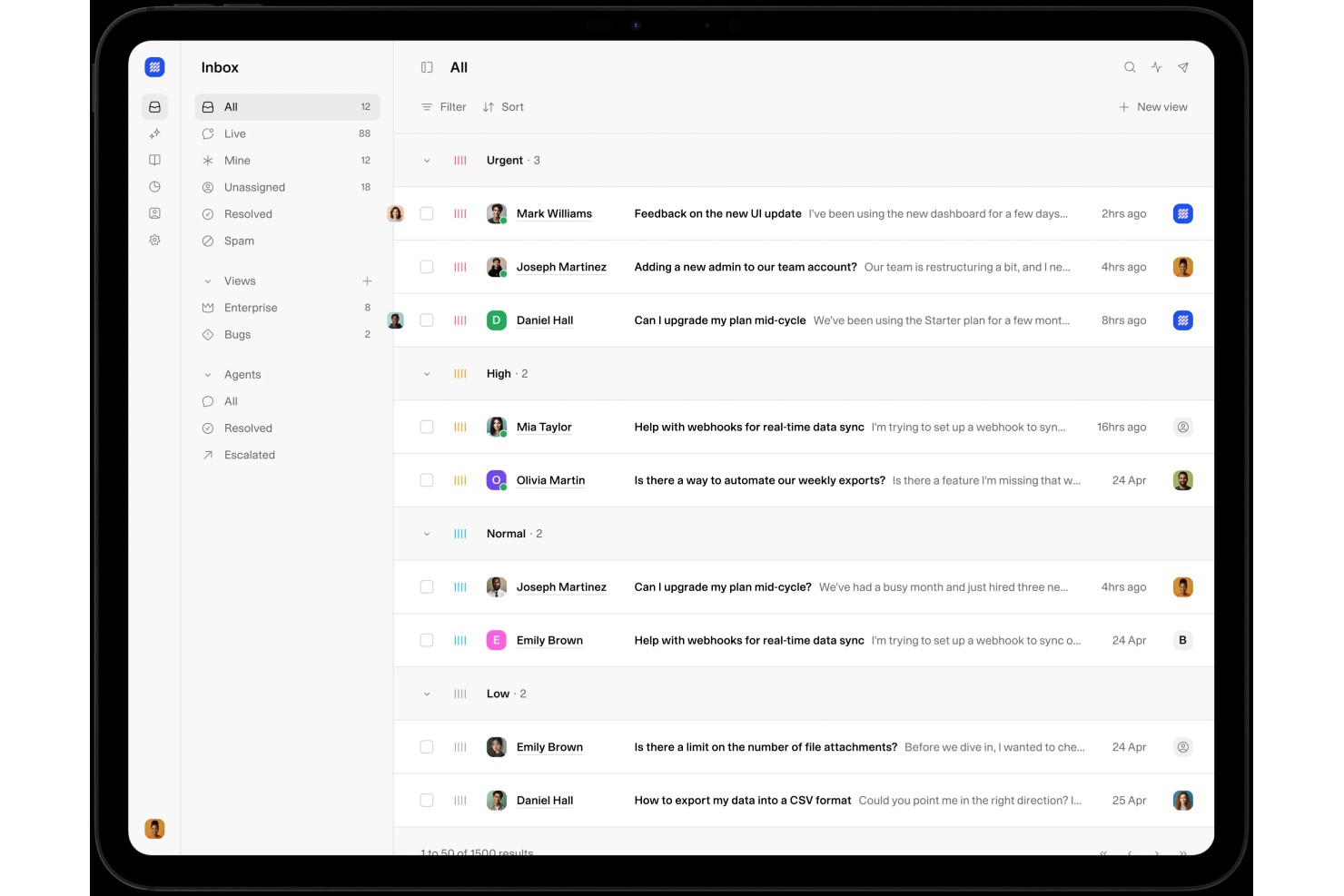
Weav is an AI-powered customer service chat platform that combines a no-code AI chatbot, a unified inbox for AI and human agent conversations, and smart escalation routing designed for small business support teams.
Who Is Weav Best For?
Weav is a good fit for small business owners and lean support teams who want to deploy an AI chatbot quickly without needing technical resources or a developer.
Why I Picked Weav
Weav is one of my top picks because I love how its AI agents handle live product and order conversations without handing off to a human unless it's truly necessary. My team is able to deploy specialized agents for specific commerce scenarios, like answering product questions or walking a customer through a return, all within an active chat session. I also find the real-time escalation routing useful here, since it moves a conversation to a live agent the moment a situation needs a human touch, keeping the buying momentum going.
Weav Key Features
- Unified inbox: Manage all AI and human agent conversations from a single dashboard, keeping your entire support queue in one place.
- Custom AI training: Upload files, paste documentation, or connect your website so Weav's AI learns your specific products and policies.
- No-code chatbot builder: Configure and launch an AI chatbot without writing any code, using Weav's built-in setup tools.
- Conversation analytics: Track chat volume, agent performance, and resolution data directly within the Weav dashboard.
Weav Integrations
Weav offers a smaller set of native integrations, including Shopify, Google Drive, and Stripe. It also supports custom actions, and its REST API and real-time webhooks are available on Pro plans and above for building custom integrations.
Pros and Cons
Pros:
- Continuous learning from resolved tickets
- Internal knowledge tool for agents
- Tone and response controls per agent
Cons:
- Free plan caps AI at 20 messages
- Limited third-party native integrations

Desk365
Best for Microsoft Teams integration
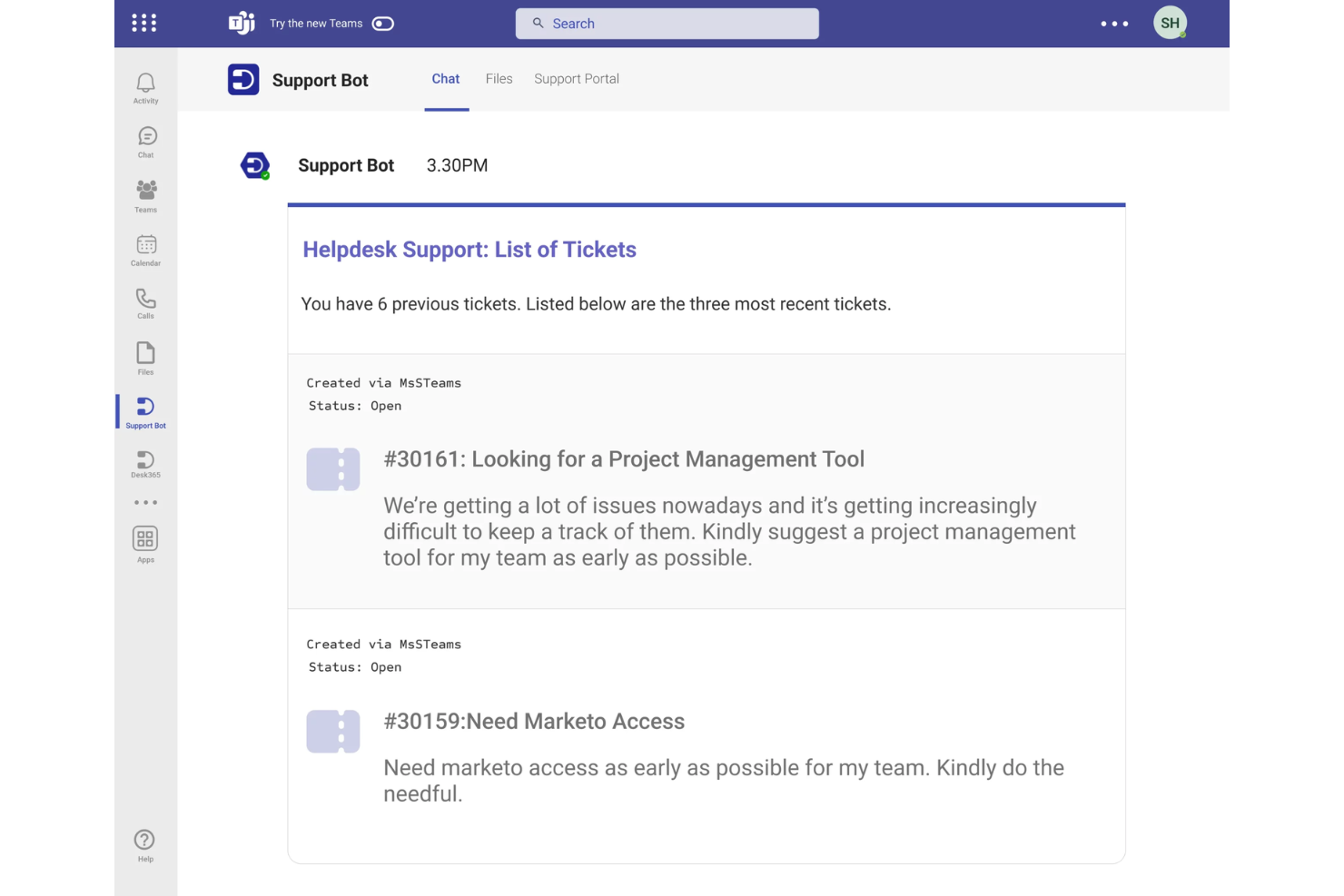
Desk365 is a cloud-based helpdesk platform that combines ticketing, AI-powered chat automation, and omnichannel support across email, Microsoft Teams, and a customizable web widget.
Who Is Desk365 Best For?
Support teams at small to mid-sized businesses already running Microsoft 365 will get the most out of Desk365's native Teams and Entra ID integration.
Why I Picked Desk365
Desk365 earns its spot on my shortlist because of how deeply it embeds support into Microsoft Teams. I like that customers can create tickets, check statuses, and reply to conversations directly inside Teams, with no portal login required. The AI Copilot also lets my team draft replies and summarize long ticket threads without switching context, which keeps response times tight when chat volume spikes.
Desk365 Key Features
- Unified shared inbox: Lets agents view and manage tickets from email, Teams, web portal, and widget all in one place.
- No-code AI chatbot: Allows teams to deploy an AI-powered agent for basic customer support without any custom development.
- Knowledge base builder: Provides a built-in tool for creating, storing, and surfacing self-serve help content.
- Role and department management: Supports multi-team setups with custom roles, departments, and access controls.
Desk365 Integrations
Desk365 has native integrations across the Microsoft ecosystem, including Microsoft Teams, Microsoft 365, and Microsoft Entra ID. An API is available for custom integrations.
Pros and Cons
Pros:
- Quick setup with no dev resources needed
- AI Copilot drafts replies in real time
- Tickets raised directly inside Microsoft Teams
Cons:
- Chat widget less advanced than rivals
- Limited omnichannel reach beyond Microsoft ecosystem

Best for multi-channel ticket management

Zoho Desk is a customer service and support software designed to help businesses manage and track their customer interactions and inquiries. It offers a range of features, including a ticketing system, customer portal, automated rule engine, and integrations with other Zoho and third-party applications.
As a customer service chat software, Zoho Desk allows users to embed live chats at various customer touchpoints, whether it's on a website or mobile. Additionally, its multi-channel ticket management system allows businesses to manage customer interactions from various platforms such as email, live chat, telephone, social media, and web forms, all within a single dashboard. By having all customer interactions in one place, small businesses can provide timely and consistent support.
Another significant benefit of Zoho Desk is its automation capabilities, particularly in ticket assignment. The software can automatically route customer queries to the appropriate department or agent, reducing the time and effort required to manually assign tasks. This automation ensures that customer issues are addressed promptly and by the right personnel, enhancing the overall efficiency of the support team.
Integrations include Google Workspace, Microsoft Office 365, Slack, Jira, Trello, Asana, Dropbox, OneDrive, Box, GitHub, Bitbucket, Zendesk, Salesforce, HubSpot, Intercom, Freshdesk, and other Zoho apps.

3CX
Best for escalating live chats to phone calls
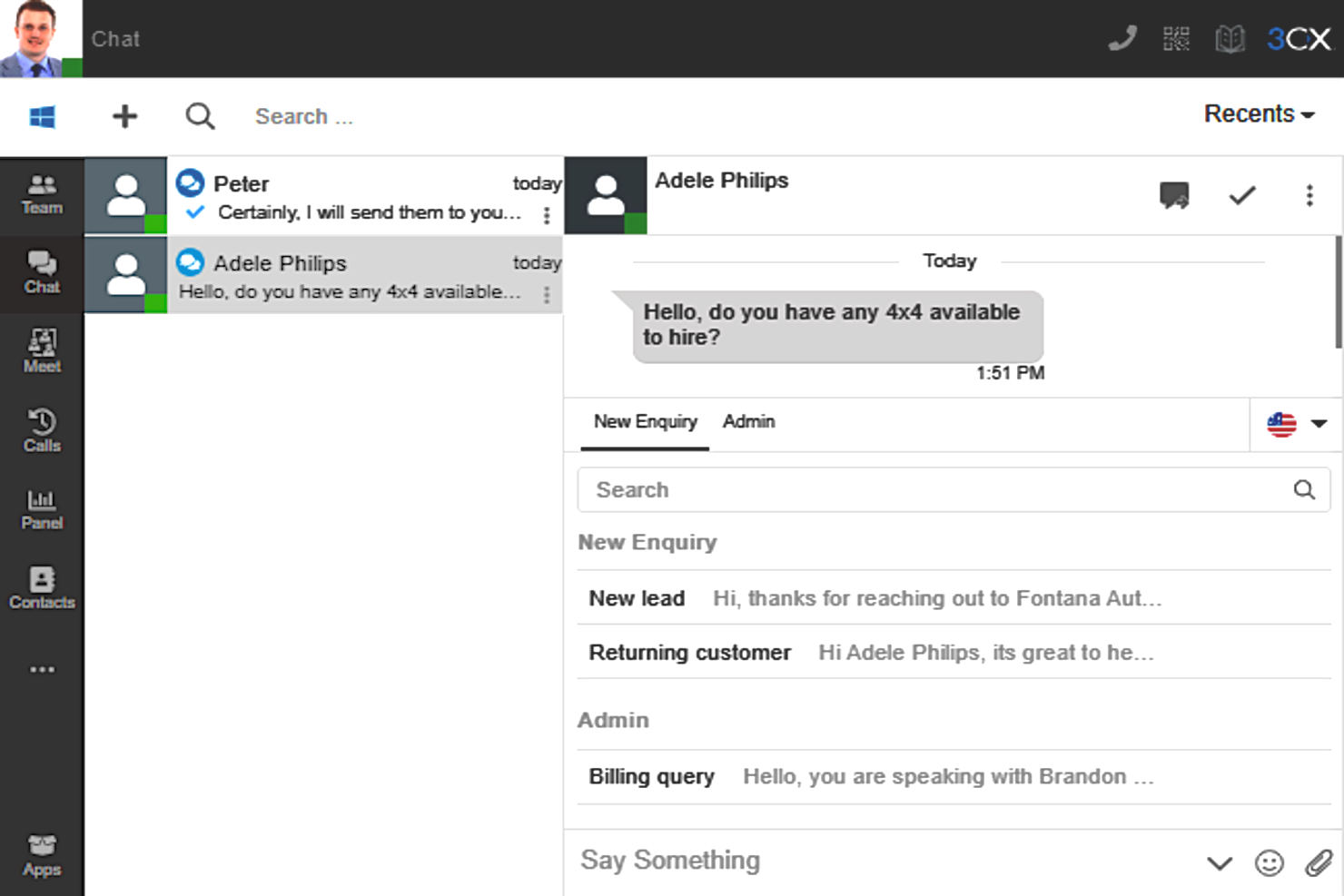
3CX is a unified communications platform that combines live chat, voice, video, WhatsApp, SMS, and Facebook messaging into a single interface for small business customer support teams.
Who Is 3CX Best For?
3CX is a good fit for small businesses that handle customer support across both chat and phone, particularly teams of up to 10 agents working on a tight budget.
Why I Picked 3CX
3CX earns its spot on my shortlist because chat-to-call escalation is genuinely rare in this category. When a support conversation gets complex, my team can flip it to a browser-based voice or video call instantly, without switching platforms or sharing phone numbers. I also like that WhatsApp, Facebook Messenger, and SMS all route into the same agent inbox alongside live chat, so no conversation gets lost mid-handoff.
3CX Key Features
- Omnichannel inbox: Manage website chat, WhatsApp, Facebook Messenger, and SMS conversations in one place.
- WordPress and Wix plugins: Install the live chat widget quickly on popular website platforms without coding.
- Queue-based chat routing: Route incoming conversations to the right agent or department using customizable rules.
- CRM integration: Log interactions and sync customer contacts with tools like Salesforce, HubSpot, and Zoho.
3CX Integrations
3CX offers native integrations with Salesforce, HubSpot, Zoho CRM, Microsoft 365, Freshdesk, Zendesk, Microsoft Teams, and more. An API is available for custom integrations.
Pros and Cons
Pros:
- Handles WhatsApp, SMS, and Facebook messaging
- Chat escalates to voice calls natively
- Free plan supports up to 10 agents
Cons:
- Mobile app reliability reported as inconsistent
- Initial setup requires technical configuration
Other Customer Service Chat Software
Here are some additional customer service chat software for small businesses options that didn’t make it onto my shortlist, but are still worth checking out:
- Zoho SalesIQ
For its easy-to-use, customizable interface
- Chatra
For ecommerce and SaaS engagement
- Front
For a combined email and chat inbox
- Intercom
For outbounding messages, alerts, and billing
- Olark
For educational institutions
- CoSupport AI
For customer support and business intelligence in one
- Podium
For creating custom reviews for small businesses
- Kayako
For a powerful chat customization system
- Helpshift
For quick responses through asynchronous live chat
- NinjaOne
For endpoint control & automation
- Quidget
For tech SMBs with small support teams
- SAAS First
For consolidating communications
- 14.ai
For intent-aware customer conversations
- Hiver
For Gmail shared inbox collaboration
- LiveAgent
For multilingual live chat
- Zendesk
For startups with a higher volume of support tickets
- Neople
For AI-powered customer support
- Pure Chat
For iOS and Android live chat support
- LiveChat
For lead generation and support ticketing
- HappyFox
Software to support unlimited agents


How I Evaluate Customer Service Chat Software for Small Business
My evaluation has two layers: the baseline every tool must clear—live chat, shared inbox, automation—and the differentiators that matter for teams running support with one or two agents.
Core Functionality (Table Stakes For This List)
When I'm selecting tools for my list, I rank each one on a scale from 0 (does not offer the functionality) to 5 (excels in this area) for each core functionality listed below. Then, I calculate the tool's total score into a percentage. Each tool needs to achieve a minimum total score of 65% to be considered for inclusion.
- Live Chat Widget: I check whether the widget supports branding, proactive triggers, and offline forms so visitors can still leave a message after hours.
- Shared Team Inbox: Small teams need to split incoming chats without stepping on each other, so I look for assignment rules, internal notes, and collision detection.
- Chatbot & Automation: I evaluate whether you can build at least a basic FAQ bot or set up auto-replies—like greeting a returning customer by name or routing billing questions to a specific agent.
- Omnichannel Messaging: Customers reach out on Instagram, WhatsApp, and email, not just website chat. I look for how many channels funnel into one inbox.
- Visitor Tracking & Context: Knowing a visitor's current page, past chat history, or cart contents before replying changes the quality of every conversation. I check how much context agents actually see.
- SMB-Friendly Pricing & Setup: I evaluate whether a two- or three-person team can install the widget, configure basic workflows, and go live without developer help or a sales call.
Once I have a list of tools that meet this criteria, I consider what sets each platform apart.
Differentiating Factors (What Sets Vendors Apart)
Here's how I compare and contrast different vendors:
Standout Features
AI-powered reply suggestions make a real difference when two agents are handling a full queue—draft responses and tone adjustment keep quality consistent without slowing things down. I also look for a connected knowledge base that feeds chatbot answers, since it cuts repeat questions before they reach an agent. For ecommerce teams, native sync with platforms like Shopify or WooCommerce lets agents see order status and cart details mid-chat, which removes the tab-switching that kills response times.
Beyond Features
Total cost of ownership matters more than the sticker price—I check whether chatbot access, integrations, or extra agent seats trigger a tier jump. Speed to value is equally important; a small team should be able to paste a script, configure a greeting, and start chatting within an afternoon. I also evaluate tech stack fit, especially CRM and helpdesk connectors like HubSpot or Salesforce, since a chat tool that lives in isolation creates more work. Mobile apps round it out—agents who split time between a desk and a shop floor need push notifications and full conversation access from their phone.
How to Choose Customer Service Chat Software for Small Business
It’s easy to get bogged down in long feature lists and complex pricing structures. To help you stay focused as you work through your unique software selection process, here’s a checklist of factors to keep in mind:
| Factor | What to Consider |
|---|---|
| Scalability | Can the software grow with your business? Check if it supports more users and higher chat volumes without a hitch, and consider any additional costs for scaling up. |
| Integrations | Does it fit with your existing tech stack? Look for tools that integrate with your CRM, email, and other essential apps to avoid workflow disruptions. |
| Customizability | Can you tailor the software to your needs? Evaluate if you can adjust the interface, workflows, and chat options to match your business processes and branding. |
| Ease of use | Is it user-friendly for your team? Test the interface and navigation to ensure your team can adopt it quickly without extensive training. |
| Implementation and onboarding | How smooth is the transition? Check for resources like training videos, product tours, and support to help your team get started quickly. |
| Cost | Does it fit your budget? Compare prices and consider any hidden fees or long-term commitments. Look for value in features that match your needs. |
| Security safeguards | How secure is your customer data? Verify if the software offers encryption, data protection, and compliance with regulations like GDPR or CCPA. |
| Support availability | Is help available when you need it? Ensure there’s 24/7 support or dedicated account management, especially if your team operates across different time zones. |
What Is Customer Service Chat Software for Small Business?
Customer service chat software is a tool that lets businesses communicate with customers in real time through a chat interface. It’s often used by support teams, service agents, and sales representatives who want to resolve customer issues faster and improve satisfaction. Live chat windows, canned responses, and chat routing capabilities help your team manage multiple conversations efficiently and maintain a consistent tone. Overall, this software helps you deliver quicker, more convenient support experiences for customers across different channels.
Which Type of Customer Service Chat Does Your Small Business Need?
Small businesses don’t necessarily need the same type of chat software. The right setup depends on your support volume, team size, and whether customers primarily need immediate human help or quick answers to repeat questions.
| Type | Best For | How It Works | Small-Business Consideration |
|---|---|---|---|
| Live chat | Businesses needing real-time customer conversations | An agent responds to customers through a website or app chat widget | Works well if someone is consistently available to respond |
| AI chatbot | Teams handling lots of repeat questions | Automatically answers common questions and routes more complex requests | Can reduce workload when you don’t have agents available around the clock |
| Shared inbox | Small teams managing several communication channels | Brings conversations from channels such as email, chat, and social into one workspace | Helps avoid paying for and monitoring separate tools |
| Help desk with chat | Growing support teams | Combines chat with ticketing, routing, history, and support workflows | Better when conversations need ownership, follow-up, or escalation |
| Omnichannel support | Businesses serving customers across many channels | Connects conversations across chat, email, SMS, social, and messaging apps | Useful once channel fragmentation becomes harder to manage |
How Does Customer Service Chat Software Work?
Customer service chat software moves each customer conversation through a simple workflow, from the first message to resolution and reporting.
Customer starts a conversation
Website chat, SMS, social media, an app, or another connected channel.
↓
Customer context is added
The software can pull in contact details, previous conversations, orders, or account history.
↓
The request is answered or routed
An agent, chatbot, or AI assistant responds, or the conversation is sent to the right person.
↓
Complex issues are escalated
Unresolved conversations can be assigned, transferred, or converted into tickets without losing their history.
↓
The interaction is tracked
Response time, resolution time, conversation volume, and customer satisfaction can feed into support reporting.
Does Your Small Business Need Live Chat?
Live chat makes the most sense when customers frequently need help before purchasing or while completing an important action.
| If Customers Often… | Live Chat Can Help With… |
|---|---|
| Ask questions before buying | Product selection and purchase decisions |
| Abandon checkout or signup | Real-time assistance at points of friction |
| Need quick account help | Resolving straightforward service requests |
| Contact you through multiple channels | Bringing conversations into one support workflow |
| Ask the same questions repeatedly | Automating common answers with chatbots or AI |
| Expect responses outside business hours | Collecting asynchronous messages or providing automated assistance |
If customer inquiries are infrequent and don’t require immediate responses, email or a shared inbox may be enough. Adding live chat only helps if your team can respond reliably or automate the periods when nobody is available.
Features
When selecting customer service chat software for small business, keep an eye out for the following key features:
- Live chat: Enables real-time communication with customers, allowing for quick resolution of inquiries and increased customer satisfaction.
- Automated responses: Provides instant replies to common questions, reducing workload on your team and ensuring timely assistance.
- Multi-channel communication: Integrates with various platforms like email, phone, and social media to streamline customer interactions across channels.
- AI-driven chatbots: Uses artificial intelligence to handle routine queries and tasks, freeing up your team for more complex issues.
- Customizable chat widgets: Allows you to tailor the chat interface to match your brand's look and feel, enhancing the user experience.
- Ticketing system: Organizes and prioritizes customer inquiries, ensuring efficient management and follow-up of support requests.
- Analytics and reporting: Offers insights into customer interactions and team performance, helping you make data-driven decisions.
- Self-service portal: Empowers customers to find answers independently, reducing the volume of direct inquiries.
- Collaboration tools: Facilitates internal communication with features like shared drafts and internal notes, improving team coordination.
- Security safeguards: Protects customer data with encryption and compliance with regulations, ensuring privacy and trust.
Benefits
Implementing customer service chat software for small business provides several benefits for your team and your business. Here are a few you can look forward to:
- Improved response times: Real-time chat and automated responses ensure customers get quick answers, enhancing satisfaction.
- Increased efficiency: AI-driven chatbots and ticketing systems reduce the workload on your team by handling routine queries.
- Enhanced customer engagement: Multi-channel communication keeps interactions consistent and accessible, fostering stronger customer relationships.
- Better data insights: Analytics and reporting tools provide valuable insights into customer behavior and team performance, aiding decision-making.
- Cost savings: Self-service portals and automated features help lower operational costs by reducing the need for additional staff.
- Stronger team collaboration: Features like shared drafts and internal notes support efficient teamwork and coordination.
- Data security: Security safeguards protect customer information, ensuring compliance and building trust with your clients.
Costs & Pricing
Selecting customer service chat software for small business requires an understanding of the various pricing models and plans available. Costs vary based on features, team size, add-ons, and more. The table below summarizes common plans, their average prices, and typical features included in customer service chat software for small business solutions:
Plan Comparison Table
| Plan Type | Average Price | Common Features |
|---|---|---|
| Free Plan | $0 | Basic live chat, limited chat history, and basic reporting. |
| Personal Plan | $5-$25/user/month | Live chat, automated responses, and basic integrations. |
| Business Plan | $30-$60/user/month | Multi-channel support, advanced reporting, and custom branding. |
| Enterprise Plan | $70-$120/user/month | AI-driven chatbots, dedicated account management, and advanced security features. |
Customer Service Chat Software for Small Businesses FAQs
Here are some answers to common questions about customer service chat software for small businesses:
Is customer data secure with chat software?
Yes, reputable customer service chat software includes security measures like encryption and compliance with regulations such as GDPR. Ensure the software provider you choose has robust security protocols to protect customer data. Review their security certifications and privacy policies to understand how they handle data protection.
Is it worth investing in chat software if I already use email for support?
Yes, if your customers expect faster replies or prefer real-time help. Chat tools let you answer questions instantly, which can improve how customers view your business. It can also reduce the back-and-forth that often happens with email support.
How can I tell if the chat tool is improving customer service?
Keep an eye on customer satisfaction and response times after you start using the software. If customers seem happier and you’re solving issues faster, that’s a good sign. You can also track how often customers return or leave positive feedback to gauge overall impact.
How many support agents does a small business Need for live chat?
There’s no fixed number. Staffing depends on chat volume, operating hours, expected response times, conversation complexity, and how many conversations agents can handle simultaneously. Track peak volumes, response times, and agent workload to determine when you need more coverage or automation.
Can a small business use ChatGPT for customer service?
Yes, but ChatGPT alone isn’t a replacement for customer service software. Small businesses can use AI to draft replies, summarize conversations, create support content, and answer common questions. Dedicated chat platforms add capabilities such as customer history, routing, permissions, reporting, integrations, and escalation to human agents.
Can customer service chat software learn from my website or help center?
Some AI-powered chat tools can use website pages, help center articles, FAQs, documents, and other approved content as knowledge sources for customer answers. Check how the platform handles content updates, source attribution, permissions, unanswered questions, and human escalation, since connecting content doesn’t guarantee every AI response will be accurate.
Can I manage live chat and social media messages from one inbox?
Yes, some customer service platforms combine website chat with channels such as email, SMS, WhatsApp, Facebook, and Instagram in a shared inbox. This can be particularly useful for small teams that don’t want to monitor separate tools throughout the day. Exact channel support varies by platform and plan.
Can customer service chat software support multiple languages?
Yes, but multilingual capabilities vary. Some platforms support multilingual chat interfaces and knowledge bases, while others provide automatic translation or AI-generated responses in different languages. Check which languages are supported and whether translation is native or requires an integration.
How difficult is customer service chat software to set up?
Basic live chat can often be added to a website using a script, plugin, or ecommerce integration. Setup gets more involved when you connect multiple channels, configure routing, import customer data, train AI on knowledge sources, or integrate a CRM or help desk. Small businesses without dedicated IT support should prioritize no-code setup and accessible onboarding support.
When should a small business add a chatbot?
Consider adding a chatbot when repetitive questions are taking up staff time, customers need help outside business hours, or chat volume is growing faster than your team. A chatbot may be less useful when support volume is low or most customer questions require judgment, account-specific investigation, or human assistance.