

How Comm100 Helps Regulated Support Teams Offer Omnichannel Support


Here's a question that doesn't get asked enough during software evaluations: what happens when the tool your team depends on every day can't meet the compliance standards your industry requires?
It comes up more often than you'd think. A university rolls out live chat to help students get
faster answers during enrollment, and three months in, the IT security team flags that the
platform doesn't meet their data residency requirements.
An iGaming operator deploys an AI chatbot to handle player inquiries around the clock, only to
realize the vendor has no PCI DSS certification and can't handle payment-related conversations without creating risk.
That’s not to say those tools don’t work fine in a demo. They just weren't built for the realities of regulated support.
This is where Comm100 has carved out a specific niche over the past 15+ years. The platform
was built for organizations where security, compliance, and data control aren't nice-to-haves that get discussed after implementation.
 has carved out a specific niche over the past 15+ years. The platform
They're prerequisites that shape every decision from day one. That means institutions like
universities, iGaming operators, credit unions, healthcare systems, and government agencies, all of which face some combination of strict regulatory oversight, sensitive data handling, and high support volumes that spike unpredictably.
Let's walk through how the core pieces of the platform; live chat, ticketing and messaging, and
the AI Agent, work together in these environments, and why the compliance layer underneath
them matters so much.
Why Omnichannel Support Gets Complicated in Regulated Industries
The idea behind omnichannel support is straightforward enough. Customers should be able to
reach you on whatever channel is most convenient for them, and the context of their interaction should follow them if they switch channels midway through.
A student who starts a conversation on live chat and follows up over email shouldn't have to re-explain their situation. A player who contacts support through the website and then sends a follow-up via SMS expects continuity.
Where things get complicated is when every one of those channels must comply with the same regulatory framework.
In higher education, student data is protected under FERPA. In iGaming, operators face licensing requirements that vary by jurisdiction and include strict rules around responsible gaming, KYC (know your customer) verification, and anti-money laundering.
In other industries like finance, PCI DSS governs how payment information can be handled and stored across any touchpoint.
Most omnichannel platforms were designed for general-purpose customer service. They work
well in retail, e-commerce, SaaS, and other industries where the compliance bar is relatively low.
But when you layer on the requirements that regulated industries bring to the table, gaps start
appearing, making many tools out there unviable for such organizations.
These aren't theoretical problems. They're the exact situations that organizations discover after they've already committed to a platform, which is why the compliance conversation needs to happen before the feature comparison, not after.
For instance, in February 2024, a British Columbia tribunal found Air Canada liable after its
chatbot gave a grieving customer inaccurate information about the airline's bereavement fare
policy.
The airline tried to argue the chatbot was a separate legal entity responsible for its own actions, but the tribunal rejected that claim outright, ruling that a company is responsible for all information on its website regardless of whether it comes from a static page or an automated system.
A year later, in August 2025, security researchers used a single 400-character prompt to trick
Lenovo's customer service chatbot into revealing sensitive company data, including live session cookies from real support agents. And that same month, a breach at Salesloft's AI chatbot provider Drift cascaded into a supply chain attack that exposed customer data from over 700 organizations, including from cybersecurity companies like Palo Alto Networks and Cloudflare.
Here's what regulated teams typically need from an omnichannel platform that generic tools
often miss:
- Data residency control, including on-premises Comm100 deployment options, so sensitive information stays where regulations require it
- Certifications that match their industry (SOC 2 Type II, PCI DSS, HIPAA, ISO
27001), verified through independent audits rather than self-attestation - Granular audit trails for every interaction across every channel, accessible in formats
that satisfy compliance reviews - Credit card masking and PII redaction built into the platform natively, not bolted on
through a third-party integration - Role-based access controls fine-grained enough that a supervisor, agent, and auditor all
see exactly what they need and nothing more
Live Chat as the Front Door
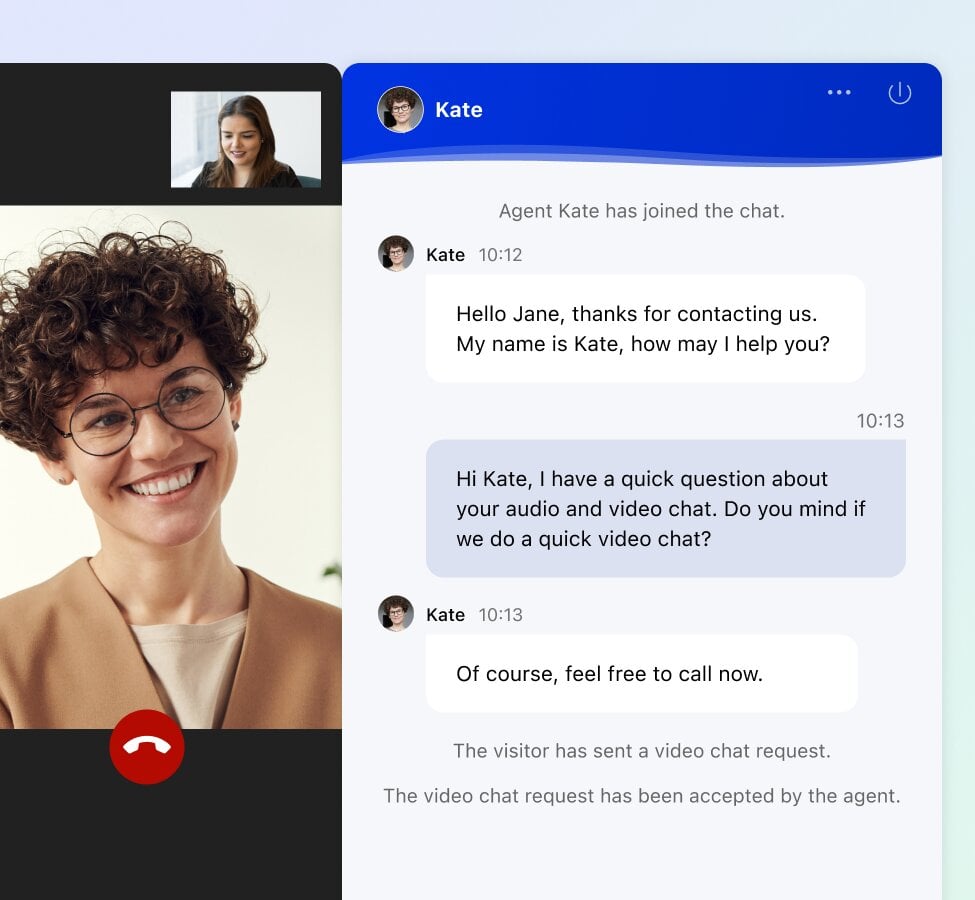
For most of the organizations Comm100 works with, live chat is where omnichannel support starts. It's the most natural starting point because live chat sits right on the website or portal where students, players, members, or citizens are already navigating. The conversation starts where the question happens.
In higher education, universities like McMaster University, San Jose State University, and UBC
use Comm100 Live Chat across multiple departments, from IT help desks to admissions to
academic advising and international student services.
The routing logic is important here because a student contacting the registrar's office shouldn't end up in the IT support queue, and vice versa. Comm100 handles this through configurable routing rules that direct conversations to the right department based on the page the visitor is on, the information they provide in a pre-chat form, or the nature of their question as identified by the system.
Useful features like screen sharing, co-browsing, and proactive chat invitations help improve the flow of conversation, as agents can guide users much better, all from the website.
In another highly regulated industry, iGaming, live chat serves a different but equally critical
function. Players expect real-time support, and the window for resolving their issue before
frustration sets in is measured in seconds rather than minutes.
VIP players in particular expect priority treatment, and routing those conversations to dedicated VIP support teams can directly impact player retention and spend. Comm100's routing capabilities allow operators to identify VIP players and funnel them to specialized agents automatically, which is a capability that several iGaming operators have deployed to reduce VIP churn and improve the overall player experience.
Similarly, agents can send proactive chat invites to those who are hovering on a particular page, creating another point of engagement and answering any questions they may have.
What makes live chat particularly effective as a starting channel is that it generates a shared
context that persists across every other touchpoint. If a student's live chat conversation gets
escalated to a ticket, the agent who picks up that ticket sees the full chat transcript.
If a player follows up via email two days later, their history is right there. That continuity is what makes omnichannel actually work in practice, rather than just being a marketing term on a features page.
Ticketing and Messaging for Everything That Can't Be Solved in Real Time
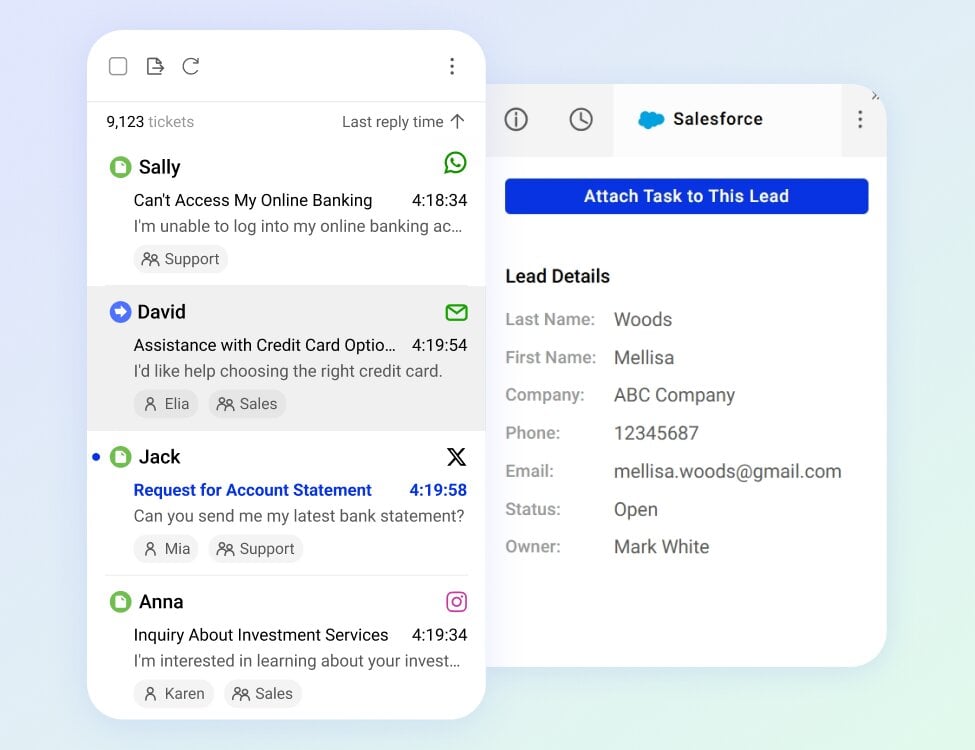
Not every support interaction resolves in a single conversation. Complex issues, those that need investigation, involve multiple departments, or require documentation review, need a system that tracks them through to completion. That's where Comm100 Ticketing & Messaging fits in.
For higher education institutions, ticketing is essential for managing the kinds of requests that
don't have quick answers. A financial aid appeal, a course transfer credit evaluation, or a housing accommodation request all involve multiple steps, multiple reviewers, and a paper trail that the institution needs to maintain.
Comm100's ticketing system manages conversations from email, social media, messaging apps and SMS in a single unified inbox, so agents aren't toggling between platforms and students aren't getting lost between channels.
In iGaming, ticketing handles the cases that fall outside of what a quick chat can resolve:
disputes, account verification delays, withdrawal processing issues, and responsible gaming
concerns that need to be escalated to a compliance team.
The ability to assign, route, and track these cases through SLA-driven workflows means that
nothing falls through the cracks, and the audit trail is built automatically rather than depending on an agent remembering to log their actions.
The key thing to understand about how Comm100 handles ticketing is that it's part of the same platform as live chat and the AI Agent, which means it draws from the same customer profile and conversation history. An agent working a ticket isn't starting from scratch. They see every previous interaction that customer has had, regardless of what channel it came through.
The AI Agent: Handling Volume Without Cutting Corners
Seasonal spikes are a defining characteristic of regulated industries. Universities get hammered during enrollment and registration periods. iGaming operators see surges around major sporting events, new market launches, and promotional campaigns. Credit unions experience peaks during tax season and year-end.
Historically, the only way to handle these spikes was to staff up. Hire temporary agents, train
them on compliance protocols, hope they're ready before the volume hits, and then let them go
when things slow down. It's expensive, time-consuming, and the quality is inconsistent because temporary staff rarely reach the same proficiency as permanent team members. Comm100 AI Agent offers a different lever. It handles the routine, predictable conversations that make up a large share of support volume, things like password resets, account status inquiries, enrollment deadlines, bonus terms and conditions, and general policy questions. These are conversations with clear, documented answers that don't require human judgment.
What makes the AI Agent appropriate for regulated environments is how it generates responses. Rather than pulling from a general-purpose language model that might improvise or hallucinate, the AI Agent generates answers from verified, approved knowledge sources. When it encounters a question it can't confidently answer, it escalates to a human agent with the full context of the conversation attached, so the student or player doesn't have to repeat themselves.
For iGaming operators, this capability is especially valuable for responsible gaming compliance. The AI Agent can be configured to recognize language patterns associated with problem gambling behavior and route those interactions to trained responsible gaming specialists, providing an additional layer of player protection that operates around the clock.
For universities, the AI Agent's biggest impact tends to show up during those brutal peak periods where admissions, financial aid, and IT support teams are all getting flooded simultaneously. The AI handles the common questions (application deadlines, document requirements, portal login issues) while human agents focus on the cases that actually need a person.
The Compliance Layer That Holds It All Together
All of these capabilities, live chat, ticketing, and the AI Agent, run on top of Comm100's security and compliance infrastructure, and this is where the platform diverges most sharply from general-purpose tools.
Comm100 holds SOC 2 Type II, PCI DSS, HIPAA, and ISO 27001 certifications. These are
independently audited, not self-declared. For organizations in banking, healthcare, and
government, those certifications are table stakes for any vendor evaluation. For higher education and iGaming, they're increasingly becoming requirements as regulatory scrutiny around data handling tightens across both industries.
Beyond certifications, Comm100 also offers on-premise deployment for organizations that need to keep all customer data within their own infrastructure. This is a meaningful differentiator for government agencies, financial institutions, and universities with strict data sovereignty policies that prohibit cloud-hosted customer interaction data from leaving their network. Most omnichannel platforms simply don't offer this option, which narrows the field considerably for organizations that require it.
Credit card masking, PII redaction, and encryption in transit and at rest are all built into the
platform natively. There's no third-party add-on to configure, no separate security module to
license.
Here's a quick snapshot of the compliance coverage:
- SOC 2 Type II for operational security controls, verified annually through independent audit
- PCI DSS for organizations handling payment data in chat and ticketing interactions
- HIPAA compliance for healthcare organizations managing protected health information
- ISO 27001 for information security management across the platform
- On-premise deployment available for organizations with data residency or sovereignty
requirements - TLS encryption, credit card masking, and PII redaction built into the platform by
default
Why Major Organizations Trust Comm100
The real test of an omnichannel platform isn't whether it has the right features listed on a
comparison page. It's whether those features actually work together in a regulated environment without creating new compliance risks or operational headaches.
Comm100's customer base includes institutions like McMaster University, San Jose State
University, and UBC in higher education, along with iGaming operators like Inbet Mexico, credit
unions like Lake Michigan Credit Union, and government agencies including the State of Texas.
These organizations chose Comm100 specifically because the compliance requirements came
first, and the platform was built to meet them from the ground up rather than retrofitting security features after the fact..
For support teams in regulated industries evaluating omnichannel tools, the biggest takeaway is this: the compliance conversation should drive the shortlist, not follow it. Start with your
regulatory requirements, your data residency needs, and your audit obligations. Then evaluate
which platforms can meet those requirements while also delivering the live chat, ticketing, AI,
and multi-channel capabilities your team needs to perform at scale.
Comm100 was built for exactly that order of operations, and the organizations that use it tend to be the ones who figured out early that the compliance layer matters more than any individual feature on a product page.

