

Hiver For Customer Service In 2026: An In-Depth Review



Hiver is a customer service platform that helps teams manage email, live chat, voice, WhatsApp, and more from one simplified workspace. It works best for customer service leaders running fast-moving teams in industries like logistics, e-commerce, finance, and tech—especially those who already rely heavily on email, chat, and voice channels. You get clear value by speeding up your team’s work, cutting busywork with AI, and making support feel effortless for both agents and customers.
In this article, you’ll get a full breakdown of Hiver’s features, pros and cons, use cases, and more, so you can decide if it’s right for your team.
Hiver Evaluation Summary

- From $25/user/month (billed annually)
- Free plan available
Why Trust Our Software Reviews
Hiver Overview
Hiver is a solid choice if you want customer service software that stays easy for your team but still delivers strong workflow automation. Its modern design, omnichannel coverage, and Hiver AI give it an advantage over tools that feel heavier or more rigid. I like that it outperforms competitors on usability, onboarding speed, and personalized responses, though teams with highly complex enterprise workflows may want deeper customization. If you're judging tools based on day-to-day productivity and how fast your team can respond, Hiver is a practical, high-value pick.
pros
-
Hiver AI reduces manual effort by drafting responses, auto-tagging conversations, and summarizing threads in seconds.
-
You deliver human-like, personalized responses without switching tabs or sounding robotic.
-
Your team stays aligned with shared drafts, notes, collision alerts, and clear ownership.
cons
-
No advanced help desk forecasting, capacity planning, or predictive SLA breach modeling.
-
Complex enterprise workflows may require more customization than Hiver currently offers.
-
Teams with support channels outside of chat, email, and call (like social channels), may find the platform lacks features.
Is Hiver Right For Your Needs?
Who Would be a Good Fit for Hiver?
Hiver is a strong fit if your team wants an AI-powered customer service platform that still feels simple and familiar. If you manage high email volumes, need better collaboration across agents, or want to deliver personalized support at scale, Hiver gives you the structure and clarity you need.
-
Small Support Teams
Hiver is easy to learn and helps your team start resolving issues within hours.
-
Logistics & Operations
Shared inboxes, tags, and workflows give you visibility and control over high-volume communication.
-
Travel & Hospitality
Personalized responses and fast collaboration help you improve customer experience.
-
IT & Internal Support
Workflows, SLAs, and collision alerts help your team respond quickly and stay aligned.
-
E-commerce Teams
You can pull order context, draft responses faster, and handle customer issues without switching tools.
-
AI-Forward Support Teams
Hiver AI handles repetitive tasks so your team focuses on high-value problems.
Who Would be a Bad Fit for Hiver?
Teams that need deep custom objects, complex enterprise routing, or highly specialized workflows may feel limited by Hiver’s structure. Organizations that need advanced field service or mobile-first workflows may also find Hiver too narrowly focused.
-
Large Corporations
Hiver’s limited scalability and customization may not meet your complex needs.
-
Healthcare Providers
The lack of robust analytics and reporting tools could hinder your compliance requirements.
-
Highly Regulated Industries
Teams needing extensive compliance workflows beyond HIPAA may find gaps.
-
Manufacturing Companies
Your need for intricate supply chain communication may not align with Hiver’s more basic abilities.
-
Custom-Heavy Data Teams
If your work depends on deeply modeled custom objects, Hiver may be too light.
-
Field Service Teams
On-site, mobile-dependent workflows may not align with Hiver’s multichannel approach.
How We Test & Score Tools
We’ve spent years building, refining, and improving our software testing and scoring system. The rubric is designed to capture the nuances of software selection and what makes a tool effective, focusing on critical aspects of the decision-making process.
Below, you can see exactly how our testing and scoring works across seven criteria. It allows us to provide an unbiased evaluation of the software based on core functionality, standout features, ease of use, onboarding, customer support, integrations, customer reviews, and value for money.
Core Functionality (25% of final scoring)
The starting point of our evaluation is always the core functionality of the tool. Does it have the basic features and functions that a user would expect to see? Are any of those core features locked to higher-tiered pricing plans? At its core, we expect a tool to stand up against the baseline capabilities of its competitors.
Standout Features (25% of final scoring)
Next, we evaluate uncommon standout features that go above and beyond the core functionality typically found in tools of its kind. A high score reflects specialized or unique features that make the product faster, more efficient, or offer additional value to the user.
We also evaluate how easy it is to integrate with other tools typically found in the tech stack to expand the functionality and utility of the software. Tools offering plentiful native integrations, 3rd party connections, and API access to build custom integrations score best.
Ease of Use (10% of final scoring)
We consider how quick and easy it is to execute the tasks defined in the core functionality using the tool. High scoring software is well designed, intuitive to use, offers mobile apps, provides templates, and makes relatively complex tasks seem simple.
Onboarding (10% of final scoring)
We know how important rapid team adoption is for a new platform, so we evaluate how easy it is to learn and use a tool with minimal training. We evaluate how quickly a team member can get set up and start using the tool with no experience. High scoring solutions indicate little or no support is required.
Customer Support (10% of final scoring)
We review how quick and easy it is to get unstuck and find help by phone, live chat, or knowledge base. Tools and companies that provide real-time support score best, while chatbots score worst.
Customer Reviews (10% of final scoring)
Beyond our own testing and evaluation, we consider the net promoter score from current and past customers. We review their likelihood, given the option, to choose the tool again for the core functionality. A high scoring software reflects a high net promoter score from current or past customers.
Value for Money (10% of final scoring)
Lastly, in consideration of all the other criteria, we review the average price of entry level plans against the core features and consider the value of the other evaluation criteria. Software that delivers more, for less, will score higher.
Core Features
Omnichannel Inbox
You manage email, chat, voice, WhatsApp, and portal requests from one simple view. It keeps your team organized without requiring them to learn a complex new interface.
Ticketing
You assign, track, and respond to customer conversations with clarity and structure. It helps your team avoid confusion and resolve issues faster.
Live Chat
You help customers in real time with simple routing and AI-backed support. It gives your team a fast way to resolve issues and keep customers engaged.
Workflow Automation
You automate routing, tagging, and categorizing tasks based on rules. This reduces manual work so your team focuses on customer conversations instead of admin tasks.
Knowledge Base & Self-Service Tools:
You create help center articles and deploy an AI-powered chat widget to let customers solve problems on their own. This reduces inbound questions and improves customer experience.
Analytics & Dashboards
You track response time, resolution time, CSAT, and agent performance. It gives you the data you need to improve operations and plan staffing.

Standout Features
Personalized, Human-Like Conversations
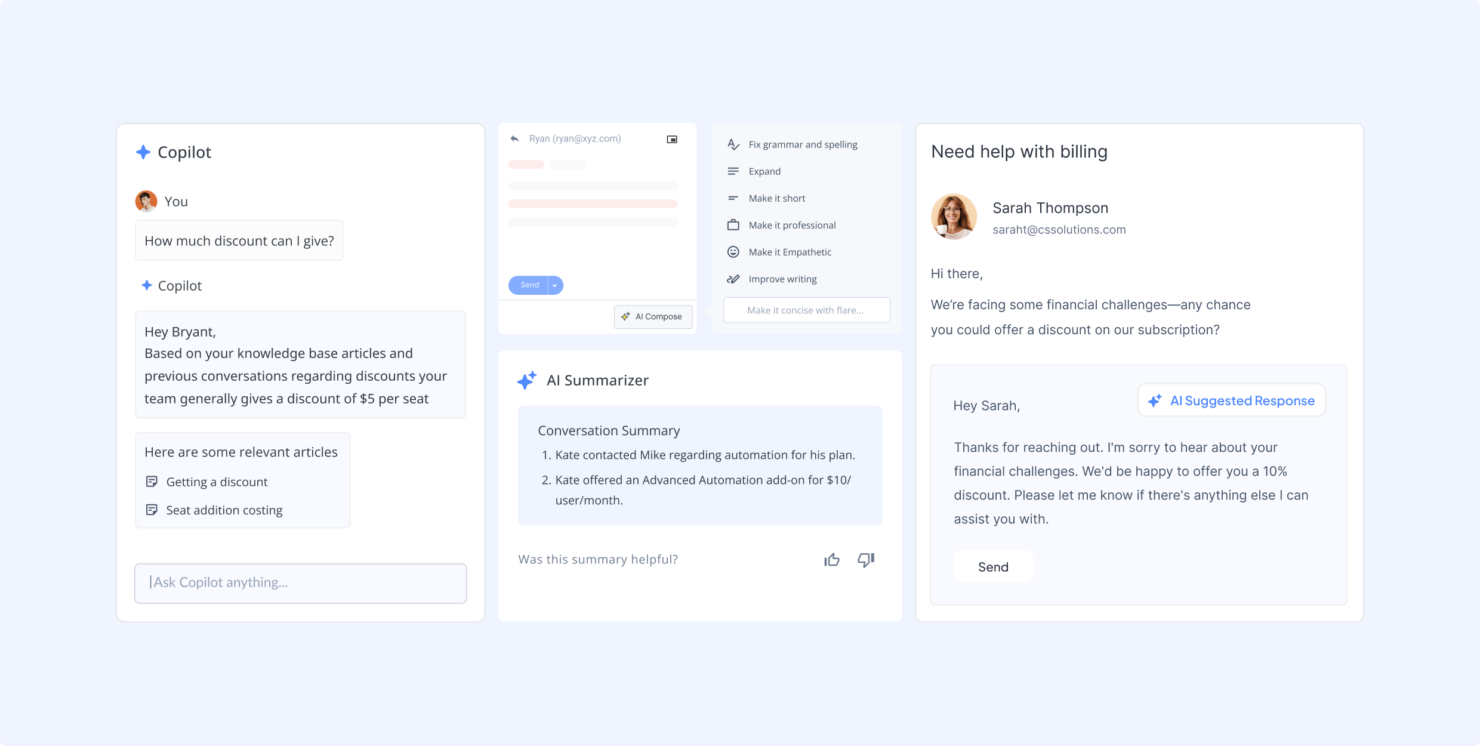
Hiver helps your team respond naturally by keeping all customer context in front of you and drafting replies that feel human—not robotic. It makes every interaction smoother and more personal for customers.
Hiver AI
You get AI-generated drafts, summaries, and sentiment detection to speed up responses. It helps your team deliver personalized answers without starting from scratch.
Ease of Use
Hiver is easy to use because its modern and intuitive design centralizes multi-channel communications. Even during busy periods, the interface stays clean and helps you assign work without confusion. AI speeds up common actions like drafting, tagging, and summarizing, which reduces the number of clicks needed to handle each conversation. It’s a practical choice if you want your team to pick up the tool quickly and stay productive.

Onboarding
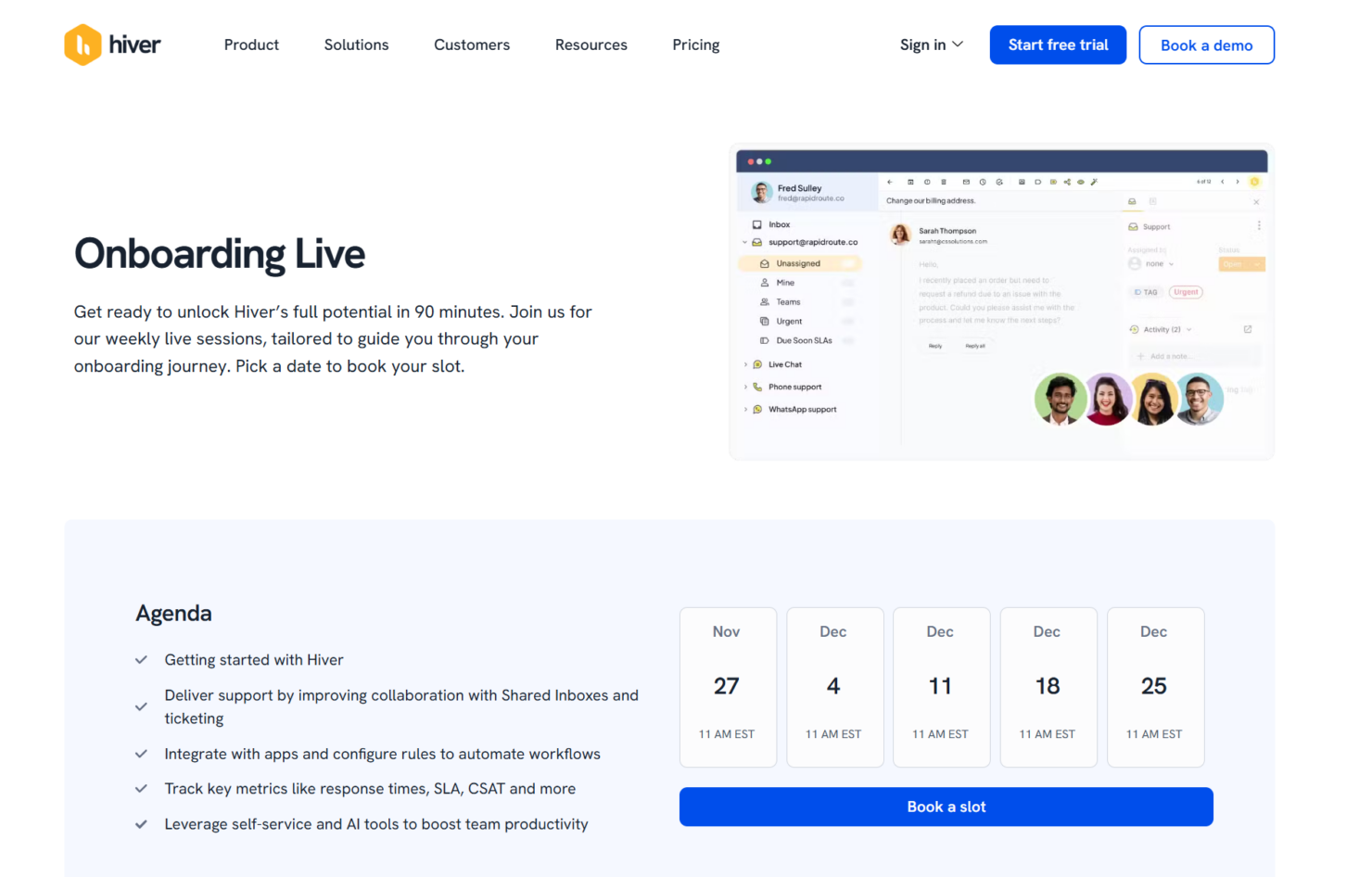
Hiver’s onboarding is quick because you connect channels, create workflows, and assign roles in minutes. The help center, product tours, and 24/7 support help you reach full productivity within a few days. I also like that Hiver offers live onboarding sessions weekly, helping you get started in just 90 minutes.
Customer Support
Hiver offers 24/7 email and live chat support, so your team always has help when needed. Their guidance is clear and practical, making it easy to resolve issues or get through setup steps. You also get access to a detailed help center and onboarding guides for self-service support. Overall, the support experience is dependable and helpful for busy teams.
Integrations
Hiver integrates natively with Salesforce, HubSpot, Shopify, Netsuite, Shopify, ClickUp, Asana, Jira, Pipedrive, Aircall, and Slack. It also offers an API and connects with third-party integration tools like Zapier.

Value for Money
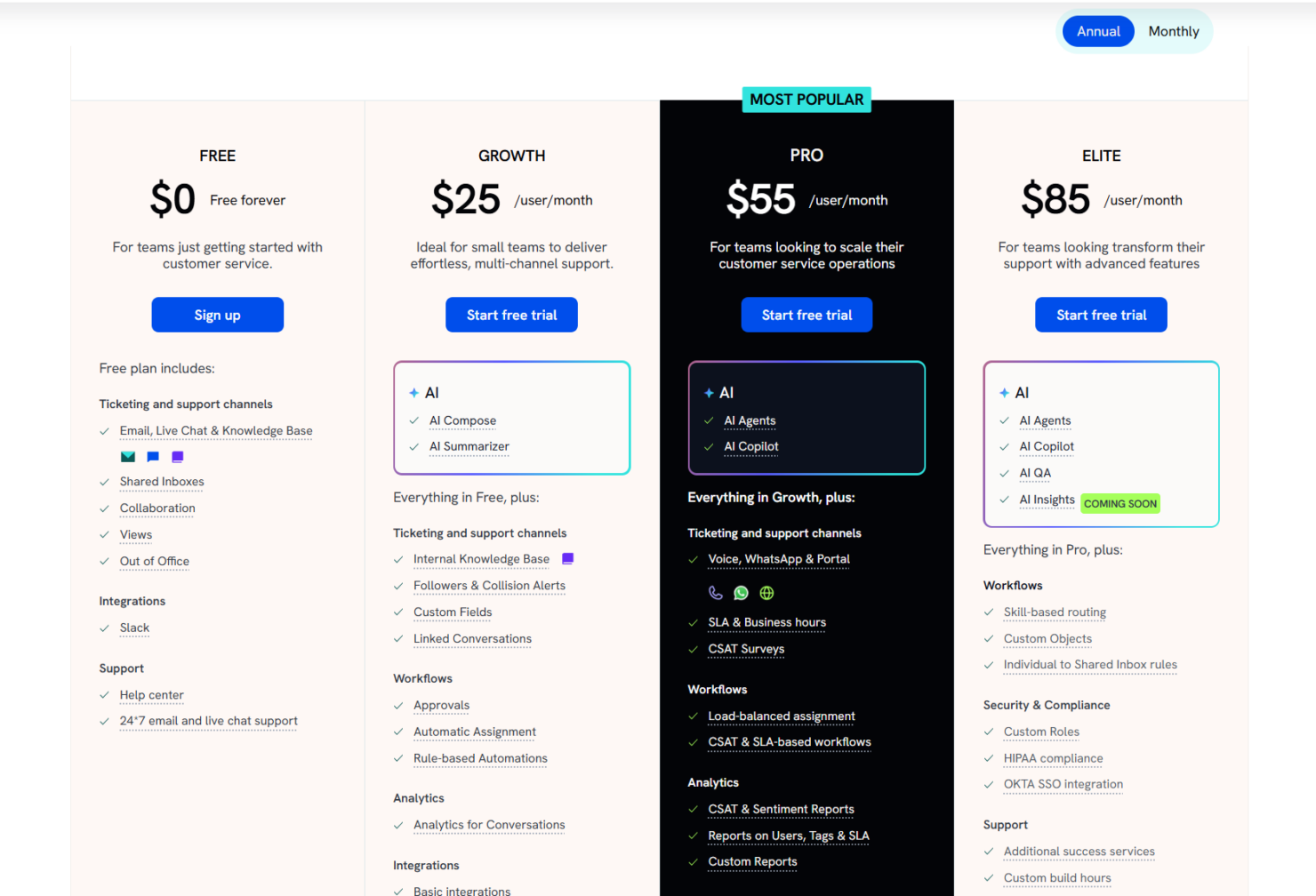
Hiver delivers strong value by giving you advanced AI tools, omnichannel support, and fast, human-like responses without overwhelming your team. The tiers scale well for teams of different sizes. You get a modern customer service platform that keeps your team efficient and focused.
- Free: Basic ticketing, shared inboxes, team collaboration, and core channels.
- Growth: Adds SLAs, custom fields, workflows, customer portal, and analytics.
- Pro: Adds CSAT, chatbots, business hours, dashboards, and deeper reporting.
- Elite: Adds skill-based routing, custom objects, custom roles, and compliance features.
New Product Updates from Hiver

Hiver Introduces AI-Powered Task Creation
Hiver introduces AI-powered tasks that automatically process incoming emails by extracting information, summarizing requests, and initiating actions through automation rules. This improves efficiency by reducing manual work and streamlining multi-step workflows. Here are the details of the update:
- AI-Powered Tasks: These tasks automate the extraction of key information from emails, enabling faster responses and efficient request handling.
- Visual Builder for Automation Rules: Users can leverage a visual tool to set up complex automation rules tailored to their needs, such as customer refunds or follow-ups.
- Multi-step Action Management: This feature enables users to automate complex processes across multiple steps, reducing the burden of repetitive tasks and boosting productivity.
Visit Hiver's official site for more details.
 for more details.
Hiver Introduces Public APIs for Custom Integrations
Hiver introduces public APIs that allow you to programmatically access and sync data across systems. This enables seamless integrations and helps teams bring customer context and actions into their existing workflows. Here are the details of the update:
- Public APIs Introduction: Developers can now access and sync Hiver data programmatically.
- Custom Integrations: These APIs enable the development of personalized integrations with other tools.
- Data Synchronization: The APIs allow pushing or pulling of conversation information, ensuring seamless data flows between Hiver and your existing application stack.
- Enhanced Customer Context: By integrating APIs, applications can bring enhanced customer context and actionable data directly into user apps.
Visit Hiver's official site for more details.

Hiver Introduces Chat Playground for Chat Testing
Hiver introduces Chat Playground to simulate chat interactions, validate bot responses, and test flow behavior before going live. This allows teams to identify issues early and deliver more reliable chat experiences. Here are the details of the update:
- Simulation of Visitor's Chat Experience: Test the chat widget from a visitor’s perspective to identify potential issues and improve user interaction.
- Validation of Bot Responses: Ensure that automated responses are correct and effective, improving communication and satisfaction.
- Flow Behaviour Checks: Verify and tweak the chat flow to ensure logical and smooth conversation paths.
Visit Hiver's official site for more details.

Hiver AI Updates: QA and Tagging Boost Efficiency
Hiver introduces AI QA and AI Tagging to evaluate response quality and automatically categorize incoming conversations. These updates improve support operations by surfacing quality insights and triggering automations based on conversation intent. Highlights include:
- AI QA: Evaluates team responses against quality parameters and surfaces performance insights across conversations.
- AI Tagging: Automatically assigns tags to conversations based on content and intent to support routing and automation.
Visit Hiver’s official site for more details.

Hiver Automatically Moves Personal Emails to Shared Inboxes
Hiver introduces automation that automatically moves customer emails sent to personal inboxes into Shared Inboxes. This improves collaboration by ensuring conversations are visible, assigned, and managed by the entire team. Highlights include:
- Automatic Email Movement: Emails addressed to personal inboxes can now be seamlessly redirected to Shared Inboxes, ensuring all team members have visibility.
- Centralized Tracking: By having all emails in one place, teams can track communications more efficiently and ensure all messages are responded to promptly.
- Improved Team Collaboration: Shared Inboxes prevent emails from being siloed, fostering a collaborative environment where team members can manage and assign conversations appropriately.
Visit Hiver's official site for more details.

Hiver Introduces Custom Objects for Data-Driven Workflows
Hiver introduces Custom Objects, enabling teams to import external data from CRM systems or spreadsheets and use it within workflows. This improves efficiency by allowing conversations to be automatically routed or managed based on predefined data relationships. Highlights include:
- Import External Data: Users can now import data from CRMs and spreadsheets directly into Hiver as Custom Objects.
- Dynamic Workflows: This feature empowers users to create dynamic workflows by utilizing imported data.
- Automated Routing: Custom Objects allow for automated routing of conversations based on predefined relationships, improving response time and accuracy.
Visit Hiver's official site for more details.

Hiver Enhances AI Sentiment Analysis
Hiver enhances AI sentiment analysis by continuously analyzing customer tone and conversation signals in real time. This improves response prioritization, helps teams identify risk early, and supports faster intervention in critical customer situations. Here are the details of the update:
- Continuous Sentiment Evaluation: Monitors customer tone across conversations to detect frustration or risk.
- Early Risk Identification: Helps teams spot at-risk or dissatisfied customers sooner.
- Smarter Response Prioritization: Enables teams to prioritize conversations based on sentiment signals.
Visit Hiver’s official site for more details.

Centralized Management In Hiver Omni
Hiver enhances centralized management in Hiver Omni by introducing a centralized Accounts and Contacts directory with full conversation context and activity history. This improves customer visibility, helps teams access key insights faster, and supports better relationship management. Here are the details of the update:
- Centralized Accounts and Contacts Directory: Access complete customer interaction history from a single view.
- Full Conversation Context: View activities, communications, and key details at account and contact level.
- Improved Customer Visibility: Enables teams to understand relationships and interactions more clearly.
Visit Hiver’s official site for more details.

Hiver Introduces AI Agent Analytics
Hiver introduces AI Agent Analytics, enabling teams to track AI-powered interactions, monitor key performance metrics, and filter AI versus human conversations in Chat Analytics. This improves visibility into AI effectiveness and helps teams understand how AI influences resolutions and customer experience. Here are the details of the update:
- AI Interaction Analytics: Track performance of AI Answers across conversations and workflows.
- AI vs Human Filtering: Filter interactions to compare AI and human performance in Chat Analytics.
- AI Performance Visibility: Monitor key AI metrics to understand impact on resolution quality and customer experience.
Visit Hiver’s official site for more details.

Hiver Omni Adds Support for Custom Email Providers
Hiver Omni now supports Custom Email Providers, enabling teams to connect any email service and manage conversations from a single dashboard. This improves inbox consolidation and simplifies multi-channel support workflows. Here are the details of the update:
- Custom Email Providers in Omni: This feature allows the integration of any email provider as a Shared Inbox, enabling seamless management of emails.
- Streamlined Communication: Users can now receive, send, and manage customer conversations from a unified workspace, improving workflow and reducing the need for multiple email accounts.
- Enhanced Collaboration: By centralizing emails, teams can collaborate more effectively on customer communications.
- Increased Flexibility: Organizations are no longer restricted to specific email services, allowing for greater adaptability and personalization of email management workflows.
- Improved Customer Interaction: With all email interactions in one place, customer queries can be addressed faster and more efficiently.
Visit Hiver's official site for more details.
Hiver Specs
- Analytics
- API
- Batch Permissions & Access
- Call Integration
- Chat
- Contact Management
- Contact Sharing
- CRM Integration
- Customer Management
- Customer Service
- Dashboard
- Data Export
- Data Import
- Data Visualization
- Email Integration
- Escalation Management
- External Integrations
- Instant Chat Integration
- Knowledge Base
- Lead Management
- Lead Scoring
- Multi-User
- Notifications
- Real-time Alerts
- Scheduling
- Self-service Portal
- Social Media Integration
- Support Forum
- Third-Party Plugins/Add-Ons
- Ticket Management
- Workflow Management
Hiver FAQs
Is Hiver suitable for large teams?
Can Hiver be customized to fit specific workflows?
Does Hiver help you handle high email volumes?
How does Hiver support omnichannel communication?
Does Hiver offer analytics and reporting?
Can Hiver improve collaboration inside your team?
How does Hiver ensure compliance with industry regulations?
How does Hiver help your team deliver personalized customer service?
Hiver Company Overview & History
Hiver is a customer service software company serving more than 10,000 teams worldwide. The company focuses on making customer service easy, personal, and fast through an intuitive interface powered by AI. Hiver is known for its strong collaboration features, fast onboarding, and Hive tools that simplify daily support work. Customers include Flexport, Upwork, NYU, Ping Identity, and Visiting Angels.
Hiver Major Milestones
- 2011: Hiver is founded.
- 2015: Launches shared inbox and collaboration features inside Gmail.
- 2018: Expands into full multi-channel customer service.
- 2023: Introduces advanced automation and analytics tools.
- 2024: Launches Hiver AI and the standalone Hiver Omni platform.
- 2025: Expands AI features for personalization, self-service, and smart routing.