

Yieldify Review: Pros, Cons, Features, and Pricing Explained


Yieldify is a customer data platform designed to help you personalize website experiences and run A/B tests without heavy IT involvement. For customer experience managers juggling fragmented data, slow campaign launches, and the need for measurable results, Yieldify offers a streamlined way to unify customer insights and optimize journeys in real time. In this review, you’ll find a detailed look at Yieldify’s features, best and worst use cases, pros and cons, and pricing—so you can decide if it fits your team’s needs.
Yieldify Evaluation Summary
- Pricing upon request
- Free demo available
Why Trust Our Software Reviews
We’ve been testing and reviewing software since 2020. As CX leaders ourselves, we know how critical and difficult it is to make the right decision when selecting software.
We invest in deep research to help our audience make better software purchasing decisions. We’ve tested more than 2,000 tools for different CX use cases and written over 1,000 comprehensive software reviews. Learn how we stay transparent & our software review methodology.
Yieldify Overview
Yieldify as a customer data platform, its intuitive interface and guided onboarding make it easy to select for teams new to personalization and A/B testing. Compared to others, Yieldify excels in rapid campaign setup and hands-on support, but may underperform for those needing deep analytics or complex integrations. If you’re determining the right fit for ecommerce or retail environments where quick wins and minimal IT lift matter, Yieldify’s straightforward pricing and accessible features make it a strong contender. For example, marketers can launch targeted overlays or banners without coding, speeding up experimentation.
pros
-
Strong onboarding with a dedicated account manager
-
Easy-to-use templates for fast campaign setup
-
A/B testing supports multiple variants in one experiment
cons
-
Integrations are available but not as flexible as enterprise tools
-
Segmentation and targeting can feel basic for data-heavy teams
-
Limited advanced analytics for deep data exploration
-

SupportYourApp
Visit WebsiteThis is an aggregated rating for this tool including ratings from Crozdesk users and ratings from other sites.4.7 -
Freshdesk
Visit WebsiteThis is an aggregated rating for this tool including ratings from Crozdesk users and ratings from other sites.4.4 -
Zendesk
Visit WebsiteThis is an aggregated rating for this tool including ratings from Crozdesk users and ratings from other sites.4.3





How We Test & Score Tools
We’ve spent years building, refining, and improving our software testing and scoring system. The rubric is designed to capture the nuances of software selection and what makes a tool effective, focusing on critical aspects of the decision-making process.
Below, you can see exactly how our testing and scoring works across seven criteria. It allows us to provide an unbiased evaluation of the software based on core functionality, standout features, ease of use, onboarding, customer support, integrations, customer reviews, and value for money.
Core Functionality (25% of final scoring)
The starting point of our evaluation is always the core functionality of the tool. Does it have the basic features and functions that a user would expect to see? Are any of those core features locked to higher-tiered pricing plans? At its core, we expect a tool to stand up against the baseline capabilities of its competitors.
Standout Features (25% of final scoring)
Next, we evaluate uncommon standout features that go above and beyond the core functionality typically found in tools of its kind. A high score reflects specialized or unique features that make the product faster, more efficient, or offer additional value to the user.
We also evaluate how easy it is to integrate with other tools typically found in the tech stack to expand the functionality and utility of the software. Tools offering plentiful native integrations, 3rd party connections, and API access to build custom integrations score best.
Ease of Use (10% of final scoring)
We consider how quick and easy it is to execute the tasks defined in the core functionality using the tool. High scoring software is well designed, intuitive to use, offers mobile apps, provides templates, and makes relatively complex tasks seem simple.
Onboarding (10% of final scoring)
We know how important rapid team adoption is for a new platform, so we evaluate how easy it is to learn and use a tool with minimal training. We evaluate how quickly a team member can get set up and start using the tool with no experience. High scoring solutions indicate little or no support is required.
Customer Support (10% of final scoring)
We review how quick and easy it is to get unstuck and find help by phone, live chat, or knowledge base. Tools and companies that provide real-time support score best, while chatbots score worst.
Customer Reviews (10% of final scoring)
Beyond our own testing and evaluation, we consider the net promoter score from current and past customers. We review their likelihood, given the option, to choose the tool again for the core functionality. A high scoring software reflects a high net promoter score from current or past customers.
Value for Money (10% of final scoring)
Lastly, in consideration of all the other criteria, we review the average price of entry level plans against the core features and consider the value of the other evaluation criteria. Software that delivers more, for less, will score higher.
Core Features
A/B Testing
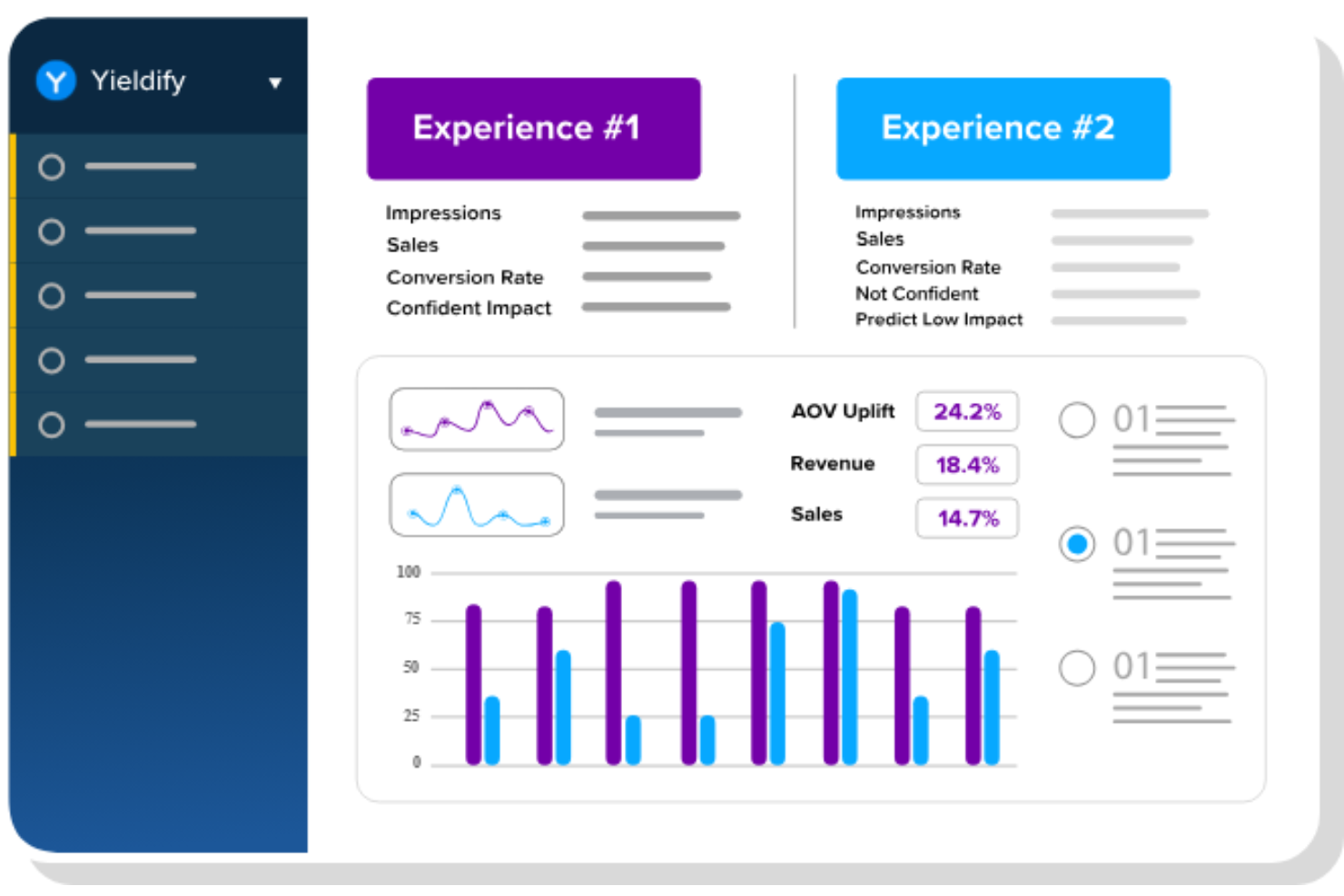
Run multiple test variations simultaneously to optimize messaging, layouts, and offers. This supports faster experimentation and better decision-making across your ecommerce marketing campaigns.
AI-Powered Prediction Engine
Yieldify’s engine analyzes user behavior and metrics to identify winning variations faster, improving campaign performance and lead generation in real-time.
Incremental Control Testing
Measure the true impact of personalization by testing against a control group that sees no changes. This helps you isolate what’s actually driving results.
No-Code Campaign Setup
Launch and manage tests or personalization campaigns without writing code. Marketers can quickly deploy overlays, banners, and messages directly from the platform.
Segmented Targeting
Use behavioral targeting, demographic, and real-time data to create personalized experiences across customer touchpoints.
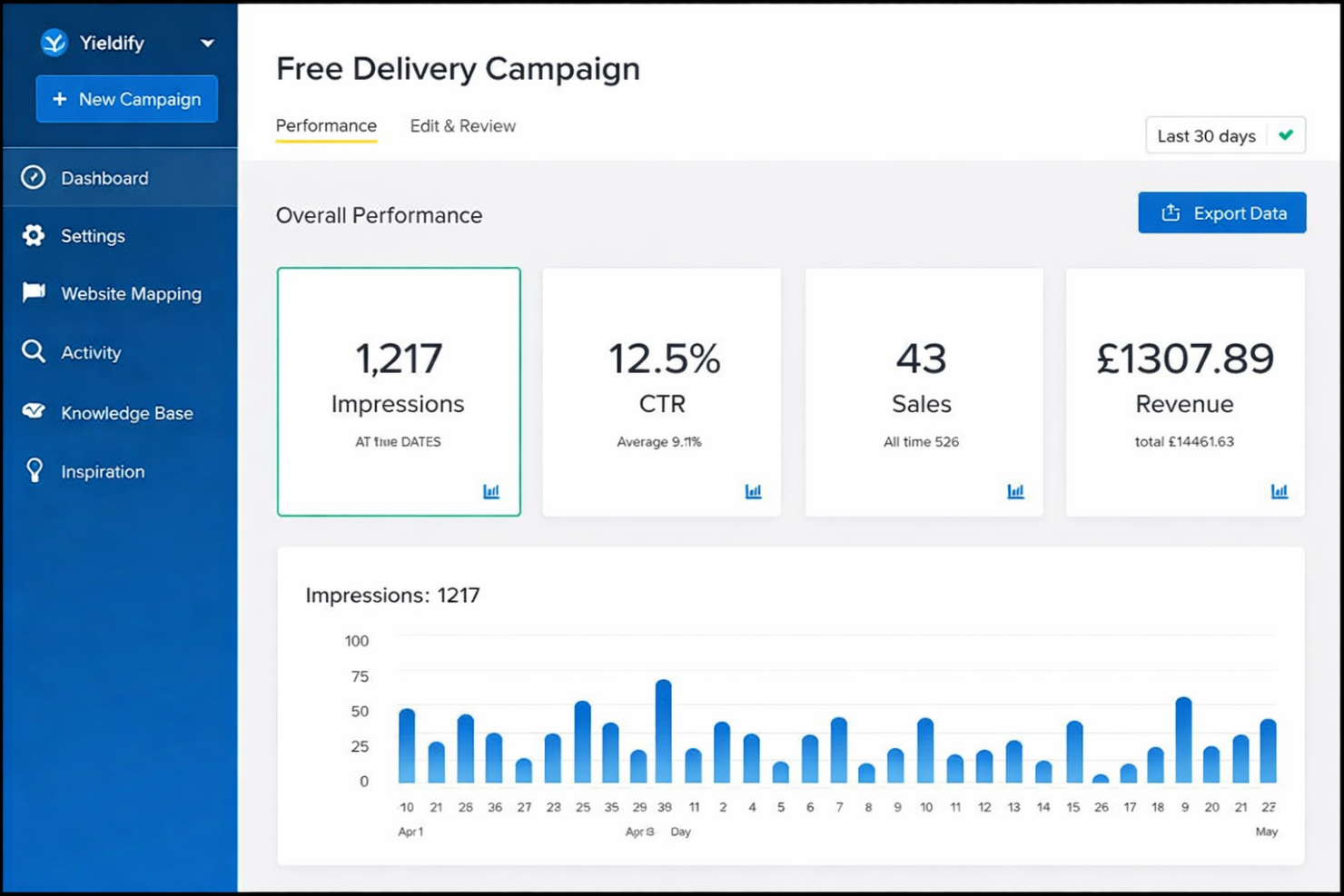
Actionable Performance Insights
Track metrics like conversions, revenue impact, and engagement to refine your strategy continuously.

Ease of Use
Yieldify is built for marketers—not developers. The platform’s interface is clean, intuitive, and designed for quick execution. Teams can launch campaigns using pre-built templates, making it easy to test ideas without technical barriers.
While advanced users may want more functionality, most user reviews highlight Yieldify’s strong ease of use as a key advantage.
Integrations
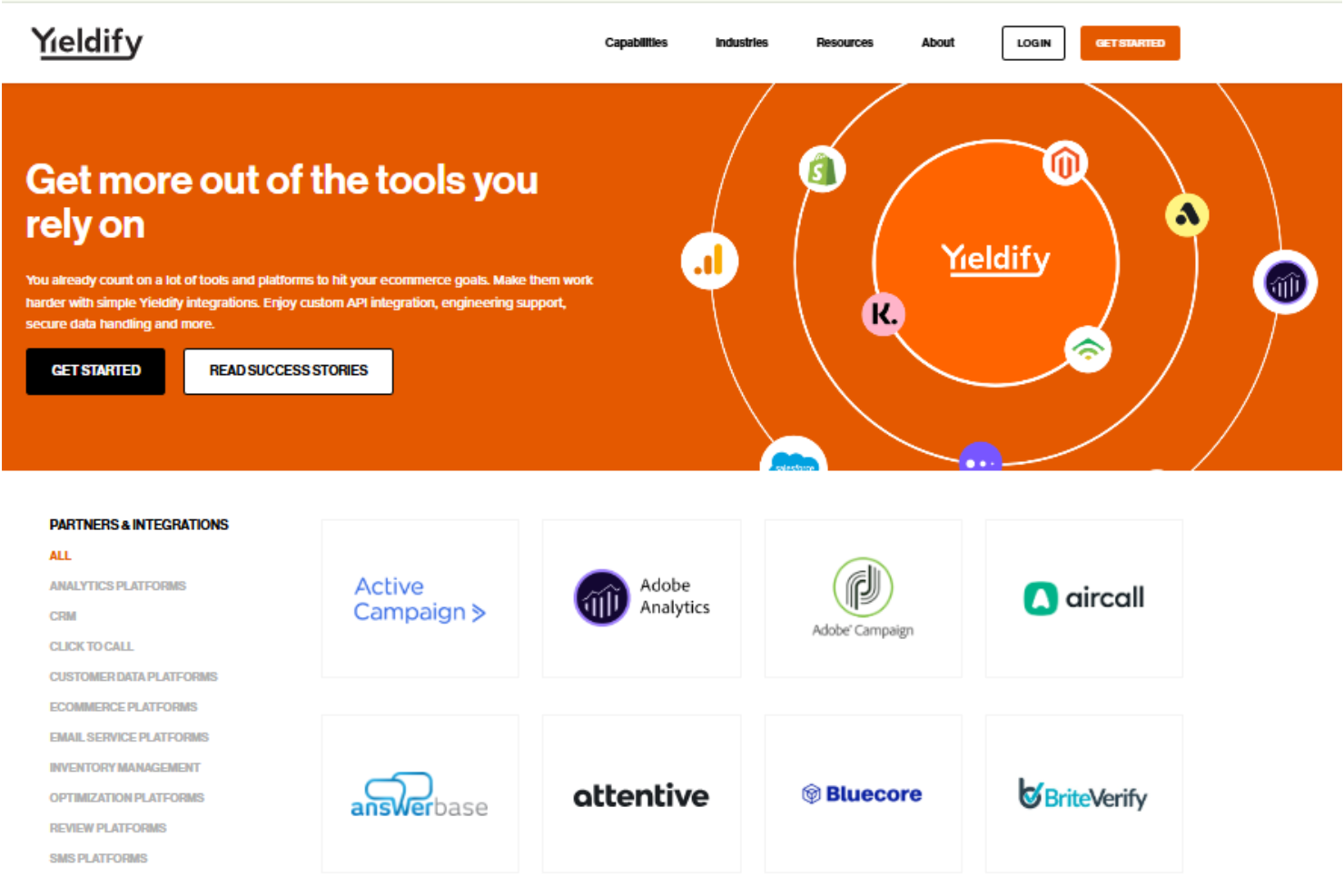
Yieldify integrates with Aircall, Adobe Analytics, HubSpot, Klaviyo, Shopify, ActiveCampaign, and Yotpo, among others.
Yieldify also offers a custom API and supports connections with third-party integration tools.
Yieldify Specs
- A/B Testing
- AI Integration
- Analytics
- API
- Automated Testing
- Bug Tracking
- Campaign Management
- Conversion Tracking
- Custom Reports
- Dashboards
- Data Export
- Data Import
- Data Visualization
- Design Templates
- External Integrations
- Feedback Management
- Form Builder
- History/Version Control
- Multi-Site
- Multi-User
- Notifications
- Performance Testing
- Referral Tracking
- Regression Testing
- Release Management
- Reports
- Scenario Planning
- SEO
- Test Management
- Visualization
- Workflow Management


