


Zendesk vs. Agentforce Service: Comparison & Expert Reviews For 2026



Whether you're supporting hundreds of customers or managing a global service operation, the platform you choose can shape every part of the customer experience. Zendesk and Agentforce Service (formerly Service Cloud) are two leading customer service solutions, offering everything from ticket management and self-service to automation and AI-powered assistance. While both platforms are designed to improve support outcomes, they differ significantly in complexity, customization, and ecosystem fit.
In this article, I’ll give you a side-by-side look at Zendesk and Agentforce Service, including pros and cons, use cases, pricing, security, and how it all feels to use, so you can choose what fits your workflow best.
Zendesk vs. Agentforce Service (formerly Service Cloud): An Overview
Zendesk
Agentforce Service (formerly Service Cloud)


Why Trust Our Software Recommendations
Our team has been testing and reviewing software since 2012. As CX leaders ourselves, we know how difficult—and important—it is to choose the right software.
For this guide, we evaluated tools using hands-on testing and independent research, scoring tools using our selection criteria.
Our reviews reflect our human editorial judgment, not a sales pitch.
Zendesk vs. Agentforce Service (formerly Service Cloud) Pricing Comparison
| Zendesk | Agentforce Service (formerly Service Cloud) | |
|---|---|---|
| Free Trial | 14-day free trial | Free trial available |
| Pricing | From $19/user/month (billed annually) | From $75/user/month |
Zendesk vs. Agentforce Service (Formerly Service Cloud) Pricing & Hidden Costs
Zendesk uses a tiered subscription model with plans that scale based on features, AI capabilities, and the number of agents. As your needs grow, costs can increase through higher-tier plans, add-ons, and expanded functionality. Agentforce Service also uses tiered pricing, but costs are often tied to Salesforce edition upgrades, AI capabilities, Success Plans, and additional Salesforce products or services. Both platforms can become significantly more expensive as organizations expand their support operations and customization requirements.
To find the right fit, start by evaluating your team's current workflows and long-term growth plans. Consider which features are included in each pricing tier, what functionality requires upgrades or add-ons, and whether you'll need implementation support, premium support, or additional integrations. Looking beyond the base subscription price can help you better understand the total cost of ownership and avoid unexpected expenses as your organization scales.
Zendesk vs. Agentforce Service (formerly Service Cloud) Feature Comparison
Zendesk and Agentforce Service share many of the core capabilities organizations expect from modern customer service software. Both platforms offer omnichannel support, case and ticket management, workflow automation, knowledge management, self-service tools, reporting, analytics, and AI-powered assistance. They also support integrations with third-party applications and provide the scalability needed to support growing service teams.
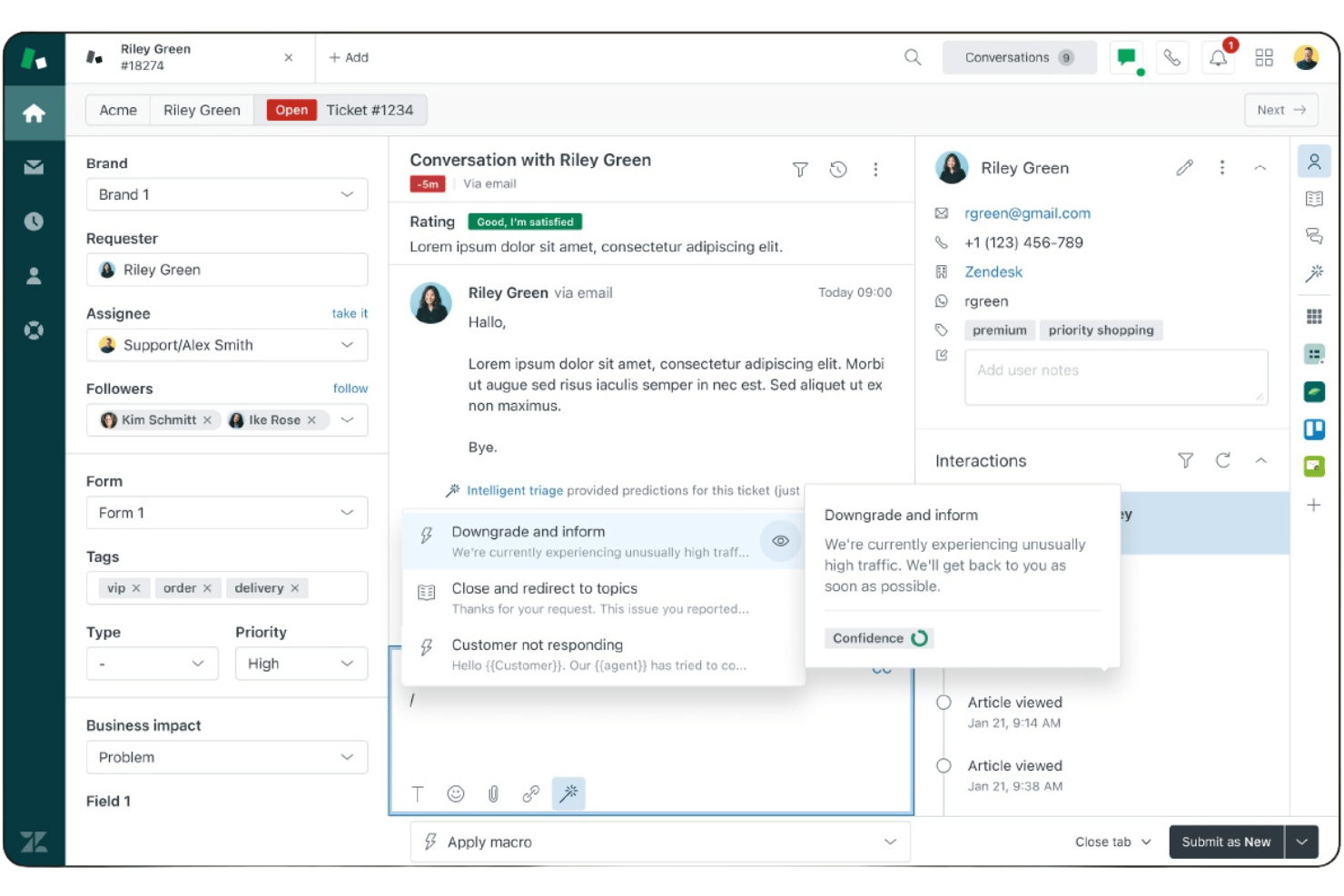
Overall, Zendesk emphasizes fast deployment, a unified agent workspace for managing conversations across channels, AI-powered automation, and self-service tools designed specifically for customer support.
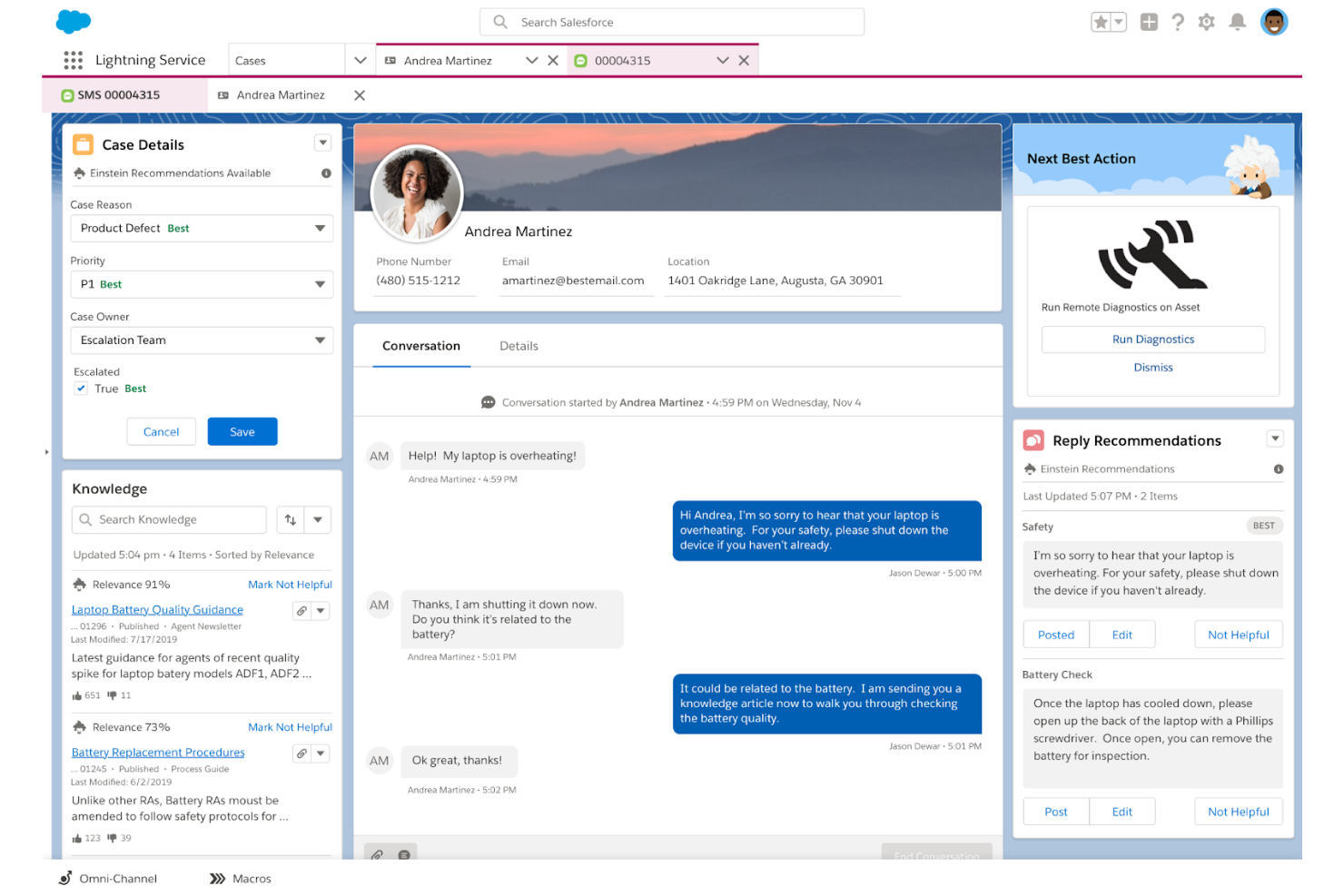
Agentforce Service, on the other hand, differentiates itself through its deep connection to the Salesforce ecosystem, bringing customer data, AI agents, incident management, Slack-based collaboration, and service operations together on a single platform.
| Zendesk | Agentforce Service (formerly Service Cloud) | |
|---|---|---|
| API | ||
| Analytics | ||
| Batch Permissions & Access | ||
| CRM Integration | ||
| Call Integration | ||
| Chat | ||
| Contact Management | ||
| Contact Sharing | ||
| Customer Management | ||
| Customer Service | ||
| Dashboard | ||
| Data Export | ||
| Data Import | ||
| Data Visualization | ||
| Email Integration | ||
| Escalation Management | ||
| External Integrations | ||
| Instant Chat Integration | ||
| Knowledge Base | ||
| Lead Management | ||
| Lead Scoring | ||
| Multi-User | ||
| Notifications | ||
| Real-time Alerts | ||
| Scheduling | ||
| Self-service Portal | ||
| Social Media Integration | ||
| Support Forum | ||
| Third-Party Plugins/Add-Ons | ||
| Ticket Management | ||
| Workflow Management |
Zendesk vs. Agentforce Service (Formerly Service Cloud) Integrations
| Integration | Zendesk | Agentforce Service |
|---|---|---|
| Slack | ✅ | ✅ |
| Microsoft Teams | ✅ | ✅ |
| Jira | ✅ | ✅ |
| Shopify | ✅ | ❌ |
| HubSpot | ✅ | ✅ |
| Salesforce Sales Cloud | ✅ | ✅ |
| Google Workspace | ✅ | ✅ |
| Zoho CRM | ✅ | ❌ |
| QuickBooks | ✅ | ✅ |
| ✅ | ❌ | |
| API | ✅ | ✅ |
| Zapier | ✅ | ✅ |
Zendesk and Agentforce Service cover most of the popular integrations, making it easy for teams who use mainstream apps to connect with their platform of choice. Both offer API and Zapier support, but Zendesk pulls ahead with wider out-of-the-box integration options for ecommerce, finance, and CRM tools, giving you more plug-and-play flexibility if your workflows span multiple systems.
Zendesk vs. Agentforce Service (Formerly Service Cloud) Security, Compliance & Reliability
| Factor | Zendesk | Agentforce Service |
|---|---|---|
| Data Encryption | Encrypts customer data in transit and at rest. | Encrypts customer data in transit and at rest across the Salesforce platform. |
| Compliance | Supports GDPR, SOC 2, ISO 27001, ISO 27701, ISO 27018, PCI DSS, and HIPAA-eligible environments. | Supports GDPR, SOC 2, ISO 27001, ISO 27018, PCI DSS, HIPAA-related controls, and numerous regional compliance frameworks. |
| Uptime & Reliability | Enterprise-grade cloud infrastructure with published service status and uptime commitments. | Enterprise-grade infrastructure backed by Salesforce's global platform and Trust resources. |
| Access Controls | Role-based permissions, SSO, and multi-factor authentication. | Granular permissions, identity management, SSO, and multi-factor authentication. |
| Incident Response | Security monitoring, documented privacy controls, and incident response processes. | Continuous monitoring, security assessments, and documented incident response programs. |
Both Zendesk and Agentforce Service provide the security features most organizations expect from enterprise customer service platforms. In my view, Zendesk offers a strong balance of security and ease of administration, while Agentforce Service benefits from Salesforce's broader compliance portfolio, governance capabilities, and enterprise ecosystem.
For most organizations, either platform should satisfy core security requirements, though heavily regulated enterprises may appreciate the additional compliance resources available through Salesforce.
Zendesk vs. Agentforce Service (Formerly Service Cloud) Ease of Use
| Factor | Zendesk | Agentforce Service |
|---|---|---|
| User Interface | Clean, modern workspace designed for managing customer conversations across channels. | Unified workspace with extensive capabilities, though navigation can feel more complex for new users. |
| Onboarding Process | Guided setup, templates, and documentation help teams get started quickly. | Typically requires more planning and configuration, especially within the broader Salesforce ecosystem. |
| Customization | Flexible no-code configuration with apps, integrations, and APIs for deeper customization. | Extensive customization through Salesforce's platform, automation tools, and ecosystem. |
| Day-to-Day Workflow | Streamlined for customer support teams focused on efficiency and fast resolutions. | Designed for organizations managing complex service operations, CRM data, and cross-functional workflows. |
| Customer Support | Help center, documentation, training resources, and premium support options. | Support resources vary by Success Plan, with Premier and Signature tiers offering additional guidance and support. |
Zendesk is generally easier to learn and deploy, making it a strong choice for teams that want to get up and running quickly (though more advanced setups can still involve complex configuration). Agentforce Service offers greater flexibility and deeper integration with Salesforce products, but that power often comes with additional complexity.
Zendesk vs Agentforce Service (formerly Service Cloud): Pros & Cons
Zendesk
- AI-powered automation helps reduce ticket volume and agent workload.
- Unified workspace for email, chat, voice, social, and messaging.
- Fast deployment with strong out-of-the-box workflows and automation.
- Administration becomes more complex as environments scale.
- Advanced customization may require apps or API development.
- Compliance requirements can require additional configuration effort.
Agentforce Service (formerly Service Cloud)
- Deep Salesforce integration provides unified customer service data.
- Advanced AI automation streamlines service workflows and resolutions.
- Extensive customization supports complex enterprise service operations.
- Higher costs can limit accessibility for smaller teams.
- Implementation often requires significant planning and technical expertise.
- Interface complexity creates a steeper learning curve initially.
Best Use Cases for Zendesk and Agentforce Service (formerly Service Cloud)
Zendesk
- SaaS Customer Success Offers automation, self-service, and analytics to help growing teams improve customer retention and scale support efficiently.
- Retail & Ecommerce Support Delivers omnichannel support across web, messaging, social, and voice to create seamless customer experiences.
- Enterprise Customer Service Operations Supports complex routing, governance, security, and multibrand environments for large-scale customer service organizations.
- Global Support Teams Provides scalable workflows for distributed agents and customers across regions, languages, and support channels.
- IT & Employee Service Desks Automates internal requests and streamlines service delivery processes to improve efficiency and employee satisfaction.
- High-Volume Customer Support Centers Uses AI and automation to improve resolution efficiency while reducing repetitive agent workloads and costs.
Agentforce Service (formerly Service Cloud)
- Salesforce-Centric Organizations Connects customer service, sales, marketing, and customer data within a unified Salesforce ecosystem.
- Enterprise Customer Support Handles high ticket volumes, complex workflows, and large service teams with AI-powered automation.
- Global Operations Supports multilingual service operations, advanced routing, and large-scale customer engagement.
- Retail and Ecommerce Unifies customer interactions across service, sales, commerce, and digital channels.
- Financial Services Supports highly regulated environments with strong security, governance, and customer visibility.
- Healthcare Providers Helps manage complex customer journeys and sensitive communications across multiple channels.
Who Should Use Zendesk, and Who Should Use Agentforce Service?
Zendesk is best for organizations that want a customer service platform that is easy to deploy, straightforward to manage, and capable of scaling as support operations grow. It's a strong fit for startups, small businesses, mid-sized companies, and enterprises that need omnichannel support, AI-powered automation, self-service tools, and a unified workspace for managing customer conversations.
I recommend Zendesk if you prioritize fast time-to-value, efficient agent workflows, flexibility, and scalability without the complexity that often comes with certain enterprise platforms.
On the other hand, Agentforce Service is best for organizations that already use Salesforce or need customer service tightly connected to CRM data, sales processes, and broader business operations. Its advanced customization, AI capabilities, incident management tools, Slack collaboration features, and deep Salesforce ecosystem integration make it particularly well-suited for larger organizations with complex service requirements.
I’d point you to Agentforce Service for enterprises that have the resources to support a more involved implementation and want a highly configurable platform that can serve as part of a larger customer operations strategy.
Differences Between Zendesk and Agentforce Service (formerly Service Cloud)
| Zendesk | Agentforce Service (formerly Service Cloud) | |
|---|---|---|
| Collaboration Tools | Supports collaboration through integrations and shared workflows. | Includes native Slack-based swarming and cross-functional collaboration. |
| Customer Data Access | Integrates with external systems to surface customer context. | Provides native access to Salesforce customer and CRM data. |
| Customization Depth | Flexible configuration through no-code tools, apps, and APIs. | Extensive customization through Salesforce's platform and development tools. |
| Deployment Speed | Known for fast implementation and quick time-to-value because of its modern, streamlined workspace. | Typically involves more of a learning curve and requires more planning, configuration, and ecosystem setup due to a feature-rich interface. |
| Visit ZendeskOpens new window | Read Agentforce Service (formerly Service Cloud) ReviewOpens new window | |
| Integration Ecosystem | Large marketplace with integrations across many third-party business applications. | Deep native integration with Salesforce products and Data Cloud. |
| Routing & Workforce Management | Omnichannel routing and skills-based routing for support teams. | Advanced routing combined with Salesforce workflow and service processes. |
| Visit ZendeskOpens new window | Read Agentforce Service (formerly Service Cloud) ReviewOpens new window |
Similarities Between Zendesk and Agentforce Service (formerly Service Cloud)
| AI-Powered Assistance | Zendesk and Agentforce Service both offer AI capabilities that assist agents, automate interactions, and improve service efficiency. |
|---|---|
| Global Support | Both platforms are designed to support distributed teams, multiple channels, and customer service operations across regions. |
| Omnichannel Support | Both platforms enable teams to manage customer conversations across email, chat, voice, messaging, and other digital channels from a unified workspace. |
| Reporting & Analytics | Zendesk and Agentforce Service provide dashboards, performance metrics, and reporting tools to help teams monitor service quality and operational efficiency. |
| Visit ZendeskOpens new window Read Agentforce Service (formerly Service Cloud) ReviewOpens new window | |
| Self-Service Tools | Each solution includes knowledge management and self-service capabilities that help customers find answers without contacting support. |
| Workflow Automation | Both platforms automate repetitive tasks such as routing, notifications, escalations, and case management workflows. |
| Visit ZendeskOpens new window Read Agentforce Service (formerly Service Cloud) ReviewOpens new window | |