

Managing customer inquiries can be a headache, especially when your ticketing system isn't up to par. If you're finding that the osTicket isn't meeting your needs, you're not alone. Many customer experience managers like you seek solutions that offer better features or fit their specific business needs more closely.
In my experience, choosing the right customer service ticketing system can significantly ease your team's workload and improve response times. I've reviewed and tested various osTicket alternatives to help you find the best fit.
What Is osTicket?
osTicket is a customer service ticketing system designed to manage and track customer inquiries and issues. It's typically used by customer support teams, IT help desks, and service departments that need to handle customer requests efficiently. Features like ticket management, automated workflows, and reporting capabilities help your team stay organized and improve response times. osTicket offers a straightforward solution for managing customer interactions and enhancing your team's efficiency.
Why Look for an osTicket Alternative?
Some users find its interface dated and take effort to install and maintain themselves, which matters when customers see your portal every day or your team has little time for server work. Here’s when another tool might fit better:
- Your customers and agents use the portal daily. Some users find osTicket’s interface dated and its navigation confusing on both the admin and customer sides. Tools like Front offer a user-friendly interface with real-time collaboration, and SupportBee keeps things simple with a shared inbox.
- You want a help desk running without server work. The free edition is self-hosted with community support only, and some users find installation and configuration lengthy, so upgrades and backups are on you unless you pay for hosting. Options like Hesk offer simple setup on a small budget, and SolarWinds Web Help Desk runs in the cloud or on your own servers.
- You report on ticket volume and resolution times. Some users find osTicket’s reporting basic for teams that rely on analytics. Platforms such as Issuetrak offer strong built-in reporting, and InvGate Service Management adds custom dashboards with a large library of metrics.
osTicket is still the right choice if you want a free, open-source help desk you can download and run on your own servers, turning emails into tickets. For budget-conscious IT teams comfortable managing their own setup, that can outweigh an older-style interface and handling upgrades yourself.
Why Trust Our Software Recommendations
6,700+
Reviews
20
Industry experts
16+
Evaluation factors
14
Years reviewing software
Our team has been testing and reviewing software since 2012. As CX leaders ourselves, we know how difficult—and important—it is to choose the right software.
For this guide, we evaluated tools using hands-on testing and independent research, scoring tools using our selection criteria.
Our reviews reflect our human editorial judgment, not a sales pitch.
 Gui DrusinaCreative Director
 Tim FisherVP of AI
osTicket Alternatives Comparison Table
This comparison table summarizes pricing details for my top osTicket alternative selections:
Score legend (out of 5)
- Excellent4.5–5
- Good4–4.4
- Average3–3.9
- Below average2–2.9
- Poor1–1.9
Sorted by: Default
| Tool | Starting Price | Website | |||||||
|---|---|---|---|---|---|---|---|---|---|
Best for account-centric B2B support | 4.0 out of 5 | 5 | 4 | 4 | 4 | 3 | 4 | $32/user/month Free trial + demo available | Website |
Best for support across affiliated brands | 3.8 out of 5 | 4 | 4 | 4 | 4 | 3 | 4 | $12/user/month 30-day free trial available | Website |
Best for in-product customer guidance | 3.8 out of 5 | 4 | 4 | 4 | 4 | 3 | 4 | $29/seat/month 14-day free trial + free demo available | Website |
Best for self-hosting or cloud deployment | 4.0 out of 5 | 4 | 4 | 5 | 4 | 3 | 4 | $9/user/month Free plan + free demo available | Website |
Best for support-to-engineering handoffs | 4.0 out of 5 | 5 | 4 | 4 | 3 | 4 | 4 | $21.50/user/month Free plan + 14-day trial available | Website |
Best for self-hosted osTicket migration | 3.8 out of 5 | 4 | 4 | 4 | 4 | 3 | 4 | $29/month Free demo available | Website |
Best for choosing hosted or self-hosted support | 4.0 out of 5 | 4 | 4 | 5 | 3 | 4 | 4 | €7/user/month 30-day free trial | Website |
Best for moving from self-hosted ticketing | 4.0 out of 5 | 4 | 4 | 4 | 4 | 4 | 4 | $25/user/month 7-day free trial + free demo available | Book Demo |
Best for ecommerce order support | 3.8 out of 5 | 4 | 4 | 5 | 3 | 3 | 4 | $25/user/month Free plan + 15-day free trial + free demo available | Website |
Best for human and AI agent oversight | 4.0 out of 5 | 4 | 4 | 4 | 4 | 4 | 4 | $75/user/month Free trial available | Website |


Best osTicket Alternatives Reviews
Below are my detailed summaries of the best osTicket alternatives that made it onto my shortlist. My reviews offer a detailed look at the key features, pros & cons, integrations, and ideal use cases of each tool to help you find the best one for you.
 Best for account-centric B2B support
- Free trial + demo available
- From $32/user/month (billed annually)
Visit WebsiteCustomer Rating:4.8/5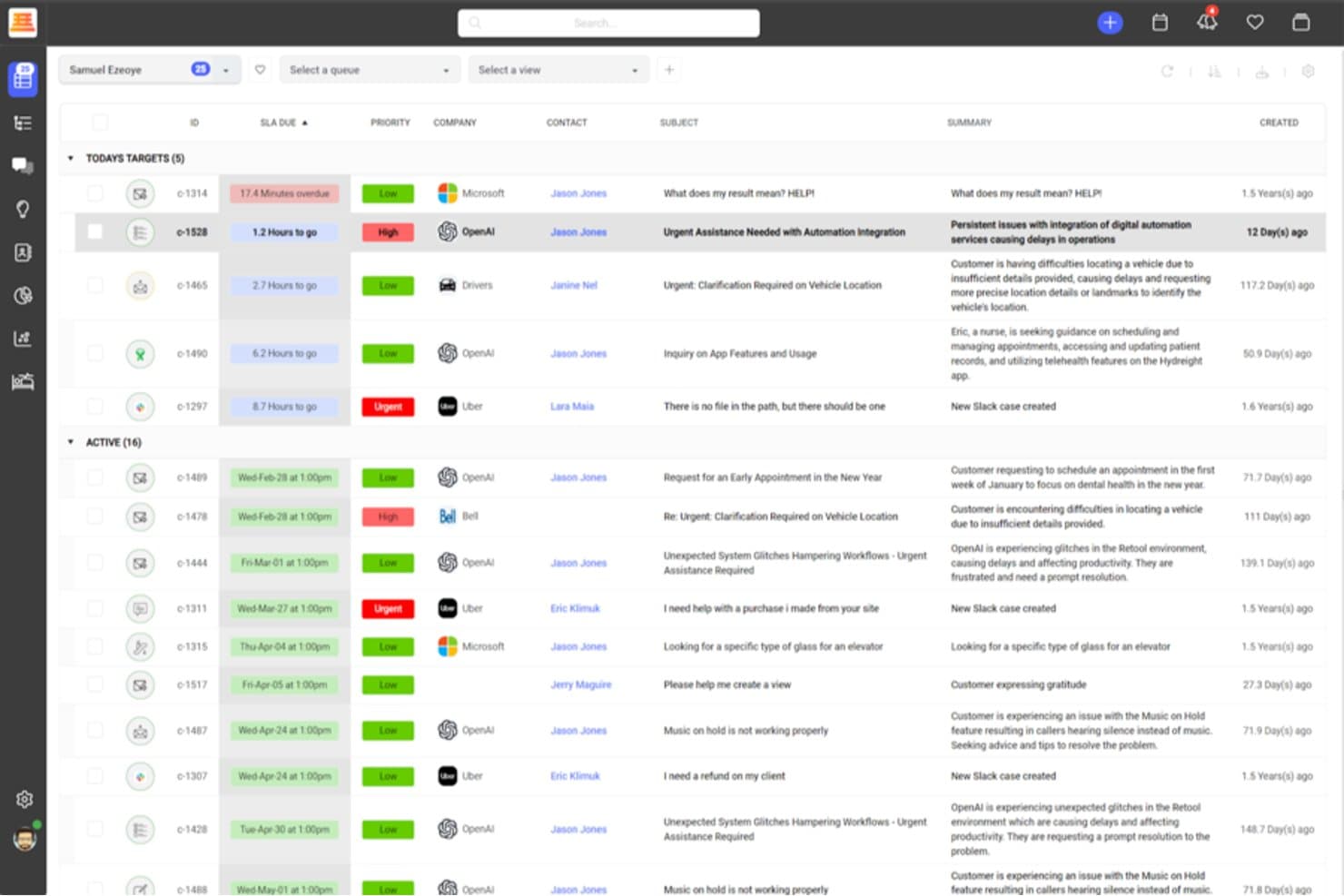
Supportbench's ticket queue showing SLA deadlines, priority levels, and customer details for active support cases. Supportbench is a B2B customer support platform that brings together ticket management, dynamic SLAs, health scoring, and AI-assisted case handling in one workspace—making it a strong fit for support teams managing complex, account-driven relationships.
Who Is Supportbench Best For?
Supportbench is a strong fit for B2B support teams that manage complex, account-driven relationships and need deep customer context, dynamic SLAs, and performance visibility in one place.
Why I Picked Supportbench
I picked Supportbench as one of the best osTicket alternatives because it's purpose-built for B2B support teams managing accounts, not just tickets. I love how dynamic SLAs pull in data from the company, contact, or asset record, so a high-value account automatically gets different response commitments than a standard one. Pair that with health scoring that tracks account-level interaction history, and my team can spot at-risk customers before they escalate.
Supportbench Key Features
- AI-generated case summaries: Automatically condenses long case conversations into concise summaries for faster agent handoffs and context reviews.
- Multi-level escalation paths: Configures Tier 1, Tier 2, and Tier 3 escalation routes with structured templates and a full audit trail.
- KCS knowledge workflows: Lets agents search, capture, improve, and publish articles directly from active cases without leaving the workspace.
- 35+ KPI scorecards: Tracks agent, team, and customer performance against configurable targets using real-time dashboards and customizable views.
Supportbench Integrations
Supportbench offers native integrations with Salesforce, HubSpot, Jira, Azure DevOps, Slack, Microsoft Teams, RingCentral, and Intercom. It also supports REST API access, account webhooks, BI service endpoints, MCP, and Zapier for custom connectivity.
Pros and Cons
Pros:
- SLA rules prioritize high-value customer cases
- Dashboards make team performance easier to monitor
- Account histories add context to every ticket
Cons:
- Routing rules take extra setup and testing
- Reporting filters and exports can feel clunky
Learn more about Supportbench: Best for support across affiliated brands
- 30-day free trial available
- From $12/user/month (billed annually)
Visit WebsiteCustomer Rating:4.6/5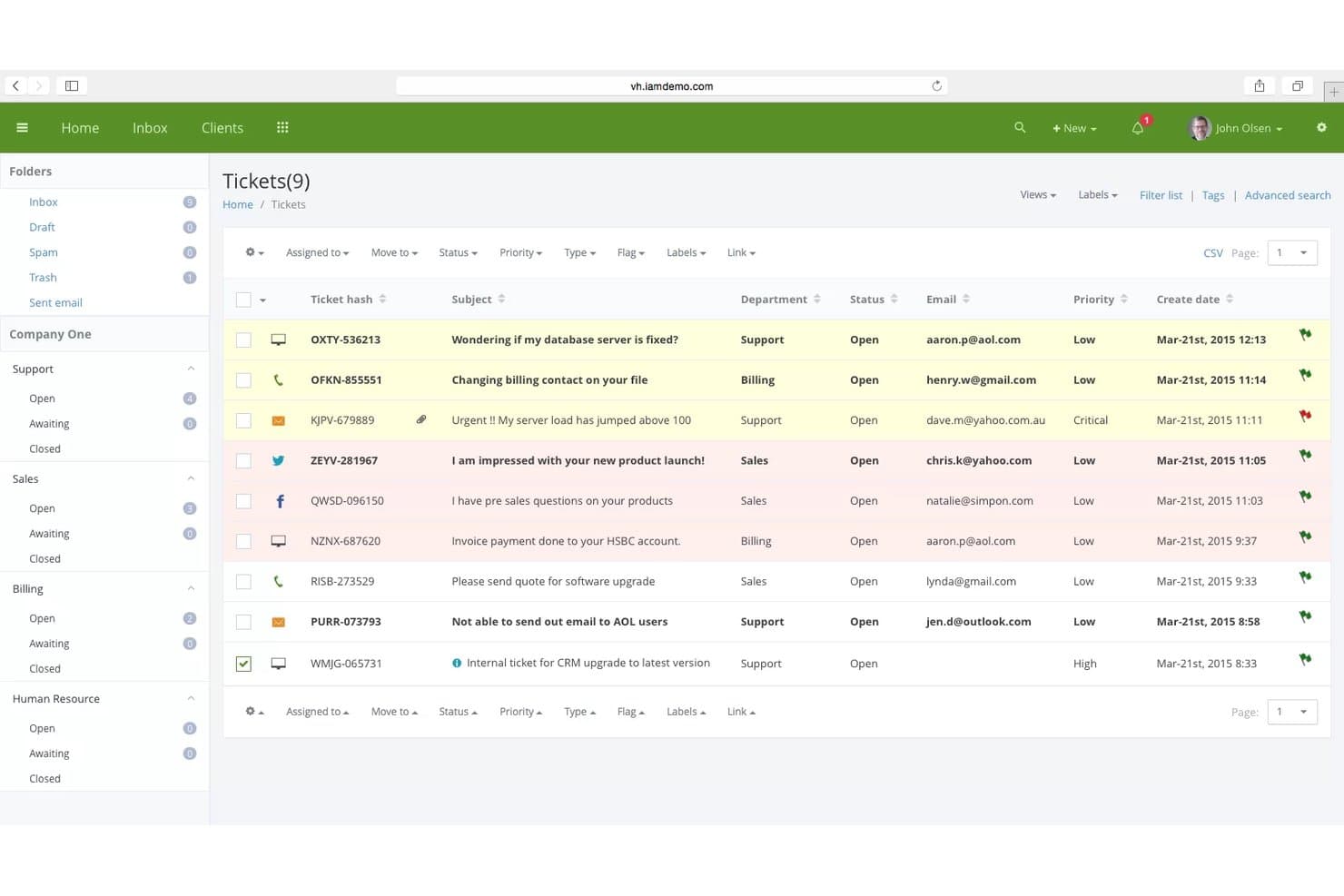
Vision Helpdesk ticket list showing open tickets, priorities, departments, and folder navigation. Vision Helpdesk's Satellite Help Desk is a multi-company support platform built for teams that need to run separate, branded customer portals for different companies or products from a single staff workspace.
Who Is Vision Helpdesk Best For?
Vision Helpdesk's Satellite Help Desk is a strong fit for support teams managing customer-facing operations across multiple brands, subsidiaries, or affiliated companies from a single staff workspace.
Why I Picked Vision Helpdesk
I picked Vision Helpdesk because it's purpose-built for teams running support across multiple brands or subsidiaries from a single staff workspace. The Satellite Help Desk lets you give each company its own branded customer portal, knowledge base, logo, and design while your agents work from one shared inbox. You can also set separate SLAs, business hours, and time zones per company, so a reseller supporting five different clients can enforce distinct response commitments for each without blending their data.
Vision Helpdesk Key Features
- Multi-channel ticket intake: Converts email, phone, chat, Facebook, Twitter, and web requests into tickets in a shared team inbox.
- Multilevel ticket escalation: Automatically escalates tickets when SLA thresholds aren't met, using configurable rules tied to events and criteria.
- Custom survey forms: Sends customers a rating option when a ticket closes and lets you build custom feedback forms with per-client or per-survey reporting.
- REST API: Supports ticket and client operations including creating, retrieving, updating, deleting, searching, and tagging tickets programmatically.
Vision Helpdesk Integrations
Vision Helpdesk lists integrations with Microsoft 365, Microsoft Exchange, Active Directory, Google Hosted Emails, WordPress, WHMCS, SugarCRM, Twilio, Facebook, and Twitter. Its REST API supports custom ticket and client integrations.
Pros and Cons
Pros:
- Reviewers praise SLA reporting and customization
- Per-company SLAs keep commitments distinct
- Separate branded portals for each company
Cons:
- Users report slowdowns at high ticket volumes
- Reviewers describe the interface as dated
Learn more about Vision Helpdesk: Best for in-product customer guidance
- 14-day free trial + free demo available
- From $29/seat/month (billed annually)
Visit WebsiteCustomer Rating:4.4/5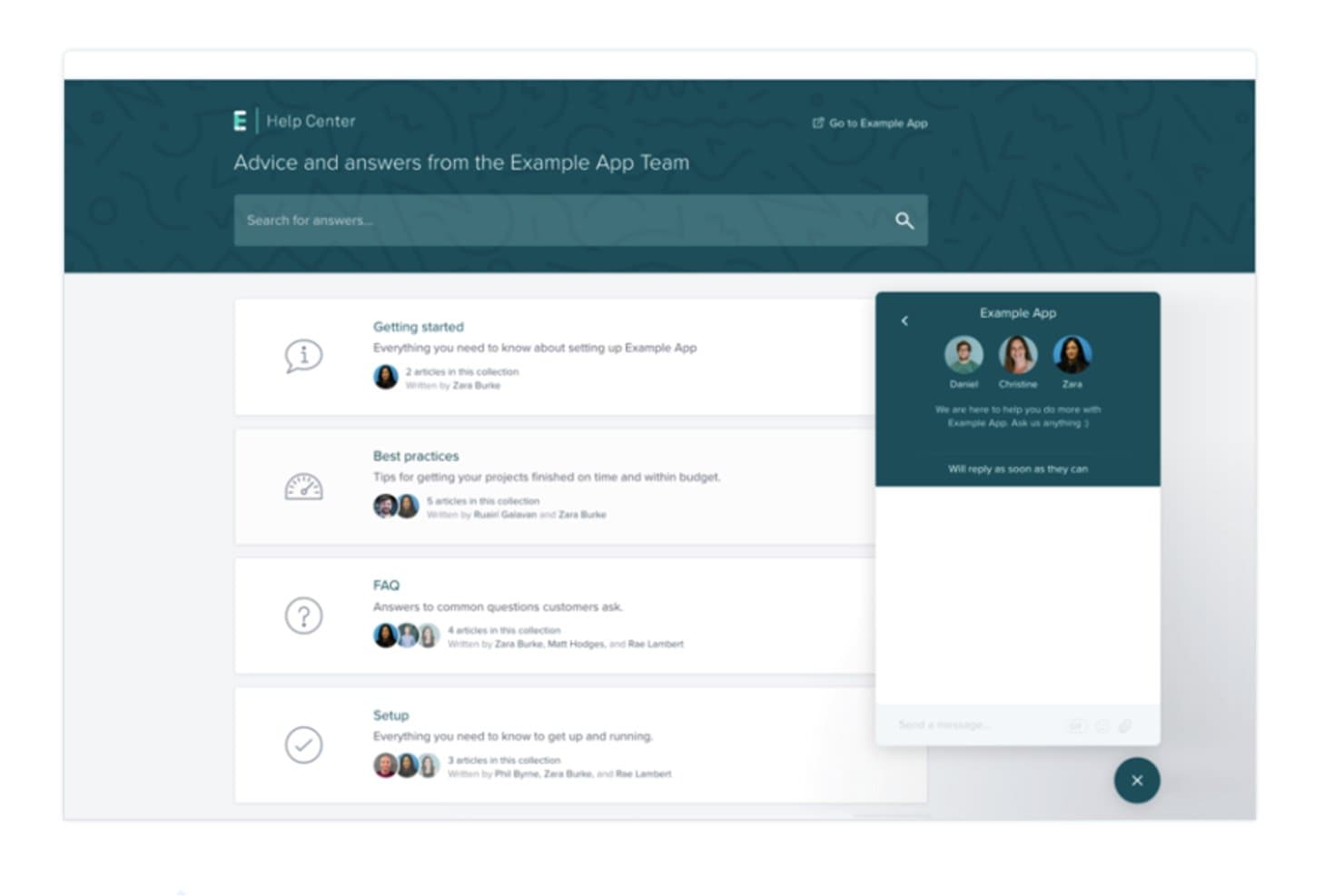
Intercom's Help Center and messenger let teams publish guides and chat with customers in one place. Intercom is a customer service platform that blends a shared inbox, AI-powered ticketing, and in-product messaging tools, making it a strong fit for product-led businesses that want to handle support, automate workflows, and guide customers through their product experience in one place.
Who Is Intercom Best For?
Intercom is a strong fit for product-led companies and small-to-mid-sized teams that want to combine customer support ticketing with in-product messaging and AI-assisted guidance in one platform.
Why I Picked Intercom
I picked Intercom as one of the best because it goes beyond basic ticketing to actually guide customers through your product, something osTicket simply can't do. I love how Product Tours and in-app tooltips let my team deliver contextual onboarding right inside the product, so customers get help exactly when and where they need it. Fin, Intercom's AI agent, can triage incoming conversations and autofill ticket details without teammate input, cutting down on manual work significantly.
Intercom Key Features
- Omnichannel shared inbox: Routes email, live chat, SMS, WhatsApp, Instagram, Facebook, Slack, and Discord conversations into a single workspace.
- Customer portal: Gives customers a self-serve view to track, reply to, and raise tickets associated with their company.
- No-code workflow builder: A visual builder that automates conversation routing, ticket creation, team assignment, and tagging across channels.
- Custom ticket types and attributes: Teams can define ticket categories with custom fields, states, and required attributes for structured intake.
Intercom Integrations
Intercom lists 450+ apps or integrations, including Salesforce, HubSpot, Jira Cloud, WhatsApp, Slack, Stripe, and Zapier. It also provides REST APIs, webhooks, and SDKs for custom integrations.
Pros and Cons
Pros:
- Back-office tickets retain customer context
- Product tours add contextual onboarding guidance
- Reviewers value time-saving support workflows
Cons:
- No asset or change-management modules
- Reviewers report setup friction and weak onboarding
 Best for self-hosting or cloud deployment
- Free plan + free demo available
- From $9/user/month
Visit WebsiteCustomer Rating:4.5/5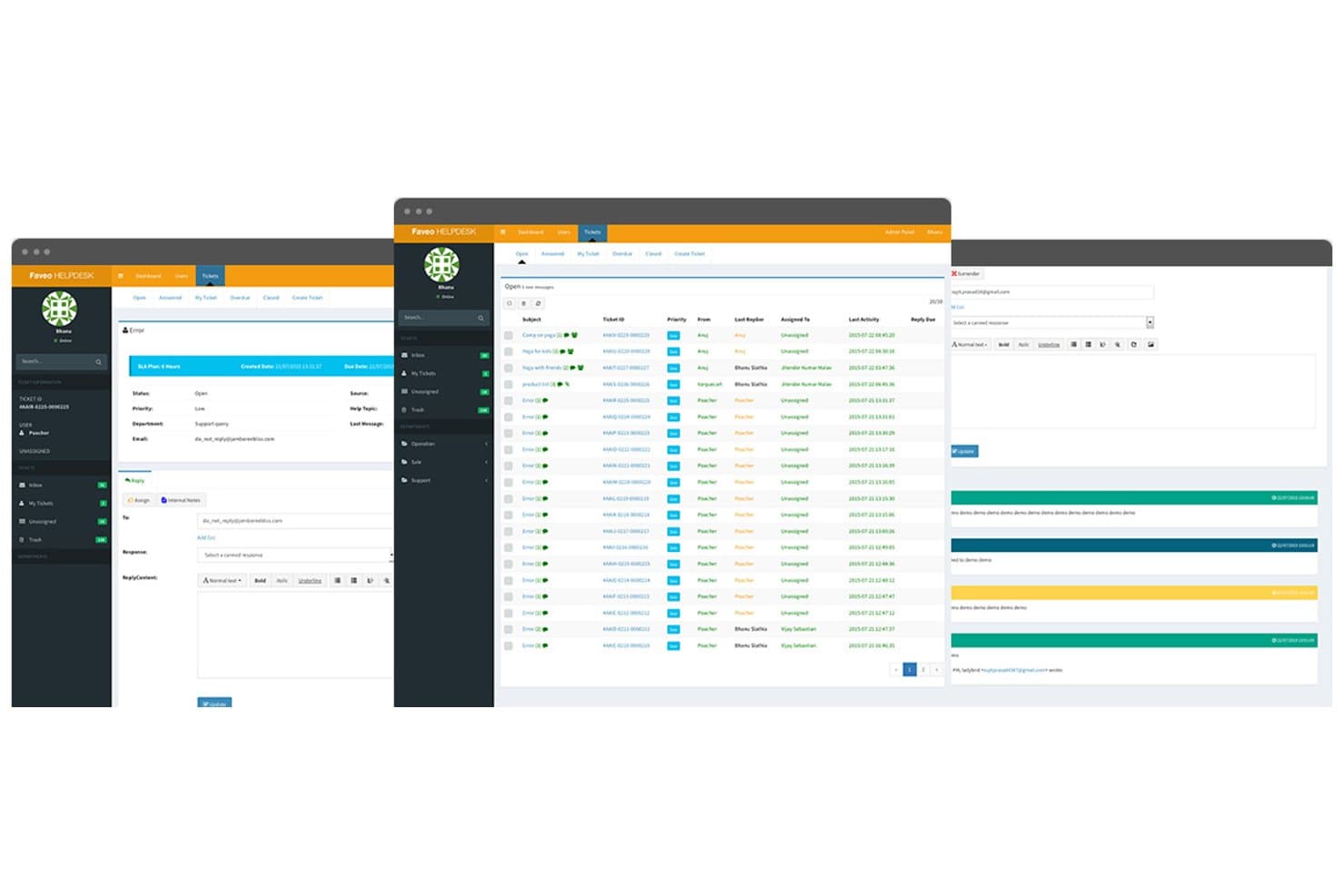
Faveo Helpdesk ticket list and reply screens for managing open support requests. Faveo Helpdesk is an open-source ticketing system that suits teams wanting full control over their support infrastructure, with multichannel intake, workflow automation, SLA management, and a built-in knowledge base.
Who Is Faveo Helpdesk Best For?
Faveo Helpdesk is a strong fit for IT teams and small businesses that want the flexibility to self-host their support system or deploy in the cloud.
Why I Picked Faveo Helpdesk
I picked Faveo Helpdesk because it gives you a genuine choice between self-hosting on your own servers or going cloud-based, which is exactly what teams moving away from osTicket are looking for. I appreciate that the self-hosted path is fully documented, with clear hardware requirements and support for Windows, Ubuntu, and other Linux distributions. The on-premise option doesn't cut corners on features either: you still get multichannel intake across email, WhatsApp, and social channels, plus SLA policies and round-robin routing.
Faveo Helpdesk Key Features
- Omnichannel ticket intake: Consolidates messages from email, WhatsApp, Facebook, Instagram, LINE, SMS, and phone calls into a single ticketing queue.
- SLA policies with escalation: Lets you set SLA rules at the product, group, or company level, with automated reminders and escalation emails when deadlines are at risk.
- Custom ticket forms and fields: Supports dynamic forms with dependent fields and custom statuses so your team captures the right information at intake.
- CSAT surveys and reporting: Sends customizable satisfaction surveys and surfaces results alongside agent performance and ticket-volume data in built-in dashboards.
Faveo Helpdesk Integrations
Faveo Helpdesk lists native integrations with WhatsApp Business, Facebook, Instagram, LINE, Microsoft Teams, Slack, Jira, GitHub, and 3CX. It also offers API access, an extendable API, webhooks, and listeners for custom connections.
Pros and Cons
Pros:
- Useful dashboards expose agent performance
- Centralize customer and internal support tickets
- Choose self-hosted or cloud deployment
Cons:
- Department changes may leave tickets unassigned
- Initial forms and department setup confuses teams
Learn more about Faveo Helpdesk: Best for support-to-engineering handoffs
- Free plan + 14-day trial available
- From $21.50/user/month
Visit WebsiteCustomer Rating:4/5
Jira Service Management displays all open tickets in a prioritized queue. Jira Service Management is Atlassian's ITSM platform built for IT and support teams that need to manage service requests, incidents, and change workflows alongside their engineering and development work.
Who Is Jira Service Management Best For?
IT and support teams that work closely with engineering and development will get the most out of Jira Service Management, thanks to its deep Atlassian ecosystem integration.
Why I Picked Jira Service Management
I picked Jira Service Management because it's the only osTicket alternative built specifically for support-to-engineering handoffs, letting my team link a customer-facing service ticket directly to a Jira Software issue so developers get full context without a single copy-paste. When a support request uncovers a bug, I can escalate it into a tracked work item, loop in the engineering team, and keep the original requester updated, all from one queue. The built-in incident and change management workflows mean my team isn't stitching together separate tools when something breaks in production.
Jira Service Management Key Features
- Asset and configuration management: Track hardware, software licenses, and service dependencies directly alongside your support tickets.
- Multi-channel request intake: Capture requests from email, a customer portal, Slack, Microsoft Teams, and embedded widgets into a single queue.
- CSAT surveys: Automatically send customer satisfaction surveys when a ticket is resolved and collect feedback via email or Slack.
- Multiple help centers: Create up to 300 individually branded help centers for different audiences from one Jira Service Management site.
Jira Service Management Integrations
Jira Service Management integrates with Slack and Microsoft Teams for request intake and agent collaboration. It also supports Twilio integrations, Atlassian tools such as Jira Software and Confluence, and a REST API for custom connections.
Pros and Cons
Pros:
- Multiple intake channels feed shared queues
- Asset records add context to IT tickets
- Configurable SLAs help prioritize service requests
Cons:
- Reporting offers limited dashboard flexibility
- Workflow setup demands administrator time
Learn more about Jira Service Management:
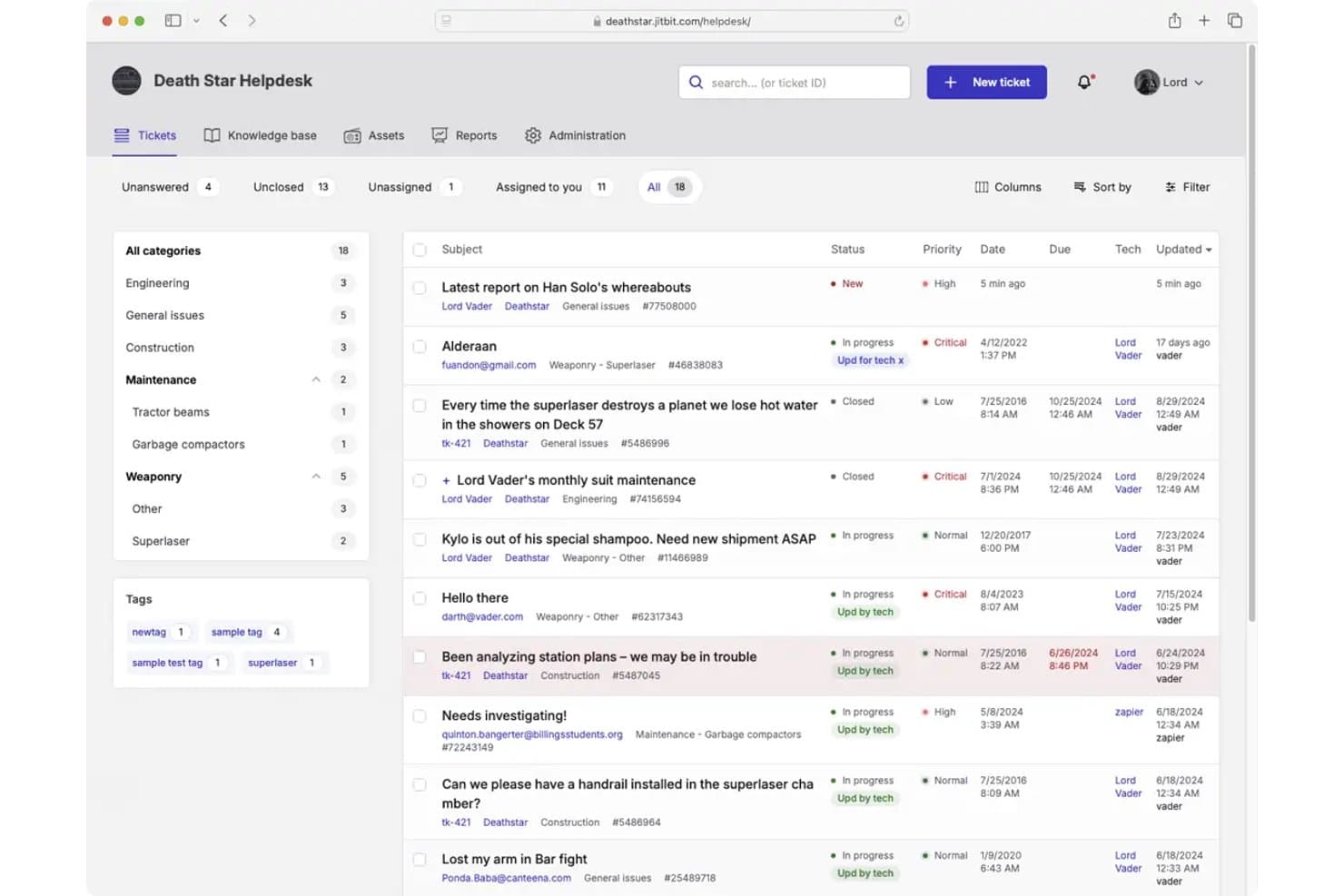
Jitbit helpdesk ticket list with status, priority, and technician columns for managing support requests. Jitbit Helpdesk is a self-hosted ticketing system that converts incoming email and other support requests into trackable tickets, making it a practical fit for IT teams and small businesses that want full control over their data without trading away automation, SLA management, or a built-in knowledge base.
Who Is Jitbit Best For?
Jitbit is a strong fit for IT teams and small businesses that want a self-hosted ticketing system with a one-time price and no recurring SaaS fees.
Why I Picked Jitbit
I picked Jitbit as one of the best because it's the only self-hosted option on this list that actively supports osTicket migration, with the vendor's team helping you move your data for free via CSV exports and API scripts. What I appreciate most is that your ticket history, categories, and custom fields all transfer over, and you stay on your own server with a perpetual license rather than locking into a SaaS subscription. The automation rules, SLA management, and asset tracking carry forward everything osTicket users rely on day-to-day.
Jitbit Key Features
- Multi-condition automation rules: Set up trigger-based rules with nested IF/else logic to automatically assign, escalate, or update tickets based on content, sender, timing, or channel.
- Asset tracking: Track hardware and software assets, link them to users or tickets, and view the full incident history for each asset.
- Built-in knowledge base: Create searchable, categorized public or private help articles with permissions, popularity reporting, and article suggestions shown while users type a ticket subject.
- Reporting suite: Access filterable reports covering ticket volume, response times, SLA compliance, technician performance, and customer satisfaction, with export to Excel or CSV.
Jitbit Integrations
Jitbit has documented native integrations with Jira, Slack, Microsoft Teams, WhatsApp, Power BI, Lansweeper, and Snipe-IT. Its REST API supports custom integrations, and Zapier is also available.
Pros and Cons
Pros:
- Free osTicket migration assistance
- Rules route tickets by content
- Email requests become trackable tickets
Cons:
- Self-hosting requires SQL and web-server skills
- Migration may require CSV or API scripts
Learn more about Jitbit: Best for choosing hosted or self-hosted support
- 30-day free trial
- From €7/user/month
Visit WebsiteCustomer Rating:4.5/5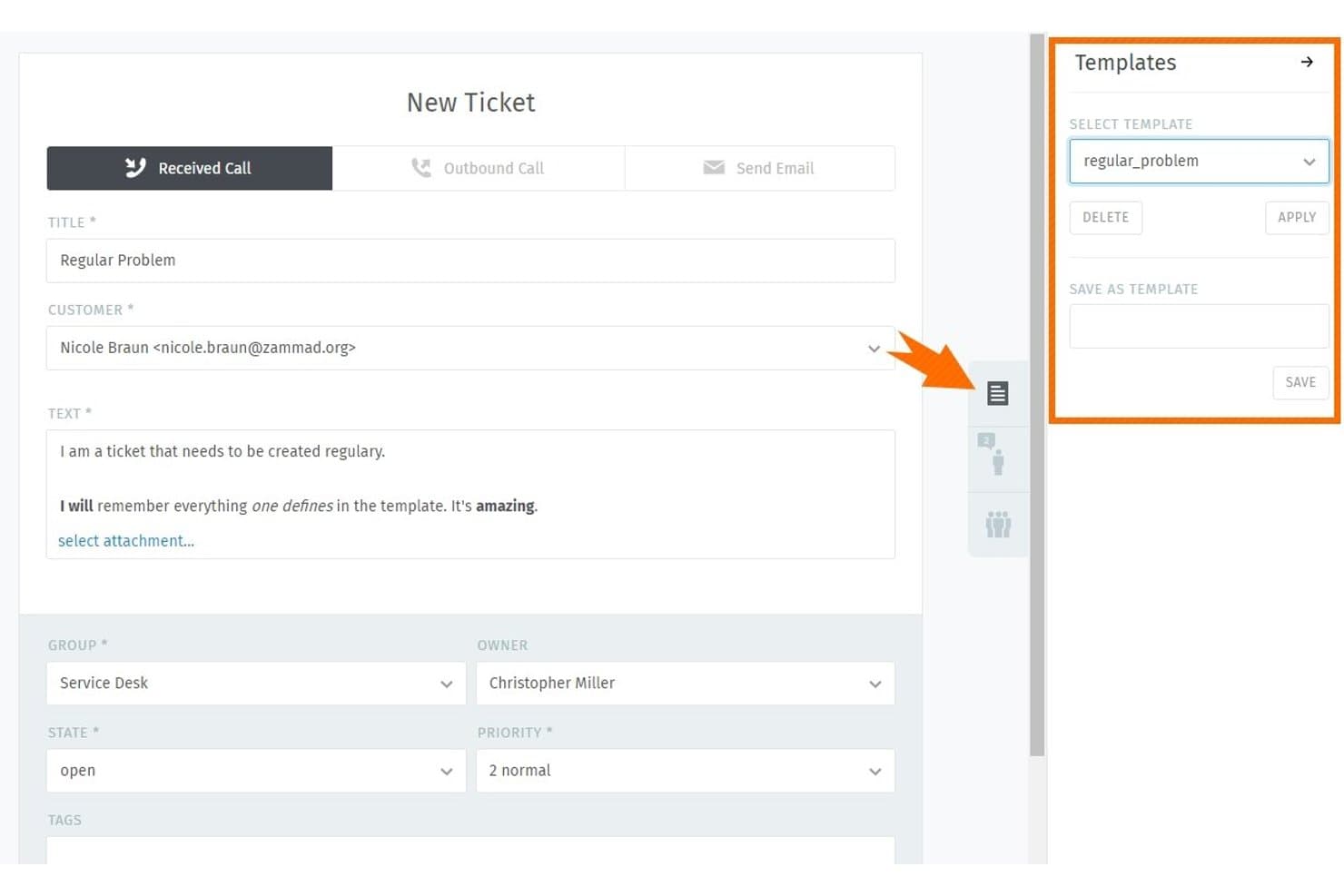
Zammad's Templates panel lets agents select, apply, delete or save ticket templates directly from a new ticket form. Zammad is an open-source helpdesk that lets support teams manage customer and internal requests across email, chat, SMS, and social channels—with the flexibility to run it on the cloud or self-host it entirely.
Who Is Zammad Best For?
Zammad suits IT and support teams that want the flexibility to self-host their helpdesk or move to the cloud without losing access to open-source customization.
Why I Picked Zammad
I picked Zammad as one of the best because it's the only tool on this list that genuinely lets you choose between a fully managed cloud setup and a self-hosted open-source deployment without losing core functionality. I appreciate that you can run it on your own infrastructure with full control, then switch to hosted later if your team's IT capacity changes. The Core Workflows feature lets administrators control exactly which ticket fields each team sees, keeping complex multi-team setups clean and manageable.
Zammad Key Features
- Multi-channel ticket intake: Agents receive and manage requests from email, web forms, SMS, chat, Telegram, Facebook, and WhatsApp in one unified queue.
- SLA management: Teams can define response and resolution time targets, with automatic escalation when thresholds are breached.
- AI ticket summary: AI condenses long ticket threads into an overview of customer intent, open questions, and recommended next steps.
- LDAP integration: Administrators can centralize user and rights management, with roles and permissions assigned automatically based on directory data.
Zammad Integrations
Native integrations include LDAP, Microsoft 365, Microsoft Teams, GitHub, GitLab, Grafana, Kibana, WhatsApp Business, Telegram, and Facebook. Zammad also supports REST API connections and webhooks for custom integrations.
Pros and Cons
Pros:
- Mobile interface and configurable ticket objects
- Email and chat share ticket context
- Hosted or self-hosted deployment choice
Cons:
- Historical imports can lose attachments
- Custom reporting takes extra effort
Learn more about Zammad: Best for moving from self-hosted ticketing
- 7-day free trial + free demo available
- From $25/user/month (billed annually)
Customer Rating:4.7/5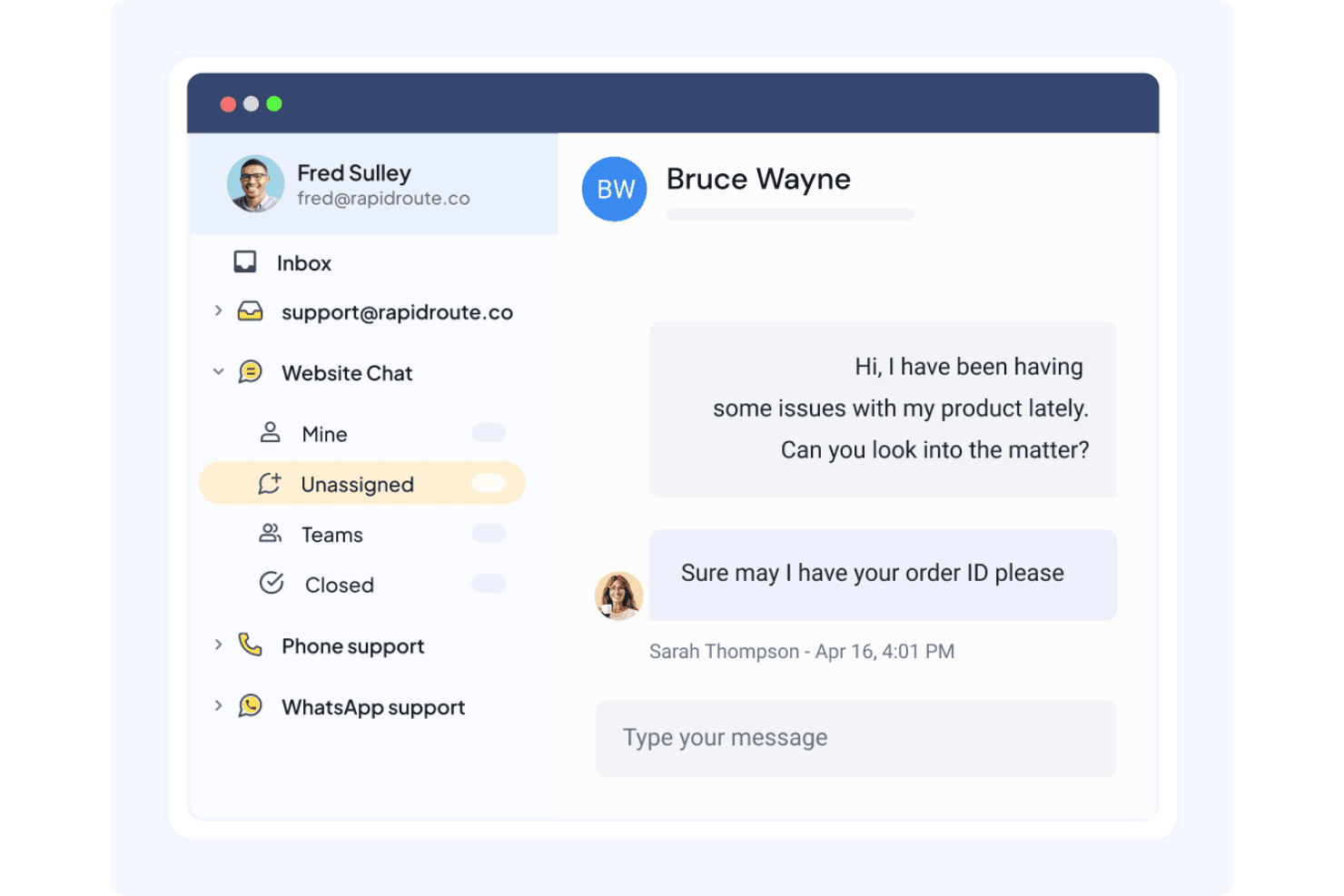
Hiver interface showing a unified inbox where support agents can manage website chat conversations, including an unassigned message thread and an active customer exchange. Hiver is a cloud-based customer support platform that brings email, chat, voice, and WhatsApp into shared inboxes, making it a practical fit for support and IT teams that want AI-powered triage, ticket ownership, and automation without managing their own infrastructure.
Who Is Hiver Best For?
Hiver is a strong fit for small to mid-sized support and IT teams that want a fully hosted, AI-ready platform without the overhead of maintaining their own infrastructure.
Why I Picked Hiver
I picked Hiver as one of the best because it's purpose-built for teams leaving self-hosted setups like osTicket behind, with Hiver handling all the infrastructure so you never touch a server again. I love how AI Agents can triage incoming requests, detect sentiment, apply tags, and auto-close routine replies without any manual sorting. Shared Inboxes with Collision Detection mean no two agents accidentally work the same ticket, which is exactly the kind of coordination gap that plagues teams migrating from osTicket.
Hiver Key Features
- SLA policies: Set first-response and resolution time targets per Shared Inbox, with automated alerts for approaching or missed deadlines.
- CSAT surveys: Automatically trigger customer satisfaction surveys after interactions and review results through dedicated reporting dashboards.
- Skill-based routing: Assign incoming conversations to teammates based on their defined skills to match requests with the right agent.
- Customer portal: Let customers submit, track, and reply to their own requests through a branded self-service portal.
Hiver Integrations
Hiver offers 100+ out-of-the-box integrations, including native Salesforce, HubSpot, Jira, Asana, Slack, Shopify, and PagerDuty integrations. API access and webhooks are available, with Zapier also supported.
Pros and Cons
Pros:
- Cloud hosting removes server maintenance
- Shared ownership helps prevent duplicate replies
- AI triage reduces manual sorting
Cons:
- Email syncing can lag under volume
- Reports don’t consolidate across inboxes
Learn more about Hiver: Best for ecommerce order support
- Free plan + 15-day free trial + free demo available
- From $25/user/month (billed annually)
Visit WebsiteCustomer Rating:4.5/5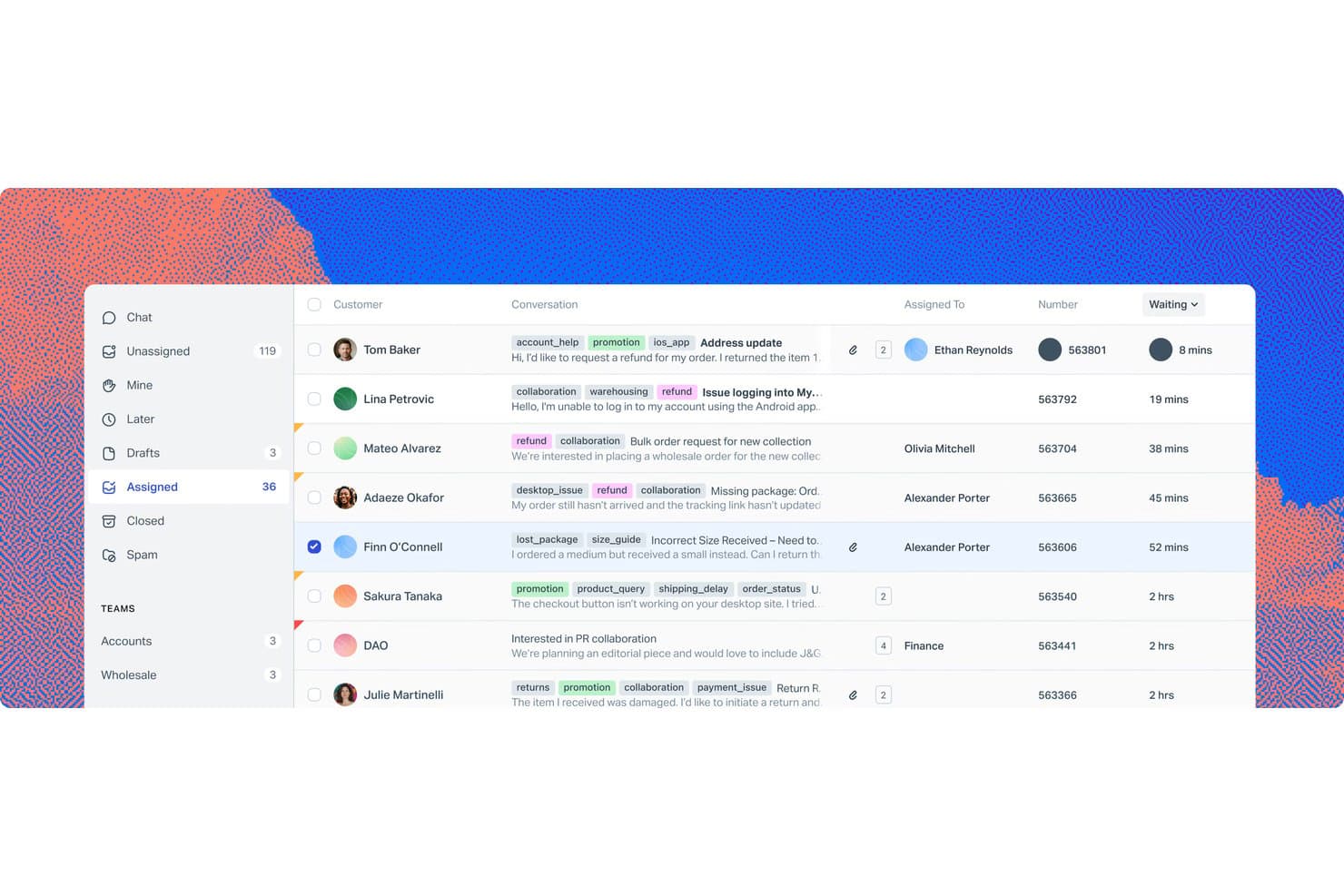
Help Scout's shared inbox lists customer conversations with tags, assignees and waiting times. Help Scout is a customer support platform that centralizes email, live chat, SMS, and social conversations in one shared inbox—making it a natural fit for growing support teams that need cleaner handoffs, automated routing, and built-in self-service tools without the complexity of enterprise ticketing systems.
Who Is Help Scout Best For?
Help Scout is a strong fit for ecommerce support teams that handle high volumes of order-related inquiries across email, chat, and social channels.
Why I Picked Help Scout
I picked Help Scout as one of the best because it handles ecommerce order support in a way that keeps everything in one place. The Shopify integration pulls order status and refund options directly into the conversation, so my team isn't switching between tabs to resolve a simple "where's my order" ticket. Pairing that with multi-condition workflows that auto-route by customer property or channel means order inquiries get to the right person fast.
Help Scout Key Features
- Collision detection: Shows agents when a teammate is already viewing or replying to the same conversation, preventing duplicate responses.
- Customer Portal: Gives customers an authenticated space to view and manage their support history, with company-level visibility settings.
- Email satisfaction ratings: Lets customers rate individual replies and leave comments, with results feeding directly into the Happiness report.
- SLA policies: Sets first-response and time-to-resolution targets, measurable in calendar or office hours, with escalation actions when targets are missed.
Help Scout Integrations
Help Scout offers 113 marketplace integrations, including Shopify, Salesforce, HubSpot, Jira, Aircall, Slack, and Zapier. Its Inbox, Chat, and Docs APIs, webhooks, and custom apps support custom integrations.
Pros and Cons
Pros:
- Automated routing supports condition-based triage
- Collision alerts help prevent duplicate replies
- Clear customer conversations with assignment and handoffs
Cons:
- Complex routing rules can feel restrictive
- Reporting offers limited metric customization
Learn more about Help Scout: Best for human and AI agent oversight
- Free trial available
- From $75/user/month
Visit WebsiteCustomer Rating:4.4/5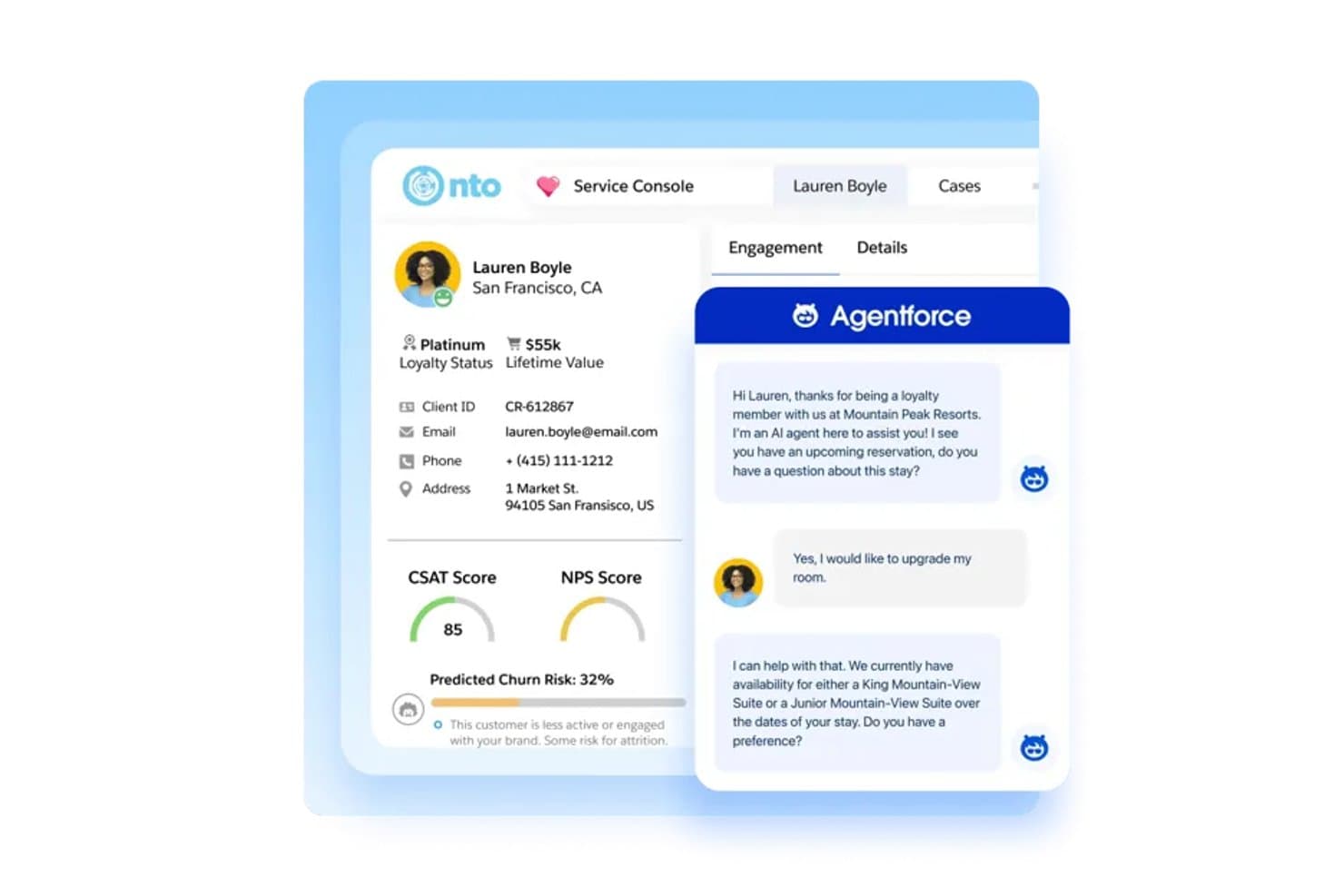
Agentforce in the Service Console handles a room upgrade request alongside the customer's loyalty and churn data. Agentforce Service (formerly Service Cloud) is Salesforce's customer service platform that brings together case management, AI-powered assistance, and multi-channel support to help growing teams handle higher volumes without sacrificing the quality of every customer interaction.
Who Is Agentforce Service Best For?
Agentforce Service is a strong fit for growing customer service teams that need to manage AI agents and human reps from a single command center—without losing visibility into either.
Why I Picked Agentforce Service (formerly Service Cloud)
I picked Agentforce Service because it's one of the few platforms that gives you a real-time command center for watching both human reps and AI agents side by side. The Service Command Center surfaces live conversations, handoff moments, and performance trends so nothing slips through unnoticed. I also appreciate that when an AI agent hits its limit, it escalates to a rep with full context already loaded, so customers never have to repeat themselves.
Agentforce Service Key Features
- Omni-Channel routing: Automatically directs incoming cases from email, chat, SMS, WhatsApp, and other channels to the right queue or rep based on skills and availability.
- Flow Builder automation: Lets you build multi-step case workflows—like auto-responses, escalations, and SLA triggers—with up to unlimited flows on paid tiers.
- Slack swarming: Enables reps to pull in subject-matter experts from a Slack channel directly tied to an open case, without losing case context.
- Service Command Center: Gives supervisors a real-time dashboard to monitor live conversations, track trends, and manage handoffs between reps and AI agents.
Agentforce Service Integrations
Agentforce Service has documented native integrations with Slack, Outlook, and Gmail. It also supports REST, GraphQL, SOAP, platform-event, and streaming APIs, plus integrations with Jira, QuickBooks, DocuSign, Mailchimp, Dropbox, and ActiveCampaign.
Pros and Cons
Pros:
- Keeps customer history alongside every case
- Routes cases by skills and availability
- Monitors human and AI-agent handoffs live
Cons:
- Complex workflows demand ongoing admin expertise
- osTicket migrations require manual data preparation
Learn more about Agentforce Service (formerly Service Cloud):
Other osTicket Alternatives
Here are some additional osTicket alternatives that didn’t make it onto my shortlist, but are still worth checking out:
- 11FreshserviceBest for separate employee and client portals
- 12TeamSupportBest for support-led B2B account management
- 13HappyFoxBest for guided osTicket migrations
- 14KayakoBest for keeping help content current with AI
- 15LiveAgentBest for AI ticket triage on every plan
- 16GLPIBest for entity-based IT request catalogs
- 17InvGate Service ManagementBest for IT ticket prioritization
- 18ManageEngine ServiceDesk PlusBest for cloud or on-premises deployment
- 19ServiceNowBest for partner and cross-team case handling
- 20FrontBest for linking support to project work
- 21FreshdeskBest for turning CSAT into ticket follow-ups
- 22HelpSpotBest for uncapped tickets with agent pricing
- 23HelpDeskBest for support with HIPAA and SOC 2
- 24ZendeskBest for automating support across systems
- 25Zoho DeskBest for multilingual customer help centers
- 26ChatwootBest for self-service and agent handoff
- 27UvdeskBest for support performance tracking
- 28FreeScoutBest for self-hosted support with local AI
- 29Request TrackerBest for cross-department service desks
How I Evaluate osTicket Alternatives
I split my evaluation into three parts. Core functionality carries the most weight—I look for tools that can log tickets from multiple channels and route them reliably to the right team. I then consider standout features like AI-powered triage, and I check migration support and pricing structure beyond the feature set.
Core Functionality (Table Stakes For This List)
When I'm selecting tools for my list, I score each one on a scale from 0 (does not offer the functionality) to 5 (excels in this area) for each core functionality listed below. I then convert the total into a percentage to help assess each tool's overall fit, with extra weight on any functionalities I’ve deemed essential.
- Ticket Management (Essential): I look for clear ticket statuses, useful fields, and tags that help teams track requests from intake through resolution.
- Multi-Channel Intake (Essential): I assess how email, web forms, chat, and other supported channels feed into one queue, keeping customer requests easy to find.
- Automation & Routing: I check whether rules can assign or escalate tickets by topic, priority, or team, such as routing a billing issue to the right group.
- Knowledge Base & Self-Service: I look for searchable, organized help content and whether customers can find relevant articles while submitting a request.
- Reporting & Analytics: I assess whether teams can review ticket volume, resolution times, and agent activity to spot backlogs and service trends.
- Agent Collaboration: I check for internal notes, teammate mentions, and handoffs that help agents coordinate on requests needing input from other teams.
Once I have a list of tools that meet the criteria, I consider what sets each platform apart.
Differentiating Factors (What Sets Vendors Apart)
Here's how I compare and contrast different vendors:
Standout Features
I look for AI-powered ticket triage that goes beyond basic routing—tools that auto-categorize, summarize, and suggest replies help agents handle spikes without sacrificing quality. A no-code workflow builder matters just as much, since CX leads need to adjust escalation paths or approval chains without waiting on a developer. I also check for dual portals that let teams run separate branded self-service sites for internal staff and external customers from one system.
Beyond Features
I check whether a vendor offers guided migration tools or import templates for ticket history and contacts, since moving off a self-hosted system like osTicket can stall a team for days without them. Integration depth matters too—native connections to CRMs, chat platforms, and collaboration tools like Slack keep ticketing tied to your broader service workflow instead of siloed. I also evaluate how pricing scales with headcount and whether key capabilities like automation or reporting are gated behind higher tiers.
osTicket Alternative Key Features
Here are some of the key features of osTicket to help you contrast and compare what alternative solutions offer:
- Ticket management: Your team can easily organize and track customer inquiries from start to finish.
- Automated workflows: Automate repetitive tasks to save time and reduce manual errors.
- Customizable fields: Tailor the ticket forms to capture the specific information your team needs.
- Multi-channel support: Handle customer interactions from emails, web forms, and more in one place.
- Reporting tools: Generate detailed reports to gain insights into your team's performance.
- Knowledge base: Provide customers with self-service options to find answers on their own.
- Email integration: Keep all customer communications centralized directly within the system.
- Priority management: Ensure urgent issues are addressed promptly by setting ticket priorities.
- User-friendly interface: Navigate the system with ease, reducing the learning curve for your team.
- Security features: Protect sensitive customer data with built-in security measures. It looks like your message might have been cut off. Could you please provide more details or let me know how I can assist you further?