

30 Best AI Helpdesk Software Reviewed in 2026

10 Best AI Helpdesk Software Shortlist


The best AI helpdesk software helps support and IT teams automate routine inquiries, reduce response times, and deliver faster, more consistent customer service. With AI handling tasks like routing, summarization, and answering repetitive questions, your team can stay focused on higher-value issues and more complex conversations.
Drawing on my experience evaluating CX and IT service platforms—and tracking how AI is reshaping modern support workflows—I’ve tested and reviewed the top AI helpdesk tools used today. Each platform in this guide was assessed for its automation depth, ticketing capabilities, AI accuracy, integrations, usability, and overall value. Below, you’ll find my shortlist, insights on where each tool excels, and what to consider when choosing the right AI helpdesk for your team.
Why Trust Our Software Reviews
We’ve been testing and reviewing customer experience software since 2020. As customer experience managers ourselves, we know how critical and difficult it is to make the right decision when selecting software. We invest in deep research to help our audience make better software purchasing decisions.
We’ve tested more than 2,000 tools for different customer experience use cases and written over 1,000 comprehensive software reviews. Learn how we stay transparent & check out our software review methodology.
Best AI Helpdesk Software Summary
This comparison chart summarizes pricing details for my top AI helpdesk software selections to help you find the best one for your budget and business needs.
| Tool | Best For | Trial Info | Price | ||
|---|---|---|---|---|---|
| 1 | Best AI-first help desk | 14-day free trial | Pricing upon request | Website | |
| 2 | Best for domain-specific AI automation | 14-day free trial available | From $19/user/month (billed annually) | Website | |
| 3 | Best for IT support | 14-day free trial + free demo available | From $19/agent/month (billed annually) | Website | |
| 4 | Best for AI-driven task automation | 30-day free trial + free demo available | From $149/technician/month (billed annually) | Website | |
| 5 | Best for small teams | Free plan + free trial available | From $25/user/month (billed annually) | Website | |
| 6 | Best for unified ecommerce inbox management | 14-day free trial | From $39/agent/month | Website | |
| 7 | Best for smart escalations | Free plan available | From $32/month (billed annually) | Website | |
| 8 | Best for ecommerce integration | Free trial + free plan available | From $24.17/month (billed annually) | Website | |
| 9 | Best for automating customer interactions | 14-day free trial available | From $16/user/month (billed annually) | Website | |
| 10 | Best for collaborative inbox management | 30-day free trial + free plan available + free demo available | From $14/user/month (billed annually) | Website |


-

Freshdesk
Visit WebsiteThis is an aggregated rating for this tool including ratings from Crozdesk users and ratings from other sites.4.4 -
Tidio
Visit WebsiteThis is an aggregated rating for this tool including ratings from Crozdesk users and ratings from other sites.4.7 -
SupportYourApp
Visit WebsiteThis is an aggregated rating for this tool including ratings from Crozdesk users and ratings from other sites.4.7


Best AI Helpdesk Software Review
Below are my detailed summaries of the best AI helpdesk software that made it onto my shortlist. My reviews offer a detailed look at the key features, pros & cons, integrations, and ideal use cases of each tool to help you find the best one for you.

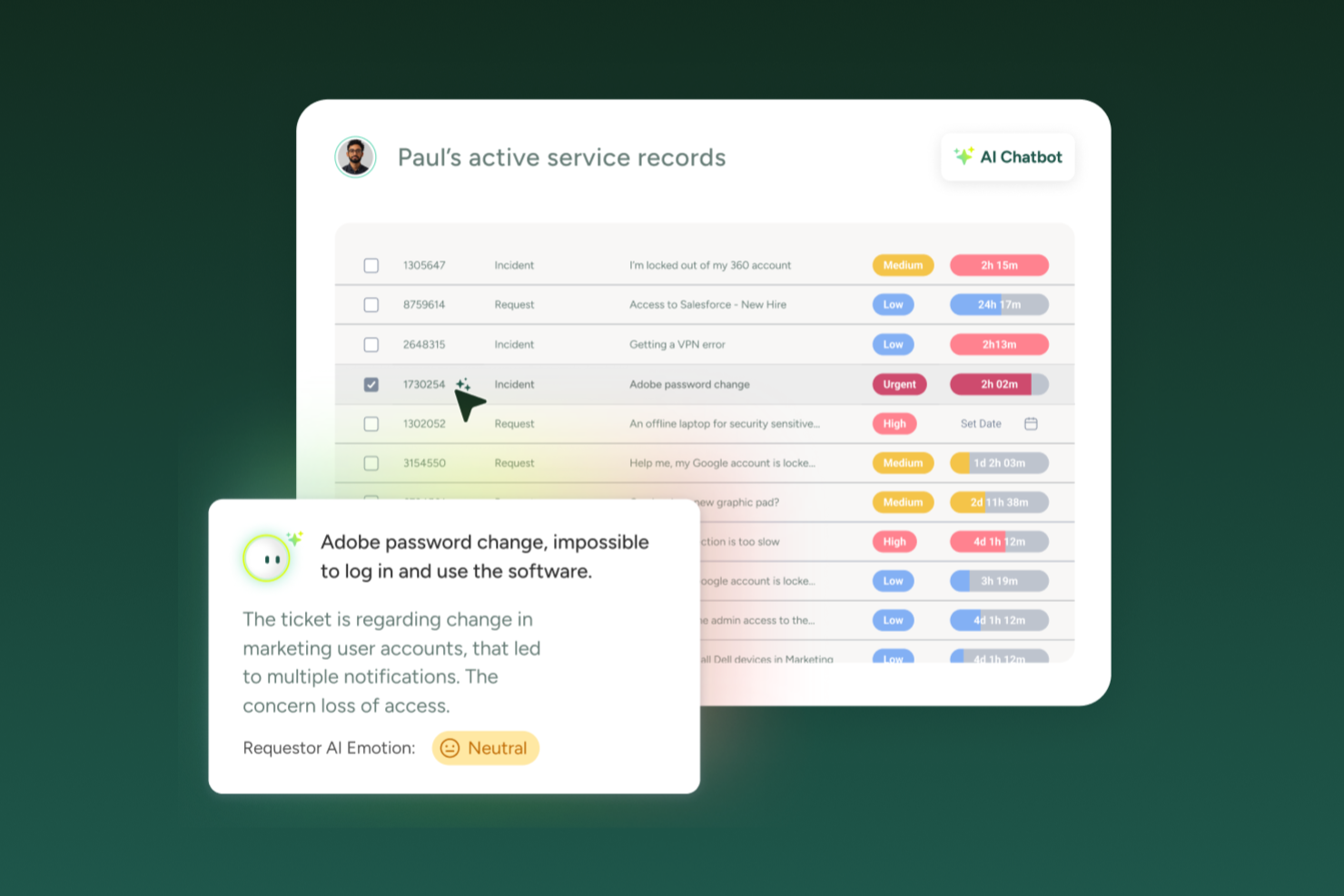
SysAid provides an AI-supported service desk designed to reduce the workload on IT teams by embedding automation and AI assistance into existing workflows. Its Copilot capabilities extend across chat, email, and the self-service portal, allowing users to submit requests, ask questions, or resolve common issues without directly contacting the IT team.
Why I Picked SysAid
I picked SysAid for this list because its Copilot features support more than just conversational intake. SysAid’s AI tools help capture issues submitted through Microsoft Teams, email, or the self-service portal and convert them into structured service requests. Automation then supports ticket categorization, prioritization, and assignment based on predefined rules, which reduces manual triage for agents. On the agent side, Copilot tools can summarize ticket histories and highlight relevant context from past cases, helping teams respond more efficiently without searching through prior records.
SysAid Key Features
In addition to its AI capabilities, SysAid offers a range of features that enhance its functionality as an AI helpdesk software.
- Incident and Request Management: Manage and resolve IT incidents and service requests effectively to ensure smooth operations.
- Asset Management: Keep track of your IT assets, including hardware and software, to optimize resource allocation and maintenance.
- Visual workflow designer: Your team can model approval flows, escalations, and cross-department processes with a drag-and-drop workflow builder rather than custom scripts.
- Security and Compliance: Ensure your IT operations adhere to industry standards and maintain robust security practices.
SysAid Integrations
SysAid supports a wide range of integrations through native connectors, APIs, and integration platforms. Common integrations include Microsoft Teams, Slack, Salesforce, Google Workspace, Microsoft 365, Azure services, Amazon services, ServiceNow, HubSpot, and Zendesk.
Pros and Cons
Pros:
- Real-time chat feature aids immediate issue resolution.
- Offers a self-service portal for enhanced user independence.
- Ticket automation categorizes and assigns incidents with minimal human triage.
Cons:
- Email notifications sometimes behave inconsistently, causing confusion for senders.
- Automation and routing configuration can be time-consuming for complex environments.
New Product Updates from SysAid

SysAid Adds Direct Knowledge Base Linking in Service Records
SysAid now allows linking knowledge base articles directly to service records, enhancing centralized access to information and speeding up issue resolution. For more information, visit SysAid's official site.
 .
.
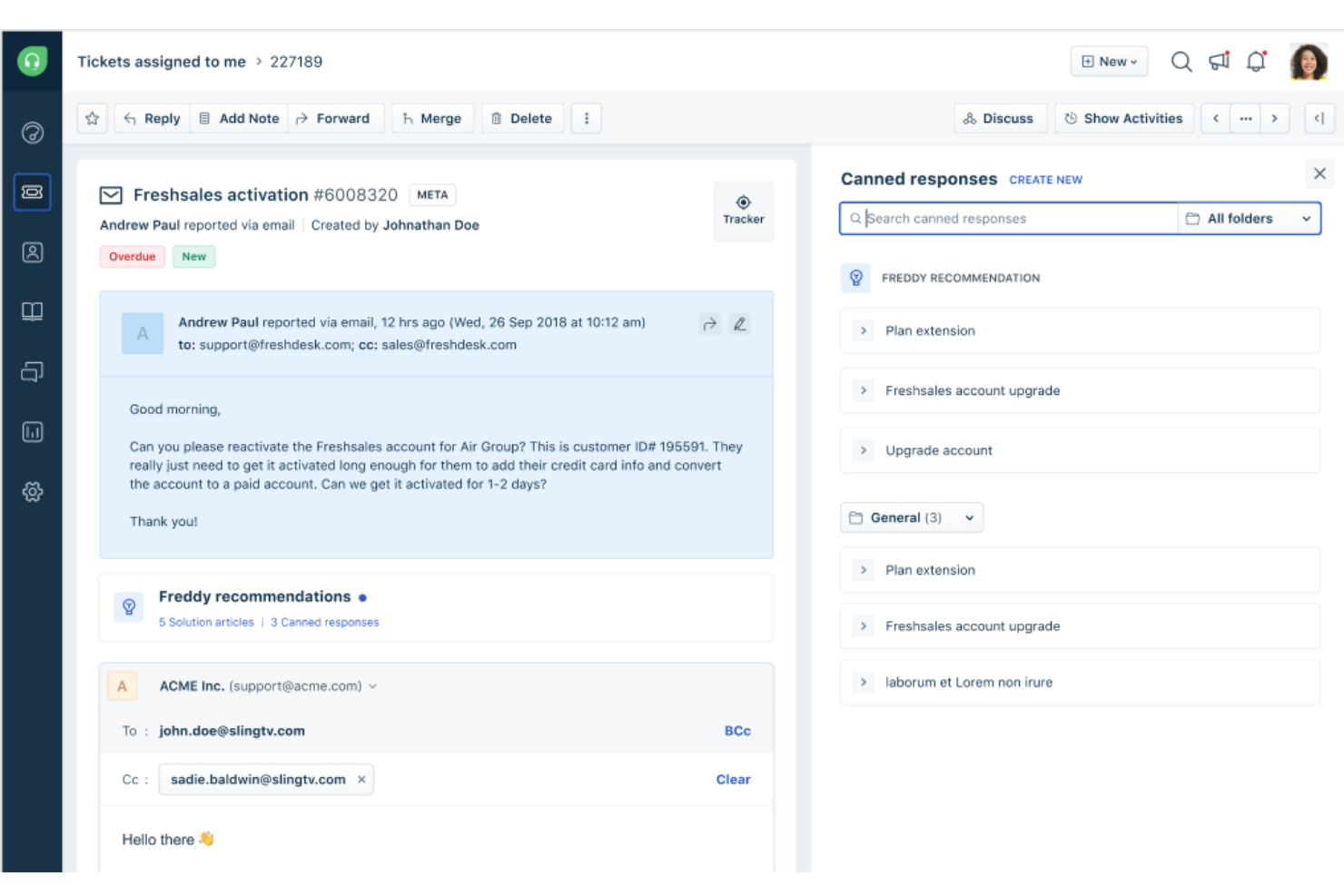
Freshdesk is a cloud-based helpdesk platform built for support teams in businesses of all sizes who want to automate ticket management, streamline customer conversations, and deliver fast, AI-powered support across multiple channels.
Who Is Freshdesk Best For?
Freshdesk is a good fit for growing businesses and mid-market companies that need a scalable, AI-powered support platform without heavy IT overhead.
Why I Picked Freshdesk
Freshdesk earns its spot as one of the best on my shortlist because of how its Freddy AI handles domain-specific automation out of the box. The AI Agent Studio includes a pre-built library of vertical AI agents—covering e-commerce, fintech, HR, IT services, logistics, and travel—each loaded with agentic workflows tailored to that domain's common queries and processes. So instead of building automation logic from scratch, I can deploy a context-aware agent in minutes. I also like how Freddy AI Copilot works alongside human agents in real time, suggesting replies and summarizing conversations without requiring any context-switching inside the workspace.
Freshdesk Key Features
- Freddy AI Insights: Generates reports on support trends, ticket volume, and agent performance using AI-driven analysis across your help desk data.
- Skill-based ticket assignment: Automatically routes incoming tickets to agents based on their specific skills or areas of expertise.
- Omnichannel shared inbox: Consolidates customer conversations from email, chat, phone, and social media into a single unified inbox.
- Knowledge base with article versioning: Lets your team build and maintain a multilingual self-service knowledge base, with version control to track content changes over time.
Freshdesk Integrations
Freshdesk offers 1,000+ native integrations, including Slack, Microsoft Teams, Google Calendar, Google Analytics, Atlassian Jira, Amazon Connect, Google BigQuery, Freshsales Suite, and Zapier. An API is available for custom integrations.
Pros and Cons
Pros:
- AI automation improves response times and reduces workload.
- Omnichannel support integrates various communication platforms.
- Customizable dashboards provide real-time support metrics.
Cons:
- Mobile app lacks some advanced features available on desktop, limiting on-the-go support.
- Lacks integrated calling solutions, requiring separate tools.
New Product Updates from Freshdesk

Freshdesk Adds Voice AI Agents in Freshcaller
Freshdesk introduces Voice AI Agents available through Freshcaller Marketplace apps to handle routine calls and reduce queues. This feature enables automated call handling with real-time, conversational support. For more information, visit Freshdesk's official site.
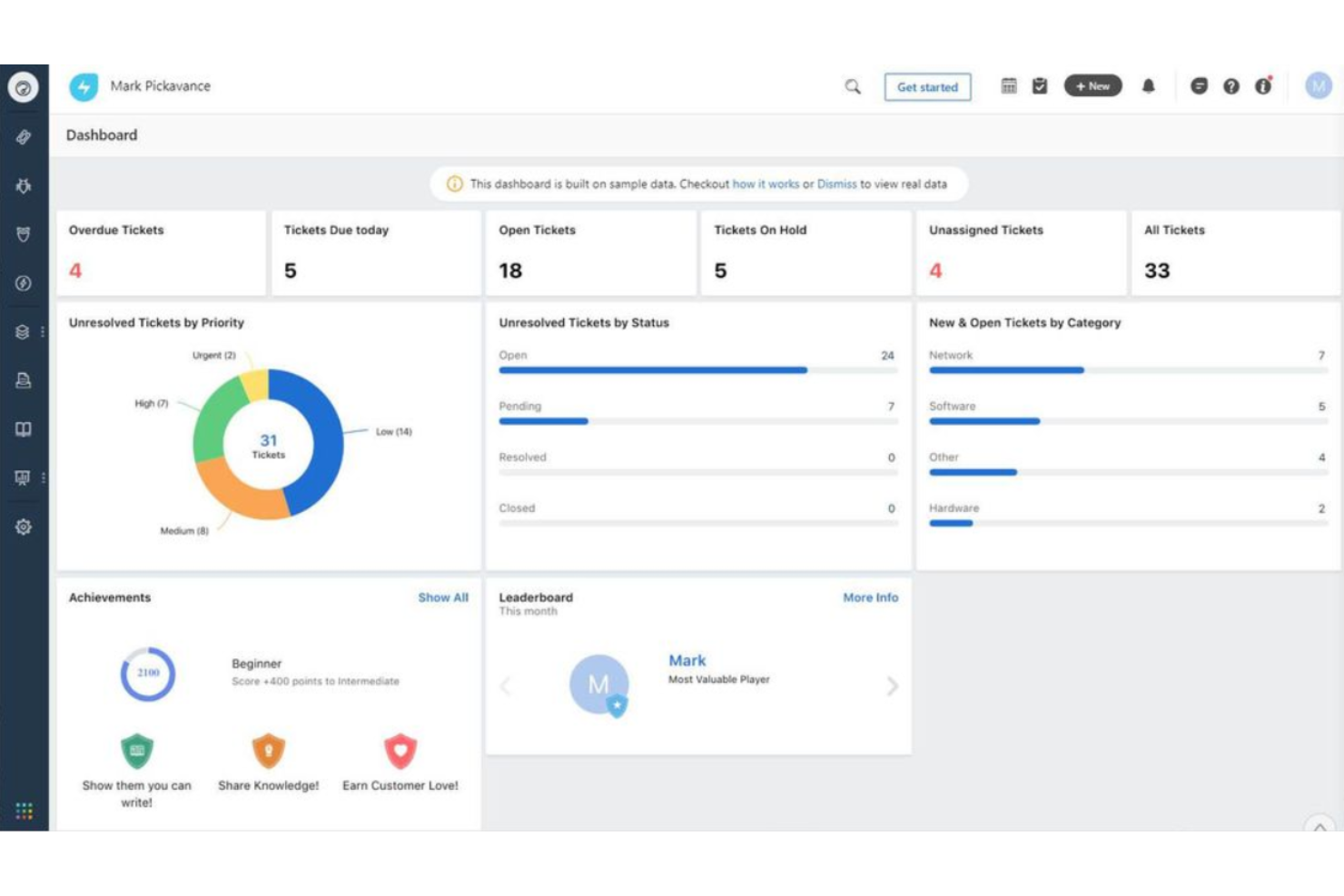
Freshservice is a cloud-based IT service management tool designed for IT teams in organizations of all sizes. It focuses on streamlining IT operations with features like incident management and asset tracking.
Why I picked Freshservice: It's particularly effective for IT support, with features designed for IT teams. The incident management system ensures efficient issue tracking and resolution, while asset management helps maintain an IT inventory. Automation reduces manual tasks, allowing the team to focus on critical issues.
Standout features & integrations:
Features include a service catalog that lets users request and track services. The change management feature helps your team manage changes to IT infrastructure with minimal disruption. The platform also offers a comprehensive reporting and analytics suite to track performance metrics.
Integrations include Microsoft Teams, Slack, Jira, Google Workspace, Azure AD, Zapier, Dropbox, Trello, QuickBooks, and FreshBooks.
Pros and Cons
Pros:
- Gamification feature to enhance motivation
- Seamless third-party app integrations
- Robust security and compliance tools
Cons:
- Mobile app lacks full desktop functionality
- Reporting capabilities could be more advanced
New Product Updates from Freshservice

Freshservice Adds Integrations and Document Workflow Updates
Freshservice introduces ControlUp integration, Adobe Acrobat Sign integration, enhanced document management and data mapping, and document attachments for Journey emails. These updates improve workflow efficiency by streamlining documentation, approvals, and issue resolution. For more information, visit Freshservice’s official site.

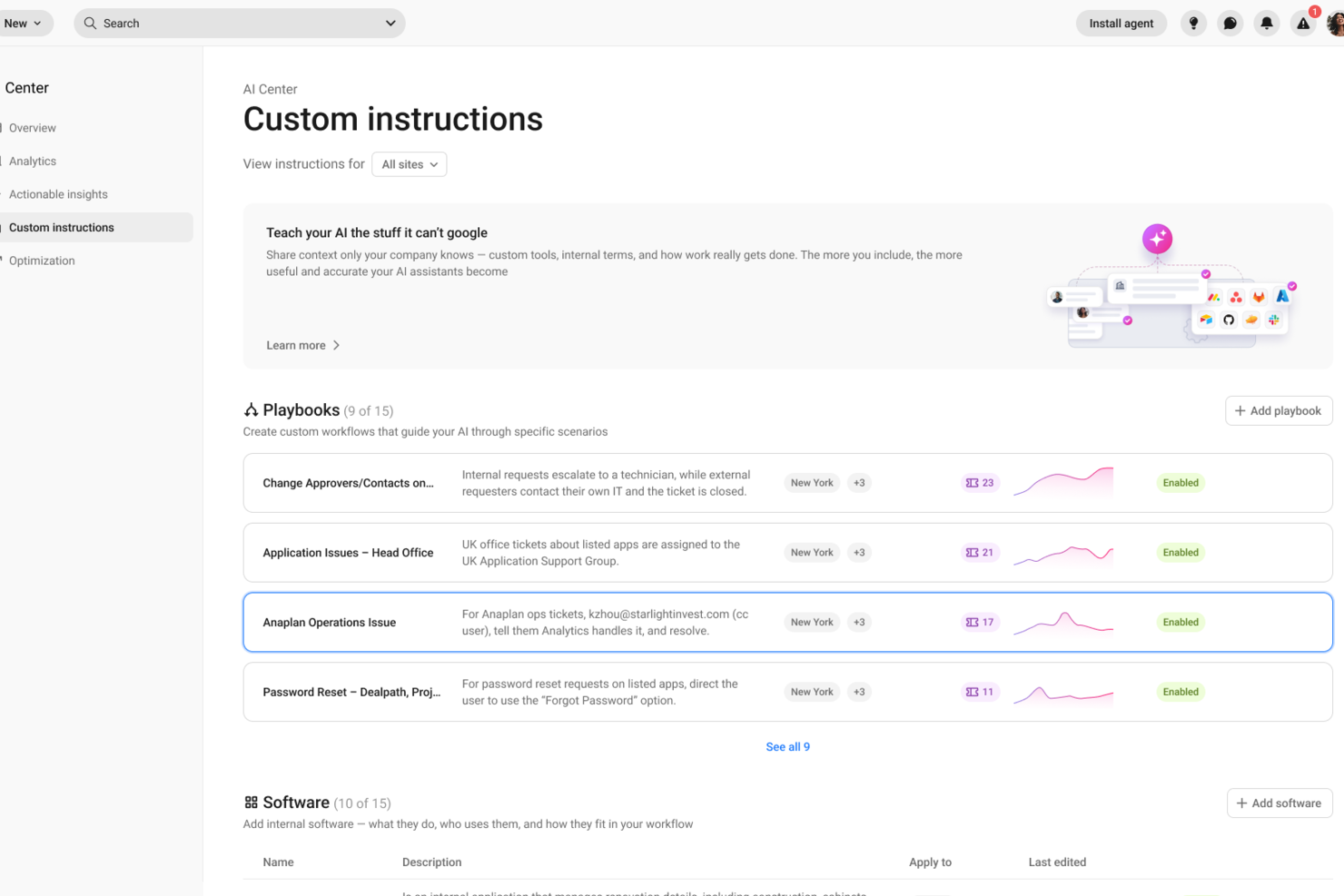
Atera is an all-in-one IT management platform built for IT teams and managed service providers who want to automate helpdesk operations, streamline ticket resolution, and proactively manage client systems with AI-powered tools.
Who Is Atera Best For?
Atera is a strong fit for managed service providers and internal IT departments that need a unified platform for helpdesk ticketing, remote monitoring, and endpoint management.
Why I Picked Atera
Atera earns its spot as one of the best on my shortlist because of how far its AI goes beyond basic ticket suggestions. The Robin AI agent doesn't just recommend actions—it takes ownership of a ticket from intake to resolution, running fixes directly on endpoints or in the cloud, like resetting passwords, installing apps, or clearing print queues, without a technician touching it. I also like the playbook-based workflow automation, where Robin executes predefined resolution paths the moment trigger conditions are met. That means my team isn't manually routing or triaging the same recurring issues over and over—Robin handles them autonomously and only escalates when something genuinely needs human judgment.
Atera Key Features
- AI ticket summarization: Automatically generates concise summaries of incoming tickets so technicians can assess and act on issues faster.
- Remote monitoring and management (RMM): Monitors endpoints, servers, and networks in real time and triggers alerts when thresholds are breached.
- Patch management: Automates OS and third-party software patching across all managed devices on a scheduled or on-demand basis.
- Integrated remote access: Launches remote desktop sessions directly from a ticket using tools like Splashtop or AnyDesk without switching platforms.
Atera Integrations
Atera offers native integrations with Splashtop, AnyDesk, TeamViewer, Bitdefender, Acronis, Webroot, OpenAI, QuickBooks Online, Xero, and connects with Zapier. An API is available for custom integrations.
Pros and Cons
Pros:
- Reduces Tier-1 support workload
- Integrates RMM, helpdesk, and automation
- AI Autopilot resolves tickets automatically
Cons:
- Automation setup may need technical configuration
- Advanced AI features require higher plans
New Product Updates from Atera

Atera Enhances IT Autopilot With Automation and File Support
Atera’s IT Autopilot gets three major boosts: you can now attach common files for deeper analysis, automate IT tasks with clear workflows, and choose how the system follows up when users go silent. These updates help streamline IT operations and improve resolution efficiency. For more information, visit Atera’s official site.

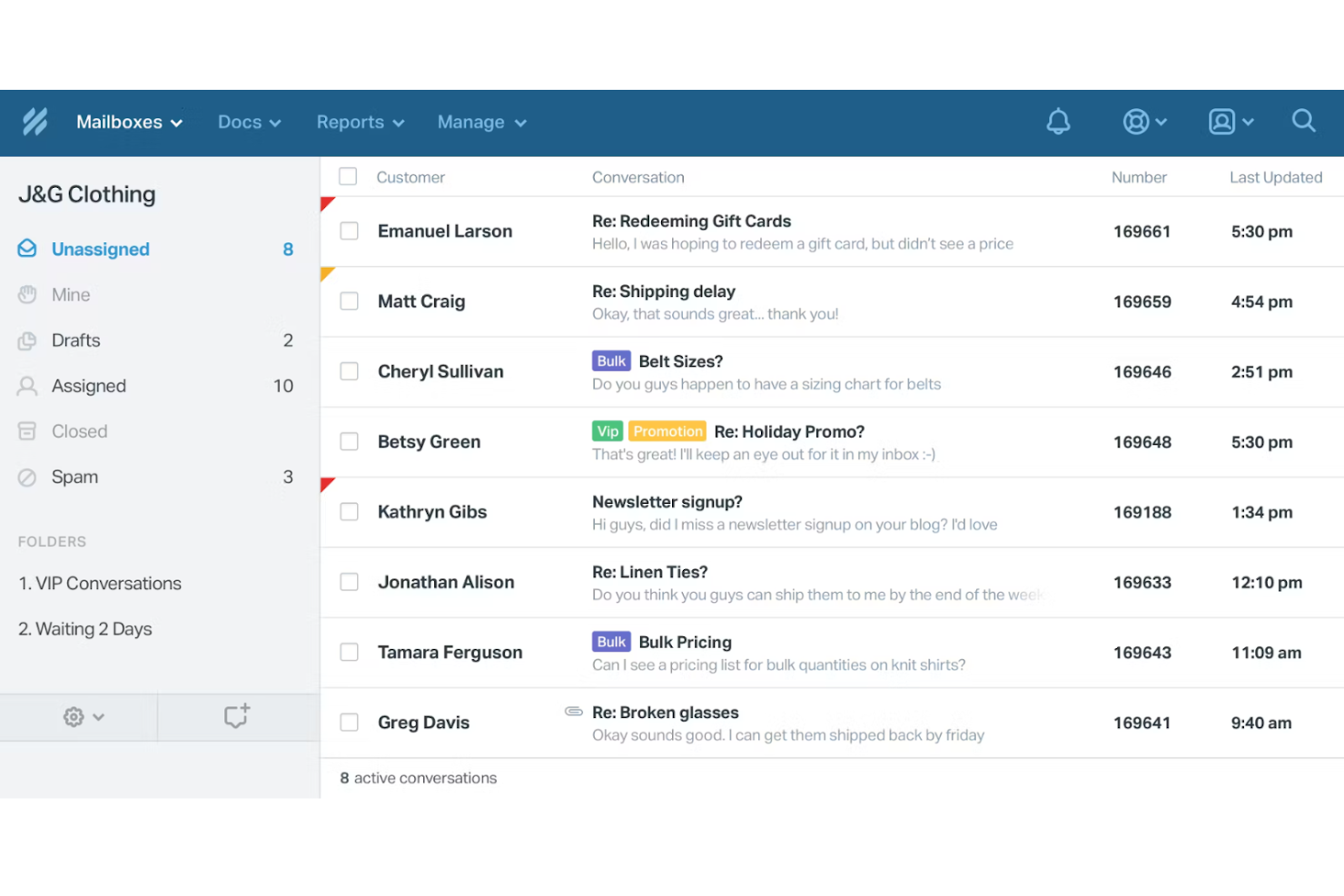
Help Scout is an AI-powered helpdesk platform built for customer support teams who want to manage conversations, automate repetitive tasks, and deliver fast, personalized service across email, chat, and self-service channels.
Who Is Help Scout Best For?
Help Scout is a great fit for small support teams that need a straightforward, AI-assisted helpdesk without the complexity of enterprise-grade platforms.
Why I Picked Help Scout
Help Scout earns its spot on my shortlist because it's one of the few AI helpdesk tools that genuinely works out of the box for small teams. I love that AI Answers pulls directly from your existing knowledge base and web sources to handle incoming requests automatically, with no lengthy setup or AI training required. The Inbox Assistant is also a practical win for lean teams—it drafts replies, summarizes long threads, and adjusts tone without agents ever leaving the conversation view. For a small team juggling a high volume of tickets with limited headcount, that kind of in-workflow support makes a real difference to response times.
Help Scout Key Features
- Saved replies: Store pre-written responses to common questions that agents can insert into any conversation with a single click.
- Customer profiles: Automatically pull in customer details and conversation history from connected apps directly within the inbox view.
- Docs report: Track article views, failed searches, and content gaps in your knowledge base to identify where self-service is falling short.
- Workflow automation: Set up rule-based triggers to automatically assign, tag, or route incoming conversations without manual intervention.
Help Scout Integrations
Help Scout offers 90+ native integrations, including Slack, HubSpot, Salesforce, Jira, Shopify, Mailchimp, Google Workspace, Microsoft 365, Trello, and Zapier. An API is also available for custom integrations.
Pros and Cons
Pros:
- Insightful reporting features
- Useful automation rules
- Easy collaboration with shared inboxes
Cons:
- Integration challenges with existing workflows
- Dependence on AI accuracy
New Product Updates from Help Scout

Help Scout Adds SLAs for Response and Resolution Times
Help Scout introduces SLAs for tracking response and resolution times. This update helps teams monitor performance and prioritize conversations more effectively. For more information, visit Help Scout’s official site.
 .
.
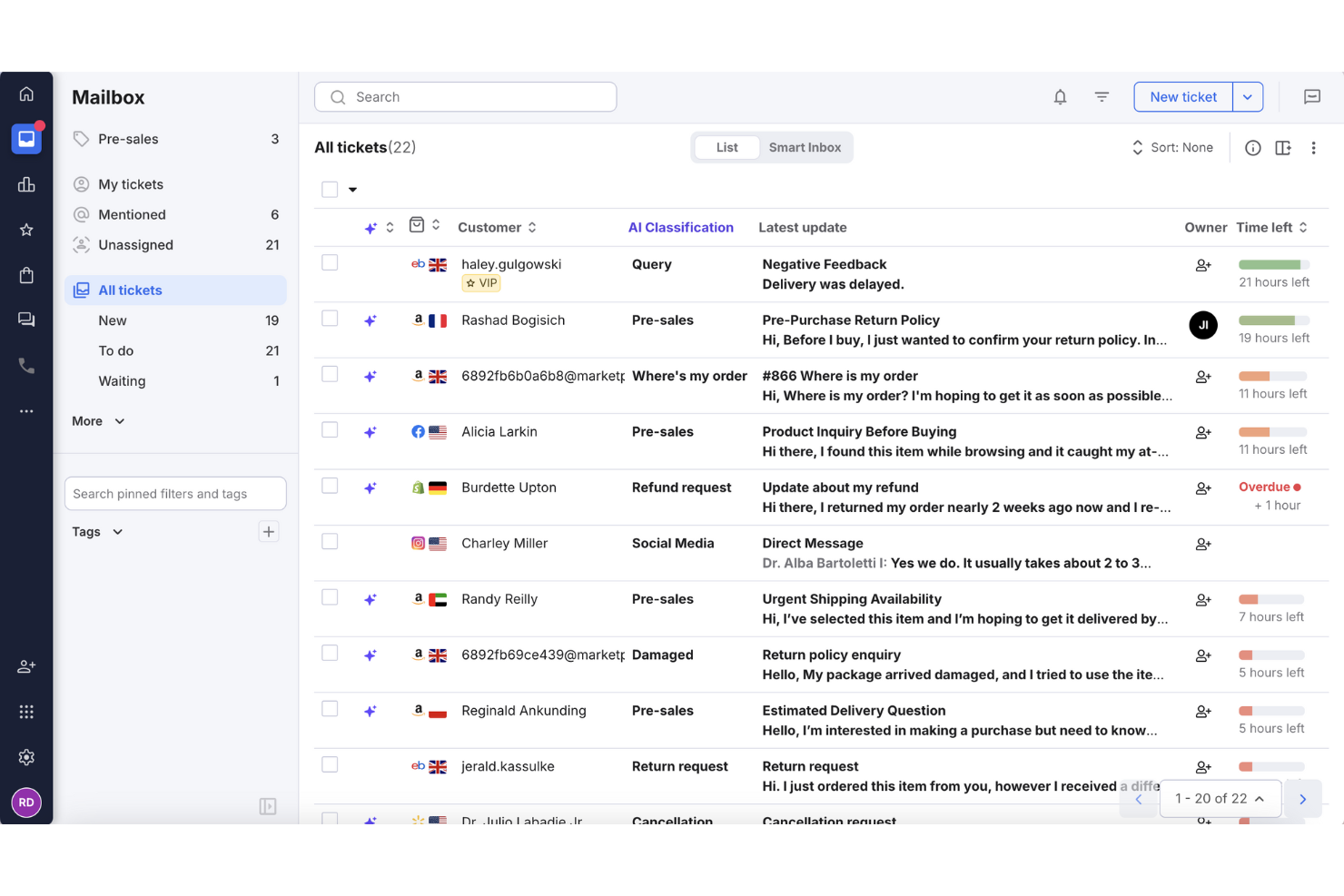
eDesk is an AI-powered helpdesk platform built for ecommerce teams who need to manage customer queries across multiple sales channels, automate responses, and keep order data at their fingertips.
Who Is eDesk Best For?
eDesk is a strong fit for ecommerce businesses selling across multiple marketplaces and storefronts who need a single place to manage all customer support.
Why I Picked eDesk
eDesk earns its spot on my shortlist because of how well its unified inbox handles the complexity of multichannel ecommerce support. When your team is selling across Amazon, eBay, and Shopify simultaneously, logging into separate portals to answer the same types of questions is a real drain—eDesk pulls every message into one workspace, with order details, shipping info, and customer history attached directly to each ticket. I also like the AI ticket classification feature, which automatically sorts and groups incoming tickets so agents avoid manually triaging a high volume of messages. The AI Agent can automate up to 65% of support interactions across all connected channels from that same single inbox.
eDesk Key Features
- Smart reply suggestions: AI generates pre-written response options based on the customer's message and order context, so agents can reply faster.
- Customer sentiment detection: eDesk automatically flags tickets by customer sentiment, helping agents prioritize frustrated or at-risk buyers.
- Live chat widget: A customizable chat widget lets you handle real-time customer conversations directly from your storefront.
- Reporting and analytics dashboard: Track response times, ticket volumes, and agent performance across all channels from a single reporting view.
eDesk Integrations
eDesk offers 200+ native integrations, including Amazon, eBay, Shopify, Walmart, BigCommerce, Magento, WooCommerce, Linnworks, ChannelAdvisor, Google, and Zapier. An API is available for custom integrations.
Pros and Cons
Pros:
- Saved reply templates speed up customer responses
- Seamless order data synchronization with major marketplaces
- 24/7 chatbot support for handling common inquiries
Cons:
- Primarily built for ecommerce, less flexible for other industries
- Reporting and analytics, while present, can be less customizable than more enterprise dashboards


Chatbase is an AI helpdesk platform for businesses that want to automate customer support, reduce repetitive queries, and provide instant answers through customizable chatbots trained on your own knowledge base.
Who Is Chatbase Best For?
Chatbase is a good fit for small to mid-sized businesses that want to deploy AI-powered support chatbots without needing a dedicated engineering team.
Why I Picked Chatbase
I picked Chatbase as one of the best because of how it handles escalation logic. Instead of building rigid decision trees or scripting every possible handoff trigger, you write escalation instructions in plain natural language—telling the agent when to route a conversation to a live agent and when to keep handling it. In practice, that means my team can set conditions like "escalate if the customer mentions a billing dispute or expresses frustration" without touching any code. When a handoff does happen, the full conversation context transfers with it, so the human agent picks up mid-conversation rather than starting from scratch. That context-preservation detail is what separates a smooth escalation from one that makes customers repeat themselves.
Chatbase Key Features
- AI model comparison: Test and switch between different LLMs to find the best configuration for your specific support use case.
- Omnichannel deployment: Deploy your AI agent across website chat, WhatsApp, Slack, and email from a single platform.
- Workflow automation: Configure actions the agent can perform inside connected systems, like updating a subscription or changing a shipping address.
- Multilingual support: Detect and respond in 80+ languages automatically using generative AI.
Chatbase Integrations
Chatbase offers native integrations with Slack, WhatsApp, Facebook Messenger, Telegram, and Zapier. An API is available for custom integrations.
Pros and Cons
Pros:
- Supports over eighty languages
- Smart routing to human agents
- Automates repetitive customer inquiries
Cons:
- Limited onboarding documentation available
- Limited customer support response


Tidio brings AI-powered chatbots and multichannel support to ecommerce and online businesses that want to automate customer service, manage tickets, and respond to customer questions in real time across chat, email, and social channels.
Who Is Tidio Best For?
Tidio is a strong fit for small to mid-sized ecommerce businesses that need to automate customer support without a large support team.
Why I Picked Tidio
I picked Tidio as one of the best AI helpdesk tools because of how deeply it integrates with ecommerce platforms—Shopify in particular. The order management features are what really set it apart: I can preview a customer's cart, check their order history, cancel orders, update shipping addresses, and send discount codes all without leaving the chat window. That kind of in-conversation order control is genuinely rare in a helpdesk tool. I also like how Lyro AI Agent connects directly to your product catalog to pull real-time inventory data, so it can answer product-specific questions and make accurate recommendations automatically.
Tidio Key Features
- Lyro AI multilanguage support: Lyro AI Agent detects and responds to customers in dozens of languages using your existing support content, with no manual translation needed.
- Ticket workflows: Automate repetitive ticketing actions like sending auto-replies, closing inactive tickets, and routing requests to the right department.
- Live visitor list: See all active website visitors and the pages they're browsing in real time, so agents can proactively start conversations based on browsing behavior.
- Flows automation builder: Build no-code automation paths with a visual editor, using 40+ ecommerce templates to trigger actions at key moments in the customer journey.
Tidio Integrations
Tidio offers 20+ native integrations, including Shopify, WooCommerce, BigCommerce, Wix, Mailchimp, HubSpot, Google Analytics, Messenger, Instagram, Zendesk, and Zapier. An API is available for custom integrations.
Pros and Cons
Pros:
- Customizable chat widgets
- User-friendly chatbot builder
- Smooth ecommerce integration
Cons:
- Occasional chatbot glitches
- Limited advanced analytics
New Product Updates from Tidio

Tidio Expands Lyro AI Across Email and Chat
Tidio expands Lyro AI to email ticketing and enhances its chatbot with Claude 3.0 integration. These updates improve automation across support channels and enhance AI-driven interactions. For more information, visit Tidio’s official site.
 .
.

SparrowDesk is an AI helpdesk platform for support teams and businesses that want to streamline customer service with automated workflows, smart ticket routing, and AI-driven responses.
Who Is SparrowDesk Best For?
SparrowDesk is a good fit for small to mid-sized businesses that need an AI-powered helpdesk to handle growing support volumes without expanding their team.
Why I Picked SparrowDesk
SparrowDesk earns its spot on my shortlist because of how well it handles automating customer interactions end-to-end. I like that it uses AI to automatically categorize and route incoming tickets, so my team isn't manually triaging every request. The AI-suggested responses are genuinely useful too—SparrowDesk surfaces relevant knowledge base articles and draft replies based on ticket context, which cuts down on repetitive typing. I've also found the automated workflow builder practical for setting up trigger-based actions, like auto-resolving common queries or escalating tickets that go unanswered past a set threshold.
SparrowDesk Key Features
- Omnichannel inbox: Manage email and chat tickets from a single inbox, with tickets organized by urgency, customer type, or channel.
- Multilingual AI agent: Automatically detects a customer's language and responds fluently, supporting global customer bases without manual configuration.
- SLA management: Set custom SLA rules by priority, channel, or customer type, with real-time breach alerts and automatic timer pausing when tickets are in pending status.
- AI agent training: Upload PDFs, scrape URLs, or import past tickets to build and continuously refine the AI agent's knowledge base.
SparrowDesk Integrations
SparrowDesk offers a very limited set of native integrations (notably SurveySparrow and Attio), with additional connections available via API (e.g., HubSpot, Salesforce) or Zapier.
Pros and Cons
Pros:
- No code workflow builder automates routing and notifications
- Copilot features summarize long conversations inside the agent inbox
- AI agents designed to auto resolve many repetitive tickets
Cons:
- Limited native integrations could hinder seamless connectivity
- Channels currently focus on email and live chat, not voice or social


Missive is an AI-enabled helpdesk platform that combines email, chat, and task management in a shared inbox. It helps teams manage customer conversations together while keeping tasks and responsibilities clearly assigned.
Why I Picked Missive: I picked Missive because its collaborative inbox makes it easy for teams to manage conversations without losing track of who’s responsible. You can assign messages, create tasks directly from emails, and keep discussions organized with internal threads. It also includes AI tools for drafting replies, translating customer messages, and summarizing long conversations, which can speed up support work.
Standout features & integrations
Features include workload balancing to evenly distribute requests, live chat for real-time customer interactions, multi-language support for global teams, and an AI Assistant with Quick Actions.
Integrations include ChatGPT by OpenAI, Integrately, Lindy.ai, Make, Relay.app, Zapier, Close, Daylite, FullContact, HubSpot, Pipedrive, and Salesforce.
Pros and Cons
Pros:
- Flexible task management
- AI-assisted replies
- Strong collaboration tools
Cons:
- Mobile app less robust
- Limited analytics reporting
New Product Updates from Missive

Missive Adds Activity Feed, AI Inbox Analysis, and ClickUp Integration
Missive introduces an activity feed, AI inbox analysis, ClickUp integration, and jump to source navigation. These updates improve visibility, streamline workflows, and enhance how users manage conversations. For more information, visit Missive’s official site.
 .
.Other AI Helpdesk Software
Here are some additional AI helpdesk software options that didn’t make it onto my shortlist, but are still worth checking out:
- Hiver
For AI-driven query assistance
- Desk365
For AI-generated ticket responses
- Zoho Desk
For omnichannel ticket management
- Zendesk
With advanced data privacy controls
- InvGate Service Management
For AI-powered ticket summarization
- HappyFox
For omnichannel support
- Intercom
For customer engagement
- Deskpro
For sentiment analysis
- Sprinklr
For real-time insights
- Zendesk
For seamless integration
- HelpSpot
For customization
- Aisera
For automated workflows
- LiveAgent
For advanced ticketing management
- monday service
For customizable service workflows
- HelpDesk
For simple interface
- OneDesk
For custom ticket forms
- Kayako
For personalized customer support
- Hiver
For Gmail integration
- Jitbit
For email ticketing
- Giva
For HIPAA compliance


AI Helpdesk Software Selection Criteria
When selecting the best AI helpdesk software to include in this list, I considered common buyer needs and pain points like reducing response times and handling high volumes of customer inquiries. I also used the following framework to keep my evaluation structured and fair:
Core Functionality (25% of total score)
To be considered for inclusion in this list, each solution had to fulfill these common use cases:
- Ticket management
- Live chat support
- Email integration
- Customer interaction tracking
- Automated responses
Additional Standout Features (25% of total score)
To help further narrow down the competition, I also looked for unique features, such as:
- AI-driven insights
- Multilingual support
- Customizable dashboards
- Sentiment analysis
- Omnichannel support
Usability (10% of total score)
To get a sense of the usability of each system, I considered the following:
- Intuitive interface
- Easy navigation
- Minimal learning curve
- Customization options
- Accessibility across devices
Onboarding (10% of total score)
To evaluate the onboarding experience for each platform, I considered the following:
- Availability of training videos
- Interactive product tours
- Access to templates
- Webinars and live demos
- Effective chatbot assistance
Customer Support (10% of total score)
To assess each software provider’s customer support services, I considered the following:
- 24/7 availability
- Multiple support channels
- Response time
- Knowledgeable staff
- Availability of self-help resources
Value For Money (10% of total score)
To evaluate the value for money of each platform, I considered the following:
- Pricing transparency
- Feature set relative to cost
- Availability of different pricing tiers
- Competitive pricing
- Cost-benefit ratio
Customer Reviews (10% of total score)
To get a sense of overall customer satisfaction, I considered the following when reading customer reviews:
- Consistent positive feedback
- Mention of reliable performance
- Satisfaction with support services
- Overall ease of use
- Feature effectiveness
How to Choose AI Helpdesk Software
It’s easy to get bogged down in long feature lists and complex pricing structures. To help you stay focused as you work through your unique software selection process, here’s a checklist of factors to keep in mind:
| Factor | What to Consider |
| Scalability | Ensure the software can grow with your business. It should handle increasing ticket volumes and user numbers without compromising performance. |
| Integrations | Check if the tool integrates with your existing systems like CRM, email, and social media platforms to streamline operations and improve workflows. |
| Customizability | Look for options to tailor workflows, reports, and interfaces to suit your team's specific needs and preferences. |
| Ease of Use | The interface should be intuitive, requiring minimal training. Your team should quickly adapt and start using it effectively. |
| Budget | Consider the total cost, including subscription fees, setup costs, and any hidden charges. Ensure it fits your financial plan. |
| Security Safeguards | Evaluate the software's security measures, such as data encryption and compliance with regulations like GDPR, to protect sensitive customer information. |
| Support | Consider the availability and quality of customer support. Look for 24/7 assistance and multiple support channels. |
| Feature Set | Ensure the software offers essential features like ticket management, live chat, and reporting, as well as any additional features that meet your needs. |
Trends in AI Helpdesk Software
In my research, I sourced countless product updates, press releases, and release logs from different AI helpdesk software vendors. Here are some of the emerging trends I’m keeping an eye on:
- Conversational AI and Chatbots: These are becoming more advanced, offering natural language understanding and personalized responses. Vendors like Intercom are enhancing their chatbots to handle complex queries, providing quicker resolutions without human intervention.
- Predictive Analytics: This trend helps businesses anticipate customer needs and issues before they arise. Tools like Aisera incorporate predictive analytics to improve customer satisfaction by addressing potential problems proactively.
- Voice Assistants: More platforms are integrating voice-enabled support, allowing customers to interact using voice commands. This trend is making helpdesk software more accessible and efficient for users who prefer speaking over typing.
- Sentiment Analysis: By analyzing customer emotions, helpdesk software can prioritize tickets and tailor responses. Deskpro, for example, uses sentiment analysis to better understand customer moods and improve service quality.
- Hyper-Personalization: AI is being used to offer personalized customer experiences based on past interactions and preferences. This trend ensures that users receive relevant solutions quickly, enhancing overall satisfaction.
What Is an AI Helpdesk Software?
AI helpdesk software uses artificial intelligence to automate customer support tasks like ticket routing, responses, and issue detection. Support and IT teams use these tools to resolve inquiries faster, reduce manual workload, and deliver more personalized, efficient service across channels.
Features of AI Helpdesk Software
When selecting AI helpdesk software, keep an eye out for the following key features:
- Ticket management: Organizes and prioritizes customer inquiries, ensuring efficient resolution.
- Live chat: Enables real-time communication with customers, improving response times.
- Predictive analytics: Anticipates customer needs and issues, enhancing proactive support.
- Sentiment analysis: Understand customer emotions to tailor responses and prioritize tickets.
- Customizable dashboards: Allows teams to track performance metrics relevant to their needs.
- AI-driven insights: Provides data-driven recommendations to improve service quality.
- Voice assistants: Facilitates interaction using voice commands, making support more accessible.
- Hyper-personalization: Offers tailored customer experiences based on previous interactions.
- Self-service portal: Empowers customers to find solutions independently, reducing ticket volume.
Benefits of AI Helpdesk Software
Implementing AI helpdesk software provides several benefits for your team and your business. Here are a few you can look forward to:
- Improved efficiency: Automates routine tasks like ticket management, freeing up your team to focus on complex issues.
- Faster response times: Live chat and AI-driven insights help address customer inquiries quickly.
- Enhanced customer satisfaction: Personalized experiences and predictive analytics ensure customers feel understood and valued.
- Proactive support: Predictive analytics and sentiment analysis allow your team to anticipate and address issues before they escalate.
- Cost savings: Reduces the workload on customer service teams, minimizing the need for additional hires.
- Better decision-making: Customizable dashboards and reporting tools provide valuable data insights for strategic planning.
- Increased accessibility: Voice assistants and self-service portals make support more accessible to a wider range of users.
Costs and Pricing of AI Helpdesk Software
Selecting AI helpdesk software requires an understanding of the various pricing models and plans available. Costs vary based on features, team size, add-ons, and more. The table below summarizes common plans, their average prices, and typical features included in AI helpdesk software solutions:
Plan Comparison Table for AI Helpdesk Software
| Plan Type | Average Price | Common Features |
| Free Plan | $0 | Basic ticket management, limited live chat, and minimal reporting. |
| Personal Plan | $5-$30/ user/month | Enhanced ticket management, email integration, and basic analytics. |
| Business Plan | $30-$50/ user/month | Advanced ticket management, live chat support, customizable dashboards, and automation capabilities. |
| Enterprise Plan | $50-$100/ user/month | Comprehensive analytics, AI-driven insights, personalized support options, and full integration capabilities. |
AI Helpdesk Software FAQs
Here are some answers to common questions about AI helpdesk software:
How does AI improve helpdesk efficiency?
AI improves helpdesk efficiency by automating routine tasks such as ticket routing and password resets. This frees up your team to focus on more complex issues. AI-driven insights can also provide quicker resolutions by suggesting solutions based on past interactions.
What are the benefits of AI chatbots in helpdesk software?
AI chatbots offer 24/7 support, handling common inquiries without human intervention. This reduces response times and improves customer satisfaction. They can also gather initial information from customers, ensuring your team receives well-documented tickets.
How can AI help with customer personalization?
AI analyzes customer data to provide personalized experiences. By understanding past interactions and preferences, AI can tailor responses and recommend products or solutions that best fit individual needs, enhancing customer satisfaction. Beyond help desks, there are other AI customer service software that can understand intent, intelligently route customers, and personalize communication based on emotion detection.
Can AI helpdesk software integrate with other tools?
Yes, AI helpdesk software often integrates with CRM systems, email platforms, and social media. These integrations ensure all customer interactions are centralized, providing a unified view and improving workflow efficiency.
What security features should I look for in AI helpdesk software?
Look for data encryption and compliance with regulations like GDPR. Secure user authentication and regular software updates are also crucial to protect sensitive customer information from unauthorized access.
How does AI helpdesk software handle high ticket volumes?
AI helpdesk software can automatically categorize and prioritize tickets based on urgency and complexity. This ensures that critical issues are addressed first, and it also helps manage high volumes efficiently by distributing tasks to the appropriate team members.
What's Next?
Subscribe to our newsletter for the latest CX insights, how-to guides, strategies, and resources from top experts in the CX field.