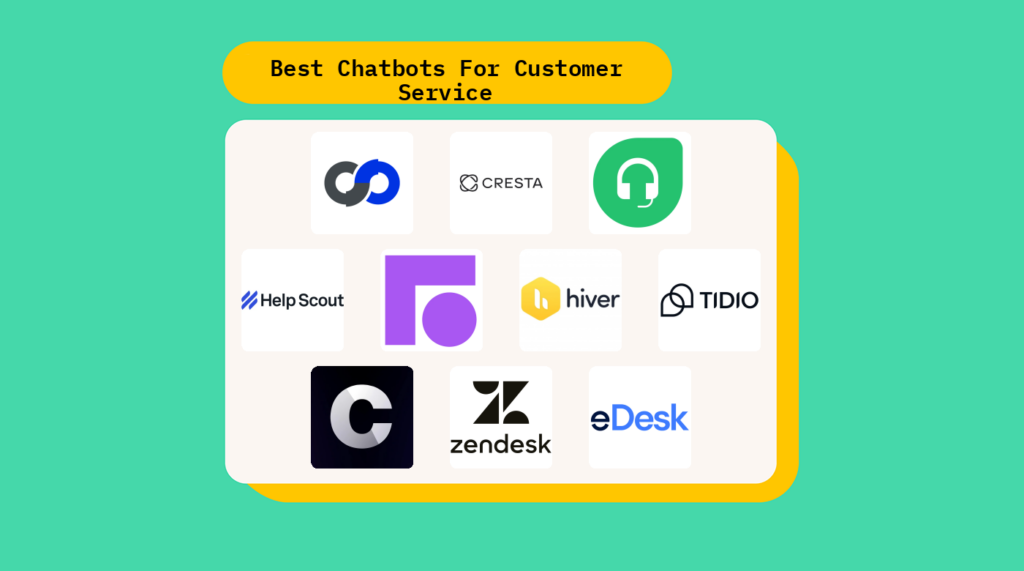

Chatbots for customer service can take pressure off support teams by answering common questions, handling routine requests, and giving customers faster support around the clock. But the right tool needs to reduce agent workload—not create more escalations to manage.
Drawing on over two decades of experience building tech platforms and leading AI operations, I evaluated the top customer service chatbots to find the tools that genuinely improve support for customers and agents.
Why Trust Our Software Recommendations
6,700+
Reviews
20
Industry experts
16+
Evaluation factors
14
Years
Our team has been testing and reviewing software since 2012. As CX leaders ourselves, we know how difficult—and important—it is to choose the right software.
For this guide, we evaluated tools using hands-on testing and independent research, scoring tools using our selection criteria.
Our reviews reflect our human editorial judgment, not a sales pitch.
 Gui DrusinaCreative Director
 Tim FisherVP of AI
Best Chatbots for Customer Service Summary
This comparison chart summarizes pricing details for my top chatbots for customer service selections to help you find the best one for your budget and business needs.
| Tool | Best For | Trial Info | Price | ||
|---|---|---|---|---|---|
| 1 | Best for AI automation in regulated industries | 30-day free trial | From $31/agent/month (billed annually) | Website | |
| 2 | Best for real-time agent coaching and guidance | Free demo available | Pricing upon request | Website | |
| 3 | Best for integration with existing helpdesks | 30-day free trial | From $199/month | Website | |
| 4 | Best for regulated financial services | Free demo available | Pricing upon request | Website | |
| 5 | Best with multi-agent AI for case resolution | Free plan available | From $0.09/interaction | Website | |
| 6 | Best for 24/7 ecommerce support | 14-day free trial + free demo available | From $39/user/month (billed annually) | Website | |
| 7 | Best for combining AI and human support | Free plan available | From $25/user/month (billed annually) | Website | |
| 8 | Best for multilingual support | 14-day free trial | From $19/user/month (billed annually) | Website | |
| 9 | Best for customizable AI agents | 14-day free trial | From $19/user/month (billed annually) | Website | |
| 10 | Best for handling complex customer queries | 7-day free trial + free plan + free demo available | From $32/month (billed annually) | Website |


Best Chatbots for Customer Service Reviews
Below are my detailed summaries of the best chatbots for customer service that made it onto my shortlist. My reviews offer a detailed look at the key features, pros & cons, integrations, and ideal use cases of each tool to help you find the best one for you.
 Best for AI automation in regulated industries
- 30-day free trial
- From $31/agent/month (billed annually)
Visit WebsiteCustomer Rating:4.4/5
Comm100 unifies AI and live agent chat with real-time AI Copilot suggestions. Comm100 is a customer service chatbot and live chat platform that combines an AI Agent, omnichannel messaging, human handoff workflows, and a native knowledge base across 12+ digital and voice channels.
Who Is Comm100 Best For?
Comm100 is a strong fit for enterprise teams in healthcare, government, financial services, and higher education that need AI-driven chat automation with strict compliance and data sovereignty requirements.
Why I Picked Comm100
I picked Comm100 as one of the best because its anti-hallucination AI architecture is purpose-built for regulated industries where a wrong answer carries real compliance risk. The AI Agent answers only from verified knowledge sources, never its pre-trained model memory, which matters enormously in healthcare or financial services contexts. Its on-premises deployment option is also rare, letting government and banking teams run the full platform behind their own firewall.
Comm100 Key Features
- AI Agent: Uses natural language processing to answer customer questions based on connected knowledge sources.
- Custom actions: Configure the AI Agent to complete tasks during conversations, including booking appointments, checking balances, and triggering custom workflows.
- On-premises deployment: Supports on-premises deployment for organizations with specific data residency or regulatory requirements.
- Reporting dashboard: Track chatbot resolution rates, agent response times, and customer satisfaction scores from a centralized dashboard.
Comm100 Integrations
Comm100 offers native integrations with Salesforce, HubSpot, Microsoft Dynamics 365, Zendesk, ServiceNow, Google Drive, SharePoint Online, Confluence Cloud, Calendly, and Microsoft Bookings. It also provides a REST API, SDK, webhooks, and Zapier.
Pros and Cons
Pros:
- Supports Telegram, X, LINE, and WeChat
- Supports SOC 2 Type II, HIPAA, ISO 27001, and GDPR compliance
- Supports configurable tones and natural-language instructions
Cons:
- AI responses rely on the quality of connected knowledge sources
- Some users report challenges with CRM integrations
Learn more about Comm100: Best for real-time agent coaching and guidance
- Free demo available
- Pricing upon request
Visit WebsiteCustomer Rating:5/5
Cresta offers an AI chatbot that recalls previous customer searches and preferences to deliver personalized support. Cresta is a contact center AI platform that combines AI-powered virtual agents for automated customer conversations across voice, chat, and SMS with real-time agent assist and conversation intelligence tools.
Who Is Cresta Best For?
Cresta is a strong fit for enterprise contact centers seeking to deploy AI agents and coach human agents from a single platform.
Why I Picked Cresta
Cresta earns its spot as one of the best for real-time agent coaching and guidance because of how its Agent Assist product works during live interactions. It pushes contextual hints, compliance reminders, and next-best-action suggestions to agents mid-conversation, not after the fact. I also like its Knowledge Agent, which combines spoken conversation context with on-screen data to surface source-backed answers instantly. On top of that, AI-generated post-call summaries are fully customizable and generate automatically, cutting the time agents spend on after-call work.
Cresta Key Features
- Cresta AI Agent: AI-powered virtual agents handle customer conversations across voice, chat, and SMS with support for multi-step workflows.
- Opera AI orchestration: A no-code builder for designing, testing, and adjusting AI agent workflows without engineering support.
- AI Analyst: Allows you to query your full conversation data with plain-language questions to find trends and patterns.
- Auto QA scoring: Scores all customer interactions against your defined quality criteria.
Cresta Integrations
Cresta integrates with telephony and chat solutions like Five9, Amazon Connect, and Genesys, as well as CRM and customer engagement platforms such as Salesforce and Zendesk. It also connects with NICE CXone and Twilio. Additional integrations span marketing tools like HubSpot and Marketo and data platforms including Databricks. Cresta offers an API for custom integrations.
Pros and Cons
Pros:
- Smart Compose auto-completes agent replies during conversations
- Analyzes all interactions, not just random samples
- Live coaching prompts help mid-level agents improve
Cons:
- Built for enterprise teams, not smaller operations
- Knowledge assist suggestions often misread caller intent
Learn more about Cresta: Best for integration with existing helpdesks
- 30-day free trial
- From $199/month
Visit WebsiteCustomer Rating:4.5/5
My AskAI integrates with your existing helpdesk like HubSpot and has the feature to automatically notify a human agent and leave an internal comment when a user requests to speak to a person. My AskAI is an AI-powered customer service chatbot that sits on top of existing helpdesks like Zendesk, Intercom, and Freshdesk, resolving tickets from synced knowledge sources with automatic handoff to human agents.
Who Is My AskAI Best For?
It's a strong fit for small and mid-sized support teams that already run a helpdesk and want AI ticket deflection without switching platforms or hiring developers.
Why I Picked My AskAI
I picked My AskAI as one of the best because it layers directly onto your existing helpdesk rather than replacing it. On Zendesk or Intercom, it resolves tickets from your knowledge sources and cites every answer with a source reference. I also like the Knowledge Improvement Studio, which mines past tickets to identify gaps and generates new help content automatically. The AI Tasks feature handles actions like refunds or address changes through plain-language instructions.
My AskAI Key Features
- Slack and Teams integrations: Connects the AI agent to internal chat tools for employee Q&A.
- Automatic source citations: Every chatbot response references the original knowledge source for traceability.
- Multilingual language detection: Supports 95+ languages with automatic detection and localized responses.
- AI ticket tagging: Tags support tickets automatically using AI to help with categorization and reporting.
My AskAI Integrations
My AskAI offers native integrations with Zendesk, Intercom, Gorgias, Freshdesk, HubSpot, and Freshchat.
Pros and Cons
Pros:
- Identifies knowledge gaps from past tickets
- Cites sources in every AI response
- Deploys on existing helpdesks without rebuilding workflows
Cons:
- Analytics depth trails enterprise-focused competitors
- Limited omnichannel reach beyond web and email
Learn more about My AskAI: Best for regulated financial services
- Free demo available
- Pricing upon request

Gradient Labs offers an AI agents dashboard where you can deploy frontline and specialized chatbots for customer service tasks. Gradient Labs is an AI-native customer operations platform built specifically for financial services, running specialist agents that handle customer service, disputes, collections, onboarding, and KYC.
Who Is Gradient Labs Best For?
Gradient Labs is a strong fit for customer service teams in financial services, insurance, and lending who need an AI agent built around regulatory compliance.
Why I Picked Gradient Labs
I've included Gradient Labs in my top picks because it's one of the only customer service chatbot platforms built from the ground up for financial services compliance. I particularly like its dispute automation, where the agent gathers evidence, decides the outcome, escalates to a human for sign-off, and files the chargeback with the card scheme. The platform also ships with 20+ financial-services-specific guardrails on every conversation turn and covers global regulatory frameworks, including FCA Consumer Duty, Reg E, Reg Z, PSD2, and the EU AI Act.
Gradient Labs Key Features
- Omnichannel deployment: The AI agent handles customer inquiries across chat, email, voice, and SMS from a single configuration.
- Automated QA checks: Every conversation turn is reviewed against your defined procedures automatically.
- Compliance guardrails: Regulatory requirements like FCA, GDPR, and EU AI Act rules are enforced directly within the conversation flow.
- Human handoff: The agent escalates conversations to a live agent when it can't resolve an inquiry.
Gradient Labs Integrations
Gradient Labs offers native integrations with Intercom, Zendesk, Salesforce, Freshdesk, Twilio, RingCentral, Genesys, NICE, and LoanPro. An API is also available for custom integrations.
Pros and Cons
Pros:
- Outcome-based pricing per resolved query
- 20+ built-in compliance guardrails
- Handles multi-day, multi-turn conversations
Cons:
- No free trial or self-serve onboarding
- Built mainly for financial services companies
Learn more about Gradient Labs: Best with multi-agent AI for case resolution
- Free plan available
- From $0.09/interaction

Aissist offers a detailed subagents dashboard displaying session counts, traffic trends, resolution ratios, and NPS scores for each customer service chatbot agent. Aissist is an agentic AI customer service platform that deploys multi-agent "Digital Employees" to handle conversations, execute back-office tasks, and automate ticket resolution across email, chat, SMS, WhatsApp, and social media.
Who Is Aissist Best For?
It's a strong fit for ecommerce and SMB support teams that run high ticket volumes through helpdesks like Zendesk, Gorgias, or Intercom and want to automate resolution without adding headcount.
Why I Picked Aissist
Aissist earns its spot on my shortlist because its AgentMesh™ architecture assigns specialized sub-agents to billing, pre-sales, and technical queries separately, keeping responses accurate and domain-specific. I also like that it executes real work within the conversation: tagging tickets, updating records, and triggering escalations rather than just replying. In practice, a Shopify order dispute handled through Gorgias can be resolved start to finish without a human ever touching it.
Aissist Key Features
- Native helpdesk integrations: Connects directly with Zendesk, Intercom, HubSpot, Freshdesk, Front, and Gorgias for unified automation.
- Omnichannel message handling: Manages conversations across chat, email, SMS, WhatsApp, and major social media channels.
- Automatic language detection: Supports over 65 languages with real-time translation and native-language replies.
- Custom API and backend actions: Triggers order lookups, returns, and account updates in live chats using REST and GraphQL APIs.
Aissist Integrations
Aissist offers native integrations with Zendesk, Intercom, HubSpot, Freshdesk, Gorgias, Front, Salesforce, eDesk, Shopify, WooCommerce, and Magento. An API is available for custom integrations.
Pros and Cons
Pros:
- Supports 65+ languages without duplicate bot builds
- Sub-agents handle domain-specific queries accurately
- Resolves tickets fully without human agent input
Cons:
- Analytics reporting is limited compared to rivals
- Setup complexity increases with multi-agent configurations
Learn more about Aissist: Best for 24/7 ecommerce support
- 14-day free trial + free demo available
- From $39/user/month (billed annually)
Visit WebsiteCustomer Rating:4.4/5
eDesk chatbot answers customer questions and routes requests to support agents. eDesk is an ecommerce customer service platform that combines AI-powered chatbots, multichannel ticketing, and marketplace integrations for online support teams.
Who Is eDesk Best For?
eDesk is a strong fit for ecommerce businesses selling across multiple online marketplaces who need a centralized platform to manage customer support at scale.
Why I Picked eDesk
I picked eDesk as one of the best because of how purpose-built it is for ecommerce support around the clock. The chatbot connects directly to your order data, product catalog, and FAQs to give customers accurate, on-brand answers at any hour—without needing an agent online. I especially like the live translation feature, which means a customer shopping at midnight in a different time zone gets the same quality of response as someone reaching out during business hours. When a query does get too complex for the bot, it escalates to a human agent with the full conversation context already attached, so nothing gets lost in the handoff.
eDesk Key Features
- Smart inbox: A unified inbox that pulls in tickets from Amazon, eBay, Shopify, and 300+ channels, with order details and shipping info attached to each ticket automatically.
- AI ticket classification: Automatically sorts and tags incoming tickets by intent—returns, cancellations, order questions—so agents can prioritize and respond faster.
- SLA tracking: Monitors response time targets across all channels and surfaces at-risk tickets before deadlines are missed.
- Pre-sales support mailbox: A dedicated workspace for handling product questions from shoppers before they buy, pulling in inventory and pricing data to help agents close more sales.
eDesk Integrations
eDesk offers 200+ native integrations, including Amazon, eBay, Shopify, Walmart, BigCommerce, Magento, WooCommerce, Linnworks, ChannelAdvisor, Allegro, and Zapier. An API is available for custom integrations.
Pros and Cons
Pros:
- Designed to handle high volumes of ecommerce inquiries
- AI automations reduce repetitive support tasks
- Integrates rich order data for enhanced customer service
Cons:
- Reporting and analytics, while present, can be less customizable than more enterprise dashboards
- Primarily built for ecommerce, less flexible for other industries
Learn more about eDesk: Best for combining AI and human support
- Free plan available
- From $25/user/month (billed annually)
Visit WebsiteCustomer Rating:4.5/5
Help Scout’s dashboard displays shared inboxes across teams, centralizing customer conversations in one workspace. Help Scout is a customer service platform that combines AI-powered chatbots, live chat, shared inboxes, and a knowledge base to support online customer conversations.
Who Is Help Scout Best For?
Help Scout is a good fit for small to mid-sized businesses that want to handle customer support across chat, email, and self-service without managing overly complex tooling.
Why I Picked Help Scout
Help Scout earns its spot on my shortlist because of how naturally it blends AI automation with human support—without making customers feel like they're stuck in a bot loop. I really like the AI Answers feature, which helps resolve routine requests by pulling from your knowledge base and custom instructions. When AI can't handle a question, customers escalate to a live agent in a couple of clicks, feeding directly into the shared inbox. The Inbox Assistant also helps my team draft replies, summarize long threads, and adjust tone as needed, so agents stay sharp even during high-volume periods.
Help Scout Key Features
- Beacon widget: An embeddable chat widget you can place anywhere on your site or in-app to surface help articles, collect email inquiries, or start live chat conversations.
- Saved replies: Pre-written response templates that agents can pull up to answer common questions without writing from scratch each time.
- Customer profiles: Automatically populated contact records that display past conversations, account details, and data pulled in from connected apps.
- Reporting and analytics: Built-in reports tracking response time, handle time, conversation volume, and customer satisfaction scores across all channels.
Help Scout Integrations
Help Scout offers native integrations with Slack, HubSpot, Salesforce, Shopify, Mailchimp, Jira, and Google Workspace. It also connects with Zapier and provides an API for custom integrations.
Pros and Cons
Pros:
- Built-in knowledge base powers accurate automated replies
- Smooth handoff preserves conversation context for agents
- AI Answers resolves common tickets without agent involvement
Cons:
- AI effectiveness depends heavily on knowledge base quality
- Not a standalone chatbot outside Help Scout ecosystem
Learn more about Help Scout: Best for multilingual support
- 14-day free trial
- From $19/user/month (billed annually)
Visit WebsiteCustomer Rating:4.4/5
Build your chatbot with Freshdesk to automate routine inquiries. Freshdesk is a customer service platform that offers AI-powered chatbots, live chat, ticketing, and automation tools for managing online customer conversations across multiple channels.
Who Is Freshdesk Best For?
Freshdesk is a good fit for customer support teams at mid-sized to large companies that handle high volumes of inquiries across multiple languages and regions.
Why I Picked Freshdesk
I picked Freshdesk as one of the best because of how well it handles multilingual support across both its chatbot and knowledge base. Freddy AI Copilot translates conversations in real time directly inside the agent workspace, so your team can respond in a customer's language without switching tools or copying text into a translator. Freshdesk's knowledge base also supports multilingual content, so your self-service articles can be published in multiple languages and surfaced by the Freddy AI Agent during chat interactions. For teams supporting customers across different regions, that combination of live translation and localized self-service is difficult to replicate in a single platform.
Freshdesk Key Features
- Freddy AI Agent: An AI-powered bot that handles incoming customer questions automatically, resolving common issues without agent involvement.
- Ticket dispatch: Automatically routes incoming tickets to the right agent or team based on predefined rules and conditions.
- Skill-based ticket assignment: Assigns tickets to agents based on their specific skills, ensuring customers reach the most qualified person.
- Community forums: A built-in space where customers can post questions, share answers, and find solutions from other users.
Freshdesk Integrations
Freshdesk offers 1,000+ native integrations, including Slack, Salesforce, Shopify, Jira, Mailchimp, WhatsApp, Facebook Messenger, Microsoft Teams, Google Workspace, and Zoom. It also provides an API for custom integrations.
Pros and Cons
Pros:
- AI automation improves response times and reduces workload.
- Omnichannel support integrates various communication platforms.
- Customizable dashboards provide real-time support metrics.
Cons:
- Lacks integrated calling solutions, requiring separate tools.
- Emphasis on AI may not fit everyone's workflow style.
Learn more about Freshdesk: Best for customizable AI agents
- 14-day free trial
- From $19/user/month (billed annually)
Visit WebsiteCustomer Rating:4.3/5
Zendesk has a ticketing system for managing customer concerns efficiently. Zendesk is a customer service platform that offers AI-powered chatbots, automated ticketing, and omnichannel messaging for online support teams.
Who Is Zendesk Best For?
Zendesk is a strong fit for mid-size to enterprise support teams that need a scalable, AI-driven customer service solution across multiple digital channels.
Why I Picked Zendesk
Zendesk is a top choice because it gives you strong control over how your AI agents behave. I love that you can define custom personas, set AI reasoning guardrails, and connect agents to your own knowledge sources—so the bot your customers interact with feels like a natural extension of your brand, not a generic FAQ machine. The AI agent builder lets you describe goals in plain language rather than scripting rigid flows, which means I can handle complex, multi-step requests without building out decision trees. Built-in QA scoring covers 100% of AI agent interactions, so I can see where the agent is performing well and where it needs tuning.
Zendesk Key Features
- Omnichannel messaging: Manage customer conversations across web, mobile, WhatsApp, Facebook, and Instagram from a single agent workspace.
- Omnichannel routing: Automatically assign incoming tickets to the right agent based on availability, workload, and skills across all channels.
- AI Copilot: Provides human agents with real-time suggestions, context, and next-step recommendations directly within the agent workspace.
- Prebuilt analytics dashboards: Track ticket volume, agent performance, and customer trends out of the box without custom report setup.
Zendesk Integrations
Zendesk offers over 1,200 native integrations through its marketplace, including Slack, Shopify, Google Play Reviews, Trustpilot, Pipedrive, Sprout Social, Harvest, ChannelReply, and Guru. An API is available for custom integrations.
Learn more about Zendesk: 10Best for handling complex customer queries
Chatbase
- 7-day free trial + free plan + free demo available
- From $32/month (billed annually)
Visit WebsiteCustomer Rating:4.4/5
Chatbase’s AI chat widget lets you deploy customizable agents for handling complex customer queries. Chatbase is an AI chatbot platform for customer service teams that lets you build, train, and deploy chatbots using your own data and connect them to your website or messaging channels.
Who Is Chatbase Best For?
Chatbase is a good fit for small to mid-sized businesses that want to deploy a custom AI chatbot trained on their own content without needing a development team.
Why I Picked Chatbase
Chatbase is one of my top picks because I love how it uses LLMs with reasoning capabilities that resolve complex customer support queries, not just simple FAQs. I use it to connect the agent to live systems like order management tools and CRMs, so when a customer asks about a delayed shipment or wants to update their subscription, the agent can pull real data and take action directly. I also rely on the smart escalation feature, which lets me set natural-language instructions for when the bot should hand off to a human agent, so genuinely tricky issues don't fall through the cracks.
Chatbase Key Features
- Custom data training: Upload documents, PDFs, or website URLs to train your chatbot on your specific knowledge base.
- Multilingual support: Detects and responds in the customer's language without manual configuration.
- Lead capture forms: Collect customer contact details mid-conversation using built-in form fields inside the chat widget.
- Conversation history: Review full transcripts of past chatbot interactions to monitor response quality and identify gaps.
Chatbase Integrations
Chatbase offers native integrations with Slack, WhatsApp, Facebook Messenger, and Telegram. An API is available for custom integrations.
Learn more about Chatbase:
Other Chatbots for Customer Service
Here are some additional chatbot for customer service options that didn’t make it onto my shortlist, but are still worth checking out:
- 11SparrowDeskBest for AI-first ticket resolution
- 12WeavBest for customer experience data insights
- 13BirdeyeBest for capturing leads
- 14Zoho SalesIQBest for its easy-to-use interface
- 15TidioBest for it focus on generating sales
- 16TarsBest for ease of setup
- 17FrontBest with AI-powered ticket triage
- 18IntercomBest for simple customer interface
- 19KommunicateBest for balancing chatbots with the human touch
- 20CoSupport AIBest for faster, accurate, and secure customer support
- 21DriftBest for turning conversations into sales
- 22AcquireBest for for human-like automated chats
- 23LiveHelpNowBest for omnichannel customer support
- 24ActivechatBest for customer-centric brands
- 25CrescendoBest for automating compliance-sensitive support
- 26HelpshiftBest for rapid deployment
- 27GenesysBest for chatbots that span digital channels
- 28Quiq MessagingBest for integrating with bots from other platforms
- 29QuidgetBest for automating repetitive frontline support
- 30HiverBest for AI-driven chat automation
- 31FreshchatBest for scaling customer support on any channel
- 32KayakoBest for integrated website and mobile support
- 33Zendesk SellExcels at reducing repetitive work
- 34NetomiBest for dealing with spikes in support demand
- 35PodiumBest for local businesses
- 36KoreAutomates and streamlines customer journeys
- 37Yellow.aiBest for total user experience automation
How I Evaluate Chatbots for Customer Service
I split my evaluation into baseline requirements—like NLP quality and agent handoff—and differentiators that reveal which tools actually reduce ticket volume and scale with your support operation.
Core Functionality (Table Stakes For This List)
When I'm selecting tools for my list, I rank each one on a scale from 0 (does not offer the functionality) to 5 (excels in this area) for each core functionality listed below. Then, I calculate the tool's total score into a percentage. Each tool needs to achieve a minimum total score of 65% to be considered for inclusion.
- Conversational AI & NLP: I evaluate how well a bot understands varied phrasing—like a customer asking "where's my order" vs. "I haven't received my package"—and responds naturally.
- Omnichannel Deployment: Each tool should support deployment across channels customers actually use, such as website chat, WhatsApp, Facebook Messenger, SMS, and mobile apps.
- Human Agent Handoff: I look at whether conversations transfer to live agents with full context intact, so the customer doesn't have to repeat their issue after the bot reaches its limits.
- Knowledge Base Integration: The bot should pull answers from existing help center content or documentation, and I check whether it stays current as source material gets updated.
- CRM & Helpdesk Integrations: Connecting to platforms like Zendesk, Salesforce, or HubSpot matters here—I look for native integrations that let the bot read customer data and log interactions.
- Analytics & Reporting: I evaluate whether the platform tracks support-specific metrics like deflection rate, containment rate, and resolution time rather than just raw conversation volume.
Once I have a list of tools that meet the criteria, I consider what sets each platform apart.
Differentiating Factors (What Sets Vendors Apart)
Here's how I compare and contrast different vendors:
Standout Features
A no-code bot builder is a major differentiator—it lets support ops teams update conversation flows without filing a dev ticket every time a return policy changes. I also evaluate multilingual support, specifically whether the bot auto-detects language rather than forcing customers to choose one. Proactive messaging matters too. A bot that triggers a help prompt when a customer stalls on a checkout error page can resolve issues before they become tickets.
Beyond Features
Pricing structure matters a lot in this space. Some vendors charge per resolution, others per conversation or monthly active user—and that difference can shift your costs significantly as ticket volume grows. I also consider deployment speed, since a chatbot that takes months to train and launch delays the deflection gains your team is counting on. Security is another factor I check, especially SOC 2 and GDPR compliance, because these bots handle sensitive customer data like order details and account information daily.
How to Choose a Chatbot for Customer Service
The best chatbot for customer service depends on what you need it to handle, how complex your support requests are, and where customers contact you. Focus on these factors when comparing your options:
| Factor | What to consider |
|---|---|
| FactorSupport volume | What to considerLook at where agents spend the most time. If repetitive questions make up a large share of tickets, prioritize strong FAQ and self-service automation. |
| FactorCustomer questions | What to considerConsider how predictable requests are. Choose a basic chatbot for straightforward FAQs and an AI chatbot for varied or contextual questions. |
| FactorSupport channels | What to considerIdentify where customers already reach out. Choose a chatbot that supports your highest-volume channels rather than the longest channel list. |
| FactorIntegrations | What to considerCheck compatibility with the help desk, CRM, knowledge base, and other systems the chatbot needs to access. |
| FactorCustomer experience | What to considerTest shortlisted tools with real customer questions. Choose one that answers accurately and makes it easy to reach a human when needed. |
| FactorSuccess metrics | What to considerDefine what you want the chatbot to improve, such as resolution rates, response times, ticket volume, or CSAT. Choose a tool that reports on those metrics. |
Emerging AI Trends in Customer Service Chatbots
AI chatbots for customer service are expanding what can be done beyond traditional FAQs and scripted responses. Here are the key changes to watch:
- Human-like conversations: Generative AI is making chatbot responses less scripted and better at understanding natural language and context.
- Beyond basic FAQs: Newer AI chatbots can increasingly work through multi-step requests, such as checking an order and starting a return.
- Deeper personalization: AI can use customer history, account details, and previous conversations to provide responses specific to each customer.
- Voice and visual support: Multimodal AI is allowing chatbots to understand voice, images, and documents alongside text.
- Proactive support: AI can use customer activity and other signals to identify potential issues and offer help before the customer reaches out.
- Independent actions: Agentic AI is beginning to let chatbots take actions across connected systems, such as updating an account or changing a booking.
What Is a Chatbot for Customer Service?
A chatbot for customer service is a tool that automates responses to customer inquiries, providing 24/7 support and handling routine questions. Customer service representatives and support teams generally use these tools to improve efficiency and response times. Features like automated responses, real-time interaction, and integration capabilities help manage large volumes of queries and enhance customer satisfaction. These tools ultimately save time and resources while improving the customer experience.
Features
The best customer service chatbots combine automation with tools that help customers get accurate answers and reach an agent when needed. Key features include:
- Automated responses: Predefined or AI-generated answers to customer questions.
- Natural language processing: Recognition of customer intent and conversational language.
- Conversation flows: Prebuilt paths for FAQs, troubleshooting, bookings, returns, and other requests.
- Knowledge base access: Retrieval of information from FAQs, help articles, and documentation.
- Human agent handoff: Transfer of conversations from the chatbot to a support agent.
- Conversation history: Storage of previous messages and interactions.
- Multichannel support: Chatbot deployment across websites, apps, and messaging platforms.
- Multilingual support: Customer conversations in multiple languages.
- Integrations: Connections with CRM, help desk, ecommerce, and other business systems.
- Analytics: Reporting on conversations, resolutions, escalations, and chatbot usage.
Benefits
Implementing a chatbot for customer service provides several benefits for your team and your business. Here are a few you can look forward to:
- Increased efficiency: Automates routine inquiries, allowing your team to focus on complex tasks and reducing response times.
- Cost savings: Reduces the need for a large support staff by handling a significant volume of queries automatically.
- Improved customer satisfaction: Offers 24/7 availability, ensuring customers receive timely support whenever they need it.
- Enhanced data insights: Provides analytics on customer interactions, helping you make informed decisions to improve service.
- Broader reach: Multilingual support allows you to cater to a diverse customer base, expanding your market presence.
- Better lead management: Features like lead scoring help prioritize high-value customers, optimizing your sales efforts.
- Consistent support quality: Ensures uniform responses and service quality across all customer interactions, maintaining brand reputation.
Costs & Pricing
Selecting a chatbot for customer service requires an understanding of the various pricing models and plans available. Costs vary based on features, team size, add-ons, and more. The table below summarizes common plans, their average prices, and typical features included in chatbot for customer service solutions:
Plan Comparison Table for Chatbot for Customer Service
| Plan Type | Average Price | Common Features |
|---|---|---|
| Plan TypeFree Plan | Average Price$0 | Common FeaturesBasic chat capabilities, limited integrations, and standard support. |
| Plan TypePersonal Plan | Average Price$5-$25/user/month | Common FeaturesAutomated responses, basic analytics, and email support. |
| Plan TypeBusiness Plan | Average Price$30-$75/user/month | Common FeaturesAdvanced analytics, multilingual support, and CRM integrations. |
| Plan TypeEnterprise Plan | Average Price$100-$200/user/month | Common FeaturesCustomizable workflows, dedicated account manager, and priority support. |
Chatbots for Customer Service FAQs
Here are some answers to common questions about chatbots for customer service:
What’s the difference between chatbots and AI agents?
Chatbots primarily interact with customers through conversation, answering questions, collecting information, and handling predefined workflows. AI agents can go a step further by deciding what actions are needed and completing multi-step tasks across connected systems.
For example, a chatbot might explain your return policy, while an AI agent could check the order, confirm eligibility, and initiate the return.
Do I need to switch from a traditional chatbot to an AI chatbot?
Not necessarily. Many chatbot platforms are already adding AI capabilities, so you may be able to upgrade your existing setup rather than switch tools entirely.
Start by checking what your current chatbot can do. Consider adopting its AI features—or switching platforms—if:
- Your bot gets stuck on unexpected questions: AI can handle variations in language without relying as heavily on predefined scripts.
- Customers need better conversations: AI can understand context and follow-up questions, making interactions feel less rigid.
- You want to automate beyond FAQs: Newer AI capabilities can help handle more complex requests and, in some cases, take actions across connected systems.
- You need better personalization: AI can use connected customer data and conversation history to tailor responses.
If your current chatbot handles its job well, you don’t need to replace it just because AI options exist. Compare the AI capabilities available in your current platform with the problems you’re actually trying to solve before investing in a new tool.
Can customer service chatbots integrate with CRM and help desk software?
Yes. Most customer service chatbots integrate with your existing CRM and help desk platforms to access customer data, create or update tickets, and pass conversation history to agents. Check whether your core tools have native integrations or require an API or third-party connector.
Can chatbots handle complex customer queries?
No, chatbots typically excel at handling routine and straightforward queries. For complex issues, it’s best to have a system in place where the chatbot can escalate the conversation to a human agent. You can configure triggers that identify when a query is beyond the chatbot’s capabilities. Train your team on how to take over and provide personalized support when needed.
Which customer service channels can chatbots support?
Customer service chatbots can support channels such as websites, mobile apps, WhatsApp, Facebook Messenger, SMS, and other messaging platforms. Channel availability varies by provider, so prioritize the channels your customers already use rather than choosing based on channel count alone.
Can customer service chatbots replace human agents?
Not entirely. Chatbots are best used for repetitive, high-volume requests such as FAQs, order updates, and basic troubleshooting. Human agents are still important for complex, sensitive, or unusual issues, so look for a chatbot that can recognize when it needs to escalate and transfer the customer with context.
Common features of customer service chatbots include:
- Automated responses: Predefined or AI-generated answers to customer questions.
- Natural language processing: Recognition of customer intent and conversational language.
- Conversation flows: Prebuilt paths for FAQs, troubleshooting, bookings, returns, and other requests.
- Knowledge base access: Retrieval of information from FAQs, help articles, and documentation.
- Human agent handoff: Transfer of conversations from the chatbot to a support agent.
- Conversation history: Storage of previous messages and interactions.
- Multichannel support: Chatbot deployment across websites, apps, and messaging platforms.
- Multilingual support: Customer conversations in multiple languages.
- Integrations: Connections with CRM, help desk, ecommerce, and other business systems.
- Analytics: Reporting on conversations, resolutions, escalations, and chatbot usage.
What happens when a chatbot can’t answer a customer’s question?
A well-designed chatbot should recognize when it can’t resolve an issue and automatically escalate it to a human agent. Ideally, it passes along the conversation history and customer details so the agent can pick up where the chatbot left off instead of making the customer start again.
| Start with | What to consider |
|---|---|
| Support volume | Look at where agents spend the most time. High volumes of repetitive questions make FAQ and self-service automation especially valuable. |
| Customer questions | Consider how predictable requests are. Simple FAQs may only need a basic chatbot, while varied or contextual questions may benefit from AI. |
| Support channels | Prioritize where customers already reach out, such as web chat, WhatsApp, SMS, or social messaging. |
| Escalation needs | Decide which issues should go to an agent and make sure the chatbot can hand them off with the conversation context intact. |
| Existing tech stack | Check compatibility with the help desk, CRM, knowledge base, and other systems the chatbot needs to access. |
| Customer experience | Test the chatbot with real questions. Assess answer quality, ease of use, and how easily customers can reach a human. |
| Success metrics | Define what success looks like, whether that’s fewer repetitive tickets, higher resolution rates, faster responses, or better CSAT. |
When should you escalate from chatbot to a human agent?
Escalate when users express frustration, when the issue falls outside common scenarios your bot can handle, or when a user specifically asks for human help.
Chatbots handle repetitive or transactional queries well, but complex or emotional issues are better managed by people. Setting clear handoff rules keeps customer interactions smooth.
Can customer service chatbots personalize customer interactions?
Yes, provided they have access to the right customer data. A chatbot connected to your CRM or other systems can use details such as account information, purchase history, or previous interactions to provide more relevant responses. Personalization should still follow your organization’s privacy and data-handling policies.
How do I measure customer service chatbot performance?
Track metrics that show whether the chatbot is actually resolving customer needs, not just handling conversations. Useful KPIs include resolution rate, escalation rate, customer satisfaction (CSAT), response time, and containment rate. Review failed or abandoned conversations as well—they can reveal gaps in the bot’s knowledge or workflows.
| What to consider | How to evaluate it |
|---|---|
| Use case | Start with the tasks you want to automate, such as FAQs, order tracking, returns, or basic troubleshooting. |
| Human handoff | Make sure customers can easily reach an agent when the chatbot can’t resolve their issue. |
| Channels | Focus on where your customers already contact you, whether that’s web chat, WhatsApp, SMS, or social messaging. |
| Integrations | Check that the chatbot works with the help desk, CRM, knowledge base, and other systems your team relies on. |
| Answer quality | Test the chatbot with real customer questions, including vague or unexpected ones, before committing. |
| Reporting | Look for metrics such as resolution, escalation, containment, and CSAT so you can measure its impact. |
| AI capabilities | Decide how much you actually need to automate. Basic bots may be enough for FAQs, while AI chatbots can handle less predictable conversations. |