

Delivering exceptional customer service is more challenging than ever. As a customer experience professional, you know the pressure to meet rising expectations while managing resources efficiently. That's where customer service automation software comes in, offering solutions to simplify complex tasks and enhance your team's productivity.
In this article, I'll share my top picks for automation tools that can help you tackle these challenges head-on. These tools aren't just about saving time—they're about improving your customer interactions and making every experience count. Dive in to discover which software solutions could be the perfect fit for your needs.
Why Trust Our Software Recommendations
6,700+
Reviews
20
Industry experts
16+
Evaluation factors
14
Years
Our team has been testing and reviewing software since 2012. As CX leaders ourselves, we know how difficult—and important—it is to choose the right software.
For this guide, we evaluated tools using hands-on testing and independent research, scoring tools using our selection criteria.
Our reviews reflect our human editorial judgment, not a sales pitch.
 Gui DrusinaCreative Director
 Tim FisherVP of AI
Customer Service Automation Software Comparison Table
This comparison table summarizes pricing details for my top customer service automation software selections:
| Tool | Best For | Trial Info | Price | ||
|---|---|---|---|---|---|
| 1 | Best help desk with dedicated mobile application | 14-day free trial | From $19/user/month (billed annually) | Website | |
| 2 | Best for L1–L3 AI ticket resolution | Free plan + free demo available | From $150/month (billed annually) | Website | |
| 3 | Best for real-time reporting and analytics | Free demo available | From $30/user/month (billed annually) | Website | |
| 4 | Best scalable automation software | Free trial available | From $75/user/month | Website | |
| 5 | Best for customizable ticket management | 15-day free trial | Pricing upon request | Website | |
| 6 | Best for helpdesk auto-replies | 30-day free trial | From $199/month | Website | |
| 7 | Best for real-time data syncing | 7-day free trial + free plan + free demo available | From $32/month (billed annually) | Website | |
| 8 | Best AI-powered interaction insights | Free plan available | From $29/month (billed annually) | Website | |
| 9 | Best for automated customer email rules | 30-day free trial | From $24/user/month (billed annually) | Website | |
| 10 | Best for AI-driven customer interactions | 14-day free trial | From $19/user/month (billed annually) | Website |


Best Customer Service Automation Software Reviews
Here’s a brief description of each of the best customer service automation software. I’ll show you what each one does best, who it works best for, plus screenshots to showcase some of the features.
 Best help desk with dedicated mobile application
- 14-day free trial
- From $19/user/month (billed annually)
Visit WebsiteCustomer Rating:4.4/5
Easily auto-assign and sort tickets by importance. Freshdesk (a product of Freshworks Inc.) is a customer service platform used to manage support tickets and workflows across multiple communication channels. It supports email, chat, phone, and social media inquiries, allowing teams to handle customer interactions within a single system.
Why I picked Freshdesk: I picked Freshdesk for its mobile application, which allows support teams to manage requests while away from their desks. The app supports ticket tracking, internal collaboration, and customer responses directly from a mobile device. Features such as push notifications, offline access to tickets, and voice support help teams stay informed and continue work without relying on a desktop setup.
Standout features & integrations:
Features include automation tools that support ticket categorization, prioritization, and routing based on predefined rules such as agent workload or expertise. Freddy AI is available within the platform to assist with these workflows as part of the existing ticketing system. Reporting tools provide visibility into response activity, resolution timelines, and customer feedback.
Integrations include Slack, Microsoft Teams, Shopify, Salesforce, Jira, QuickBooks, Zapier, Zoho CRM, HubSpot, and Google Workspace.
Pros and Cons
Pros:
- Omnichannel support in one dashboard
- AI-driven ticket categorization
- Mobile app with full help desk access
Cons:
- Occasional delays in mobile app syncing
- Some advanced features require add-ons
Learn more about Freshdesk: Best for L1–L3 AI ticket resolution
- Free plan + free demo available
- From $150/month (billed annually)
Visit WebsiteCustomer Rating:4.5/5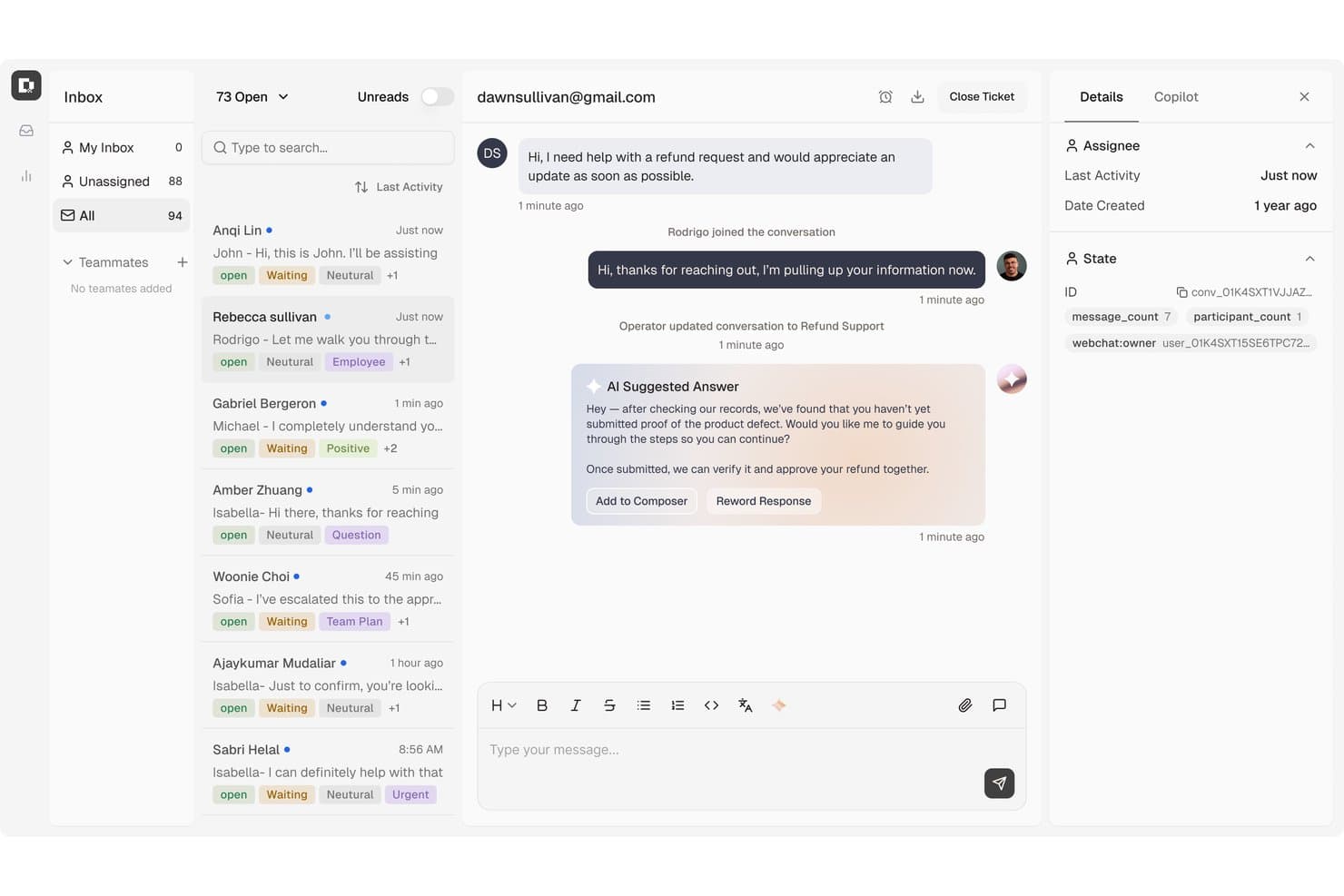
Botpress surfaces AI-suggested replies to speed up customer support. Botpress Desk is an AI-powered helpdesk platform that handles support tickets across L1 through L3, with automated routing, knowledge base-driven deflection, multi-channel coverage, and native integrations with Zendesk and Intercom.
Who Is Botpress Best For?
Botpress Desk is a strong fit for support operations teams that need AI to handle the full ticket spectrum—from routine L1 deflection to complex L3 resolution—without replacing their existing Zendesk or Intercom setup.
Why I Picked Botpress
I picked Botpress as one of the best because it's built to handle the full ticket spectrum—L1 through L3—without routing everything to a human agent. I particularly like how its AI actions can issue refunds, update CRM records, and pull live subscription data mid-conversation, so agents only step in when genuinely needed. Sentiment-based escalation and confidence-threshold handoffs keep that line between bot and human precise.
Botpress Key Features
- Ticket enrichment: Surfaces account health, subscription status, recent activity, and prior ticket history directly within each conversation for faster agent context.
- Multi-channel coverage: Supports webchat, email, WhatsApp, Slack, Discord, Telegram, Instagram, and Facebook Messenger from a single platform.
- Context-rich handoff: Transfers the full conversation history, an AI-generated summary, agent notes, and a suggested next step when escalating to a human.
- Zendesk and Intercom sync: Syncs workspace and customer data natively with Zendesk or Intercom and creates pre-enriched tickets for human handoff.
Botpress Integrations
Botpress offers native integrations with Zendesk, Intercom, WhatsApp, Slack, Discord, Telegram, Instagram, Messenger, and Facebook. It also provides HTTP Chat, Admin, Files, Tables, and Runtime APIs for custom integrations.
Pros and Cons
Pros:
- Reviewers praise its visual bot builder
- Enriches tickets with account and history context
- Automates refunds and customer-record updates
Cons:
- Reviewers say advanced setup can challenge nontechnical teams
- Reviewers report inconsistent results across knowledge bases
Learn more about Botpress: Best for real-time reporting and analytics
- Free demo available
- From $30/user/month (billed annually)
Visit WebsiteCustomer Rating:5/5
RingCentral provides automated insights and analytics in a centralized dashboard. RingCentral is a comprehensive customer service automation software that uses an AI-driven approach to communication. It caters to businesses of all sizes across a wide range of industries, ensuring you can provide tailored support based on your customers' needs.
Why I Picked RingCentral: The platform is compatible across many different channels. This means that it not only supports queries based on a customer's preferred methods but it also collects real-time data and analytics across all channels, giving you a holistic overview of customer experience and agent performance. These AI-driven reports include metrics like call volumes, agent activities, customer sentiment, and trending topics.
Standout Features & Integrations
Standout features include AI to handle tasks throughout the customer query process. These functionalities include IVR/self-service, automatic callback, AI-enabled virtual agents, and call deflection. Additionally, the AI assistant can take real-time call notes, provide writing and translation for digital messages, and offer conversation insights for quicker, higher-quality service.
Other notable features include intelligent routing, which matches customer queries with the right resources based on the chosen communication channel, intent of the message, agent skill profiles, CRM data, and more. RingCentral also offers real-time automated coaching to help improve customer interactions.
Integrations include Microsoft Teams, Salesforce, Google Workspace, Beetexting, HubSpot, Asana, Zendesk, Appointment Reminder, Aha!, Trello, Zapier, Automator, and more.
Pros and Cons
Pros:
- Comprehensive analytics and reporting
- Includes advanced AI features for self-service
- Offers omnichannel support
Cons:
- Can be a learning curve for new users
- Pricing structure may be higher
Learn more about RingCentral Contact Center: Best scalable automation software
- Free trial available
- From $75/user/month
Visit WebsiteCustomer Rating:4.4/5
Salesforce Service Cloud provides organizations with a workflow builder to automate certain processes, including handling customer cases and other processes. Salesforce Service Cloud is a customer service automation software with features that help businesses scale their service processes as they grow. This solution helps teams manage customer queries, resolve cases, and connect customers with the right people to resolve issues through live chat while streamlining the entire process with only a few clicks.
Why I Picked Salesforce Service Cloud: Salesforce Service Cloud makes complicated processes easier with the platform’s builders. These builders are low- and no-code, making it easy to automate workflows, simplify complex processes, and adapt processes with a flexible customer service platform.
Standout Features & Integrations
Features include case management to automatically create cases from web queries and emails, send auto-responses, and route cases to certain queues or agents to resolve cases at a faster rate. The platform also effectively helps businesses manage their workflows and handle large numbers of cases through auto-responses and auto-assignments, which improves the quality of customer service.
Utilizing Salesforce Service Cloud’s automation features helps improve a company’s efficiency in handling cases. Lightning Flow Automation can also be used by Essentials and Professional users for five processes and flows each, while Enterprise and Unlimited users can create an unlimited number of processes and workflows. This means the relatively affordable Service Cloud plans are still useful and functional for smaller businesses.
Integrations include Slack, Mailchimp, QuickBooks, Zendesk, HubSpot, Dropbox, Google Workspace, Microsoft Teams, SurveyMonkey, and JIRA.
Pros and Cons
Pros:
- Easy to learn and use
- Includes pre-built integrations
- Uses AI for automations
Cons:
- Could use better email functionality
- Can be expensive for small teams
Learn more about Agentforce Service (formerly Service Cloud): Best for customizable ticket management
- 15-day free trial
- Pricing upon request
Visit WebsiteCustomer Rating:4.4/5
Zoho Desk's ticket management system is highly customizable, with the option to automate various tasks. Zoho Desk is a comprehensive customer support and help desk software designed to assist businesses in managing their customer service operations efficiently. It offers a variety of features including ticket management, self-service options, and robust reporting and analytics.
Why I Picked Zoho Desk: Zoho Desk has a robust ticket management system, which allows businesses to efficiently track and manage customer inquiries. It allows for the assignment of tickets to specific team members or departments, improving response times and ensuring that the appropriate personnel handle each inquiry. Additionally, the ticket management system includes tools for tracking the status of tickets and analyzing customer inquiries.
Standout Features & Integrations
Features include tools for automating routine customer support tasks, such as workflow rules and macros, which can trigger specific actions based on predefined conditions. This automation reduces the manual workload on support agents, allowing them to focus on more complex issues. Additionally, Zoho Desk offers a self-service portal where customers can find answers to common questions and resolve issues independently.
Integrations include Google Workspace, Microsoft Office 365, Slack, Jira, Trello, Asana, Dropbox, OneDrive, Box, GitHub, Bitbucket, Zendesk, Salesforce, HubSpot, Intercom, Freshdesk, and other Zoho apps.
Pros and Cons
Pros:
- Omnichannel support integration
- AI-powered automation features
- Affordable pricing for small businesses
Cons:
- Mobile app needs improvement
- Limited third-party integrations
Learn more about Zoho Desk:

My AskAI integrates with your existing helpdesk like HubSpot and has the feature to automatically notify a human agent and leave an internal comment when a user requests to speak to a person. My AskAI is an AI customer service agent platform that plugs into existing helpdesks like Zendesk, Intercom, and Freshdesk to autonomously handle customer inquiries, auto-tag tickets, and trigger automated actions across chat, email, and messaging channels.
Who Is My AskAI Best For?
My AskAI is a strong fit for SaaS and ecommerce support teams that already run a helpdesk and want to layer in AI-driven ticket deflection without switching platforms.
Why I Picked My AskAI
I've included My AskAI in my top picks because its self-learning knowledge base does something I haven't seen elsewhere: it spots gaps in your documentation and generates new articles from resolved past tickets automatically. That means your helpdesk auto-replies get sharper over time without any manual curation. I also like that the AI tagging feature classifies and tags incoming Zendesk tickets in real time, keeping your queue organized even during high-volume surges.
My AskAI Key Features
- Multi-channel coverage: Delivers automated support across chat, email, WhatsApp, and Messenger using built-in helpdesk integrations.
- Automated knowledge syncing: Continuously ingests and updates information from your knowledge base, website, and documentation sources.
- AI-powered ticket tagging: Automatically classifies and tags incoming support tickets from platforms like Zendesk in real time.
- Slack and Teams chatbot: Provides an internal AI assistant for employee support and quick answers within Slack and Microsoft Teams.
My AskAI Integrations
My AskAI offers native integrations with Zendesk, Intercom, Gorgias, Freshdesk, HubSpot, and Freshchat.
Pros and Cons
Pros:
- Connects to existing helpdesks without migration
- Self-learning knowledge base fills documentation gaps
- Automatically deflects repetitive helpdesk tickets
Cons:
- Automation analytics lack depth for enterprise teams
- No native voice channel automation support
Learn more about My AskAI: Best for real-time data syncing
- 7-day free trial + free plan + free demo available
- From $32/month (billed annually)
Visit WebsiteCustomer Rating:4.4/5
Chatbase is an AI chatbot platform that automates support across websites and messaging apps using your data. Chatbase is an AI chatbot platform that automates customer service conversations across websites and messaging channels. It stands out for its ability to sync chatbots with live business data, allowing teams to deliver automated responses that reflect real-time information.
Who Is Chatbase Best For?
Chatbase suits support teams and businesses that want to automate customer service interactions using customizable chatbots connected to internal data sources.
Why I Picked Chatbase
I picked Chatbase because it connects chatbots directly to live business systems through APIs and webhooks. This enables real-time data syncing, so customers receive current information such as order status, account details, or inventory availability. Instead of relying only on static knowledge bases, teams can automate responses that reflect changing data. Security controls and role-based permissions help manage access while scaling automation.
Chatbase Key Features
- No-code chatbot builder: Build and customize AI chatbots using a drag-and-drop interface without coding.
- Multi-channel deployment: Deploy chatbots across web, messaging apps, and other digital channels from a single dashboard.
- Custom data source integration: Connect your chatbot to PDFs, websites, or knowledge bases to answer customer questions with your own data.
- Conversation analytics: Track chatbot interactions and performance with built-in analytics and reporting tools.
Chatbase Integrations
Integrations include Slack, WhatsApp, Facebook Messenger, and automation platforms such as Make. API and webhook access are available for custom integrations.
Pros and Cons
Pros:
- No-code builder for fast chatbot creation
- Multi-channel support including web and messaging apps
- Real-time data syncing with business systems
Cons:
- Some integrations require manual API setup
- Limited built-in escalation to human agents
Learn more about Chatbase:

Weav offers a detailed performance report dashboard showing conversation metrics for customer service teams. Weav is a customer service automation platform that combines AI agents, chatbots, a shared inbox, agent-assist tools, training, and reporting to automate and manage customer support across channels.
Who Is Weav Best For?
Weav is a good fit for ecommerce and SaaS support teams that want to automate customer interactions without fully removing human agents from the loop.
Why I Picked Weav
I've included Weav in my top picks because of how it surfaces AI-powered insights directly within live agent conversations. The Ask Weav feature pulls answers from your existing documentation and resolved tickets in real time, so agents aren't switching tabs or guessing. I also like that Weav's reporting tracks resolution outcomes at the conversation level, giving teams concrete data on where AI assist actually changes the result.
Weav Key Features
- AI chatbots: Deploy customer-facing chatbots trained on your product documentation to resolve incoming queries without human involvement.
- Smart escalation: Build routing rules that automatically hand off conversations to the right human agent when AI can't resolve the issue.
- Conversation tone and prohibited phrase controls: Set your agent's tone, response length, and a list of off-limits words to keep every reply on-brand.
- Unified inbox: Manage AI-handled and human-handled conversations in one shared workspace, with full cross-channel conversation history intact.
Weav Integrations
Weav offers a smaller set of native integrations, including Stripe, Shopify, and Google Drive, along with custom actions that let AI agents connect to third-party APIs during conversations. A REST API and real-time webhooks are available for custom integrations.
Pros and Cons
Pros:
- Internal knowledge tool for agents
- Fact-checked sources shown with replies
- Tone and response controls per agent
Cons:
- Free plan caps AI messages at 20
- Limited third-party app integrations
Learn more about Weav: Best for automated customer email rules
- 30-day free trial
- From $24/user/month (billed annually)
Visit WebsiteCustomer Rating:4.8/5
Missive lets you set automated rules to sort, classify, and route incoming emails using AI. Missive is a shared inbox and collaborative email platform that centralizes email, SMS, WhatsApp, and social messaging into a unified workspace with AI-powered routing rules, automated triage, and agent-assist drafting tools.
Who Is Missive Best For?
Missive is a strong fit for small-to-midsize support teams that manage high volumes of customer email and need smart, rule-based routing without a complex enterprise setup.
Why I Picked Missive
I picked Missive as one of the best because its AI Rules engine is genuinely impressive for email-heavy support teams. Using plain-language prompts, it classifies incoming messages by content, like detecting a frustrated customer and escalating automatically, without any training data required. I also love that it pairs this with workload-balancing assignment methods, like least-busy-first, so routed emails actually land with the right agent at the right time.
Missive Key Features
- Multi-provider AI support: Connect to OpenAI, Anthropic, or Google Gemini—or bring your own API key—to power drafts, summaries, and translations inside the inbox.
- Omnichannel unified inbox: Manage email, SMS, WhatsApp, Instagram, Facebook Messenger, and live chat from a single workspace.
- Canned responses with shortcodes: Save and trigger pre-written reply snippets using shortcodes for faster, consistent agent responses.
- Missive MCP Server: Connect external AI tools (like Claude or ChatGPT) to query customer service data, check calendars, and draft replies—while keeping agent approval required before sending.
Missive Integrations
Missive integrates with HubSpot, Salesforce, Pipedrive, Shopify, Stripe, Notion, Linear, Twilio, WhatsApp Business, and Facebook Messenger. Productive and Business plans include an Open REST API, webhooks, Zapier, and its new MCP Server (requires admin activation).
Pros and Cons
Pros:
- Flexible automation built with plain-language rules
- Omnichannel inbox supports email, SMS, messaging
- AI classifies and routes emails automatically
Cons:
- Not designed for full ticket lifecycle tracking
- No native chatbot or self-service portal
Learn more about Missive: 10Best for AI-driven customer interactions
Zendesk
- 14-day free trial
- From $19/user/month (billed annually)
Visit WebsiteCustomer Rating:4.3/5
Zendesk has a ticketing system for managing customer concerns efficiently. Zendesk is a customer service automation platform designed to help businesses manage customer inquiries across multiple channels with the support of AI. It offers tools to automate repetitive tasks, route tickets intelligently, and maintain high-quality support experiences while safeguarding customer data.
Why I Picked Zendesk: I picked Zendesk for its ability to use AI agents to handle inquiries across email, chat, phone, and more—freeing up your team to focus on complex issues. Its advanced call routing assigns tickets to the right agents based on skill or workload, helping reduce wait times. I also like its robust time-based automation, which can, for example, escalate tickets that remain unresolved for 48 hours, ensuring important issues get attention without manual tracking.
Standout features & integrations:
Features include workforce management tools that help balance team workloads, a secure knowledge base for both agents and customers, and data privacy safeguards that comply with industry regulations. AI admin tools surface customer trends and allow teams to refine workflows based on real-time insights.
Integrations include Slack, HubSpot, Marketo, Twilio, Zapier, Jira, Trello, Hootsuite, Mailchimp, PandaDoc, Dialpad, and Zoho Analytics.
Pros and Cons
Pros:
- Strong compliance and data privacy controls
- Advanced call routing to match issues with the right agent
- AI agents handle routine inquiries across channels
Cons:
- Complex setup for advanced workflows
- Automation limits may require higher-tier plans
Learn more about Zendesk:
Other Customer Service Automation Software
Here’s a few more customer relationship management software options for you that didn’t make my top 10 list.
- 11TidioBest for AI-powered chatbots
- 12monday serviceBest for smart ticket routing
- 13FrontBest for automated shared inbox routing
- 14CrescendoBest AI-driven call quality assurance
- 15NinjaOneBest for unified IT management
- 16HiverBest for Gmail-based customer support
- 17QuidgetBest for automating repetitive frontline support
- 18UDESKBest for its highly customizable ticketing system
- 19Creatio CRMBest for service request management
- 20HiverBest for managing shared inboxes in Gmail
- 21LiveAgentBest for optimized ticket distribution
- 22NeopleBest for integrating with existing workflows
- 23StreakBest Gmail manager for hiring
- 24LiveChatBest for multi-channel live chats
- 25KayakoBest multi-departmental integration software
- 26TenfoldBest customer service software for a growing sales team
- 27SysAidBest for internal service departments
- 28IssuetrakBest for omnichannel ticket management
- 29HelpCrunchBest popup customization tool
- 30Jira Service ManagementBest automation for internal service management
How I Evaluate Customer Service Automation Software
I look at two layers when evaluating these tools: the baseline capabilities like AI chatbot resolution and automated ticket routing, and the differentiators that set the best options apart.
Core Functionality (Table Stakes For This List)
When I'm selecting tools for my list, I rank each one on a scale from 0 (does not offer the functionality) to 5 (excels in this area) for each core functionality listed below. Then, I calculate the tool's total score into a percentage. Each tool needs to achieve a minimum total score of 75% to be considered for inclusion.
- AI Chatbot or Virtual Agent: I evaluate whether the bot can autonomously resolve common requests like order status checks or password resets, not just collect info and hand off.
- Omnichannel Automation: Each tool should apply the same automation logic across email, chat, social, and messaging—so a customer switching channels doesn't restart the process.
- Automated Ticket Routing & Triage: I look for AI-driven classification that tags, prioritizes, and assigns tickets based on intent and urgency rather than simple keyword matching.
- Knowledge Base Integration: The platform should pull from a connected KB to generate or suggest answers in real time, both for self-service bots and agent-facing workflows.
- Workflow Automation Builder: I check for a visual, no-code builder that lets CX ops teams create multi-step workflows like automated follow-ups or escalation chains on their own.
- Agent Assist & Suggested Replies: Strong tools surface AI-drafted responses, conversation summaries, and next-step recommendations so agents spend less time on repetitive typing.
Once I have a list of tools that meet the criteria, I consider what sets each platform apart.
Differentiating Factors (What Sets Vendors Apart)
Here's how I compare and contrast different vendors:
Standout Features
Multilingual AI support matters when your customer base spans multiple regions. I check whether a platform can detect language and respond natively without requiring separate bot builds for each one. Sentiment and intent analytics are equally valuable, especially for triggering automatic escalations when frustration is detected mid-conversation. I also look at automation performance dashboards that track deflection rates and resolution quality, since those metrics directly show whether your automation is actually reducing agent workload.
Beyond Features
CRM and helpdesk integrations are one of the first things I check. A tool that connects natively to platforms like Zendesk, Salesforce, or Freshdesk keeps customer context intact across every automated interaction. Pricing structure also matters—I evaluate whether vendors charge per resolution, per conversation, or per seat, since this directly affects ROI as ticket volume scales. Security is another key factor, particularly SOC 2 Type II and GDPR compliance, and I look for PCI-DSS or HIPAA readiness when the tool will handle sensitive data in industries like fintech or healthcare.
How to Choose Customer Service Automation Software
It’s easy to get bogged down in long feature lists and complex pricing structures. To help you stay focused as you work through your unique software selection process, here’s a checklist of factors to keep in mind:
| Factor | What to Consider |
|---|---|
| FactorScalability | What to ConsiderEnsure the software can grow with your business. Check if it can handle increasing user numbers and data volumes. |
| FactorIntegrations | What to ConsiderLook for compatibility with your existing tools, like CRM systems, to ensure smooth data flow. |
| FactorCustomizability | What to ConsiderDetermine if you can tailor the software to fit your team's specific workflow and requirements. |
| FactorEase of Use | What to ConsiderAssess if the interface is user-friendly, allowing your team to get up to speed quickly without extensive training. |
| FactorBudget | What to ConsiderAnalyze the total cost, including hidden fees, to ensure it aligns with your financial plans. |
| FactorSecurity Safeguards | What to ConsiderVerify the software has robust security measures to protect sensitive customer data. |
| FactorSupport Options | What to ConsiderCheck for reliable customer support, including availability and channels like chat or phone assistance. |
| FactorAnalytics | What to ConsiderConsider if the software provides insightful reports to help you improve customer service strategies. |
Trends in Customer Service Automation Software
As customer service continues to evolve, adapting to the shifting demands of organizations and embracing technological advancements like artificial intelligence (AI). Here are several emerging trends currently influencing the development of customer service automation software:
- Emotion Recognition Technologies: Incorporating emotion detection to gauge customer sentiment during interactions represents a groundbreaking shift. This unique feature aims to humanize digital interactions, allowing for more empathetic and effective communication.
- Integrated Customer Relationship Management (CRM): The demand for tightly integrated CRM systems within customer service automation platforms underscores the importance of having a 360-degree view of the customer. This feature is crucial for delivering personalized service and tracking customer history across all touchpoints.
- Conversational AI Enhancements: Innovations in conversational AI, making chatbots and virtual assistants capable of handling more complex inquiries, represent the fastest-evolving feature. This mirrors the goal of automating more customer service tasks without compromising the quality of interaction.
- Focus on Self-Service Tools: The emphasis on improving self-service tools, including more intuitive knowledge bases and advanced chatbots, indicates a shift towards empowering customers to solve their own issues efficiently. This development addresses the demand for instant resolution without necessarily increasing direct human intervention.
- Real-Time Analytics and Insights: Advancements in real-time analytics and insights for tracking customer conversations and agent productivity highlight the industry's move towards data-driven decision-making. This trend caters to the need for continuous improvement based on actionable metrics.
As technology advances, customer service professionals can anticipate automation software becoming increasingly intuitive and customer-centric, essentially becoming customer experience automation platforms, that further ease the complexities of managing customer interactions and enhance the overall service experience.
What is Customer Service Automation Software?
Customer service automation software is a cloud-based tool that businesses use to make their support services more efficient and effective. It automates simple tasks like sending out quick replies to common questions, sorting customer messages into the right categories, and keeping track of conversations as they move from one support agent to another.
Using this software, support teams can handle more queries without getting overwhelmed, and the business can offer help around the clock, even when human agents aren't available. All of this boosts the productivity of customer service teams and helps maintain a high level of customer engagement.
Features
Automation software is a vital tool to enhance customer service efficiency and effectiveness, particularly when handling an influx of repetitive tasks, complex issues, and tracking interactions. Here, I delve into the most crucial features to consider in customer service automation software.
- Automated Ticket Routing - Directs inquiries to the appropriate agent or department based on predefined criteria. This ensures customers receive help from the most qualified individual, speeding up resolution times.
- Self-Service Portals - Allows customers to find answers to common questions without needing direct assistance. This reduces the overall volume of support requests, freeing agents to tackle more complex issues.
- AI-Powered Chatbots - Offers immediate responses to customer inquiries 24/7. Chatbots can handle a vast range of simple tasks, ensuring human agents are available for more nuanced support needs.
- Customizable Ticketing System - Enables the creation of a ticketing system tailored to specific business needs. This feature is critical for organizing and prioritizing customer issues effectively.
- Multi-Channel Support - Consolidates customer interactions from various channels into a single platform. This seamless integration ensures no customer query goes unanswered, regardless of the communication channel used.
- Analytics and Reporting Tools - Provides insights into customer service operations and agent productivity. By analyzing data, businesses can identify areas for improvement and make informed decisions.
- Knowledge Management - Centralizes information, making it easily accessible to both customers and agents. This fosters efficient issue resolution and consistent support quality.
- Workflow Automation - Streamlines repetitive tasks through predefined rules and triggers. Automating these tasks reduces the potential for human error and increases operational efficiency.
- Customer Feedback Collection - Facilitates the gathering of customer opinions and satisfaction levels. Feedback is crucial for continuous improvement and tailoring services to meet customer expectations.
- Agent Performance Tracking - Monitors key performance indicators (KPIs) to evaluate and enhance agent productivity. Understanding agent performance helps in optimizing training and development strategies.
Adopting customer service automation software with these features can significantly transform the way your team interacts with customers. As your business continues to evolve, investing in advanced automation tools will undoubtedly remain a cornerstone of successful customer service strategies.
Benefits
Customer service automation software is engineered to elevate every facet of your customer support workflow. By incorporating advanced customer service automation tools, your team can reduce manual tasks, enhance decision-making with data-driven insights, and discover actionable strategies to uplift your customer service effectiveness. Here are five primary advantages of utilizing this software for your team:
- Increased Efficiency and Productivity: Automation handles repetitive tasks swiftly, allowing your team to focus on more complex customer needs. This shift not only speeds up response times but also optimizes your team's workload for better productivity.
- Improved Customer Satisfaction: With features like 24/7 chatbots and self-service options, customers enjoy quicker, more autonomous support. This immediate access to help enhances the overall customer experience, fostering loyalty and satisfaction.
- Enhanced Quality of Service: By automating routine inquiries and directing more complex issues to the right agents, your service quality improves. Automated workflows ensure that every customer interaction is handled with the appropriate level of care and expertise.
- Data-Driven Insights for Better Decision Making: The software's analytics capabilities offer a deep dive into customer interactions and service performance. These insights allow you to make informed decisions, tailor your services to meet customer expectations better, and identify areas for improvement.
- Scalability: As your business grows, customer service automation software scales with you, managing an increasing volume of inquiries without the need to proportionally increase your support staff. This scalability ensures that your customer service quality remains high, even as demand fluctuates or grows.
For organizations aiming to refine their customer service operations, reduce manual workloads, and heighten customer contentment, customer service automation software presents a persuasive proposition. These systems not only boost the efficacy and precision of customer service but also contribute to heightened customer satisfaction and more strategic customer service management.
CX Automation Process and Implementation: Best Practices
Customer experience (CX) automation helps businesses provide faster, more efficient, and personalized interactions while reducing costs. However, successful implementation requires a thoughtful approach to ensure automation enhances, rather than harms, the customer experience. Follow these best practices to achieve the best results:
- Define Clear Goals – Set specific objectives like faster response times, improved customer satisfaction, or cost reduction.
- Understand Customer Needs – Identify pain points and automate tasks like FAQs, order tracking, and recommendations.
- Choose the Right Tools – Use AI chatbots, CRM automation, email workflows, and self-service portals.
- Balance Automation with Human Touch – Automate routine tasks but keep human agents for complex issues.
- Personalize Interactions – Leverage customer data to make automated responses feel relevant and engaging.
- Ensure Omnichannel Support – Integrate automation across email, chat, social media, and phone for a seamless experience.
- Test and Optimize Continuously – Monitor performance, collect feedback, and refine automated workflows.
- Prioritize Data Security and Compliance – Follow regulations to protect customer information and maintain trust.
Potential Disadvantages Customer Service Automation
While customer service automation offers many benefits, it also has some potential drawbacks. Here are a few key disadvantages:
- Lack of Human Touch – Automated responses may feel impersonal, frustrating customers who need empathy or personalized assistance.
- Limited Problem-Solving Ability – Bots and AI struggle with complex or unusual issues, requiring human intervention.
- Customer Frustration – Poorly designed automation can lead to endless loops, making it hard for customers to reach a human agent.
- High Initial Costs – Implementing advanced automation tools can be expensive and require significant setup time.
- Data Privacy Concerns – Automation relies on customer data, raising concerns about security and regulatory compliance.
- Maintenance and Updates – Automated systems need regular monitoring and updates to stay effective and relevant.
- Potential Job Losses – Over-reliance on automation may reduce human customer service jobs, affecting employment.
Cost and Pricing
The cost of customer service automation software can vary a lot. It depends on how many features you need and how big your customer service operations are. We’ve put together a range of options, from simple tools for small teams to powerful systems for big companies.
Here’s a look at the different plans and what they cost:
| Plan Type | Average Price | Common Features |
|---|---|---|
| Plan TypeFree | Average Price$0 | Common FeaturesBasic automation, ticketing system, limited reporting |
| Plan TypeBasic | Average Price$10 - $50/ agent/month | Common FeaturesEnhanced ticketing systems, automation rules, basic analytics |
| Plan TypeProfessional | Average Price$50 - $100/ agent/month | Common FeaturesMulti-channel support, advanced analytics, increased automation capabilities |
| Plan TypeEnterprise | Average Price$100+/ agent/month | Common FeaturesCustomizable workflows, comprehensive analytics, priority support, API access |
When picking a customer service automation software plan, think carefully about what your team really needs and how much you can spend. A plan that gives you the right features without breaking the bank is a smart choice. You might want to start with a free plan to see if it works for you, then move up to more advanced plans as your business grows and your needs change.
FAQs
What is customer service automation?
Customer service automation involves using software tools to manage and streamline customer support processes, with the aim to increase efficiency and improve the customer experience. It automates repetitive tasks such as answering common questions with pre-set responses, routing inquiries to the appropriate department, and managing tickets for customer issues.
What is an example of customer service automation?
Customer service automations create processes that resolve customer requests in a more efficient manner. These might include:
- Self-serve knowledge bases
- Chatbots
- Interactive voice response (IVR)
- Automatic email responses
How do you ensure automation enhances customer experience?
To ensure automation enhances customer experience, focus on automating simple, repetitive tasks that don’t require human empathy or complex decision-making. This includes using chatbots for FAQs, automated emails for order updates, and self-service portals for account management. Key to success is the continuous collection and analysis of customer feedback regarding their interactions with automated services. This feedback should guide the iterative improvement of automation strategies, ensuring they meet customer needs effectively without removing the human element where it’s crucial for satisfaction
What metrics improve with service automation?
Service automation can lead to improvements in several key metrics: response times decrease as automated systems handle inquiries instantly; customer satisfaction scores often increase due to the efficiency and 24/7 availability of automated responses; first-contact resolution rates improve as well-designed automated systems can resolve common issues without escalation; and operational costs may decrease as automation reduces the workload on human agents, allowing them to concentrate on more value-added activities.
What are the limitations of customer service automation?
While customer service automation can significantly improve efficiency and customer satisfaction, it does have limitations. It may struggle with complex customer service issues that require human intuition and empathy. Additionally, over-reliance on automation can lead to impersonal customer interactions. It’s essential to find the right balance between automated and human customer service to address these limitations effectively.
Why is customer experience automation important?
Customer experience automation is important because it helps businesses provide fast, consistent, and personalized service while reducing costs. Here’s why it matters:
- Faster Responses: Automated systems like chatbots and AI assistants can answer customer questions instantly, improving satisfaction.
- Consistency: Automation ensures every customer gets the same high-quality service, avoiding human errors or inconsistencies.
- Personalization: AI can analyze customer data to offer tailored recommendations, emails, and support.
- Cost Savings: Reducing the need for human agents lowers operational costs while maintaining efficiency.
- 24/7 Support: Automated systems work around the clock, helping customers anytime without delays.
- Scalability: As businesses grow, automation makes it easier to handle more customers without hiring more staff.
By automating routine tasks, businesses can focus on improving relationships and solving more complex customer issues.
What is orchestration in customer experience?
Orchestration in customer experience (CX) refers to the process of coordinating various touchpoints, channels, and automation tools to create a seamless and personalized customer journey. Instead of treating each interaction separately, orchestration ensures that all customer interactions—whether through chat, email, phone, or in-person—are connected and consistent.
Key Aspects of CX Orchestration:
- Personalization – Uses customer data to tailor experiences across different channels.
- Omnichannel Integration – Ensures smooth transitions between chatbots, human agents, emails, and social media.
- Automation & AI Coordination – Combines different automation tools (like chatbots and CRMs) for a unified experience.
- Real-Time Decision-Making – Adjusts responses and services dynamically based on customer behavior.
- Data-Driven Insights – Analyzes interactions to improve customer engagement and satisfaction.
Effective CX orchestration leads to better engagement, reduced friction, and a more satisfying experience for customers.
How does automation help with personalization through segmentation?
Automation helps with personalization through segmentation by using data and AI to group customers based on their behaviors, preferences, and needs, then delivering tailored experiences to each segment. Here’s how it works:
- Customer Data Collection – Automation gathers data from website visits, purchases, emails, and support interactions.
- Behavior-Based Segmentation – AI categorizes customers by actions, like frequent buyers, first-time visitors, or inactive users.
- Customized Messaging – Automated systems send targeted emails, offers, or product recommendations based on customer segments.
- Dynamic Content Personalization – Websites and chatbots adjust content in real-time based on customer profiles.
- Predictive Analytics – AI forecasts customer needs and proactively offers relevant solutions or promotions.
- Automated Follow-Ups – Sends reminders, abandoned cart emails, or personalized support responses without manual effort.
By combining automation and segmentation, businesses can deliver more relevant and engaging experiences, improving customer satisfaction and conversion rates.
What are future trends in automation?
Here are some key predictions for future trends in automation across industries:
- AI-Driven Hyper-Personalization – Automation will use advanced AI to deliver even more tailored customer experiences in real time.
- Conversational AI & Voice Assistants – Chatbots and voice assistants will become more human-like, improving customer interactions.
- No-Code & Low-Code Automation – Businesses will use easy-to-build automation tools, reducing reliance on developers.
- Predictive & Proactive Automation – AI will anticipate customer needs and take action before issues arise.
- Seamless Omnichannel Integration – Automation will connect interactions across all platforms for a consistent experience.
- Ethical AI & Data Privacy Focus – More regulations and AI transparency efforts will shape how automation handles customer data.
- Smart Process Automation (SPA) – AI and machine learning will enhance workflow automation, reducing manual tasks.
- Automation in HR & Employee Experience – AI-driven tools will improve hiring, onboarding, and employee engagement.
- AI-Powered Decision-Making – Businesses will rely more on AI to make strategic choices in marketing, sales, and operations.
- Autonomous AI Agents – AI systems will operate independently, handling tasks without human intervention.
As technology advances, automation will continue to evolve, making businesses more efficient while improving customer and employee experiences.