

As a customer experience manager, you're tasked with ensuring your team delivers top-notch support. But sometimes, the tools you use don't quite fit your needs. Maybe HappyFox isn't meeting your expectations or you need features it doesn't offer.
In my experience, finding the right help desk software can alleviate many challenges, from managing customer inquiries to improving response times.
In this article, I'll share my top picks for the best HappyFox alternatives. You'll get an unbiased, well-researched review of solutions that could better suit your team's needs. Let's explore options that might just be the perfect fit for your business.
What Is HappyFox?
HappyFox is a help desk software designed to improve customer support operations. It's generally used by customer service teams, IT professionals, and support managers who need to efficiently handle customer inquiries. Features like ticket management, automation, and reporting help your team manage requests, reduce response times, and make data-driven decisions. Overall, HappyFox aims to enhance your team's ability to provide effective and organized customer support.
Why Trust Our Software Recommendations
6,700+
Reviews
20
Industry experts
16+
Evaluation factors
14
Years
Our team has been testing and reviewing software since 2012. As CX leaders ourselves, we know how difficult—and important—it is to choose the right software.
For this guide, we evaluated tools using hands-on testing and independent research, scoring tools using our selection criteria.
Our reviews reflect our human editorial judgment, not a sales pitch.
 Gui DrusinaCreative Director
 Tim FisherVP of AI
Comparison Table: HappyFox Alternatives
This comparison table summarizes pricing details for my top HappyFox alternative selections.
Score legend (out of 5)
- Excellent4.5–5
- Good4–4.4
- Average3–3.9
- Below average2–2.9
- Poor1–1.9
Sorted by: Default
| Tool | Starting Price | Website | |||||||
|---|---|---|---|---|---|---|---|---|---|
Best for customer support automation | 3.8 out of 5 | 4 | 4 | 3 | 4 | 4 | 4 | $25/user/month 7-day free trial + free demo available | Book Demo |
Best for lean support teams | 3.7 out of 5 | 4 | 4 | 3 | 4 | 4 | 3 | $16/agent/month Free plan + 14-day trial + free demo available | Website |
Best for turning support into product insight | 4.0 out of 5 | 4 | 4 | 4 | 4 | 4 | 4 | $40/month 7-day free trial + free demo available | Website |
Best for in-product support and guidance | 4.2 out of 5 | 4 | 4 | 4 | 4 | 5 | 4 | $19/user/month 14-day free trial + free demo available | Website |
Best for contact center coaching and staffing | 4.0 out of 5 | 3 | 4 | 4 | 4 | 5 | 4 | Pricing upon request Free demo available | Website |
Best for guided HappyFox data migration | 3.8 out of 5 | 3 | 4 | 4 | 4 | 4 | 4 | $39/user/month Free demo available | Website |
Best for email-centric support | 3.8 out of 5 | 4 | 4 | 4 | 3 | 4 | 4 | $29/month Free demo available | Website |
Best for shopping and service in one chat | 4.0 out of 5 | 3 | 4 | 4 | 5 | 4 | 4 | Pricing upon request Free demo available | Website |
Best for centralized multi-brand support | 4.3 out of 5 | 4 | 4 | 4 | 5 | 5 | 4 | $19/agent/month 14-day free trial + demo available | Book Demo |
Best for support across multiple brands | 4.2 out of 5 | 5 | 4 | 4 | 4 | 4 | 4 | $19/agent/month 14-day free trial + free demo available | Book Demo |


We’ve been testing and reviewing customer experience software since 2020. As customer experience managers ourselves, we know how critical and difficult it is to make the right decision when selecting software. We invest in deep research to help our audience make better software purchasing decisions.
We’ve tested more than 2,000 tools for different customer experience use cases and written over 1,000 comprehensive software reviews. Learn how we stay transparent & check out our software review methodology.
Best HappyFox Alternatives Reviews
Below are my detailed summaries of the best HappyFox alternatives that made it onto my shortlist. My reviews offer a detailed look at the key features, pros and cons, integrations, and ideal use cases of each tool to help you find the best one for your customer support team.
 Best for customer support automation
- 7-day free trial + free demo available
- From $25/user/month (billed annually)
Visit WebsiteCustomer Rating:4.7/5
Hiver lets teams manage and tag support emails from a shared inbox. Hiver is an omnichannel customer support platform that unifies email, live chat, voice, WhatsApp, and SMS into shared inboxes—making it a strong fit for support teams that need to manage high conversation volumes across multiple channels without switching between tools.
Who Is Hiver Best For?
Hiver is a strong fit for support teams that live in shared inboxes and need to manage high conversation volumes across email, chat, and messaging channels without a heavy lift from IT.
Why I Picked Hiver
I picked Hiver as one of the best because its automation goes well beyond simple routing rules. I particularly like how time-based automations can fire when something hasn't happened, so if a customer hasn't received a reply within a set window, Hiver escalates it automatically. Pair that with AI Agents that triage and resolve incoming requests across email, chat, and WhatsApp without human input, and you get a support operation that handles volume without constant manual intervention.
Hiver Key Features
- Shared inbox with collision detection: Multiple agents can work from the same inbox without accidentally doubling up on a reply, thanks to real-time collision alerts.
- CSAT surveys: Automatically send satisfaction surveys after conversations close and track responses directly in Hiver's Analytics dashboard.
- SLA policies with breach warnings: Set response and resolution targets by conversation type or tag, with a "Due soon" status that alerts your team before an SLA is missed.
- Native CRM integrations: Connect Salesforce, HubSpot, Pipedrive, Zoho CRM, or Copper to view and update customer records without leaving your inbox.
Hiver Integrations
Hiver lists 100+ out-of-the-box integrations, including native Salesforce, HubSpot, Pipedrive, Zoho CRM, Copper, Shopify, WooCommerce, Jira, Asana, and Slack connections. It also supports REST APIs, webhooks, and Zapier.
Pros and Cons
Pros:
- AI triage spans email, chat, WhatsApp
- Collision alerts prevent duplicate customer replies
- Time-based rules escalate unanswered conversations
Cons:
- Reviewers report billing and cancellation frustrations
- Reviewers want broader reporting dashboards
Learn more about Hiver: Best for lean support teams
- Free plan + 14-day trial + free demo available
- From $16/agent/month (billed annually)
Visit WebsiteCustomer Rating:4.6/5
SparrowDesk lets users customize chat widget greetings and messaging. SparrowDesk is a help desk platform from SurveySparrow that unifies email, live chat, phone calls, and social messaging in one shared inbox, with AI-assisted routing and automation tools suited to small and growing support teams.
Who Is SparrowDesk Best For?
SparrowDesk is a strong fit for small and growing support teams that need multichannel ticketing, AI-assisted automation, and transparent pricing without enterprise-level complexity.
Why I Picked SparrowDesk
I picked SparrowDesk as one of the best because it's purpose-built for lean teams that need real multichannel coverage without the overhead of an enterprise platform. I especially like how phone calls land directly in the shared inbox as transcribed, speaker-labelled conversations, so a small team isn't juggling separate tools for voice. The AI Copilot summarizes threads and drafts replies from the same inbox, which means even a two- or three-person support team can keep pace with volume without burning out.
SparrowDesk Key Features
- SLA policies with breach alerts: Teams can configure response and resolution time targets by priority, channel, or tag, with automatic alerts before a deadline is missed.
- Customer portal: Customers can submit tickets, track progress, comment, and upload files directly through a branded portal connected to the Help Center.
- CSAT surveys: Automated satisfaction surveys send after a support interaction closes, with customizable rating scales and reporting across channels.
- Round-robin assignment: Tickets are automatically distributed among eligible online team members when a workflow assigns them to a round-robin-enabled team.
SparrowDesk Integrations
SparrowDesk offers native integrations with Salesforce, HubSpot, Pipedrive, Zoho CRM, Attio, Shopify, Stripe, Slack, Jira, and Notion. It supports REST API, webhooks, and Zapier for custom connectivity.
Pros and Cons
Pros:
- AI routing classifies tickets by context
- Voice calls include speaker-labelled transcripts
- Quick setup without IT support
Cons:
- Knowledge articles lack advanced formatting
- Complex workflows may outgrow available controls
Learn more about SparrowDesk: Best for turning support into product insight
- 7-day free trial + free demo available
- From $40/month
Visit WebsiteCustomer Rating:4.6/5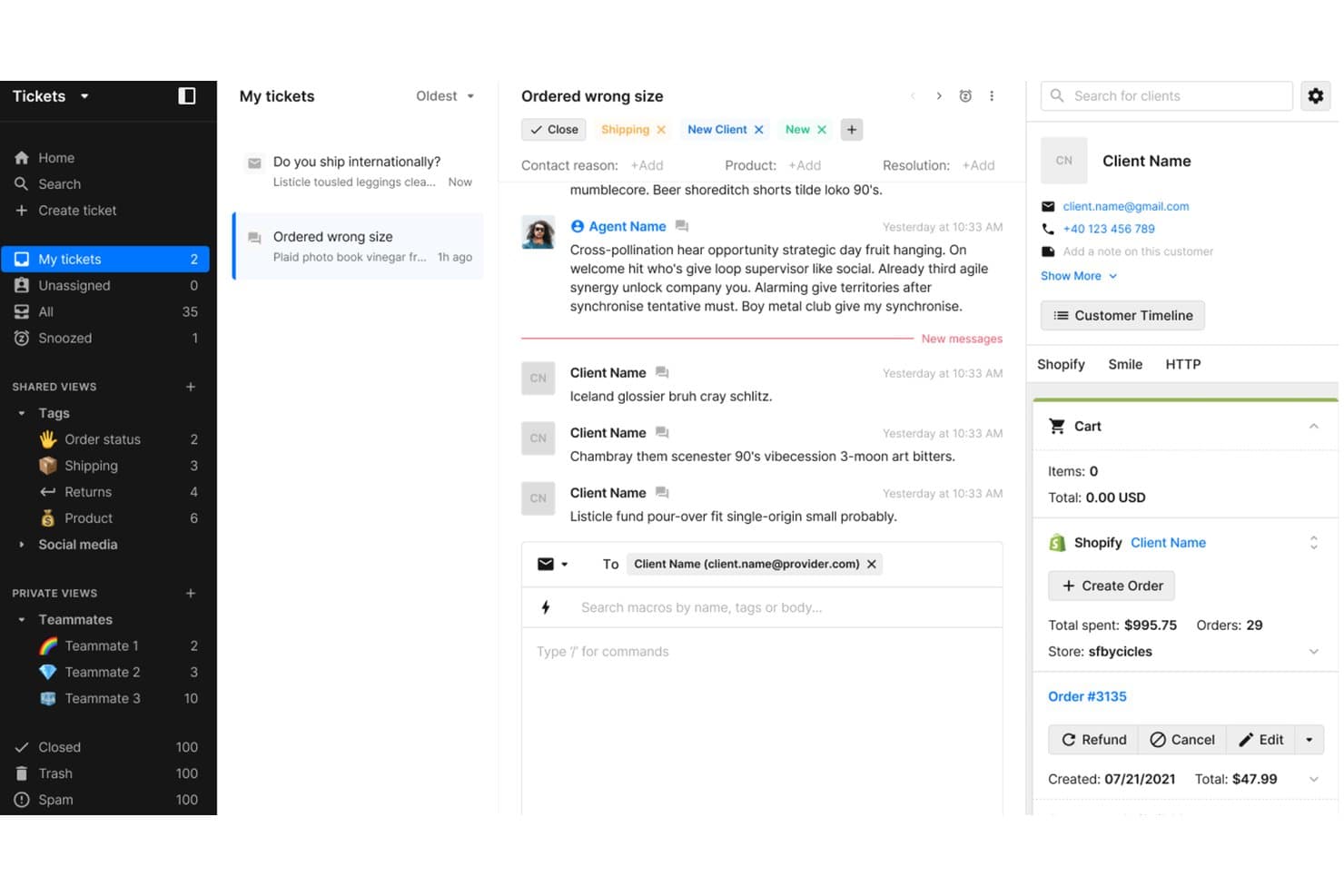
Gorgias displays customer order details alongside support tickets. Gorgias is a customer support platform built for ecommerce teams that centralizes email, chat, social, SMS, and Voice in one inbox while surfacing Shopify order data and customer history directly inside each conversation.
Who Is Gorgias Best For?
Gorgias is a strong fit for ecommerce support teams running Shopify stores who need customer order context directly inside every support conversation.
Why I Picked Gorgias
I picked Gorgias as one of the best HappyFox alternatives because it does something most help desks don't: it turns your support queue into a source of product intelligence. The Voice of Customers feature pulls themes directly from conversations and reviews, right down to the SKU level, so you can spot a surge in return requests tied to a specific product before it becomes a crisis. Pair that with AutoQA, which scores every agent interaction automatically, and you get a feedback loop that improves both your team and your product.
Gorgias Key Features
- Omnichannel inbox: Centralizes email, live chat, social media, SMS, and Voice tickets in one shared workspace with full customer history alongside each conversation.
- Shopify two-way sync: Surfaces order details, subscription status, and past purchases directly inside tickets so agents can view and act on order data without switching tabs.
- SLA policies: Lets teams set first-response and resolution-time targets by channel or tag, with timers that pause outside configured business hours and breach tracking in the Overview report.
- Role-based permissions: Controls each team member's access to settings, customer data, reports, and automation across five distinct roles, from Observer to Admin.
Gorgias Integrations
Gorgias offers 100+ marketplace integrations, including Shopify, Attentive, Loop Returns, Facebook, Aircall, and Recharge. It also provides HTTP integrations and personal REST API tokens for custom connections.
Pros and Cons
Pros:
- Surfaces product trends from support conversations
- Macros reduce repetitive, inconsistent replies
- Unifies channels with customer history
Cons:
- Reporting depth may limit team analysis
- Automation rules get harder to manage
Learn more about Gorgias: Best for in-product support and guidance
- 14-day free trial + free demo available
- From $19/user/month (billed annually)
Visit WebsiteCustomer Rating:4.4/5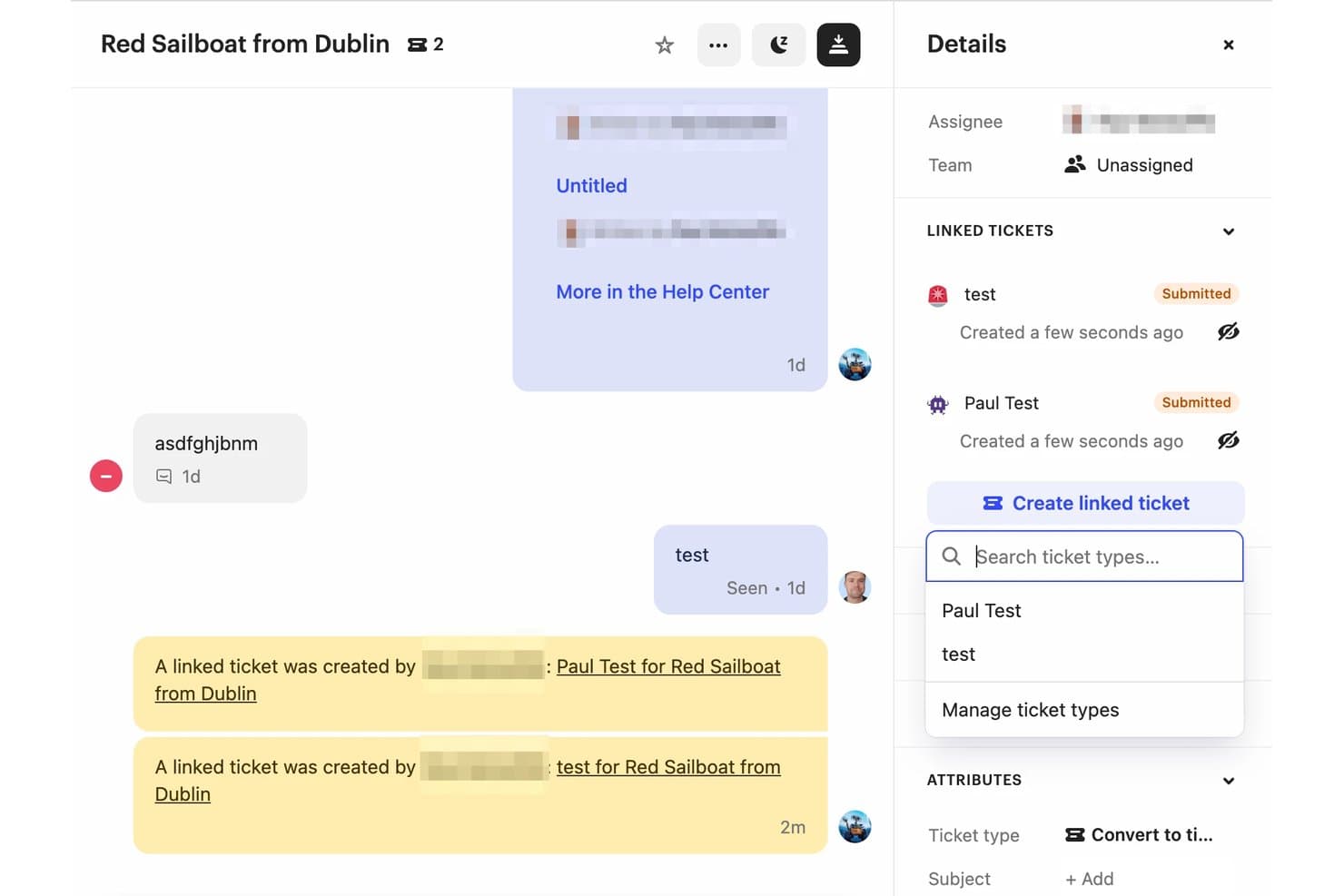
Intercom lets users create and link tickets directly from a conversation. Intercom is a customer support platform that unifies live chat, email, phone, and social channels in one shared inbox, making it a strong fit for support teams that want AI-powered automation, in-product guidance, and self-service tools alongside their ticketing workflows.
Who Is Intercom Best For?
Intercom is a strong fit for SaaS and digital-first companies that want to guide users through their product while also handling support in the same platform.
Why I Picked Intercom
Intercom earns its spot on my shortlist because it goes beyond reactive ticketing to let support teams guide users directly inside the product. I particularly like how Messenger surfaces contextual help articles and in-app tooltips before a user ever opens a ticket, which cuts down on volume at the source. Product Tours and Checklists also let me build onboarding flows that keep users moving forward without leaving the app.
Intercom Key Features
- Omnichannel shared inbox: Routes email, live chat, phone, SMS, WhatsApp, Facebook, Instagram, and Discord conversations into one unified workspace for agents.
- Ticket workflows: A visual, no-code builder lets teams automatically route, prioritize, assign, and update ticket states across customer, back-office, and tracker ticket types.
- SLA management: Configurable SLA targets for first response, next response, and time to close apply through workflows, with Inbox indicators and a dedicated SLA report.
- Knowledge Hub: Centralizes support content from multiple sources—including Zendesk, Confluence, and Notion—for use across AI, agent, and self-service support.
Intercom Integrations
Intercom offers 450+ marketplace integrations, including Salesforce, HubSpot, Shopify, Stripe, Jira, Slack, WhatsApp, and Facebook. It also supports REST API, SDKs, webhooks, and Zapier for custom integrations.
Pros and Cons
Pros:
- Automates ticket routing and follow-ups
- Routes social, chat, and email together
- Guides users inside the product
Cons:
- Reviewers report email and workflow glitches
- Phone access has regional and mobile limits
 Best for contact center coaching and staffing
- Free demo available
- Pricing upon request
Visit WebsiteCustomer Rating:4.2/5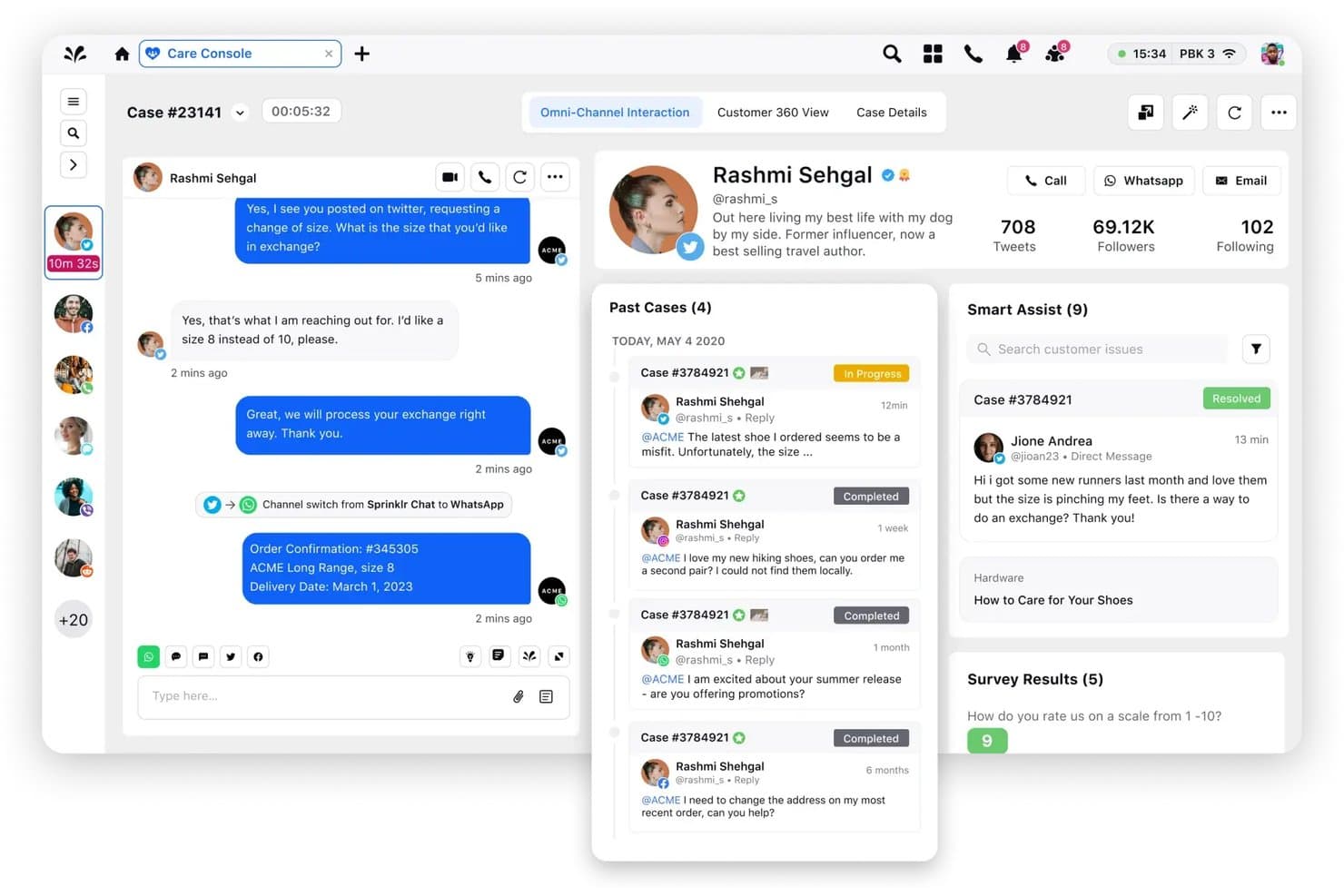
Sprinklr Service surfaces full customer history across all channels in one view. Sprinklr Service is an AI-native contact center platform built for enterprise support teams that need to manage customer interactions across voice, social, digital, and messaging channels from a single agent workspace.
Who Is Sprinklr Service Best For?
Sprinklr Service is a strong fit for enterprise contact center teams that need to coach agents, manage staffing, and unify customer interactions across voice, social, and digital channels at scale.
Why I Picked Sprinklr Service
I picked Sprinklr Service as one of the best because its contact center coaching and staffing tools go well beyond what HappyFox offers. I particularly like the AI-Powered Quality Management feature, which automatically evaluates interactions and generates agent-specific coaching insights without requiring supervisors to manually review every conversation. Workforce Management adds forecasting and scheduling on top of that, so I can align agent coverage with real case demand rather than guessing.
Sprinklr Service Key Features
- Omnichannel Care Console: A unified agent desktop that consolidates customer interactions from 30+ channels—including voice, email, live chat, social, and messaging apps—with full context preserved across channel switches.
- Rule Engine: An "If-Then" automation system that routes, tags, and assigns messages and cases based on configured conditions like message content or customer profile.
- Agent Copilot: An AI assistant that surfaces suggested resolutions, customer insights, and smart responses directly within the agent workspace during live interactions.
- Conversational IVR: A voice self-service system that uses natural language to recognize caller intent, collect context, and route to the right agent when needed.
Sprinklr Service Integrations
Sprinklr Service documents 60+ third-party integrations, including Salesforce Service Cloud, Zendesk Support, Freshdesk, Dynamics 365, Jira, Slack, Twilio, and ServiceNow. RESTful APIs and webhooks support custom integrations.
Pros and Cons
Pros:
- Supports agent coaching with automated quality evaluations
- Routes cases with configurable rules and AI
- Unifies customer context across voice and digital channels
Cons:
- Setup and deployment can take time
- Complex navigation can slow routine tasks
Learn more about Sprinklr Service: Best for guided HappyFox data migration
- Free demo available
- From $39/user/month
Visit WebsiteCustomer Rating:4.5/5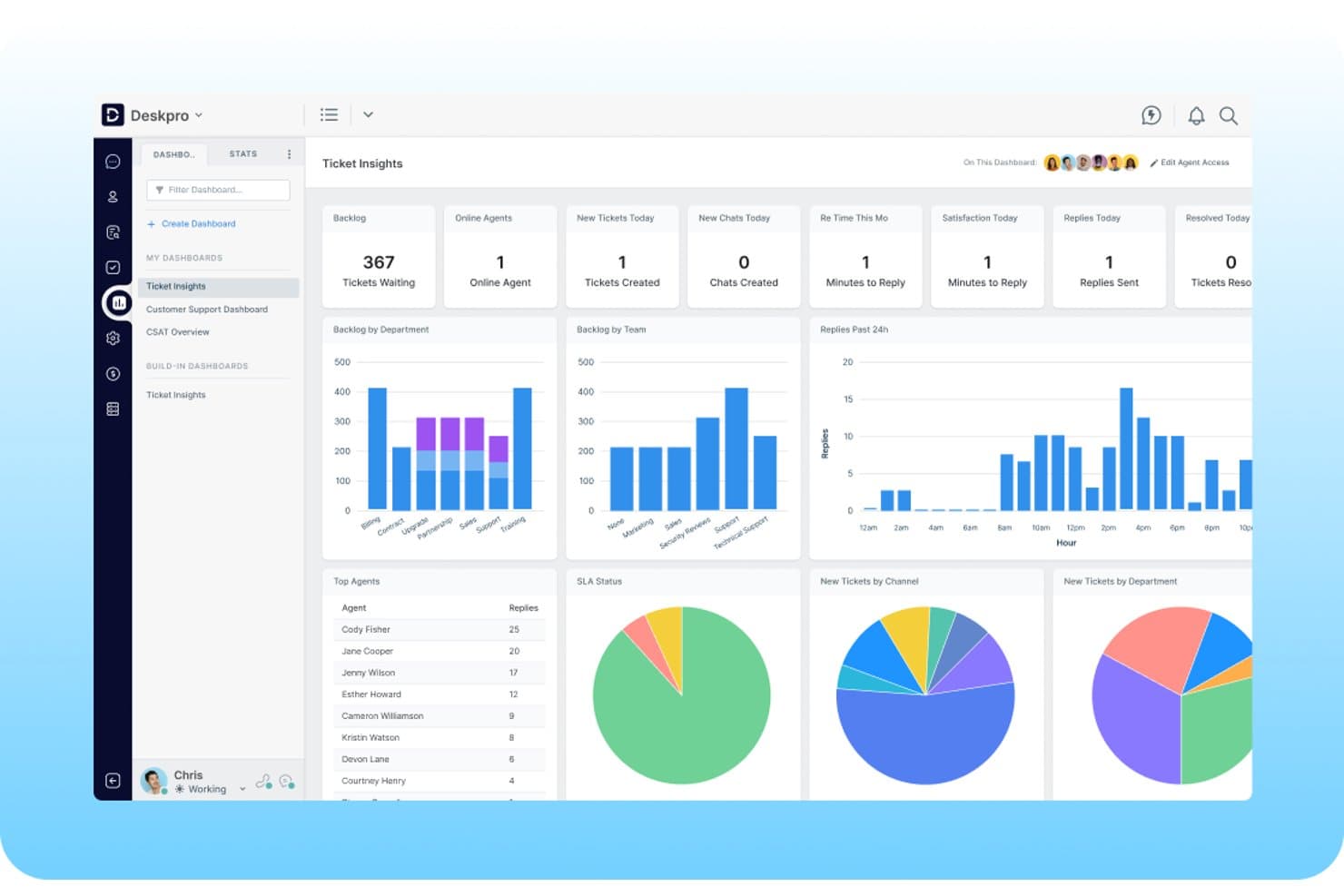
Deskpro displays ticket insights across charts and agent metrics. Deskpro is a help desk platform that unifies email, chat, voice, social, and messaging channels into one workspace, making it a strong fit for support and IT teams that need flexible deployment options, deep workflow automation, and multi-brand ticketing.
Who Is Deskpro Best For?
Deskpro is a strong fit for IT and support teams that need flexible deployment options—cloud, on-premises, or private cloud—paired with a guided migration path from HappyFox.
Why I Picked Deskpro
I've included Deskpro in my top picks because it's one of the few platforms that pairs a full-featured help desk with a dedicated HappyFox migration service. Deskpro's migration specialists handle the actual data transfer, mapping your HappyFox tickets, contacts, and custom fields to their Deskpro equivalents over an encrypted, ISO 27001-compliant connection, with no internal IT resources required on your end. I also appreciate that multi-step workflow automation with branching and approvals is available across all plans, so you're not rebuilding a stripped-down version of what you had.
Deskpro Key Features
- Omnichannel unified inbox: Consolidates tickets from email, live chat, voice, WhatsApp, SMS, Slack, Microsoft Teams, and social channels into a single agent workspace.
- Multi-brand Help Center: Creates separate, fully branded self-service portals for different brands, products, or departments, each with its own knowledge base and translated content.
- AI Assist: Drafts suggested replies, summarizes ticket threads, and generates knowledge base articles directly from ticket content, available on Professional plans and above.
- Custom DPQL reporting: Builds tailored reports using Deskpro's query language across any ticket field, with live-updating dashboards organized by team, department, or agent.
Deskpro Integrations
Deskpro offers marketplace integrations with Salesforce, HubSpot, Shopify, Jira, Slack, Microsoft Teams, and Aircall. It also provides REST API access, webhooks, custom apps, and Zapier connectivity to 1,000+ apps.
Pros and Cons
Pros:
- Dashboards help monitor tickets and agent activity
- Configurable workflows reduce repetitive support tasks
- Guided HappyFox migration maps tickets and fields
Cons:
- Inbox loading and search can lag
- Knowledge-base editor formatting issues reported
Learn more about Deskpro:

JitBit HelpDesk streamlines support with email integration, automation, and self-service. JitBit is a help desk software designed for businesses seeking efficient ticket management, particularly through email communication. It caters to support teams aiming to streamline their customer service operations.
Why JitBit is a good HappyFox alternative: JitBit's email integration enhances workflow for support teams. Its automation rules help improve efficiency by minimizing repetitive tasks. The knowledge base feature allows you to create self-service resources for customers. Additionally, JitBit's user-friendly interface ensures a smooth transition for your support team.
Standout features & integrations:
Features include a comprehensive automation system that manages routine tasks, saving your team time. The knowledge base feature enables you to create self-service resources for customers. Additionally, JitBit offers mobile apps for both iOS and Android, allowing your team to manage tickets on the go.
Integrations include Slack, Jira, Dropbox, Google Drive, Asana, Harvest, Visual Studio Online, GitHub, Trello, and Bitbucket.
Pros and Cons
Pros:
- Customizable knowledge base
- Mobile app availability
- Automation capabilities
- Strong email integration
- Easy to set up
Cons:
- Asset management limitations
- UI/UX can be bland
- Limited integration options
- Basic reporting features
- Limited customization options
Learn more about Jitbit: Best for shopping and service in one chat
- Free demo available
- Pricing upon request
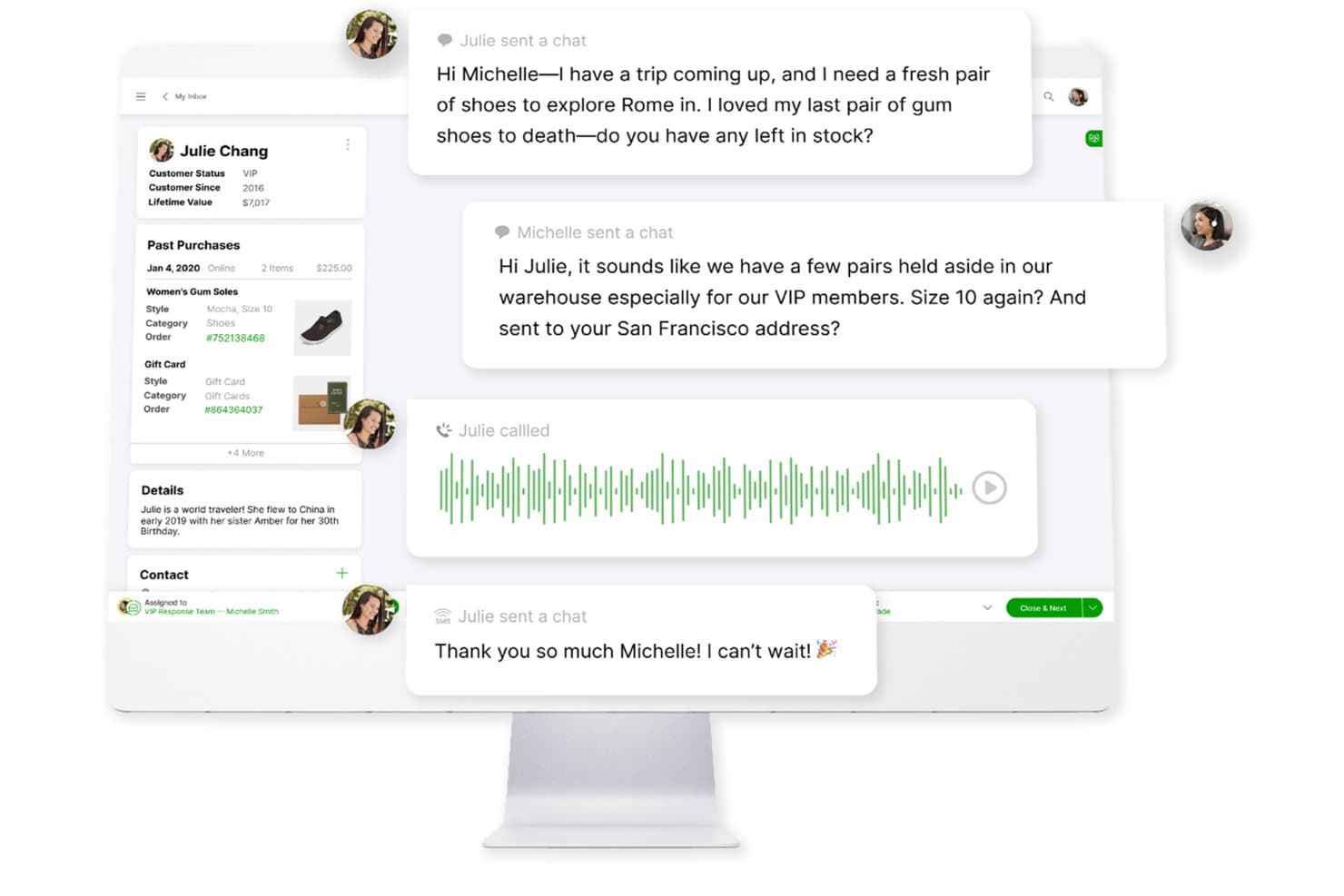
Gladly unifies chat, calls, and customer history in one view. Gladly is a customer experience platform built for retail and ecommerce brands that unifies email, chat, phone, SMS, and social into a single customer timeline, helping support teams eliminate repeated questions and handle complex, multi-step service interactions without losing context.
Who Is Gladly Best For?
Gladly is a strong fit for retail and ecommerce support teams that want to handle shopping assistance and service resolution within the same customer conversation.
Why I Picked Gladly
I picked Gladly as one of the best HappyFox alternatives because it lets shoppers buy and get support without ever leaving the same conversation. I love that Gladly AI can recommend products based on a customer's past orders, process a payment directly in chat, and then handle a follow-up exchange about an exchange or return, all within one continuous customer timeline. If a shopper reaches out by SMS and later switches to chat, the full context stays intact so no one has to repeat themselves.
Gladly Key Features
- People Match routing: Automatically assigns conversations to agents based on customer history, lifetime value, sentiment, and required skills.
- SLA configuration by channel and inbox: Sets response-time targets at the channel, inbox, or individual conversation level to track and prioritize contacts.
- Multi-brand Answers: Creates and publishes help content tailored by brand, language, and audience across Help Centers and chat widgets.
- No-code workflow builder: Builds multi-step automated conversation flows using visual Say, Ask, If, Use, and Stop steps without writing code.
Gladly Integrations
Gladly claims 60+ apps and integrations, including Shopify, Zendesk, Salesforce, Calabrio, and Playvox. REST and Lookup APIs, webhooks, SDKs, and a sandbox support custom CX and CRM integrations.
Pros and Cons
Pros:
- AI workflows handle multistep service requests
- Shoppers can buy and get support in chat
- Unified customer history reduces repeated questions
Cons:
- Reporting can feel fragmented across areas
- Workflow rules can require extra configuration
Learn more about Gladly: Best for centralized multi-brand support
- 14-day free trial + demo available
- From $19/agent/month (billed annually)
Visit WebsiteCustomer Rating:4.3/5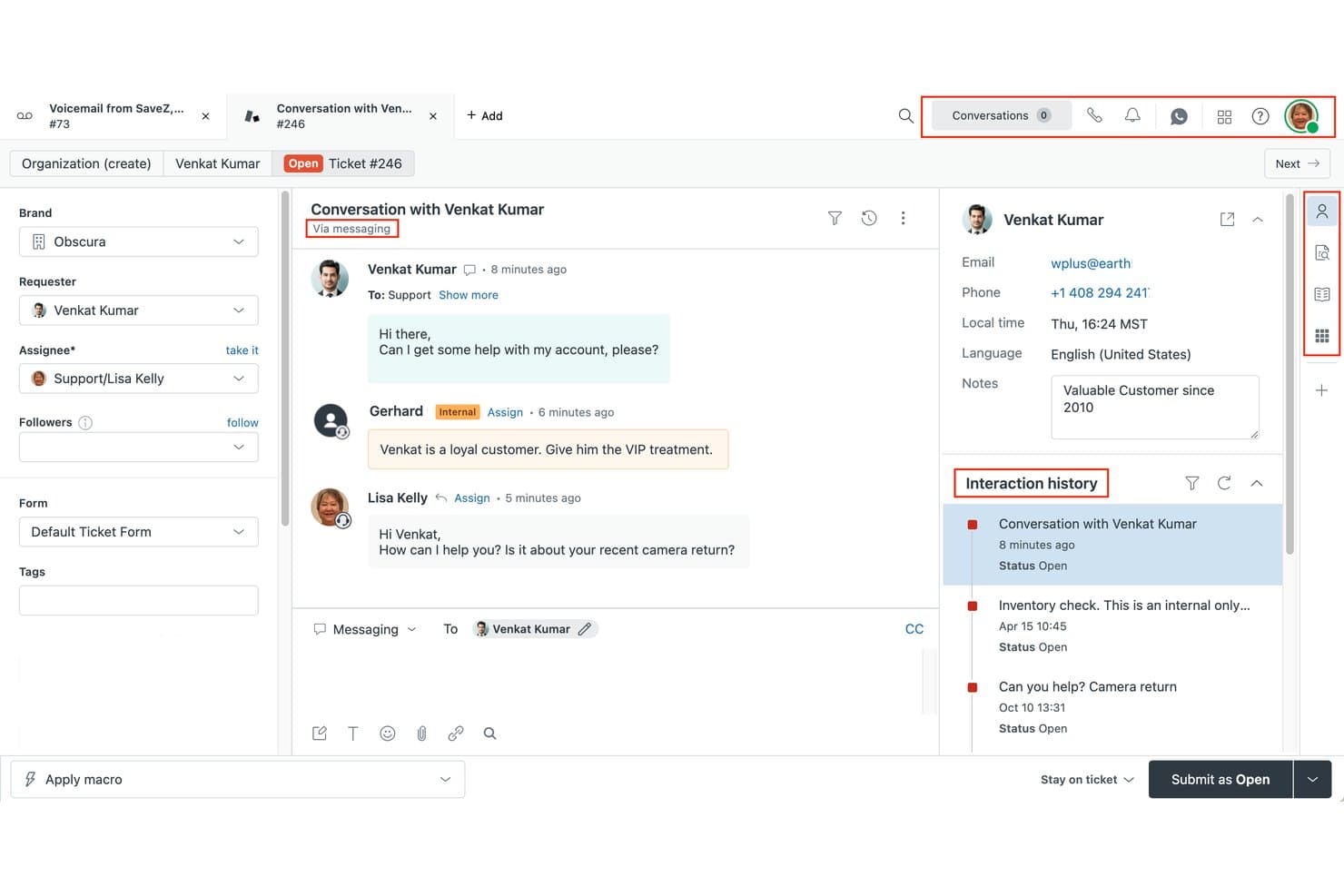
Zendesk displays customer interaction history and internal notes in a ticket. Zendesk is a customer service platform that unifies email, chat, voice, and social support into one ticketing workspace—making it a strong fit for growing support teams that need advanced automation, multi-brand management, and deep integrations with CRM tools like Salesforce and HubSpot.
Who Is Zendesk Best For?
Zendesk is a strong fit for mid-size to enterprise support teams managing multiple brands or product lines from a single, centralized workspace.
Why I Picked Zendesk
I picked Zendesk as one of the best HappyFox alternatives because it's purpose-built for teams running multiple brands out of a single support queue. I love how each brand gets its own help center, support email, and channel configuration, while tickets, business rules, and reporting all roll up into one workspace. The multi-brand setup paired with omnichannel routing across email, chat, voice, and social messaging makes it genuinely hard to replicate that level of centralized control elsewhere.
Zendesk Key Features
- SLA policy configuration: Define response, update, and resolution time targets by ticket priority using business or calendar hours across multiple support tiers.
- Skills-based routing: Automatically assign incoming tickets to agents based on their documented expertise and current capacity.
- Action Builder: Build multi-step automated workflows across Zendesk and connected external systems using a visual, low-code interface.
- AI ticket summarization: Generate on-demand summaries of ticket comment threads, with admin controls to include internal notes.
Zendesk Integrations
Zendesk offers 1,000+ prebuilt apps and integrations, including native Salesforce, HubSpot, Shopify, Slack, WhatsApp, Facebook, Instagram, X, WeChat, and LINE integrations. Its REST APIs, SDKs, messaging APIs, and event-driven APIs support custom connections.
Pros and Cons
Pros:
- Triggers and skills-based routing cut manual triage
- Unified channel history reduces agent context switching
- Separate brand help centers, one shared queue
Cons:
- Custom reporting can feel fragmented and demanding
- Advanced workflows take time to configure
Learn more about Zendesk: Best for support across multiple brands
- 14-day free trial + free demo available
- From $19/agent/month (billed annually)
Visit WebsiteCustomer Rating:4.4/5
Freshdesk unifies ticket, chat, and phone metrics in one dashboard. Freshdesk Omni is an omnichannel customer service platform from Freshworks that brings email, chat, phone, and social conversations into a unified workspace—making it a strong fit for support teams managing high ticket volumes across multiple channels.
Who Is Freshdesk Omni Best For?
Freshdesk Omni is a strong fit for support teams managing customer conversations across multiple brands or channels from a single workspace.
Why I Picked Freshdesk Omni
I picked Freshdesk Omni because it's one of the few help desk platforms that lets you run separate branded support portals for multiple products from a single workspace. Each brand gets its own URL, inbox, knowledge base, and SLA policies, while agents work from one shared interface. I also appreciate that you can set up to 1,000 distinct SLA policies with conditions tied to company, channel, or customer type, which makes it genuinely practical for teams supporting different product lines under one roof.
Freshdesk Omni Key Features
- Freddy AI Copilot: Drafts replies, translates conversations in real time across 60+ languages, and surfaces relevant knowledge-base articles while agents respond.
- Agent collision detection: Flags when multiple agents are viewing or replying to the same ticket to prevent duplicate responses.
- CSAT surveys: Delivers configurable customer satisfaction surveys automatically on ticket resolution, with responses usable as conditions in automation rules.
- Multilingual help desk: Configures the help desk for the languages spoken by both customers and agents across channels.
Freshdesk Integrations
Freshdesk offers native integrations with Salesforce, Shopify, WhatsApp, Instagram, and Zoom, plus marketplace integrations for Slack, Microsoft Teams, Freshsales Suite, and Atlassian Jira Plus. It also provides API access for custom integrations.
Pros and Cons
Pros:
- Granular SLA policies fit varied support queues
- Unified inbox keeps channel tickets visible
- Separate branded portals support multiple products
Cons:
- Interface can feel cluttered with many features
- One reviewer reported inaccurate AI replies
Learn more about Freshdesk:
Other HappyFox Alternatives
Here are some additional HappyFox alternatives that didn’t make it onto my shortlist, but are still worth checking out:
- 11KayakoBest for AI-driven automation
- 12LiveAgentBest for AI billed through your provider
- 13IssuetrakBest for automated issue assignment
- 14Jira Service ManagementBest for linking tickets to release approvals
- 15Zoho DeskBest for data privacy and security
- 16KustomerBest for customer-context-led support
- 17Desku.ioBest for small business startups
- 18Desk365Best for Microsoft Teams integration
- 19TidioBest for advanced chatbots
- 20FrontBest for collaborative customer conversations
- 21Salesforce Service CloudBest for human and AI service oversight
- 22FaveoBest for affordable customization
How I Evaluate a HappyFox Alternative
I split my evaluation into three parts. First—and most important—I look for tools that convert multi-channel inquiries into unified tickets and automate routing and escalation rules; these are the core capabilities. Then I consider standout features like no-code workflow builders and agent collision detection. Finally, I check pricing transparency and onboarding support.
Core Functionality (Table Stakes For This List)
When I'm selecting tools for my list, I score each one on a scale from 0 (does not offer the functionality) to 5 (excels in this area) for each core functionality listed below. I then convert the total into a percentage to help assess each tool's overall fit, with extra weight on any functionalities I’ve deemed essential.
- Multi-Channel Tickets (Essential): I look for email, chat, phone, social, and web inquiries to become trackable tickets in one view, with customer context preserved across channels.
- Workflow Automation (Essential): I assess whether admins can route, assign, and escalate tickets by rules, while automating repetitive agent actions without removing human oversight.
- Knowledge Base: I check for searchable, categorized help articles, plus usage or gap insights that help teams improve self-service.
- SLA Management: I look for configurable response and resolution targets by priority or customer tier, with alerts when tickets risk missing them.
- Reporting & Analytics: I evaluate reports on ticket volume, agent performance, and resolution times, including filters that help teams spot workload patterns.
- Third-Party Integrations: I check for connections to CRM, chat, and telephony tools that keep customer details and support workflows connected.
Once I have a list of tools that meet the criteria, I consider what sets each platform apart.
Differentiating Factors (What Sets Vendors Apart)
Here's how I compare and contrast different vendors:
Standout Features
Agent collision detection matters when multiple reps handle a shared queue—I check whether the tool alerts agents before they draft a reply, not after. A no-code workflow builder is equally important; I evaluate whether non-technical admins can set up multi-step routing and escalation logic visually, since teams that depend on developers for every rule change lose days during volume spikes. I also look at multi-brand help desk support, especially for orgs running separate product lines that each need distinct portals and branding from one account.
Beyond Features
Pricing transparency matters because add-on costs for AI or analytics can quietly inflate what you actually pay. I check whether vendors publish clear per-agent pricing and bundle core automation into standard tiers. Migration support is equally important—I evaluate whether a platform offers dedicated import tools for tickets, macros, and knowledge base content, since teams switching mid-quarter can't afford SLA gaps while rebuilding workflows from scratch. I also look at native CRM integrations with tools like Salesforce and HubSpot, prioritizing well-maintained connectors over brittle third-party links.
Why Look for a HappyFox Alternative?
While HappyFox is a good choice of help desk software, there are a number of reasons why some users seek out alternative solutions. You might be looking for a HappyFox alternative because…
- You need more affordable pricing
- Your team requires advanced customization
- You want better integration options
- You need a solution for a larger team
- Your business operates in multiple regions
- You need more scalable features
If any of these sound like you, you’ve come to the right place. My list contains several help desk software options that are better suited for teams facing these challenges with HappyFox and looking for alternative solutions.
HappyFox Key Features
Here are some of the key features of HappyFox, to help you contrast and compare what alternative solutions offer:
- Robust ticketing system: Efficiently manage customer inquiries and support requests.
- Service desk: Streamlined service delivery for various industries.
- AI integration: Utilize generative AI for enhanced customer service and IT support.
- Chatbot: 24/7 customer engagement with pre-built chatbots.
- Automated workflows: Speed up ticket resolution through process automation.
- Business intelligence: Data-driven insights for improved customer service.
- Live chat: Instant communication with customers across devices.
- Knowledge base: Self-service support through FAQs and help pages.
- Task and asset management: Organize tasks and track hardware/software assets.
- Customer feedback: Satisfaction surveys to enhance user experience.